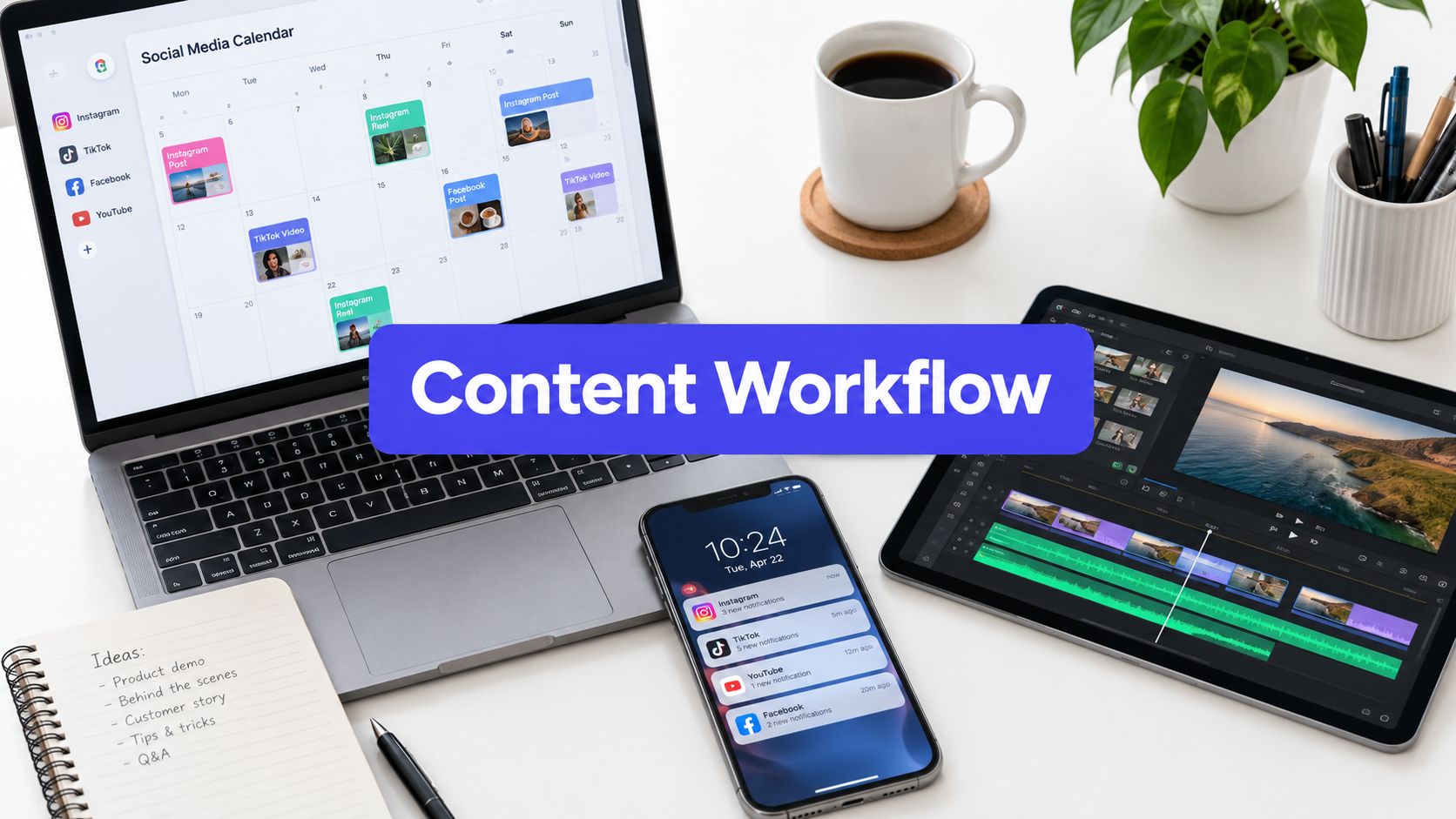











You paste a polished caption from Google Docs into a scheduler. The spacing collapses. Bullet points turn into a blob. The line break before the call to action disappears on mobile. Then the “bold” Unicode version you tested on desktop shows up as broken boxes in one app preview.
That’s a normal social media workflow now. It’s also why knowing how to format text online matters far beyond making copy look tidy. Clean formatting protects readability, keeps posts accessible, and prevents platform-specific rendering errors that make a brand look careless.
Teams have leaned into browser-based text tools for exactly this reason. The online text formatting and analysis tools sector saw 300% growth from 2018 to 2023, with over 10 million unique sessions globally, according to OnlineTextTools usage data. That same source says analysis of content from over 50,000 creators found that a 25% reduction in caption length after optimization was associated with an 18% engagement lift on Instagram and LinkedIn. Formatting isn’t cosmetic. It changes how people read and respond.
Why Your Text Breaks and How to Fix It
A lot of broken social copy starts before you ever open a scheduler. It starts in Word, Notion, Google Docs, email drafts, CMS editors, and AI chat windows. Each one carries its own invisible formatting baggage.

What usually goes wrong
A post can look clean in the original document and still break after paste because the destination platform interprets spacing, line endings, or special characters differently. Social tools also strip or normalize formatting in their own way.
The failures I see most often look like this:
- Collapsed spacing: Paragraphs become one dense block after paste.
- Broken line breaks: The “breathing room” between hook, body, and CTA disappears.
- Strange characters: Curly quotes, non-standard bullets, or copied symbols render inconsistently.
- Fake bold issues: Unicode-styled text works in one app preview and fails in another.
- Hashtag clutter: Tags that looked separated in draft form get jammed into the main caption.
Practical rule: If text came from a rich text editor, assume it needs cleanup before publishing.
What fixes it
The fix usually isn’t a bigger writing tool. It’s a smaller utility used at the right moment. A line break cleaner, whitespace remover, plain text converter, or caption-specific formatter can remove the junk before it reaches the platform.
For Instagram captions, a dedicated Instagram line break tool helps preserve visual spacing that often gets mangled during copy-paste. That matters because on social, structure does part of the persuasive work. A short hook, a clean middle section, and a separated CTA outperform one unreadable slab of text.
The workflow shift that helps
Treat formatting as a final production step, not an afterthought. Write first. Clean second. Preview third. Publish last.
That sequence saves more time than constant manual fixes inside each platform editor. It also cuts down on the most frustrating kind of error: the post that looked fine in draft and wrong once it went live.
Choosing Your Online Text Formatting Toolkit
Users often select the wrong formatter, as they believe all formatters perform identical functions. This is incorrect. Some clean messy input. Some restyle text. Some convert syntax. Some only create decorative Unicode characters that look good in one place and fail in another.

Four tool types that matter
Basic cleaners
These are the workhorses. They remove extra spaces, normalize line breaks, strip tabs, and convert rich text into plain text.
Use them when you copy from:
- Google Docs
- Word
- Email drafts
- CMS editors
- AI chat outputs
They’re boring. That’s why they’re valuable.
Case converters
These tools change sentence case, title case, uppercase, lowercase, or alternating case. They’re useful when a client sends a headline in all caps, or when you need consistent formatting across carousel slides, post titles, and first-line hooks.
Good use case: turning a rough draft headline into cleaner LinkedIn or X copy without editing word by word.
Markdown and HTML formatters
These matter when your workflow touches newsletters, blogs, Telegram posts, developer communities, or any content that moves between structured editors. They help preserve hierarchy and make list-heavy content easier to control.
They’re less important for native Instagram captions, but they’re useful when social copy is extracted from longer-form content.
Unicode generators
These create “fancy” bold, italic, script, or struck-through text by swapping characters, not by applying native styling. They’re popular because they can mimic formatting where native support is weak.
They’re also the easiest way to create cross-platform headaches.
What to evaluate before you use any tool
A formatter can solve one problem and create two more. The evaluation checklist is simple.
- Privacy handling: Some browser-based tools rely on client-side processing. According to RedactAI’s review of text formatting tools, browser fingerprinting showed up as a privacy risk in 12% of sessions in tool audits.
- Unicode reliability: The same review notes inconsistent Unicode support can break formatting on up to 8% of mobile devices.
- Preview quality: If a tool can’t show how output will appear in a real social context, you’re still guessing.
- Speed for repeat tasks: A tool that works once but forces tab-hopping every day creates friction.
If you manage multiple brands, that fragmentation becomes the significant cost. One tab for line breaks. One for plain text cleanup. One for case conversion. One for fake bold. One for scheduling.
A central library of social media tools makes more sense when the same team handles recurring post formats across channels.
Here’s a quick demo worth watching if you want to see how modern text formatting workflows look in practice:
The practical decision framework
Don’t ask, “What’s the best online formatter?” Ask, “What job am I doing?”
| Job | Tool type | Best for | Watch out for |
|---|---|---|---|
| Cleanup after paste | Basic cleaner | Removing spacing junk and hidden leftovers | May strip intentional spacing |
| Headline standardization | Case converter | Fast title and caption cleanup | Can create awkward capitalization |
| Structured publishing | Markdown or HTML formatter | Lists, emphasis, imported long-form text | Native social platforms may ignore formatting |
| Visual emphasis hacks | Unicode generator | Short display text and selective emphasis | Inconsistent rendering on mobile |
The right formatter is usually the least flashy one. Cleanup beats decoration most days.
Essential Techniques for Flawless Text
When people search for how to format text online, they usually need one of three fixes. Clean the paste. rebuild structure. make emphasis readable without breaking the post.
AI-powered formatters now achieve over 95% success rates for cleaning messy text through semantic restructuring, but hidden characters like zero-width spaces can still reduce parsing accuracy by 22% if they aren’t handled explicitly, according to Skywork’s guide to AI text formatting.
Clean pasted text first
Don’t start editing a messy paste inside a social caption box. Strip it down first.
Use this order:
- Paste into a plain-text cleaner
- Normalize line breaks
- Remove double spaces and tabs
- Replace unusual bullets or symbols
- Paste into your scheduler or editor for final styling
Here’s a common before-and-after.
Before
New product update!
We’ve added 3 new reporting views, improved exports, and fixed mobile bugs.
• Better dashboard load times
• Cleaner team permissions
• Faster export flowTry it now!
After
New product update!
We’ve added new reporting views, improved exports, and fixed mobile bugs.
- Better dashboard load times
- Cleaner team permissions
- Faster export flow
Try it now.
The second version is easier to transfer into social tools because it uses predictable spacing and simple characters.
Hunt hidden formatting when text still looks wrong
If a caption keeps failing after cleanup, invisible characters are often the problem. Zero-width spaces and odd line separators show up after copying from websites, PDFs, Slack, or messaging apps.
Signs you’ve got hidden junk:
- Cursor jumps oddly when you arrow through text
- Line breaks won’t behave even after retyping parts
- Hashtags split strangely
- A platform rejects or truncates text unexpectedly
The fastest fix is often brutal but effective. Paste into a plain-text field, then rebuild intentional spacing manually.
If the same line keeps breaking in the wrong place, stop tweaking the visible text. Remove the invisible text.
Use case conversion with restraint
Case tools save time, but they can also make social copy look robotic. All caps can work for one short hook. It usually weakens readability when used across an entire caption.
A practical rule set:
- Use sentence case for body copy on most platforms.
- Use title case for carousel titles, section headers, or headline-style first lines.
- Use uppercase sparingly for labels like “NEW” or “LIMITED.”
- Avoid alternating or decorative case unless the brand voice is intentionally playful.
When I’m cleaning newsletter copy for social reuse, I also borrow structure ideas from email writing because both channels reward scannability. If your audience includes older consumers, Victoria O’Hare’s guide on email list tips for women over 50 is useful for understanding clarity, pacing, and readability choices that also translate well to social captions.
Build structure with lightweight formatting
Most social posts don’t need heavy formatting. They need clean hierarchy.
Use:
- Short opening line for the hook
- One idea per paragraph
- Simple bullets when listing benefits or steps
- Whitespace before the CTA
- Minimal symbols unless they help scanning
Try this structure for educational content:
- Hook: State the problem in one line.
- Context: Add one or two sentences.
- Body: Use bullets or short paragraphs.
- CTA: Separate it visually.
That pattern works because the reader can skim it without losing the thread.
Keep emphasis platform-safe
Bold and italics are tempting. In many social workflows, they’re also unreliable.
Safer emphasis options include:
- Line breaks
- List formatting
- One strong first line
- Strategic repetition
- Selective emoji use where brand-appropriate
If a post only works because of decorative Unicode, it isn’t suitable for cross-platform publishing.
Formatting Text for Major Social Networks
Generic formatters usually fail at the part that matters most. They don’t account for how each platform renders text. That gap shows up in real-world usage. Surveys and forum discussions summarized by OnlineFormater’s review of formatting gaps found 68% of creators report cross-platform rendering issues, including Unicode text appearing as broken characters, and some Android environments show failure rates as high as 25%.

Social Media Text Formatting Guide
The biggest mistake is assuming one clean caption belongs everywhere. It doesn’t. The same text needs different spacing, emphasis, and structure depending on where it lands.
| Platform | Character Limit | Line Breaks | Native Formatting | Common Issues |
|---|---|---|---|---|
| Varies by field and post type | Essential for readability in captions | Limited native styling in standard captions | Line breaks collapse, Unicode styling may fail, hashtags clutter body | |
| Varies by field and post type | Helpful for longer posts | Limited native styling in standard posts | Link previews can dominate, long paragraphs reduce scanability | |
| X (Twitter) | Tight by design | Useful for threads and hook separation | Limited native styling | Over-compression, awkward thread splits, decorative characters waste space |
| Supports longer professional posts | Very important for mobile readability | Some native formatting support in certain editors and surfaces | Overly dense copy, pasted bullets look messy, inconsistent results from imported text |
Instagram rewards clean spacing more than clever styling. A readable caption usually performs better than one full of decorative Unicode tricks.
What works:
- Short hook on line one
- Brief paragraph blocks
- Whitespace before CTA
- Hashtags separated from body copy when possible
What doesn’t:
- Large emoji clusters
- Fancy Unicode “fonts” as a core formatting strategy
- Copy straight from Docs without cleanup
If you want emphasis, use structure instead of novelty. One line by itself is often stronger than pseudo-bold text.
X
X punishes wasted characters. Every formatting decision has a cost because visual decoration takes up space that could hold the actual point.
Good X formatting tends to look like this:
- Sharp opening line
- One idea per line
- Threads for expansion
- Minimal filler
- No unnecessary symbols
A bloated paste from a blog intro usually dies here. Cut hard. Keep the core argument. Move supporting detail into replies or follow-up posts.
On X, formatting is compression. If the first line drifts, the whole post loses force.
LinkedIn gives you more room, but extra room creates its own problem. People write as if they’re still in a document editor. The result is often a business post that reads like an internal memo.
Use:
- A direct first line
- Short paragraphs
- Bullets for steps, lessons, or takeaways
- A separate closing question or CTA
Avoid:
- Huge intro blocks
- Fake typography for authority
- Pasting article paragraphs unchanged
LinkedIn readers scan before they commit. If your formatting doesn’t support scanning, your argument won’t get a fair chance.
TikTok
TikTok caption strategy is less about rich text and more about clarity under tight attention. The on-screen text, caption, and first spoken line all need to support one another.
Formatting priorities:
- Keep the caption lean
- Lead with the payoff or angle
- Use line breaks only when they improve quick comprehension
- Match text style to the pace of the video
Most generic online formatters aren’t built for this. They clean text, but they don’t help shape a caption for a video-first environment.
The practical rule across all platforms
Treat every post as a rendering test, not just a writing task. The copy needs to survive platform rules, app behavior, and mobile display.
One source draft can become:
- A spaced caption for Instagram
- A compressed hook for X
- A skimmable professional post for LinkedIn
- A stripped-down support caption for TikTok
That is formatting work. It’s also why single-purpose text tools often fall short once you’re managing more than one network.
Automate Formatting with PostSyncer's AI Editor
Manual formatting breaks down fastest when you repurpose content. A blog paragraph becomes an Instagram caption, then a LinkedIn post, then an X thread, then a TikTok caption draft. The cleanup isn’t just technical. It’s contextual.
That’s the gap many simple tools leave behind. According to TextFormatter.ai’s discussion of contextual AI formatting, AI-driven tools that generate platform-tuned hooks and summaries can boost engagement by up to 35% compared with manually formatted text in a 2026 Sprout Social study.

What changes when formatting is built into the publishing workflow
Instead of cleaning text in one tab, styling it in another, and testing it manually in separate apps, an integrated editor lets the formatting happen inside the same production flow as scheduling and previewing.
That matters for three reasons:
- Less context switching: You don’t keep bouncing between utilities.
- Fewer copy-paste errors: Text stays in one controlled workspace.
- Better platform adaptation: The output can be shaped for the destination, not just cleaned generically.
Where PostSyncer fits
For teams that publish across networks, PostSyncer’s guide to AI for social media management shows the broader workflow this supports. In practice, the useful part is simple. The editor can help turn one source asset into multiple post versions without forcing you to manually rebuild formatting for every channel.
That is different from a stand-alone formatter. A stand-alone tool answers, “How do I clean this text?” An integrated editor also answers, “How should this read on Instagram, LinkedIn, and X?”
The workflow that saves the most time
A practical automation flow looks like this:
- Start with a source asset such as a URL, article draft, product update, or campaign brief.
- Generate platform-specific versions instead of one universal caption.
- Review spacing and hierarchy inside the editor, not after export.
- Check previews before scheduling so formatting failures show up early.
- Publish without re-pasting into multiple tools.
Good automation doesn’t just remove typing. It removes decision fatigue.
What still needs human review
Even with AI help, three things still deserve a human pass:
- Brand voice: A cleaned caption can still sound generic.
- Platform judgment: Not every post should be repurposed everywhere.
- Final readability: If it looks dense on mobile, edit it down.
Automation works best when it handles the repetitive formatting labor and leaves the editorial call to the team.
Stop Formatting Manually and Start Publishing
Formatting used to feel like cleanup. In social media, it’s production. It decides whether a post is skimmable, whether a CTA gets noticed, and whether your copy survives the trip from draft to live post without breaking.
The reliable workflow is straightforward. Clean pasted text before editing. Use simple structure instead of fragile styling hacks. Format for the platform, not for an imaginary universal text box. Then automate the repeatable parts so your team isn’t rebuilding the same caption by hand every week.
That shift does more than save time. It protects brand consistency and reduces the small errors that make content feel rushed. A polished post usually isn’t the one with the fanciest styling. It’s the one that reads clearly everywhere it appears.
If your current process involves a stack of browser tabs and too much last-minute fixing, the problem usually isn’t your writing. It’s the workflow around it.
If you want a simpler way to create, format, preview, and publish social content from one workspace, try PostSyncer. It helps teams turn one piece of source content into platform-specific posts without the usual copy-paste mess.