











Ever wonder if your social media efforts are actually hitting the mark? It's easy to get lost in your own analytics, but the real question is: how do you stack up against the competition?
This is where competitive benchmarking comes in.
It’s the process of systematically measuring your performance against your top competitors using specific data points. This isn't about blindly copying what others are doing. Far from it. It’s about understanding the industry standard so you can spot gaps, uncover opportunities, and set goals that are ambitious but achievable.
What Competitive Benchmarking Really Means

Let's cut through the jargon. Think of it like a pro athlete studying game tapes of their rivals. They aren't just watching to imitate every move. They're looking for winning strategies, identifying weaknesses in their opponent's game, and figuring out how to gain their own competitive edge.
In the social media world, this means looking at what your competitors are doing to establish a baseline for success. This gives you a data-backed standard to measure your own performance against, turning vague goals like "get more engagement" into specific, measurable targets.
From Guesswork to Strategy
Without benchmarking, your marketing strategy is basically a shot in the dark. With it, every decision is informed by real-world data about what actually works in your market. And in a global social media management market projected to soar from USD 24,756.7 million in 2024 to a staggering USD 85,062.5 million by 2030, you can't afford to be guessing.
Proper benchmarking goes way beyond a quick glance at a competitor's follower count. A deep dive focuses on:
- Performance Metrics: Analyzing things like engagement rates, reach, and follower growth over time.
- Content Strategy: Breaking down the types of content they post, how often they post, and which formats get the best results.
- Audience Behavior: Understanding what resonates with their audience—which is likely your shared target market.
To really get a feel for your positioning, digging into specific B2B industry benchmarks can give your analysis some much-needed context.
By comparing your business against industry best practices, you can set realistic performance goals grounded in actual data, not just internal hopes. This transforms your marketing from guesswork into a calculated plan for success.
To give you a clearer picture, here’s a quick breakdown of what makes up a solid benchmarking process.
Core Components of Competitive Benchmarking
| Component | What It Means | Why It's Important |
|---|---|---|
| Identify Competitors | Choosing the right rivals to measure against—direct and indirect. | Ensures your comparison is relevant and provides actionable insights. |
| Select Key Metrics | Deciding which specific data points to track (e.g., engagement rate). | Focuses your analysis on what truly matters for your goals. |
| Gather Data | Collecting performance data from your own and competitor accounts. | Provides the raw material for your entire analysis. |
| Analyze Gaps | Comparing the data to find where you lead, lag, or have opportunities. | This is where you find the "so what?"—the strategic takeaways. |
| Set New Goals | Using the insights to create new, data-informed performance targets. | Turns analysis into a concrete, forward-looking action plan. |
This table simplifies it, but each step is crucial for turning raw numbers into a winning strategy.
Ultimately, benchmarking empowers you to answer critical questions with confidence. Are you ahead of the curve or falling behind? Where are the untapped opportunities just waiting for you? This information is the foundation for a social media strategy that doesn't just compete—it wins.
Why Benchmarking Is Your Secret Marketing Weapon
Okay, so we know what competitive benchmarking is. But the real question is, why should you even bother?
Put simply, benchmarking is what turns your marketing from a shot in the dark into a calculated, data-backed strategy. It’s the difference between trying to find your way by just following the sun versus navigating with a high-tech GPS.
Without that external context, your team is flying blind. You might set goals that are so ambitious they’re impossible to hit, or so safe they’re hardly worth celebrating. Benchmarking grounds your ambitions in reality. When you see what the top performers in your space are actually achieving, you can set targets that are both realistic and challenging enough to push your team forward.
For example, let's say the average engagement rate in your industry is 2.5%, but you're hovering around 1%. Aiming for 10% overnight is just setting yourself up for failure and frustration. A much smarter move? First, aim to match that 2.5% average. Once you hit that, you can methodically work on blowing past it.
Uncover Hidden Opportunities
One of the best ways to spark some fresh ideas is to see what your competitors are up to. You’re not looking to copy them, but to get inspired.
You might discover they’re absolutely crushing it with a content format you’ve completely ignored, like interactive Instagram Stories or long-form articles on LinkedIn. This is about identifying tactics that are clearly working and figuring out how to adapt them to your own unique brand voice and audience.
Imagine you're an e-commerce brand and you notice a rival is getting crazy-high engagement on their Instagram Reels. That’s your lightbulb moment. It could prompt you to pivot from static product photos to creating short-form video tutorials or even kicking off a user-generated content campaign, unlocking a whole new way to connect with your audience.
Competitive benchmarking gives you the context you need to not only sharpen your strategy but also to justify your marketing spend and prove its value. It helps you turn a bunch of raw data into a compelling story of success.
This whole practice isn't new, by the way. It actually got its start in the manufacturing world back in the 1980s. Xerox famously used it in 1979 to claw back market share they were losing. Over the years, it evolved into a core strategy for digital marketing, which was perfect timing with the explosion of social media and the tools needed to manage it all. The social media management software market's forecast growth shows just how crucial these tools have become.
Justify Your Strategy with Cold, Hard Data
At the end of the day, benchmarking hands you the evidence you need to make smart decisions and get everyone else on board.
When you walk into a meeting and can show that your new proposed strategy is based on a deep analysis of what’s already working for successful competitors, it’s a whole lot easier to get the budget and resources you need. No more wishy-washy requests.
It also gives you a clear framework for measuring ROI. Instead of just reporting on your own internal metrics in a vacuum, you can present them right alongside industry standards. This immediately highlights your wins and gives you a strategic way to talk about the areas you’re working to improve. This kind of proactive, data-driven approach doesn’t just make you look good—it proves that marketing is a critical driver of business growth.
How to Run Your First Benchmarking Project
Alright, we’ve covered the "why" of competitive benchmarking. Now for the fun part: the "how."
Getting your first project off the ground can feel like a huge task, but it really boils down to a simple, repeatable framework. Think of the next five steps as your playbook for turning abstract data into a real-world growth plan. Each step builds on the last, making sure your analysis is sharp, focused, and ultimately, effective.
Step 1: Identify Your True Competitors
First things first: you need to know who you’re actually competing against. It’s easy to just look at the biggest names in your industry, but your true competitors are the ones fighting for the same audience’s attention and dollars.
Start by listing your direct competitors—the ones offering a product or service that’s a mirror image of yours, to the same market. Then, broaden your scope to include indirect competitors. These are businesses that solve the same customer problem but with a different solution. For a local coffee shop, another café is a direct competitor, but that trendy tea house down the street is an indirect one. You need to keep an eye on both.
Step 2: Define Your Key Performance Indicators
Once you know who you’re watching, you have to decide what to measure. This is a crucial step. Don’t fall into the trap of tracking every metric under the sun. Instead, focus on the Key Performance Indicators (KPIs) that are directly tied to your business goals.
- Goal: Brand Awareness? Track metrics like follower growth rate, reach, and share of voice.
- Goal: Engagement? Benchmark your likes, comments, shares, and saves per post.
- Goal: Lead Generation? Analyze click-through rates on bio links or website traffic from social.
Choosing the right KPIs from the start ensures your benchmarking efforts are targeted and that the insights you uncover will actually help you make better decisions.
Step 3: Gather and Organize Your Data
Now it's time to roll up your sleeves and collect the data. You’ll need to pull performance numbers for your own accounts and for every competitor you’ve identified. You could do this manually by visiting each profile one by one, but that’s a recipe for hours of tedious work and a high chance of human error.
This is the core workflow you'll follow.
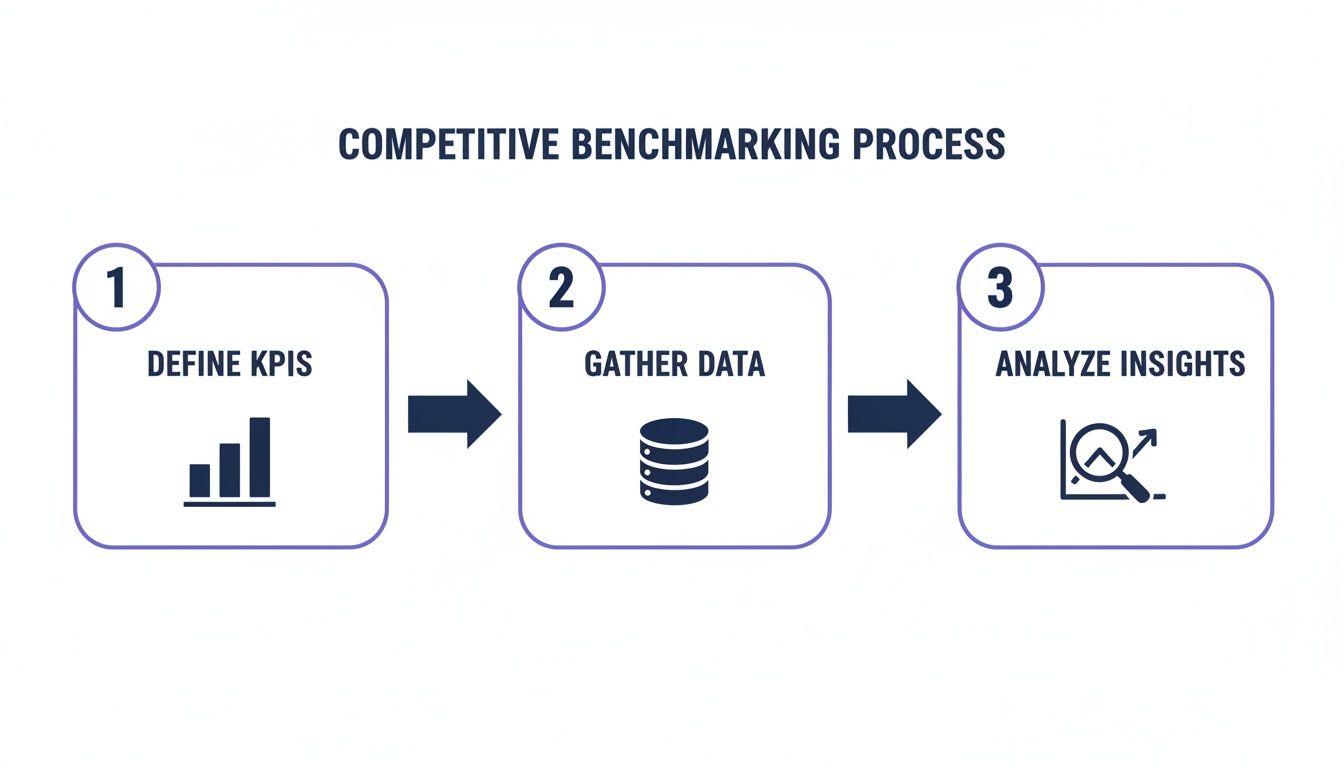
For a much smarter and more accurate approach, specialized competitor tracking software is a lifesaver. Tools like PostSyncer automate this entire process, pulling all the data you need directly into a dashboard for easy comparison. Discover how the right competitor tracking software can completely change your workflow and give you back hours of your week.
Step 4: Analyze the Data for Insights
With all your data in one place, it’s time to find the story hiding in the numbers. This is the most important part of the whole process. Don’t just look at what is happening; you have to dig deeper to understand why.
The goal isn't just to see that a competitor's engagement rate is 2% higher than yours. The goal is to figure out why their content connects so well with the audience you both share.
Start asking probing questions as you sift through the data:
- Why do their carousel posts get so many more saves than their single-image posts?
- What content themes consistently spark the most comments for them?
- Are they posting at specific times that seem to light up their engagement?
These are the kinds of questions that turn raw data into strategic gold.
Step 5: Implement and Monitor Your Changes
The final, and most crucial, step is to put your insights to work. Don’t let your analysis just sit in a spreadsheet. Create a concrete action plan based on what you’ve learned. This plan should spell out the specific changes you’ll make, who on your team is responsible, and a timeline for getting it done.
For example, if you discovered a competitor is crushing it with user-generated content, your action plan might be to launch your own branded hashtag campaign next quarter.
And remember, benchmarking isn’t a one-and-done project. It's a cycle. After you make changes, keep monitoring your performance and run your benchmarks regularly—monthly or quarterly is a good rhythm—to track your progress and stay one step ahead.
Key Social Media Metrics You Must Track
Okay, so you know who to watch and how to watch them. The next big question is: what are you actually looking for? If you're just glancing at follower counts, you're missing the whole story.
True competitive benchmarking is about digging into the numbers that reveal the why behind a competitor's performance. It’s about understanding the engine that drives their success.
Think of the metrics in three core buckets: how they're growing their audience, how deeply they're connecting with that audience, and the content strategy making it all happen.
Let's break down the numbers that matter.
Audience Growth Metrics
A growing audience usually signals a healthy, relevant brand. But a huge follower count can be a vanity metric—it doesn't tell you much on its own.
What you really want to track is the follower growth rate. This number shows you how quickly a competitor is pulling in new fans. Did they have a sudden spike last month? That's your cue to investigate. It could be a viral post, a killer ad campaign, or a partnership you need to know about.
Another crucial metric is reach, which is the unique number of eyeballs on a competitor’s content. If a brand has a smaller follower count but massive reach, it means their content is incredibly shareable and they've cracked the algorithm's code. That’s a strategy worth dissecting.
Engagement and Connection Metrics
This is where the real truth lies. Engagement metrics tell you if an audience is just passively scrolling or if they're genuinely loyal fans. Clicks and likes are nice, but the actions that require more effort tell a much more interesting story.
Here's what to look for:
- Saves: When someone saves a post, they’re bookmarking it as a valuable resource to come back to. If your competitor has a high save rate, they are likely creating educational or highly aspirational content that solves a real problem for their audience.
- Shares: A share is the ultimate social media compliment. It's a personal endorsement where a user tells their own network, "Hey, you need to see this." This is a gold-plated indicator of content that truly hits home.
- Comments: I'm not talking about fire emojis. I mean real comments that spark conversation. Analyzing a competitor's comment section is like getting free access to their audience's focus group. You can uncover pain points, burning questions, and the topics that get people talking.
High engagement, especially on saves and shares, is a dead giveaway that a competitor’s content strategy is perfectly aligned with what their audience actually wants. It’s less about grabbing attention and more about holding it.
Content Strategy Metrics
Finally, you need to get under the hood and look at the mechanics of how they’re getting these results. This means analyzing the nuts and bolts of their content strategy.
A great place to start is their post frequency. Are they a machine, posting multiple times a day? Or are they more selective, only showing up a few times a week? This tells you a ton about their approach to content and how they allocate their resources.
The content format mix is just as important. Dig into the performance of their different formats—short-form video (like Reels or TikToks), multi-image carousels, and single-image posts. If you notice their carousels consistently crush their videos, it’s a huge clue that their audience prefers in-depth, digestible information over quick entertainment.
Social Media Metrics Cheat Sheet
To help you keep everything straight, here’s a quick-reference table of the most important metrics to track and what they reveal about your competitors.
| Metric Category | Specific Metric | What It Tells You |
|---|---|---|
| Audience Growth | Follower Growth Rate | How quickly they are attracting new followers; spikes can indicate successful campaigns. |
| Audience Growth | Reach | The unique number of people seeing their content; high reach suggests strong algorithmic favor. |
| Engagement | Saves | How valuable and evergreen their content is; high saves mean they're seen as a resource. |
| Engagement | Shares | How resonant and relatable their content is; a strong signal of audience endorsement. |
| Engagement | Comments | The level of community and conversation they've built; reveals audience questions and interests. |
| Content Strategy | Post Frequency | Their content volume and resource allocation; shows their approach to staying top-of-mind. |
| Content Strategy | Content Format Mix | Which formats (video, carousel, static) perform best; reveals audience content preferences. |
| Content Strategy | Engagement Rate | The overall percentage of their audience that interacts; a benchmark for content quality. |
This cheat sheet is your starting point for turning raw data into actionable insights.
Diving deep into the nuances of social media analytics for business is what separates passive observation from a winning strategy. These insights aren't just interesting—they're your roadmap to creating better content and outperforming the competition.
Automating Your Analysis with Benchmarking Tools

Let's be real: trying to manually track every metric for a handful of competitors is more than just tedious—it’s a one-way ticket to burnout. You can easily lose hours sifting through social profiles, jotting down post times, and crunching engagement rates in a spreadsheet. That’s precious time you could be spending on actual strategy.
Worse yet, this manual grind is incredibly prone to human error. A single typo or a missed data point can throw off your entire analysis, leading you to draw the wrong conclusions about what’s working.
This is where automation completely changes the game. Modern benchmarking tools are built to handle all the heavy lifting, turning a frustrating manual chore into an efficient, hands-off workflow. Instead of getting lost in the weeds of data collection, you get to focus on what actually matters: figuring out what it all means and what to do next.
Streamlining Your Competitive Benchmarking Process
Using a platform like PostSyncer, you can set up your competitor tracking once and then let the software take over. Just tell it who to watch, and it will automatically pull in their performance data in real-time. No more daily check-ins, no more manual data entry. The numbers you need are always fresh and waiting for you.
This automated approach gives you a few massive advantages:
- Accuracy: You can finally say goodbye to manual typos and miscalculations. The data is reliable.
- Efficiency: Think of all the hours you'll get back. Time that was once spent on repetitive tasks is now yours to use for high-impact work.
- Consistency: With a steady, uninterrupted stream of data, you can spot trends, shifts, and opportunities the moment they happen.
When you're shopping around for the right tool, it's a good idea to see what specific features are on offer, like the ones detailed on Copycat247's features page. Many of the best social media competitor analysis tools do more than just scrape data—they offer slick reporting features that turn raw numbers into genuine intelligence.
From Raw Data to Actionable Insights
The true magic of these tools is in how they present information. Instead of staring at a sprawling, soul-crushing spreadsheet, you get clean dashboards and visual reports. In seconds, you can see exactly how you stack up against the competition.
The goal of automation isn't just to gather data faster; it's to get to the "so what?" of your analysis more quickly. These tools help you connect the dots between a competitor's actions and their results.
For example, a dashboard might show a huge engagement spike for a rival last Tuesday. With just a couple of clicks, you can drill down and see the exact post that caused it—maybe it was a clever short-form video or an interactive poll. Now you have a concrete idea to test with your own audience. Some platforms even use AI to analyze competitor activity and suggest new content ideas or the best times to post.
This level of insight transforms your benchmarking from a backward-looking report card into a forward-looking playbook. You’re no longer just reacting to what already happened; you’re armed with the intel you need to make smarter, faster decisions that keep you one step ahead.
Common Benchmarking Mistakes to Avoid
Even the sharpest marketing teams can get competitive benchmarking wrong. It's easy to fall into a few common traps that make all your hard work pretty much useless. But once you know what they are, they're surprisingly easy to sidestep.
The biggest and most common mistake? Obsessing over vanity metrics. A competitor’s massive follower count might look impressive at a glance, but it tells you absolutely nothing about how connected they are with their audience. It's a classic case of quantity over quality.
Instead, you need to be looking at the metrics that actually matter—engagement rate, shares, and comments. These are the numbers that tell the real story of how well their content is landing.
Comparing Apples to Oranges
Another classic blunder is picking the wrong competitors to begin with. It’s tempting for a small startup to put itself next to a global powerhouse like Nike or Apple, but that comparison is almost always pointless. Their budgets, brand recognition, and team sizes are playing a completely different game.
Your analysis will be far more insightful if you benchmark against companies that are:
- At a similar stage of growth as you.
- Chasing the exact same audience.
- Directly fighting you for market share.
Sticking to this kind of focused comparison gives you a realistic baseline and, more importantly, reveals strategies you can actually use.
The single biggest mistake in competitive benchmarking isn't bad data—it's good data that just sits there. Collecting insights without creating an action plan is just a sophisticated form of procrastination.
At the end of the day, every single insight you pull has to lead somewhere. If you find out a competitor’s videos get 50% more shares than yours, that’s not just a cool stat—it's a call to action.
For every key finding, build a simple action plan. Assign it to someone on your team and give it a deadline. This is how you turn a spreadsheet of numbers into a real roadmap for winning.
Got Questions About Benchmarking? We've Got Answers
Alright, you’ve got the framework down. But I’m willing to bet a few practical questions are bubbling up. Let's tackle some of the most common ones I hear so you can move forward with total confidence.
How Often Should I Actually Run a Benchmarking Analysis?
There's no single magic number, but a great starting point is either a monthly or quarterly review. Think of it like this: monthly check-ins are perfect for keeping a finger on the pulse of short-term campaigns and making quick, tactical adjustments.
Quarterly analyses, on the other hand, give you the altitude to spot bigger strategic trends and set more ambitious goals for the next period. The most important thing is just to be consistent. Make it a non-negotiable part of your marketing rhythm.
What's the Real Difference Between Analysis and Benchmarking?
This is a classic point of confusion, but it's pretty simple when you break it down.
- Competitive analysis is the broad, fact-finding mission. You’re looking at what your competitors are doing as a whole—their products, marketing channels, and overall strategy. It’s about understanding their entire playbook.
- Competitive benchmarking is where you get specific and start keeping score. It zeroes in on measuring your performance against theirs using hard, quantifiable metrics, like engagement rate or follower growth.
In short: analysis is the qualitative "what," while benchmarking is the quantitative "how well." You absolutely need both for a complete picture, but benchmarking is what gives you the cold, hard data to set meaningful goals.
Can I Benchmark a Competitor on a Platform I'm Not Even On Yet?
Absolutely! In fact, it’s one of the smartest pre-launch moves you can make. By benchmarking the top performers on a social network where you aren't yet active, you can set realistic goals right out of the gate.
More importantly, you get an immediate cheat sheet on the content formats, posting frequency, and engagement tactics that are already winning over your target audience. It’s like getting a massive head start before the race even begins.
Ready to stop guessing and start outperforming? PostSyncer’s automated competitive analysis tools do all the heavy lifting, delivering the insights you need to get ahead of the competition. Start your free 7-day trial of PostSyncer today.