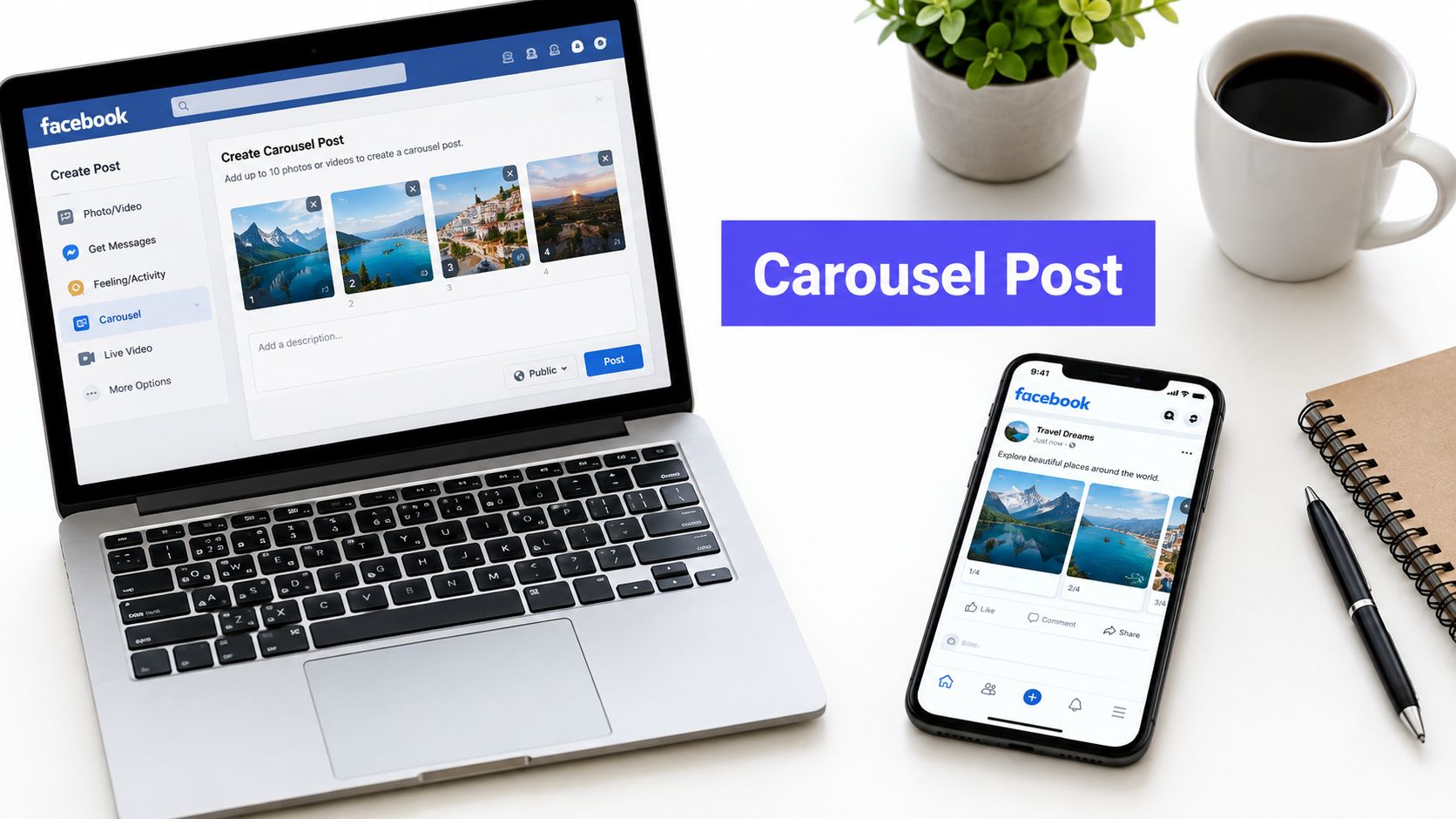











You've got the photo. The design is ready. The post is scheduled for today. And you're still staring at the caption box.
That's where a lot of social posts slow down. Not because the image is weak, but because the words don't know what job they're doing. A good caption can add context, pull attention to the right detail, start a conversation, or move someone toward a click. A bad one just fills space under the image.
If you want to know how to caption photos in a way that supports engagement, brand clarity, and business goals, the process gets much easier when you stop treating every caption like the same writing task. The best captions change by platform, by audience, and by what the image needs from the text.
Define Your Caption's Job Before You Write a Word
Most caption problems start before any writing happens. People ask whether captions should be short or long, witty or informative, direct or subtle. The better question is simpler: what is this caption supposed to do for this photo, on this platform, for this audience?
That one question clears up most of the confusion around detail level. Some photos need context because the image alone doesn't tell the whole story. Others already communicate the point visually, so a long explanation just repeats what people can already see. Editorial guidance often pulls in different directions for that reason. One side recommends structure and context, while another warns against stating the obvious. As caption guidance from Chico State notes, the right level of detail depends on whether the image is informational, narrative, or decorative.

Start with the business outcome
Before writing, decide which of these jobs the caption owns:
- Inform: Explain what's happening, what changed, what matters, or what the audience should notice.
- Entertain: Make the post feel human, memorable, or shareable.
- Persuade: Push toward an action such as commenting, saving, clicking, booking, or buying.
A product launch photo and a behind-the-scenes team photo shouldn't sound the same, even if they're posted on the same brand account. One might need clarity and positioning. The other might need warmth and personality.
Practical rule: If you can't finish the sentence “This caption needs to make the reader…” you're not ready to write it.
Match the voice to the image, not just the brand guide
A lot of social teams overcorrect on “brand voice” and make every caption sound uniform. Consistency matters, but rigid sameness hurts performance. Voice should be recognizable. Tone should flex.
Use this quick filter:
| Photo type | What the caption should emphasize |
|---|---|
| Informational | Clarity, context, specifics |
| Narrative | Sequence, emotion, meaning |
| Decorative or aesthetic | Mood, brevity, brand feel |
A founder update on LinkedIn can sound reflective and sharp. A customer photo on Instagram can sound warmer. A TikTok still might only need a quick setup line because the video does the heavy lifting.
Decide what the image can do on its own
Experienced caption writing becomes faster. Ask three questions:
- What does the image already say without help?
- What important thing would the viewer miss without a caption?
- What action, if any, should happen after reading?
If the photo already delivers the emotion, don't explain the emotion. Add meaning instead. If the image is ambiguous, anchor it quickly. If the post supports a campaign goal, the caption should guide attention toward that goal.
The strongest captions feel effortless because the strategy happened first. That's the part often skipped.
Essential Caption Formulas That Always Work
Blank caption boxes are a workflow problem, not a creativity problem. You need formulas you can reuse without sounding templated.
A good formula gives you structure, but it still leaves room for voice. The ones below work because each one maps to a different business need: storytelling, education, or engagement.

The Hook, Context, Action formula
This is the most reliable all-purpose structure. It's also close to classic caption writing. In photojournalism, a widely taught structure is two sentences: the first is written in present tense and identifies the who, what, where, and when, while the second adds context in past tense and deeper meaning, according to the University of Kentucky photo caption guidelines.
That approach adapts well to brand content.
Use it when:
You need clarity first, then a reason to care, then a next step.
Weak version:
“Our team at the event today.”
Stronger version:
“We're meeting customers at our industry event in Austin this afternoon. These conversations started after months of product feedback, and they're shaping what we build next. Stop by and say hello.”
The first line grounds the post. The second line adds significance. The final line creates momentum.
To see the structure in action, this walkthrough is useful:
The Problem, Tension, Answer formula
This one works when the photo supports expertise, education, or product marketing.
Use it when:
You're teaching, reframing a common issue, or showing why a solution matters.
Try this shape:
- Problem: Name what people struggle with
- Tension: Show why it keeps happening
- Answer: Offer the fix, insight, or next move
Weak version:
“Caption writing tips for marketers.”
Stronger version:
“Most brands don't struggle because they lack ideas. They struggle because every photo gets the same kind of caption, no matter the platform or goal. Start by defining whether the post needs to inform, entertain, or convert, then write to that job.”
This formula performs well on LinkedIn, carousel posts, and educational Instagram content because it rewards attention with a clear takeaway.
A caption gets stronger when the reader feels understood before you try to teach them something.
The Relatable Observation formula
Not every caption needs hard structure or a CTA-heavy ending. Some posts work because they sound observant and human.
Use it when:
You want comments, affinity, or a lighter social tone.
Weak version:
“Monday at the office.”
The photo says ‘calm planning session.’ In truth, it was three tabs open, two coffee refills, and one last-minute deadline change.
That kind of caption works because it gives the audience something easy to agree with, respond to, or share. It's especially useful for brand-building posts that aren't trying to drive immediate traffic.
The trick is to keep it specific. Generic relatability sounds manufactured. Real observations sound lived-in.
Tailoring Your Caption for Every Platform
A strong caption on one network can feel awkward on another because user expectations change faster than most content calendars do. The same photo might need a different opening line, different paragraphing, and a different CTA depending on where it goes.
Instagram needs a strong opening and clean formatting
Instagram gives you room to tell a story, but attention still lives in the first line. If the opener is flat, the rest of the caption doesn't matter.
On Instagram, these usually work well:
- Story-led captions for personal brands, founder accounts, and behind-the-scenes posts
- Quick educational captions for carousels and product explainers
- Punchy one-liners when the visual already carries the message
Line breaks matter here. Dense text discourages reading. Break the caption into short chunks so the viewer can scan before deciding to commit.
If you want a faster drafting workflow, an Instagram caption generator can help you produce variations for different tones, then you can edit the opener and CTA by hand.
LinkedIn rewards clarity and a point of view
LinkedIn captions should sound like a person with experience, not a polished ad. The audience usually wants one of three things: a useful lesson, a credible opinion, or a practical story.
Here's the comparison that matters most:
| Platform | Caption style that usually fits | What often falls flat |
|---|---|---|
| Insight, reflection, professional takeaway | Meme-heavy slang, vague hype | |
| Story, mood, community, visual complement | Long blocks with no formatting | |
| Community updates, links, local relevance | Overly polished corporate tone | |
| TikTok | Short setup text that supports the video | Explaining everything the video already shows |
A LinkedIn caption can be longer if every paragraph earns its place. Lead with the insight, not the backstory. If the post includes a team photo, say why it matters to the business or the audience.
Facebook and TikTok need different kinds of restraint
Facebook often works better when the caption supports conversation or traffic. Community pages, local brands, and event-driven businesses do well when the caption gives clear context and then asks for a response or click.
TikTok is different. The video usually does most of the communication. The caption should complement, not duplicate. Short setup lines, framing, or a fast prompt work better than overexplaining.
If the platform is built around motion, don't make the caption carry the whole post.
Hashtags should also shift by platform. Instagram can support discovery tags and niche descriptors. LinkedIn needs more restraint. TikTok captions benefit from relevance and timing more than bulk. Facebook usually doesn't need a wall of tags at all.
Driving Action with CTAs and Hashtags
A caption that gets attention but doesn't direct it leaves value on the table. You don't need to sound pushy, but you do need to tell people what to do next.
Use the CTA that matches the post goal
The easiest way to make CTAs feel natural is to match them to intent.
- Conversation CTAs work when the goal is comments. Ask for an opinion, a preference, or a lived experience. “What would you add?” works better than “Thoughts?”
- Click CTAs fit educational, product, or traffic-driving posts. Be direct. “Read the full guide,” “see the demo,” or “grab the checklist” tells the user exactly what's next.
- Share or save CTAs work when the post is practical. If the content helps people remember a process, compare options, or avoid mistakes, give them permission to save it.
Weak CTAs are vague. Strong CTAs reduce friction.
Weak: “Check it out.”
Better: “Comment with the platform you're posting on most, and I'll tell you which caption formula fits it best.”
Keep hashtags strategic, not decorative
Most hashtag mistakes come from copying the same block into every post. That creates clutter and weak targeting.
A more useful system is this:
- Use broad tags sparingly if they describe the category.
- Add niche tags that match the specific audience or topic.
- Include branded tags only if they're active and relevant to your content.
Don't use hashtags just because they're popular. Use them because they connect the post to the right context. A highly relevant small tag often does more for discoverability than a giant generic one that buries your post in noise.
For a practical workflow, this guide on finding trending hashtags is useful if you want to build topic-specific hashtag sets instead of recycling the same list.
Writing for Everyone with Accessible Captions and AI
A product launch post goes out. The caption is polished, the creative looks strong, and the team checks the box. Then someone using a screen reader gets almost none of the context that drives the post. That gap costs reach, clarity, and trust.
Visible captions and alt text do different jobs. The caption helps the post perform. Alt text helps people access the image itself. Teams that blur those roles usually end up with weaker copy and weaker accessibility.
For social teams, the practical split is simple. Use the visible caption to add meaning, business context, and the next step. Use alt text to describe what is shown, clearly and briefly. If the image includes data, text overlays, or details the audience needs to understand the post, make sure those details are available in a form assistive tech can read.
Write alt text for recognition and clarity
Strong alt text gets to the point fast. It tells someone what matters in the image without trying to sound clever or promotional.
Use this checklist:
- Name the main subject
- Describe the action or setting
- Include important on-image text if it affects understanding
- Skip filler unless the platform adds it poorly on its own
- Leave out slogans and sales language
- Keep it concise enough to scan with assistive tech
The standard I use is straightforward. If a person heard the alt text without seeing the image, would they understand what the post shows and why the visual matters?

Use AI as a production tool, not a final editor
AI helps most when the content calendar is full and the team needs a first draft fast. It can speed up both caption drafting and alt text creation across Instagram, LinkedIn, X, Facebook, and Pinterest. The trade-off is accuracy. AI often misses brand-specific details, mislabels products, or writes generic descriptions that sound acceptable but fail the user.
The workflow that holds up in practice is this:
- Generate a draft from the image
- Verify the nouns, brand elements, and setting
- Add missing context, especially if the image supports a campaign goal
- Rewrite for the platform and audience
- Approve alt text and visible caption separately
That last step matters if you manage content across multiple channels. One image may need different visible captions by platform, while the alt text stays close to the same. That gives you a unified workflow without flattening every post into the same template.
If you want a repeatable process, this guide to social media alt text for images is useful for building a review system your team can apply at scale.
AI should remove blank-page friction and speed up production. Human review is still what ties the caption back to the business goal, protects accuracy, and makes the post usable for more people.
Common Caption Mistakes and How to Fix Them
A post goes live with a strong image, solid timing, and a clear campaign goal. Then the caption undercuts it. It opens slow, says what the photo already says, and gives the audience nothing to do next. That is usually where results slip. Not because the team cannot write, but because the caption was never assigned a clear job.

The pattern is predictable across Instagram, LinkedIn, X, Facebook, and Pinterest. Teams reuse the same caption everywhere, chase clever wording before clarity, or let AI output go live with no platform edit. The result is weak engagement, lower click-through intent, and posts that support neither reach goals nor conversion goals.
The mistakes that show up most often are:
- Starting with the least interesting detail. Lead with the strongest hook, the clearest benefit, or the sharpest point of tension.
- Repeating exactly what the image shows. Add context, stakes, opinion, or a reason the post matters now.
- Using a mismatched tone. Match the voice to both the platform and the business objective. A product launch, customer story, and founder update should not sound the same.
- Forgetting the next step. Add a CTA that fits the goal, whether that is a click, comment, save, share, or reply.
- Writing captions as a wall of text. Break lines with purpose so the post is easy to scan on mobile.
- Treating alt text like a caption. Keep alt text focused on describing the image, and use the visible caption for interpretation, persuasion, and action.
The fix is a simple framework I use with clients and internal teams. Check the goal first. Then write in three parts: hook, value, action. Once that draft exists, adapt it by platform instead of copying it word for word everywhere. AI can speed up the first pass, but the final edit still needs a human who can protect tone, accuracy, and business intent.
If you manage content across multiple channels, PostSyncer can help you plan captions, adapt them for different platforms, and keep publishing organized in one workflow. It's a practical option for teams that want faster drafting, easier scheduling, and fewer last-minute caption bottlenecks.