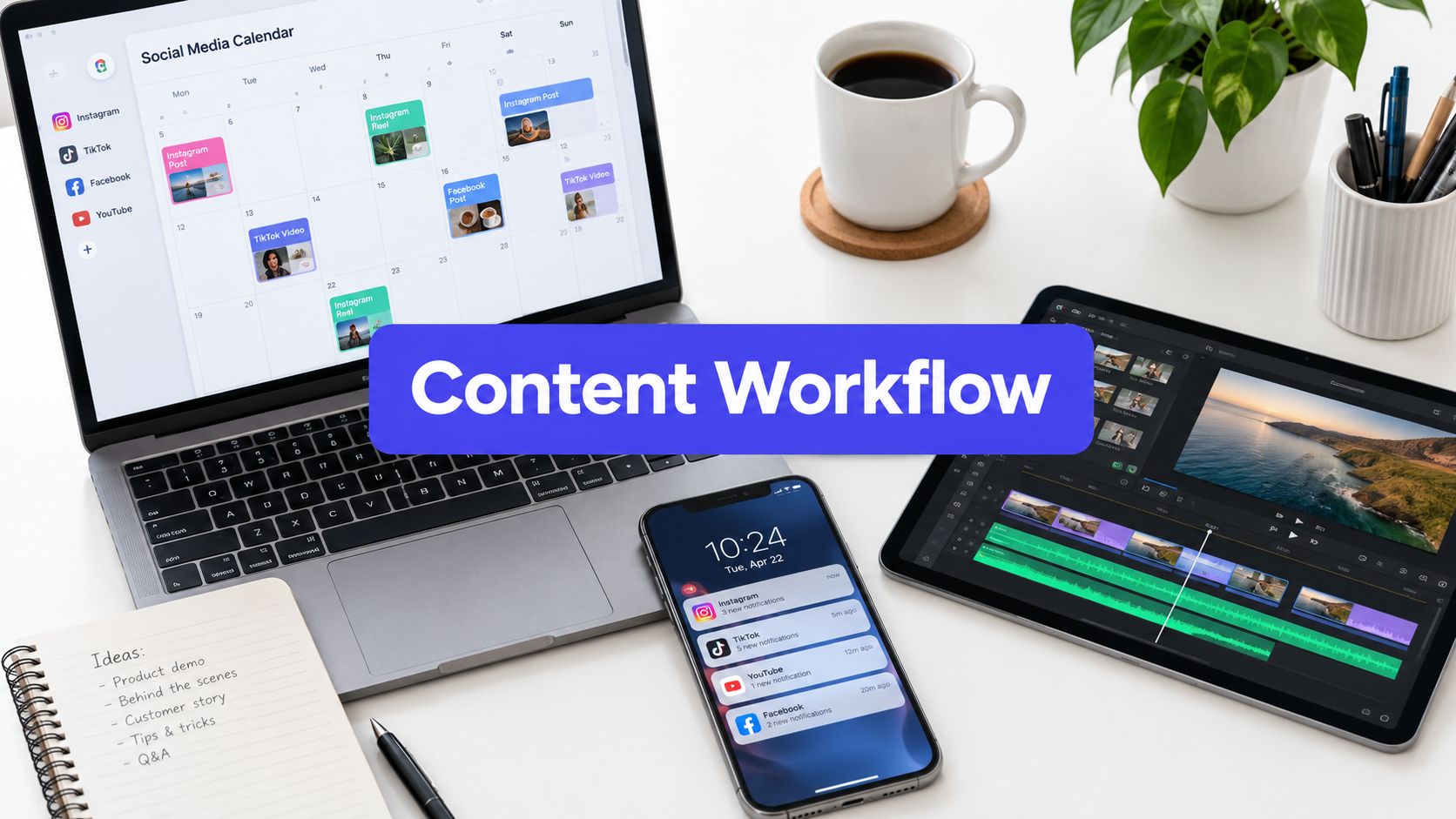












You already have clips worth posting. They’re buried inside your webinar, podcast, interview, product demo, livestream, or founder update.
Teams often don’t have a content problem. They have an extraction problem. They publish one long video, maybe two, then wonder why reach stalls while shorter, sharper posts keep showing up everywhere.
That’s why learning how to clip videos matters now. Not as a side skill for editors, but as a repeatable publishing workflow. The shift is moving from trimming one clip at a time to building a system that turns every long recording into multiple platform-ready posts without wasting a day in the timeline.
Why Clipping Is Your Most Powerful Content Strategy
Clipping works because social platforms reward speed, clarity, and immediate payoff. In 2026, clipping has exploded as a core content strategy, driven by algorithms favoring short-form video under 60 seconds, with 70 billion daily views on YouTube Shorts alone. Marketers also report 29.18% usage of short-form formats like Reels and Shorts as the top video type, and 81% of consumers want more short-form content from brands, according to this 2026 clipping report.
That matters because a long video usually contains several different assets at once:
- A hookable opinion that can stand alone as a short
- A teaching moment that works as an educational clip
- A sharp quote that performs well with captions
- A story beat that can carry a full Reel or Short
Most creators still post the full asset and stop there. That leaves discovery on the table. A sixty-minute webinar can produce clips for awareness, retargeting, social proof, and replies to common objections, all without recording anything new.
Practical rule: Treat the long video as raw material, not the final product.
Clipping also changes how you think about effort. Instead of asking whether one video will perform, ask how many distinct posts you can pull from it. That mindset is what separates occasional posting from reliable distribution.
The best part is that clipping scales both ways. If you’re a solo creator, it helps you stay visible without filming daily. If you manage several brand accounts, it turns each recording session into a backlog of usable content. That’s the advantage.
The Fundamentals of Trimming Video Content
Clipping starts with one simple move: choosing where a segment begins and where it ends. Every editor calls it something slightly different, but the job is the same. You find the in-point, find the out-point, cut the rest away, then export the part that deserves to live on its own.

What makes a good clip
Before touching any software, decide what you’re extracting. Good clips usually do one of three things fast:
- They make a clear promise. The viewer knows why they should keep watching.
- They start late. Dead air, throat-clearing, and setup kill retention.
- They end cleanly. The point lands before attention drifts.
If you clip too early, the video feels slow. If you clip too late, you lose the strongest moment in unnecessary context. The right cut often feels a little aggressive when you first make it. That’s usually a good sign.
How to trim on desktop
A free desktop editor like CapCut Desktop is enough for most clipping work. Import the source video, drag it onto the timeline, and scrub through until you find the exact frame where the valuable moment starts.
Then:
- Set the start point where the sentence becomes interesting, not where the speaker inhales.
- Set the end point right after the payoff lands.
- Split or trim the surrounding footage.
- Play it back once to check pacing before exporting.
Desktop editing is best when you need precision. It’s easier to fine-tune cuts, add captions, resize for vertical output, and clean up mistakes. If you’re still comparing tools, this roundup of best video editing apps for TikTok is useful because it separates quick mobile editors from more capable desktop options.
One more practical resource helps if your source material starts on YouTube. This guide on how to take clips from YouTube videos covers the extraction side before you move into formatting and publishing.
How to trim on your phone
Phone editing is faster than people think. On iPhone or Android, the native Photos editor lets you open a video and drag the handles at the beginning and end of the timeline to shorten it.
That’s enough when you need speed. It works well for:
- Quick social reactions clipped from a fresh recording
- Simple talking-head cuts where no reframing is needed
- Approvals on the go before sending a draft to a client or teammate
The downside is control. Native mobile editors are fine for rough trims, but they’re weak for layered captions, framing changes, or multi-version exports.
If the clip needs polishing, use the phone for selection and the desktop for finishing.
How to trim in a web editor
Web tools like Clipchamp are a middle ground. You upload a file, drop it into a browser-based timeline, trim the segment, and export without installing full editing software.
That setup works well for marketers who don’t want a heavy post-production stack. The workflow is usually:
- Upload the source asset
- Duplicate the timeline if you want multiple versions
- Trim each segment into separate clips
- Export in the shape you need for the platform
The core lesson is simple. The editor matters less than your eye for moments. If you can identify a self-contained insight, emotional reaction, or punchy explanation, you can clip video in almost any tool.
Pro Techniques for More Engaging Clips
Basic trimming gets the job done. Better clips come from tiny decisions that make the video feel intentional instead of chopped.

Cut faster with keyboard habits
If you edit on desktop, keyboard shortcuts change everything. In many editors, I sets the in-point and O sets the out-point. Even if your software uses different keys, the principle is the same. Mark the usable section first, then remove everything around it.
That habit speeds up review because you stop dragging clips around with the mouse for every decision. It also helps when you’re pulling several clips from the same source file.
A few workflow habits make a big difference:
- Watch once at normal speed to feel the natural rhythm.
- Mark candidate moments before editing anything.
- Name clips by topic instead of “clip 1” or “final final.”
Use audio transitions to hide rough cuts
A lot of clips feel amateur because the speaker’s tone jumps too abruptly. That’s where simple J-cuts and L-cuts help.
A J-cut lets the next audio line begin slightly before the visual cut. An L-cut lets the current audio continue briefly after the visual changes. You don’t need cinematic ambition here. You just want the transition to feel less mechanical.
Smooth audio often matters more than fancy visuals. People forgive a plain frame faster than they forgive a jarring cut.
This walkthrough shows the kind of pacing and cut choices that make shorts feel cleaner in practice:
Trim harder than feels comfortable
Most weak shorts are too long at the front. The speaker says hello, adds context, repeats the setup, then finally reaches the point. Social clips need the opposite.
Try this test:
- Version A keeps the original setup.
- Version B starts on the strongest sentence.
- Version C starts one beat before the strongest sentence.
Watch all three back-to-back. Version B usually wins. Version C sometimes works if the lead-in adds tension.
Another useful trick is micro-zooming or reframing after a cut so the jump feels motivated rather than accidental. Keep it subtle. If every cut punches in dramatically, the clip starts to feel nervous.
Optimizing Clips for Every Social Platform
A clean cut isn’t enough. The export has to match the platform. The same moment can work on TikTok, Instagram Reels, YouTube Shorts, and LinkedIn, but only if the framing, length, and captions fit how people watch there.
Professional clipping usually means preparing multiple versions of the same source. That includes 9:16 vertical, 1:1 square, and 16:9 horizontal outputs. It also means taking captions seriously, because 85% of mobile viewers watch without sound, and vertical 9:16 content generates 40% higher completion rates on TikTok and Instagram than square 1:1. Clips that open with the strongest moment in the first three seconds also achieve 2.5x higher engagement, according to these video clipping benchmarks.

Pick the format before you export
A common mistake is exporting one square file and pushing it everywhere. That usually leaves vertical platforms under-optimized and horizontal platforms awkwardly cropped.
Use this as a practical baseline:
| Platform | Aspect Ratio | Max Length | Recommended Captions |
|---|---|---|---|
| TikTok | 9:16 | Varies by platform rules | Burned-in or native captions with strong opening line |
| Instagram Reels | 9:16 | Varies by platform rules | Large animated captions centered for mobile viewing |
| YouTube Shorts | 9:16 | Up to 60 seconds | Clean captions that don’t block key visuals |
| 1:1 or 16:9 | Varies by platform rules | Readable captions with more conservative styling |
This table is a working guide, not a substitute for checking each network’s current upload rules before posting. If you need a deeper breakdown for Instagram exports, this reference on Instagram video file format is useful when you’re troubleshooting rejections or compression issues.
Captions aren’t optional anymore
Captions do more than improve accessibility. They hold attention, clarify fast speech, and let the clip survive silent autoplay. But style matters.
Good social captions are:
- Short per line, so they’re easy to scan
- Placed away from UI elements, so buttons don’t cover them
- Timed tightly, so they feel synced, not delayed
If you want a simpler production step, an AI caption tool for video helps speed up subtitle creation before export.
Strong clips are built twice. First in the edit, then in the export settings.
Match the clip to the feed behavior
TikTok and Reels reward immediacy. LinkedIn often tolerates a slightly slower start if the value is obvious and professional. YouTube Shorts needs tight pacing and clear visual focus because viewers move fast.
That doesn’t mean every platform needs a completely different idea. It means the same clip should be framed like it belongs there. A vertical talking-head short with readable captions often travels well. A square version can still help where a feed feels more mixed. A horizontal cut remains useful for long-form channels and embedded website content.
The Automated Workflow From Clipping to Scheduling
Manual clipping is worth learning because it teaches judgment. But it stops scaling once you’re handling a backlog of podcasts, webinars, customer calls, interviews, and creator content every week.
That’s the gap most tutorials miss. They teach the trim, the split, the jump-cut fix, maybe some B-roll. They don’t show how teams move from one edited clip to a dependable repurposing system.
AI clipping tools have grown fast for exactly that reason. The underserved part of the market is AI-driven automated video clipping, and usage of those tools grew 340% in 2025, while 72% of small businesses reported feeling underserved by manual editing workflows, based on this source discussing AI clipping demand.

Where manual workflows start breaking
The problem isn’t just editing time. It’s context switching.
A manual clipping process usually looks like this:
- Open the long video and review the full recording
- Mark possible moments and trim them one by one
- Resize each clip for vertical and square versions
- Add captions
- Export multiple files
- Upload them into a scheduler
- Write post copy and assign publish dates
That can work for one source video. It gets messy fast when you’re managing content across several brands or trying to build a real posting cadence.
What AI clipping actually improves
The best automated workflows don’t replace judgment. They remove repetitive labor. You still decide what fits the brand, what sounds on-message, and which moments deserve distribution. The tool handles the heavy lifting around extraction, resizing, captioning, and prep.
Some advanced systems use streaming submodular maximization for real-time clip extraction. In plain language, that means the software evaluates incoming segments as they arrive instead of waiting to analyze the entire video after the fact. Systems using this method can reduce computational overhead by 40% to 60% compared with exhaustive frame analysis, according to this technical explainer on video clipper methods.
You don’t need to understand the math to benefit from it. The practical takeaway is simple: smarter clipping systems aren’t just looking for dramatic facial expressions. They’re weighing pacing, relevance, and contextual value while processing the video.
Automation helps most when the bottleneck isn’t creativity. It’s repetition.
A scalable repurposing flow
A better workflow looks like this:
Start with one long asset
Upload a webinar, interview, podcast video, screen recording, or paste a public URL.Generate multiple candidate clips
Let the system detect likely short-form moments instead of hunting manually through the full timeline.Review, reject, and refine
Keep the strong clips, cut the weak ones, and adjust hooks where needed.Add platform-ready elements
Apply captions, check framing, and make sure the first line lands quickly.Schedule from the same workflow
Move approved clips directly into a publishing calendar instead of downloading and re-uploading everything.
For teams that want that kind of setup, a long video to short video AI workflow is the natural next step because it cuts out the handoff between editing and scheduling.
What still needs a human
Automation doesn’t solve weak source material. If the original recording wanders, the clips will wander too. It also won’t protect you from bland openings, cluttered captions, or off-brand phrasing unless someone reviews the output.
The strongest teams use AI for volume, then apply human review for taste. That’s the balance that works. Let the system give you options. Don’t let it make your final judgment for you.
From Manual Trims to Automated Growth
The progression is simple. First, learn to spot a strong moment. Then learn to cut it cleanly. After that, stop doing every repetitive task by hand.
That’s how clipping becomes growth instead of just editing. A long video stops being a single post and becomes a reusable content bank. You publish more often, adapt clips for different feeds, and build consistency without recording from scratch every day.
Manual skills still matter. They teach pacing, judgment, and what makes a clip worth watching. But the teams that stay consistent don’t rely on manual effort alone. They build workflows that keep content moving from source video to published post with fewer handoffs and less friction.
If you’re still trimming one clip at a time, that’s a fine place to start. It’s not the place to stay.
Frequently Asked Questions About Video Clipping
How many clips should I make from one long video
Make as many as the source naturally supports. A strong interview might produce several usable clips. A weak recording might only contain one. Don’t force volume if the segments overlap or repeat the same point.
A practical rule is to look for different clip types, not just more clips. Pull one opinion, one educational takeaway, one story, and one objection-handling segment if they exist.
What’s the best way to find the most engaging moments
Start by scanning for moments where one of these happens:
- The speaker makes a clear claim
- A surprising answer appears
- A process gets simplified
- Emotion rises, even subtly
- The audience question is stronger than the prepared material
If you’re reviewing manually, mark those moments first and cut later. If you’re using AI support, review the generated candidates with the same filter. Don’t approve a clip just because the software found it.
Should I remove every pause and breath
No. Remove delays that make the clip drag, but keep enough natural rhythm that the speaker still sounds human. Over-editing creates the “stitched together” feeling people notice immediately.
When in doubt, cut for pace, then play it once with your eyes closed. If the audio sounds unnatural, you trimmed too aggressively.
Can I legally clip content I don’t own
Usually, the safest route is to clip content you created, recorded, or have permission to repurpose. If the footage belongs to someone else, especially for commercial use, get clear rights before publishing.
That applies to podcasts, webinars, interviews, customer footage, livestreams, and creator collaborations. The easiest legal workflow is clean ownership before editing starts.
If you’re ready to turn long videos into publish-ready shorts without juggling separate editing and scheduling tools, PostSyncer gives you one place to generate clips, add captions, organize content, and schedule across every major platform. It’s built for creators, marketers, and agencies that want a faster path from raw footage to consistent posting.