







You're probably doing one of two things right now. You're posting on Facebook consistently and not seeing many new likes, or you're thinking about putting money behind the page because organic growth feels slow.
Both situations are normal.
Facebook is still useful, but getting page likes isn't a random outcome anymore. It's a system problem. If your page looks weak, your content won't convert visitors. If your content is decent but nobody sees it, growth stalls. If people engage once and never come back, you don't build momentum.
The fix isn't a trick. It's a repeatable loop: Foundation, Content, Engagement, Promotion, Analysis. That's the playbook I'd use if I had to grow a Facebook page from scratch today.
Laying the Groundwork to Earn More Facebook Likes
Before you chase reach, make the page worth liking. Most businesses skip this and jump straight to posting or boosting. That's backward.
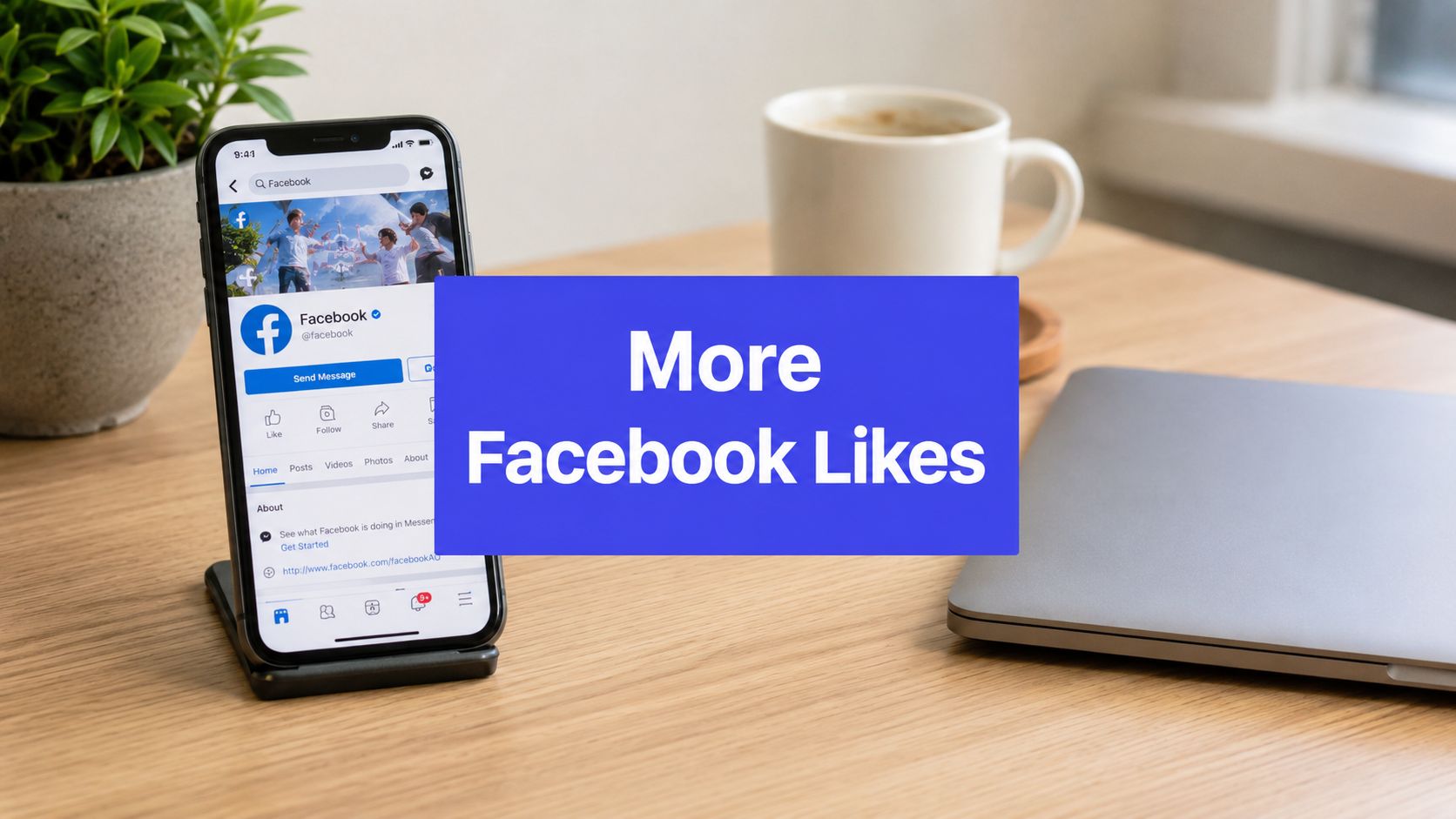
When someone lands on your Facebook Page, they decide fast. They look at the profile image, the cover photo, the About section, and the call-to-action button. If those four pieces feel generic, they leave. If those four pieces clearly answer what you do, who it's for, and why they should follow, your later efforts work much better.

Audit the page like a landing page
Treat your Facebook Page like a mini homepage, not a social profile.
A weak setup looks like this: cropped logo, vague banner, one-line About text, and a CTA button that sends people somewhere unrelated to the content they just saw. A strong setup feels consistent from top to bottom.
Use this checklist:
- Profile picture that reads clearly: If you're a local business or founder-led brand, a recognizable face can outperform a tiny unreadable logo. If you use a logo, make sure it's simple enough to be clear at small size.
- Cover photo with a job to do: Don't use decorative art unless brand recognition is already strong. Use the space to reinforce your offer, positioning, or content promise.
- About section with plain-English value: Tell visitors what you post, who it helps, and what they should do next.
- CTA button tied to one action: Pick the action that matches your business goal. Book, shop, sign up, message, or learn more. Don't make people guess.
Practical rule: If a first-time visitor can't understand your page in a few seconds, they won't reward you with a like.
Improve each element with a before-and-after mindset
The easiest way to improve a page is to rewrite each piece from the visitor's point of view.
Profile picture
Before: a detailed logo with small text.
After: a clean logo mark or high-quality headshot with strong contrast.
Cover photo
Before: stock art with no message.
After: a simple visual that tells people what they'll get by following the page. Think product previews, customer transformation, content categories, or brand promise.
About section
Before: “We help businesses grow.”
After: “We share practical tips, examples, and updates for small businesses that want better Facebook content and stronger customer engagement.”
Fix the CTA button
The CTA button gets ignored because people set it once and forget it.
If your page is trying to generate leads, use a button that sends people to a focused next step. If your business closes more conversations in DMs, make messaging frictionless. If you sell products, send people to the category or offer most aligned with what you post on Facebook.
That alignment matters. A page that posts educational content but sends people to a generic homepage creates drop-off. A page that posts product demos and sends people straight to the relevant collection converts attention better.
A like-worthy page isn't flashy. It's clear. Clear pages earn more follows because they reduce uncertainty.
Fueling Growth with a Strategic Content Mix
A lot of pages lose likes here. The branding is solid, the page looks credible, then the content turns into a grab bag of promos, recycled memes, and posts with no clear role in the system.
Facebook does not reward that kind of inconsistency. According to recent data from Sprout Social, average engagement per post is low across the platform, photo posts and albums often perform well, and short-form video gets a large share of user interaction. Reels in the 90 to 120 second range also stand out. The practical takeaway is simple. Content format should be chosen on purpose, based on the job the post needs to do.

Build content pillars that support repeatable growth
Likes grow faster when the page feels consistent. That does not mean posting the same thing every day. It means people can tell what they will keep getting if they follow you.
This is why I build around content pillars. Usually, three to five is enough for a business page.
A practical mix looks like this:
- Educational posts: tips, how-tos, common mistakes, quick explainers
- Proof posts: customer results, examples, testimonials, case snapshots
- Personality posts: behind-the-scenes content, team perspective, brand opinions
- Conversation posts: questions, polls, simple prompts, hot takes with context
- Offer posts: launches, promos, featured products, event announcements
The trade-off matters. A page packed with offers may drive occasional clicks, but it gives people very little reason to like the page for ongoing value. A page with only entertaining or discussion-based posts may get interaction, but it can struggle to turn attention into business results. The better approach is balance. Use each pillar to do one part of the growth job.
If you want more prompt-based ideas, this list of engagement posts for Facebook is a strong place to start.
Match the format to the outcome
One of the easiest fixes is assigning a clear purpose to each format. That turns content from random posting into a repeatable system.
Here's the planning framework I use:
| Content Format | Primary Goal | Best For | Pro Tip |
|---|---|---|---|
| Photo post | Quick engagement | Product highlights, simple tips, quotes, visual updates | Use a strong image with one clear idea |
| Album | Deeper interaction | Step-by-step stories, event recaps, product collections, before-and-after series | Make each image earn its place |
| Reel | Reach and discovery | Tutorials, reactions, demonstrations, storytelling | Keep the hook early and the pacing tight |
| Text-led post | Conversation | Opinions, questions, community prompts | Only use when the opening line is strong |
| Poll or prompt post | Participation | Feedback, preferences, lightweight engagement | Make the choice easy and relevant |
The mistake is expecting one format to carry the whole page. Reels can expand reach, but they are not always the best tool for trust. Text posts can spark comments, but weak wording kills them fast. Albums take more effort to create, yet they often keep people interacting longer because there is more to click through.
Use a weekly mix, not isolated tactics
Pages start to feel intentional when you change your focus. Instead of asking, "What should we post today?" ask, "What does the page need this week?"
For example:
- One or two reach posts to get in front of new people
- Two engagement posts to create visible activity
- One trust-building post to show proof or expertise
- One offer post tied to a relevant action
That mix creates a loop. Reach brings in new viewers. Engagement gives them a reason to interact. Proof helps them trust the page. Offers turn attention into clicks, leads, or sales. Then the next week builds on that instead of starting from zero again.
Random posting breaks that loop. Strategic posting strengthens it.
A smaller page can use this especially well. You do not need massive volume. You need consistency, clear post roles, and a content mix that earns the next interaction instead of hoping for it.
Driving Interaction with Proactive Community Engagement
A page can look polished and still feel empty. You see it all the time. Plenty of likes on the page, almost no real conversation under the posts.
That's why community engagement has to be proactive. If you wait for discussion to happen on its own, you'll spend a lot of time refreshing a quiet comment section.
Turn posts into conversations
Say you run a local coffee brand. You could post a clean product image and caption it with “Now available.” That's fine, but it doesn't invite anyone in.
A better version asks for something simple and specific: which roast people prefer in the morning, what brewing method they use at home, or what flavor they'd want next. That kind of prompt lowers the effort required to respond.
Polls work for the same reason. They give people an easy on-ramp. Instead of asking for a fully formed opinion, you offer a quick choice. Once people vote, they're more likely to comment too.
Reply in a way that extends the thread
Most page admins kill momentum with one-word replies. “Thanks.” “Agreed.” “Love that.”
Those replies close the loop instead of opening it.
Try this instead:
- Acknowledge the comment: Show that you read it.
- Add a useful detail: Give context, a tip, or a related point.
- Ask a follow-up: Keep the exchange moving naturally.
For example, if someone comments that they struggle to stay consistent with Facebook posting, don't just say “Totally.” Say that consistency gets easier when you narrow your content pillars, then ask whether their bigger issue is ideation, writing captions, or finding time to post.
That extra step makes your page feel active and human.
The comment section isn't admin work. It's where casual followers decide whether your page feels alive.
If you want a broader framework for this, these audience engagement strategies are useful for shaping reply habits and community prompts.
Show up outside your own page
One of the most overlooked moves is engaging as your Page in relevant spaces. That might mean commenting on partner posts, participating in local business conversations, or contributing thoughtful replies inside niche groups where your audience already spends time.
The key is tone. Don't drop promotional comments. Add something useful, specific, or encouraging.
A page that only talks on its own timeline stays isolated. A page that joins real conversations becomes more visible and more credible. Over time, that visibility feeds the likes system because people discover the page in context, not through a cold ask.
Amplifying Your Reach Through Smart Promotion
A lot of Facebook Pages hit a wall here. They have decent posts, they reply to comments, and they still wonder why likes stay flat. The problem usually is not effort. It is promotion without a system.
Promotion works best after the earlier pieces are in place. Good content gives people something worth following. Active engagement gives the page proof of life. Promotion then adds reach to a system that can already convert attention into likes.

Start with the channels you already control
Owned distribution is usually the cheapest lift because the audience already has some relationship with you. I treat it as the first promotion layer, not an afterthought.
A practical cross-promotion setup includes:
- Email traffic: Mention your Facebook Page in newsletters when there is a specific reason to join you there.
- Website placements: Add Facebook links where intent already exists, such as your footer, contact page, or blog author bio.
- Other social channels: Send Instagram, LinkedIn, or X followers to a Facebook Live, a comment-heavy post, or a time-sensitive update.
- Customer touchpoints: Add your page to receipts, thank-you emails, packaging inserts, or onboarding emails.
The key is context. A generic “like our page” ask underperforms because it gives people no payoff. A clear reason performs better. Weekly Q&As, local updates, product demos, community discussions, and behind-the-scenes clips all give people a concrete reason to follow.
A quick walkthrough can help if you're planning both organic and paid distribution.
Use paid growth as a testing system
Paid promotion gets expensive fast when the setup is loose. Boosting random posts can increase reach, but it does not give you a clean read on which audience and message drive Page likes.
A more disciplined approach, outlined in DashTwo's guide to getting more Facebook likes, is to split audiences into separate ad sets, test multiple creative variations inside each one, exclude people who already like your Page, and build from a qualified Custom Audience before testing Lookalikes.
That structure matters because it makes promotion measurable. You can see whether the problem is audience quality, creative, or offer.
A paid setup that stays readable
Use a structure like this:
Build a qualified seed audience
Start with existing customers, email subscribers, or another audience with real brand familiarity. Cleaner inputs usually produce better Lookalikes.Create separate Lookalike ranges
Keep 1%, 3%, and 5% audiences in different ad sets so you can compare precision against scale instead of blending the results.Exclude current Page followers
This saves budget and keeps reporting honest. Otherwise, Meta can spend against people who already know you and cannot become a new like.Test more than one creative
Keep the audience constant and vary the image, hook, or copy angle. In a lot of campaigns, the targeting is fine and the message is what misses.Judge downstream quality
Cheap likes are not always useful likes. Watch whether new followers engage with later posts, click through, or respond to offers after they arrive. If you want a cleaner way to review that, build a simple habit around tracking social media analytics across reach, engagement, and audience growth.
Promotion should strengthen the system. It should not hide weak content, vague targeting, or a page that gives people no reason to stick around.
The trade-off is straightforward. Broad targeting can produce more volume, but it often gives you lower intent followers and murkier results. Tighter audience logic usually means slower testing at the start, but it gives you better signal and a stronger base for long-term growth. That is the difference between buying activity and building a repeatable likes engine.
Using Analytics and Tools to Accelerate Growth
The fastest way to waste months on Facebook is to rely on memory. Individuals tend to remember the post they liked making, not the post that performed well. Those are often different things.
Analytics fixes that. It turns “I think this worked” into “This format, topic, and angle earned the strongest response, so I should make more of it.”
Watch the metrics that support growth
Inside Facebook Insights, focus on a short list of practical signals:
- Reach: Which posts are getting in front of more people
- Engagement rate: Which posts earn interaction once seen
- Follower and Page like trends: Whether your activity is translating into audience growth
- Top-performing post patterns: Which subjects, hooks, and formats repeat among winners
You don't need a huge dashboard to make better decisions. You need consistency. Review your posts regularly and look for patterns around topic, format, timing, and response quality.
If analytics still feels scattered, this guide on how to track social media analytics gives a clear framework for turning platform data into action.
Build a workflow you can keep running
A lot of Facebook strategies fail for operational reasons, not creative ones. The team doesn't have a clean calendar. Drafts live in too many places. Comments get missed. Nobody reviews results until weeks later.
That's where scheduling and reporting tools matter.

A tool like PostSyncer can help centralize the workflow by letting teams plan content in a calendar, schedule Facebook posts, generate draft ideas with AI, and review performance from one dashboard. That doesn't replace strategy, but it does reduce the friction that usually breaks consistency.
Use analysis to close the loop
The actual benefit of analytics isn't reporting. It's iteration.
If your albums keep drawing strong engagement, make that a recurring series. If your Reels get reach but not many follows, improve the hook or the page branding in the video. If question posts generate comments but weak page growth, tighten the topic so it attracts the right audience instead of general chatter.
That's how to get more Facebook likes without guessing. You keep the system running, then make small adjustments based on what the data keeps confirming.
Your Next Move for Sustainable Facebook Growth
Getting more Facebook likes isn't about a single tactic. It comes from stacking the right behaviors in the right order. A clear page earns trust. A strategic content mix creates reasons to follow. Active engagement makes the page feel alive. Smart promotion puts your content in front of the right people. Analytics helps you keep what works and cut what doesn't.
That's why sustainable growth feels slower at first and stronger later. You're not buying the appearance of momentum. You're building a page people want to return to.
Pick one move and do it this week. Rewrite your About section. Create three content pillars. Post a poll. Set up an audience exclusion in your next campaign. Review your top posts and identify one repeatable pattern.
Small, deliberate improvements compound into a page that earns likes consistently.
If you want a simpler way to manage the system behind Facebook growth, PostSyncer can help you plan content, schedule posts, organize approvals, generate ideas, and review performance without juggling multiple tools. It's a practical option for creators, teams, and agencies that want a more consistent publishing workflow.