










You publish a Facebook post that should work. The creative is clean, the copy is sharp, and the offer is relevant. Two hours later, it has a handful of reactions, no real comment thread, and nothing useful to learn from.
That usually points to an interaction design problem, not a volume problem.
Strong engagement posts for Facebook are built around low-friction actions first. A vote. A quick opinion. A simple choice. If the audience has to stop and think too hard, response rates drop fast. Teams often post content they want people to see, but engagement rises when the post is built for an easy response.
Execution matters just as much as the idea. Format affects how quickly someone can process the post. Timing affects who sees it while they are still in scrolling mode. Testing affects whether you keep repeating weak patterns or improve them. The practical win is not finding one magical post type. It is building a repeatable system for creating, scheduling, measuring, and refining post formats that reliably earn reactions, comments, shares, and clicks.
That is the angle of this guide.
The 10 post types below are not just examples to copy. Each one can be scheduled into a content mix, A/B tested with different hooks or creative treatments, and scaled with tools such as PostSyncer. Its AI Content Agent can help generate variations faster, and its analytics can show which formats drive engagement instead of just filling the calendar.
Use this as an operating framework, not a swipe file.
1. Question and Poll Posts
Question posts work when the answer feels obvious to give.
That's the difference between “What do you think about marketing?” and “Which matters more to you right now: more leads or better conversion from existing traffic?” One is broad and mentally expensive. The other gives people a fast lane into the comments.
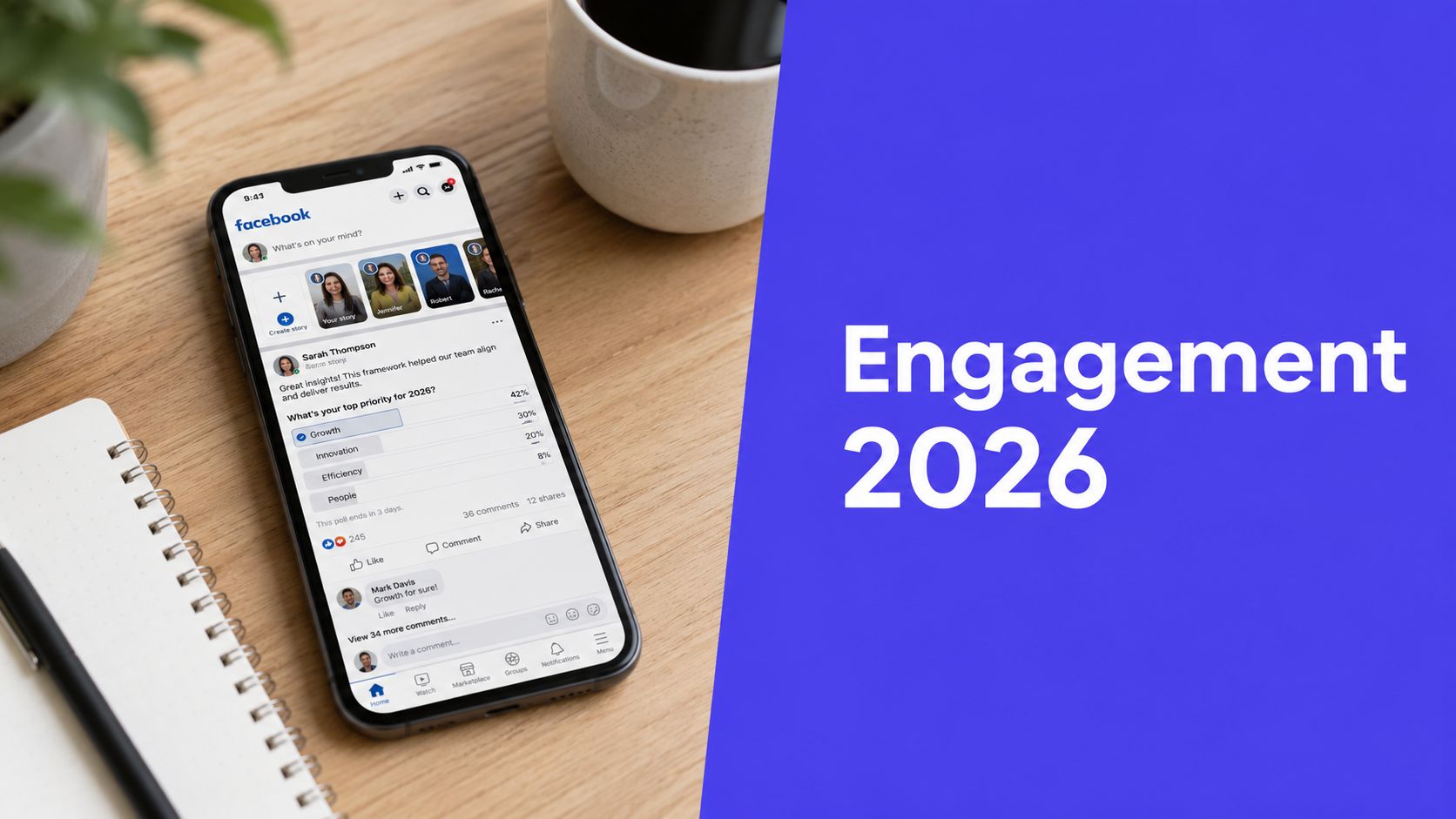
For engagement posts for Facebook, polls are usually strongest when they reduce cognitive load. A useful rule from community-focused Facebook guidance is to ask one clear thing and avoid stacking prompts because people need something quick to process. That framing comes straight from Tonya Kubo's advice on Facebook group engagement posts, and it maps well to brand pages too.
What to post instead of vague questions
- Choice posts: “Which would help you more this week: a template or a tutorial?”
- Preference polls: “Dark mode or light mode?”
- Decision posts: “If you had to pick one, would you fix reach or conversion first?”
- Identity prompts: “Are you a plan-ahead marketer or a post-it-when-inspired marketer?”
Sephora-style trend polls, Starbucks seasonal preference questions, and Nike-style “which one would you wear?” comparisons all work because they ask for a quick judgment. They don't require a speech.
Practical rule: If someone can answer in under five seconds, your comment rate usually has a better chance.
Use PostSyncer to queue several poll variants at different times, then compare which wording gets more comments versus reactions. Don't only test topics. Test the shape of the ask. “Pick one” often beats “Tell us everything.”
After the poll closes, turn the winning answer into the next post. If a particular feature receives the most votes, build a follow-up around that feature. Good poll posts don't end at the result. They feed the next week's calendar.
2. User-Generated Content Campaigns

UGC gives your audience a role, not just a seat.
That's why it often creates better conversations than polished brand creative. A customer photo, a routine video, a setup shot, a before-and-after, or a simple testimonial screenshot feels lived in. People trust content that looks like it came from someone who uses the product.
The mistake is launching a UGC campaign with no boundaries. “Share your story” sounds nice, but it's too open. A narrower prompt is often required.
Prompts that lower friction
- Routine prompt: “Show us where this product lives in your daily setup.”
- Result prompt: “Post your finished look using one product from the collection.”
- Moment prompt: “Share your workspace before your first coffee.”
- Theme prompt: “Weekend setup, travel setup, or desk setup. Pick one and post it.”
GoPro, Coca-Cola, Airbnb, and Lululemon built strong participation loops by making the audience part of the brand story. Smaller businesses can do the same without trying to copy enterprise campaigns. A skincare brand can ask for shelf photos. A SaaS tool can ask for dashboard setups. A local studio can ask members to post post-class wins.
Feature the best submissions regularly, not randomly. If you repost audience content only once every few weeks, people stop seeing it as something worth joining. In PostSyncer, create a repeating UGC slot in the calendar so participation has a visible reward.
Offer direction in the caption, then engage hard in the comments. Like submissions, ask follow-up questions, and tag creators when you reshare. UGC dies when brands collect it passively. It grows when brands turn contributors into regulars.
3. Behind-the-Scenes Content

Behind-the-scenes posts are where brands stop sounding managed.
People don't engage with every polished campaign asset. They often respond to the in-between moments. The packing table before launch. The rejected draft. The founder rewriting a headline. The team debate over packaging, pricing, or design. That material feels closer to a real relationship.
Recent practitioner guidance also points to a bigger shift. Engagement isn't only about asking questions anymore. It's increasingly tied to whether the post takes up visual space and communicates the hook instantly on mobile, including recommendations to use larger visual formats like 1080 × 1350 and clearer calls to action in the creative itself, as discussed in this Facebook engagement video breakdown.
What strong BTS posts usually show
- Work in progress: drafts, prototypes, edits, setup photos
- People: team intros, role spotlights, day-in-the-life snippets
- Problems: delays, mistakes, false starts, lessons learned
- Process: how a product gets made or how a campaign gets built
That doesn't mean every BTS post should be messy. It means it should be legible and human. One clear scene beats a cluttered montage.
If your team struggles to come up with angles, use PostSyncer's AI behind-the-scenes content tool to generate prompts from the work you're already doing. Then batch-capture clips and photos during the week instead of staging them later.
Show the part your customer never sees, but would care about once they do.
A simple rhythm works well: one BTS post before a launch, one during execution, one after with lessons learned. That gives your page continuity and makes followers feel included instead of marketed to.
4. Storytelling and Emotional Connection Posts
A good story post doesn't need to be long. It needs tension.
Start with a problem your audience recognizes. Then show the decision, the obstacle, and the shift that happened next. That's what keeps people reading. “We started this brand because we love quality” isn't a story. “We nearly scrapped the launch because customers kept getting stuck on step two” is.
Many engagement posts for Facebook either connect effectively or become generic inspiration. Emotional posts work when they stay specific. A founder moment, a customer turning point, a team setback, a mission-driven decision. Those details give people something to react to beyond “love this.”
A simple structure that works
- Problem: what was hard, broken, unclear, or risky
- Journey: what changed, what failed, what got tested
- Outcome: what improved, what was learned, what mattered
- Prompt: a comment question tied to the story
Brands like Patagonia, TOMS, Warby Parker, and Glossier built stronger audiences by making people care about more than products. But the post itself still has to carry the weight. If the caption sounds like a press release, the emotion disappears.
Try prompts like these at the end:
- “Have you faced a version of this in your business?”
- “What would you have done here?”
- “What part of the story feels most familiar?”
You can also turn one story into a short series. Start with the conflict, follow with the middle, then share what changed after. That cadence gives the audience a reason to come back. It also gives your team more than one post from the same source material, which matters when you're trying to scale without sounding repetitive.
5. Educational and How-To Content
Educational posts win when they solve one small problem immediately.
That's why “3 ways to write a stronger hook” usually lands better than a giant lecture on content strategy. Your follower is scrolling between meetings, errands, and messages. If the lesson can't be applied quickly, it often gets saved for later and forgotten.
On Facebook, visuals matter here more than many teams assume. Statista reported that as of November 2023, the average Facebook page fan engagement rate was 0.06%, with image posts at 0.10% and link posts at 0.03%, according to Statista's Facebook page engagement breakdown. If you're teaching something, don't hide it inside a bare link post if you can turn it into a visual walkthrough.
Here's a useful format to borrow:
- Slide 1: the problem
- Slide 2 to 5: the steps
- Final slide: the mistake to avoid, plus a comment prompt
A short teaching asset often beats a link-out. Keep the value inside the feed first.
Here's an example format you can embed into your workflow:
How to make educational posts more engaging
- Teach one move: Don't cram a full playbook into one post.
- Use screenshots: People understand interfaces faster than descriptions.
- Invite objections: Ask, “What part of this step usually trips you up?”
- Turn comments into sequels: Every repeated question is another post idea.
In PostSyncer, build recurring education slots like “Tip Tuesday” or “Fix This Friday,” then let the AI Content Agent generate several caption angles from one core lesson. That gives you repetition in format without repetition in wording.
6. Trending Hashtags and Timely Posts
Trend-chasing is easy to do badly.
The common failure mode is speed without relevance. A brand sees a trending phrase, meme, or event and rushes out a post that has nothing to do with its audience. It may look current, but it rarely creates useful engagement. The comments go quiet because followers can tell the post wasn't made for them.
The better approach is selective participation. Join conversations your audience already overlaps with. For a coffee brand, that might be seasonal rituals. For a B2B company, it might be an industry event, platform update, or workflow pain point everyone is discussing that week.
When timely posts make sense
- Seasonal buying behavior: holiday prep, gifting, back-to-school, launch windows
- Industry moments: major product changes, conference weeks, policy updates
- Cultural overlap: trends your audience shares, not just trends you noticed
- Fast reactions: commentary while the topic still feels live
Wendy's, Netflix, and Duolingo are obvious references because they built teams and voices around timeliness. Most brands don't need that level of speed. They need a simple workflow that lets someone approve a relevant post before the moment passes.
Use PostSyncer's guide to trending hashtags on Facebook as a planning reference, then create a lightweight approval path for reactive posts. Keep a bank of on-brand templates ready so the team only has to swap the hook, visual, and CTA.
Fast matters. Forced doesn't.
A timely post should still feel native to your brand. If it would confuse a regular follower, skip it. Missing a trend is better than joining one awkwardly.
7. Giveaways and Contests

Giveaways can inflate weak signals.
That doesn't mean they're useless. It means you should know what you're buying with them. A contest can produce a burst of comments, tags, and reach, but low-quality prizes often pull in people who won't stick around after the winner announcement.
The strongest giveaway mechanics attract the same people you'd want as customers. If you run a fitness brand, give away a relevant bundle or member experience. If you sell software, offer a meaningful product-related reward. If the prize is generic, the audience often becomes generic too.
What keeps giveaway engagement useful
- Keep entry simple: comment, answer a prompt, or tag someone relevant
- Make the prize aligned: reward the audience you want to attract
- State the rules clearly: eligibility, timeline, and selection method
- Use a follow-up plan: announce the winner, then nurture non-winners
Glossier-style product bundles, seasonal gift packages, and partner giveaways with complementary brands can all work. Just avoid making people jump through too many hoops. Every extra step lowers participation and often reduces quality too.
A practical version is a comment-driven contest. Ask something easy but brand relevant, like “Which scent should return next?” or “What's one feature you'd want first?” That gives you engagement and feedback at the same time.
Schedule the launch and reminder posts in PostSyncer instead of relying on one big announcement. Mid-campaign reminders often keep a contest alive, especially if you highlight a few participant comments or creator entries. The giveaway itself is only part of the job. The surrounding posts are what make it visible.
8. Interactive Carousel and Carousel Quiz Posts
A carousel has one job. Get the next swipe.
Teams usually lose that moment on slide one. The cover tries to explain everything, the design looks identical from frame to frame, and the payoff arrives too late. If you want comments, saves, and swipe-through, build the post like a sequence, not a stack of static graphics.
Carousel quizzes work especially well because they create a small commitment. Someone makes a choice, tests an assumption, or tries to predict the answer before the reveal. That interaction changes the post from passive viewing into participation.
Carousel ideas that invite action
- Which one would you choose
- Guess the answer before slide 4
- Beginner mistake or best practice
- Before and after reveal
- Pick your category, then see your result
The strongest versions stay narrow. A fashion brand can run a style-choice carousel with two clear options per slide. A SaaS team can post “Which workflow fits your team?” and reveal the match at the end. A fitness creator can build “Which recovery mistake are you making?” and use the final slide to correct it.
Structure matters more than volume. Put one promise on slide one, one idea on each following slide, and one action on the last slide. “Comment with your result” or “Tell us which slide matched your situation” usually works better than a broad CTA.
I'd also treat carousel posts as a repeatable testing format, not a one-off creative exercise. Build three templates in PostSyncer: quiz, comparison, and transformation. Keep slides two through five mostly consistent, then test different first-slide hooks, reveal timing, and final CTAs. That gives you cleaner comparisons in analytics because you changed one variable instead of rebuilding the whole post every time.
For drafting, use a Facebook caption generator for carousel hooks and quiz CTAs to create multiple cover-line options before scheduling. Then queue two variants for similar audience segments or posting windows, review swipe-through and comment quality, and keep the format that gets both attention and useful responses.
That is how carousel posts scale. Not by making them longer. By making them easier to test, easier to repeat, and easier to improve.
9. Video and Reel Content with Captions and Hooks
Video on Facebook gets talked about as if posting it is enough. It isn't.
A weak hook in a video fails faster than a weak static post because people decide almost instantly whether to keep watching. If the first line is slow, the framing is unclear, or the captions are hard to read, the post loses people before the value appears.
That makes the opening seconds the primary battleground. Lead with the point, the surprise, the problem, or the result. Don't spend the first moments introducing yourself unless your audience already cares who you are.
What improves Facebook video engagement
- A direct first line: “This is why your product page keeps getting ignored.”
- Readable captions: large enough for mobile, clean contrast
- One promise: one takeaway, one lesson, one reveal
- A clear CTA: comment, save, vote, or message
Captions matter because many people watch with sound low or off. They also sharpen the hook. If your spoken opening is solid but the on-screen text is vague, the post still loses force.
Use PostSyncer's Facebook caption generator to draft multiple hook options for the same Reel, then test them across similar content types. One practical workflow is to produce one core video, then vary the cover text, opening caption, and CTA.
If you already have blog posts, webinars, demos, or customer calls, repurpose them. Cut one lesson into a short Reel. Pull one surprising line into a talking-head clip. Turn one screenshot into a narrated walkthrough. Scaling video usually starts with editing smarter, not filming more.
10. Testimonials and Social Proof Posts
Testimonials don't engage because they praise you. They engage because people see themselves in them.
That's why generic reviews underperform. “Great service” doesn't give a prospect much to react to. A testimonial that names the problem, hesitation, or use case does. It creates recognition. It gives the audience a way to comment, ask follow-up questions, or tag someone who has the same need.
Social proof also works better when it looks native to Facebook instead of pasted in from a sales deck. A customer photo, a short quote card, a screenshot paired with context, or a brief founder note introducing the story usually feels more credible than a polished claim block.
How to make testimonial posts more interactive
- Anchor them to a use case: who this helped and what they were trying to solve
- Add context in the caption: what was happening before the result
- Ask a response question: “Which part of this process are you stuck on?”
- Rotate voices: new customers, long-term customers, different segments
Don't overstuff these posts with proof points unless they're essential and verified. A strong testimonial often wins with specificity, not volume. Show the situation, then let the customer perspective carry the post.
A useful rhythm is to pair each testimonial with a matching educational or BTS post in the same week. The testimonial shows what happened. The companion post shows how or why. That creates a tighter content system and stops your social proof from feeling like a standalone ad.
10 Facebook Engagement Post Comparison
| Post Type | Implementation Complexity 🔄 | Resource Requirements ⚡ | Expected Outcomes 📊⭐ | Ideal Use Cases 💡 | Key Advantages ⭐ |
|---|---|---|---|---|---|
| Question and Poll Posts | Low, quick to design and publish | Minimal, native poll tools, captions | High engagement (⭐⭐⭐⭐) and fast audience insights 📊 | Quick market research, testing ideas, spark comments | Easy participation; real-time feedback |
| User-Generated Content (UGC) Campaigns | Medium, planning, guidelines, moderation | Moderate, community management, incentives | Authentic reach & social proof (⭐⭐⭐⭐) with variable quality 📊 | E‑commerce testimonials, brand advocacy, content sourcing | Continuous low-cost content; strong credibility |
| Behind-the-Scenes (BTS) Content | Low–Medium, regular cadence, consent needed | Low, phone/video, team time | Builds trust & loyalty (⭐⭐⭐) and emotional connection 📊 | Employer branding, humanizing brand, recruiting | Humanizes brand; differentiates from competitors |
| Storytelling and Emotional Connection Posts | Medium–High, narrative development & sourcing | Moderate, interviews, editing, permissions | Deep engagement & shares (⭐⭐⭐⭐) with long-term value 📊 | Purpose-driven brands, loyalty-building campaigns | Creates memorable emotional bonds |
| Educational and How-To Content | Medium, research and clear structure required | Moderate–High, expertise, visuals, production | Authority building & saves (⭐⭐⭐⭐) with sustained engagement 📊 | Thought leadership, audience nurturing, lead gen | Positions brand as expert; high retention |
| Trending Hashtags and Timely Posts | High, constant monitoring and fast turnaround | Moderate, social listening, rapid creation | Short-term spikes & virality potential (⭐⭐⭐⭐) 📊 | Awareness, cultural relevance, real-time engagement | Rapid reach gains; signals cultural relevance |
| Giveaways and Contests | Medium, rules, legal and moderation work | Moderate–High, prize budget, fulfillment | Rapid follower growth & engagement (⭐⭐⭐⭐) but variable quality 📊 | Launches, list growth, viral sharing campaigns | Fast audience expansion; high excitement |
| Interactive Carousel and Carousel Quiz Posts | Medium–High, slide planning and design | Moderate, graphic design and copy per slide | Increased time-on-post & engagement (⭐⭐⭐⭐) 📊 | Educating audiences, quizzes, preference collection | Keeps users engaged longer; versatile format |
| Video and Reel Content with Captions and Hooks | High, production, editing, trend alignment | High, equipment, editing, creative resources | Maximum reach & algorithm priority (⭐⭐⭐⭐⭐) 📊 | Reach, brand voice, conversions across platforms | Top performer for reach and shareability |
| Testimonials and Social Proof Posts | Low–Medium, collect and curate approvals | Low, customer asks, simple design | Strong conversion lift & trust (⭐⭐⭐⭐) 📊 | Conversion-focused content, new-audience trust building | Highly persuasive; improves purchase confidence |
Scale Your Engagement with a Smart System
Monday morning, the content calendar is half empty, someone wants a quick promo post, and last week's top performer still hasn't been turned into a repeatable format. That is a primary Facebook engagement problem for many social teams. The issue is rarely idea shortage. It is the lack of a system that turns good post concepts into consistent execution.
The pages that keep generating comments, shares, and clicks usually run on a planned mix. They rotate proven formats across the month, watch performance by post type, and adjust based on what their audience responds to. They also accept a basic trade-off. More posting does not fix weak hooks, vague CTAs, or repetitive formats. A smaller set of well-structured posts, scheduled with intent, usually performs better than filling the calendar with rushed updates.
Benchmarks still help, but only as a starting point. Earlier data points in this article already showed that Facebook engagement rates are tight and that average posting frequency has limits. That matters because it forces a more disciplined approach. Teams need to test format, timing, creative angle, and CTA instead of assuming extra volume will create interaction on its own.
A practical testing loop is simple:
- Keep the core topic constant
- Change one variable per test, such as hook, image style, CTA, or publish time
- Track comments, shares, reactions, clicks, and saves separately
- Compare results by post type, not just by overall engagement
- Rework winning posts into a second version instead of treating each post as one-and-done
That last point gets missed often. A strong question post can become a Reel script. A testimonial can become a carousel. A behind-the-scenes update can turn into a short story post with a stronger opening line. Scaling engagement means building on what already worked, not starting from zero every week.
PostSyncer supports that operating model in a practical way. The visual calendar helps teams space out post types so the feed does not get stuck in one mode for days at a time. The AI Content Agent helps generate alternate hooks, fresh captions, and new versions of existing assets for testing. Its analytics make it easier to see which formats are carrying the page and which ones are taking up space without producing results.
Use the tool to build a monthly rhythm. Schedule anchor posts first, then add lighter engagement prompts between them. Review results weekly. Keep a short list of top-performing patterns by audience segment, campaign goal, and format. That gives the team a playbook, not just a backlog.
If you want a faster way to plan, test, and scale your Facebook content, PostSyncer gives you one workspace for scheduling, AI-assisted ideation, and performance tracking so your engagement strategy stays consistent instead of reactive.