










Most advice about trending hashtags on Facebook starts with the wrong assumption. It treats hashtags like a volume game. Add more tags, borrow whatever looks popular, and expect reach to follow.
That's not how Facebook works in practice.
On Facebook, hashtags are useful when they sharpen relevance and help the right people discover a post. They're weak when they turn into clutter. If you want better results, stop asking, “What's trending?” and start asking, “Which small set of tags fits this post, this audience, and this account?”
Why Most Trending Hashtag Advice Is Wrong
The biggest mistake is confusing visibility with fit.
A lot of Facebook hashtag advice still pushes long lists of broad tags like #trending or #love. That sounds efficient, but it usually creates noise. One industry guide says posts with 1 or 2 hashtags averaged 593 interactions, while posts with more than 10 averaged 188 in Taggbox's Facebook hashtag guide. More hashtags didn't create more engagement. They correlated with less of it.
That matches what many social teams see in day-to-day execution. Long hashtag strings make posts look pasted together. They weaken the caption, distract from the message, and make measurement harder because you can't tell which tag mattered.
Popular doesn't mean useful
A trending hashtag can be active and still be a poor choice for your post. If the conversation behind the tag doesn't match your topic, offer, or audience, you're not improving discoverability. You're adding friction.
Practical rule: Don't choose a hashtag because it's big. Choose it because the people clicking it are the people you want.
A lot of marketers waste time. They copy a list, drop it into every post, and then judge hashtags as a whole. That's the wrong lens. The useful question isn't whether hashtags “work.” It's whether a specific hashtag helped a specific post reach the right people.
The better standard
A good Facebook hashtag strategy is small, deliberate, and measurable.
Use hashtags to support a strong post, not rescue a weak one. If a tag improves topical alignment, helps Facebook categorize the post, or brings in qualified discovery, keep it. If it only makes the caption look busier, cut it.
That shift matters. It turns trending hashtags on Facebook from a habit into a testable channel input.
How to Discover Potential Trending Hashtags
Teams often start with lists. A better approach is to build a candidate pool.
You're not hunting for “the best Facebook hashtags” in the abstract. You're collecting possible tags that might fit your niche, your audience, and your current content themes. Discovery comes first. Judgment comes later.

Start inside Facebook
Facebook itself gives you the first layer of intelligence.
Search for keywords tied to your niche, products, customer problems, and industry topics. Then look at what appears in public posts, Pages, and creator content. You're looking for patterns:
- Repeated niche phrasing that shows up across relevant posts
- Audience language that sounds natural, not stuffed for search
- Campaign tags used by brands, communities, or events in your space
- Topic variations that reveal how people describe the same need differently
This part is manual, and that's a good thing. Manual review shows you the context behind a hashtag, not just the word itself.
A lightweight helper can speed up brainstorming. If you need a starting set of tag ideas from a seed keyword, try PostSyncer's Facebook hashtag generator tool. Use it for ideation, not blind publishing.
Use monitoring tools for momentum
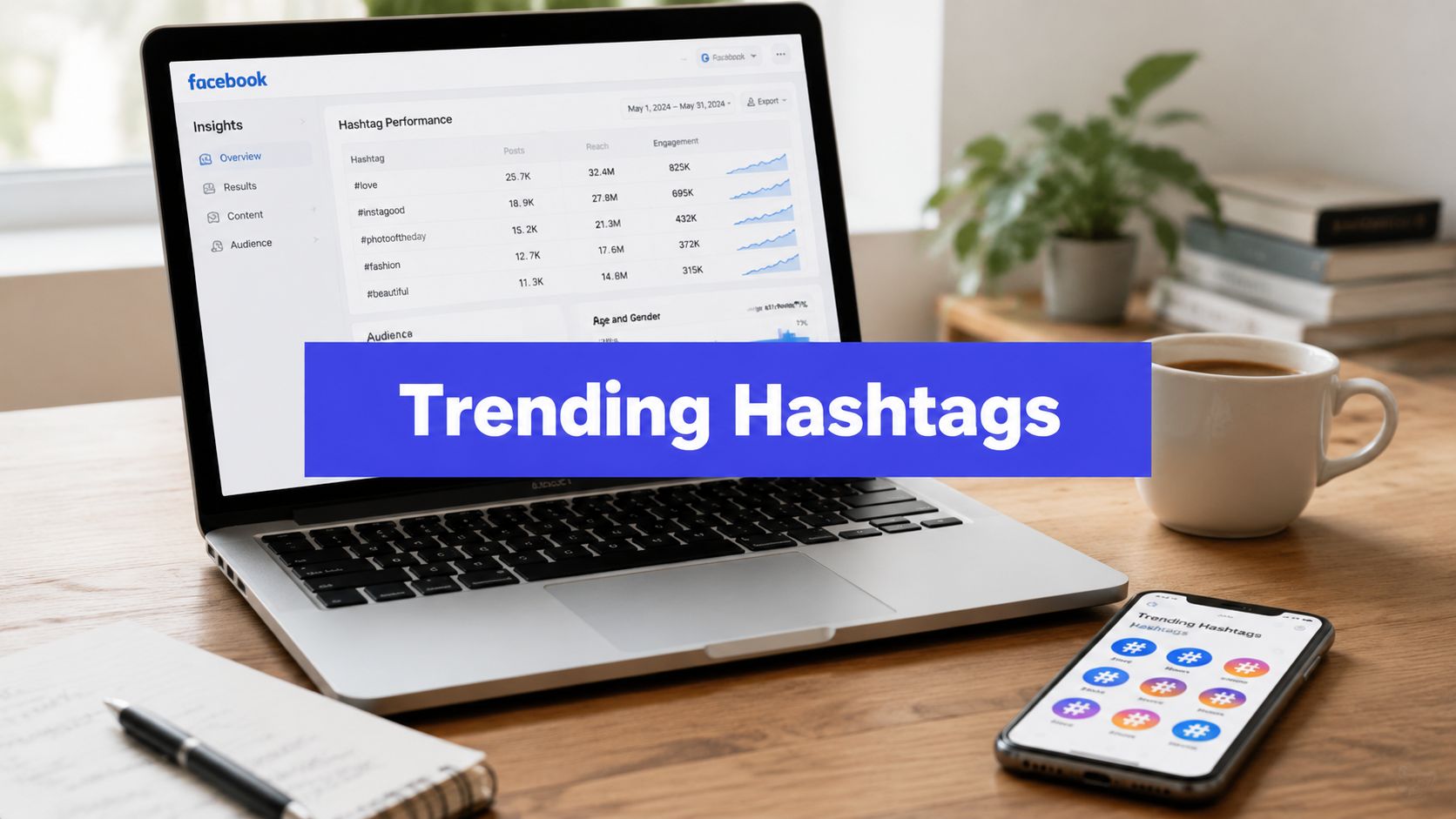
There isn't an official Facebook trending hashtag list that marketers can rely on. Research and monitoring typically depend on public-post volume and engagement metrics, with independent tools aggregating mentions across Facebook and other networks. Practitioners are advised to watch reach, engagement, and click-through rates over time to identify which tags are gaining momentum, as outlined in Brand24's Facebook hashtag analytics overview.
That matters because “trending” is usually inferred, not declared.
So when you use social listening tools, don't treat the output as proof. Treat it as signal. A tag with growing public usage may deserve a spot on your test list. It still has to survive relevance checks before it goes into a post.
Watch conversations, not just dashboards
Some of the most useful hashtag opportunities don't come from tools first. They come from repeated language in the market.
Track these inputs every week:
- Industry events that create short-lived but relevant topic tags
- Customer pain points showing up in comments, groups, and sales calls
- Creator vocabulary that shapes how your niche labels trends
- News cycles that shift the framing of a familiar topic
A hashtag is worth testing when people are already using it to talk about a problem your content actually addresses.
That gives you a working list of candidates. Not final picks. Candidates.
Validating Hashtags for Relevance and Reach
Discovery is cheap. Validation is where you avoid bad data.
A hashtag can look promising on paper and still be wrong for your brand. The problem usually isn't volume. It's mismatch. The audience may be off, the surrounding content may be irrelevant, or the tag may be active in a context that doesn't support your post.

Use the three-layer query model
A practical workflow is to build hashtag sets with a three-layer query model: start with a niche tag, add a problem or need tag, then a solution or outcome tag, and validate each one in Facebook Search before posting. Independent guidance also recommends keeping the set small, generally 1 to 2 hashtags per post on Facebook, with some practitioners allowing up to five, because larger sets are harder to measure and often clutter the post without clear reach gains, according to Sendible's Facebook hashtag guidance.
That model is useful because it forces range without randomness.
Here's what that looks like in practice:
| Layer | What it does | Example type |
|---|---|---|
| Niche tag | Anchors the topic | Industry or community phrase |
| Problem tag | Connects to need | Pain point, challenge, blocker |
| Solution tag | Points to outcome | Result, method, transformation |
You don't need all three in every post. You use the model to generate and vet options.
What to check in Facebook Search
Don't just search a hashtag and stop at the feed. Open the tag and inspect the content around it.
Look at:
- Post quality. Are the top public posts relevant, current, and credible?
- Audience fit. Do the people using the tag look like the audience you want?
- Content type. Is the tag dominated by memes, giveaways, personal updates, or real educational content?
- Brand safety. Does the tag appear next to topics you wouldn't want to be associated with?
- Intent. Are people browsing it for information, community, entertainment, or spam?
This step filters out a lot of false positives. A hashtag can be active and still useless if the surrounding conversation is low quality.
A simple pass-fail system
Use a quick review before anything goes live:
- Pass if the hashtag clearly matches the post topic and audience
- Maybe if the tag is relevant but broad enough that your post may get buried
- Fail if the tag is vague, off-topic, or dominated by unrelated content
Relevance beats raw popularity because relevance gives you cleaner data later.
That's the part many teams skip. They want a shortcut. But skipping validation is why hashtags often feel inconsistent. The problem usually isn't the platform. It's weak selection.
Best Practices for Using Hashtags in Facebook Posts
Once you've validated a small set of hashtags, execution gets simpler. Facebook rewards clean, readable posts far more than cluttered captions packed with tags.
The goal isn't to squeeze hashtags into every corner of the post. The goal is to make each one earn its place.

Use fewer hashtags than you think
Facebook hashtags were introduced in 2013, and current guidance still treats them as a discoverability tool rather than a major growth lever. One 2026 analysis found that Facebook posts with 1 hashtag average 593 engagements, posts with 3 to 5 hashtags average 416, and posts with 6 to 10 hashtags average 307, which points to lighter usage outperforming heavy tagging in Search Logistics' hashtag statistics roundup.
That's why the “more is better” playbook breaks down on Facebook.
If you want a practical operating rule, start with one hashtag. Add a second only if it adds a distinct discovery angle. Anything beyond that should have a very clear reason to exist.
Keep the caption readable
Placement matters less than clarity.
You can place hashtags naturally in the caption when they fit the sentence. You can also group them at the end if that keeps the copy cleaner. What usually doesn't work is dropping a hashtag every few words and breaking the reading flow.
A simple comparison:
| Better | Worse |
|---|---|
| Clear caption with one or two aligned tags at the end | Paragraph overloaded with broad tags |
| Hashtags tied to topic and audience | Generic tags with no topical fit |
| Consistent formatting across posts | Random placement that changes every time |
If you're also refining timing, this guide on the best time to post on social media is a useful companion. Timing and hashtag testing should be reviewed together because a weak posting window can distort your read on hashtag performance.
Here's a practical rule for teams: write the caption first, then add hashtags last. That prevents hashtags from driving the message.
Build a balanced hashtag mix
A strong Facebook post usually uses a mix, not a pile.
Consider these categories:
- Branded tags for campaign consistency or owned conversations
- Community tags that connect with your niche audience
- Trend-adjacent tags that align with a timely topic without forcing it
Don't include all three every time. Use whichever combination fits the post. If a trending tag feels bolted on, remove it.
A quick video can help visualize how creators approach this in real workflows.
Measure Impact and Automate with PostSyncer
If you don't measure hashtag performance at the post level, you're guessing.
That's the reason so many teams feel stuck with trending hashtags on Facebook. They change captions, creatives, timing, and tags all at once, then try to draw conclusions from mixed inputs. You can't optimize what you haven't isolated.
Treat hashtags as a test variable
For content optimization, the strongest technical signal is to treat hashtags as an experiment variable and analyze performance at the post level using reach, impressions, and engagement. In a machine-learning hashtag recommendation study, a context-aware approach that combined post keywords with user or post popularity improved popularity outcomes by 3.5% for low-popularity posts, showing that relevance plus popularity signals outperformed popularity alone in Sprout Social's hashtag analytics analysis.
That doesn't mean every Facebook team needs a machine-learning workflow. It does mean your process should reward relevance instead of chasing whatever looks hot.
Use a simple testing structure:
- Hold the creative steady and vary the hashtag set
- Keep timing comparable so posting windows don't skew the result
- Track reach, impressions, reactions, comments, and clicks
- Review in batches so one outlier post doesn't control your decisions
The win isn't finding a universally strong hashtag. The win is finding which tags improve results for your account, your audience, and your content style.
Why a workflow tool matters
Manual testing inside native analytics works, but it gets messy fast. Once you're running multiple campaigns, comparing posts across content types, and coordinating approvals, hashtag experiments start slipping.

If you're evaluating software stacks for this kind of process, this comparison of social media tools for SaaS growth is a useful reference point because it frames scheduling and analytics in the context of operational scale, not just publishing.
PostSyncer fits this workflow by giving teams one place to schedule Facebook posts, organize variations, and compare performance with a unified analytics view. If you want faster feedback loops, its guide to real-time social media analytics is worth reading before you set up tests.
The key is operational discipline. Schedule test posts in advance. Label them clearly. Compare like with like. Then keep the hashtags that repeatedly support stronger downstream metrics.
Putting It All Together A Smarter Hashtag Strategy
The useful way to think about trending hashtags on Facebook is simple. They're not a shortcut to reach. They're a filtering tool that can improve discovery when they match the content and audience.
That distinction matters because Facebook itself says hashtags only surface posts that use the tag, which makes them a search and filter mechanism, not a guaranteed reach hack, as explained in Sprout Social's guide to hashtags on Facebook. If your post isn't relevant, useful, or engaging, a trending hashtag won't rescue it.
A smarter workflow looks like this:
- Discover candidate hashtags through Facebook search, competitor review, and social listening
- Validate each tag by checking the actual conversation behind it
- Use a very small set that supports the post instead of cluttering it
- Measure results at the post level so you know what helped
That's a manageable system. It also scales.
Teams get into trouble when they chase every trend and treat every hashtag list like a template. That creates messy captions, weak audience alignment, and poor analysis. The better approach is slower at the front end and faster everywhere else. You spend more time choosing well and less time cleaning up bad assumptions later.
The practical takeaway is straightforward. Facebook hashtags work best when they're relevant, restrained, and tested. Stop copying long lists. Stop judging hashtags in the abstract. Build a repeatable validation process and let actual post performance decide what stays.
If you want a cleaner way to plan Facebook posts, test hashtag variations, and review performance without juggling multiple tools, PostSyncer gives you one workspace for scheduling, publishing, and analytics across your social channels.