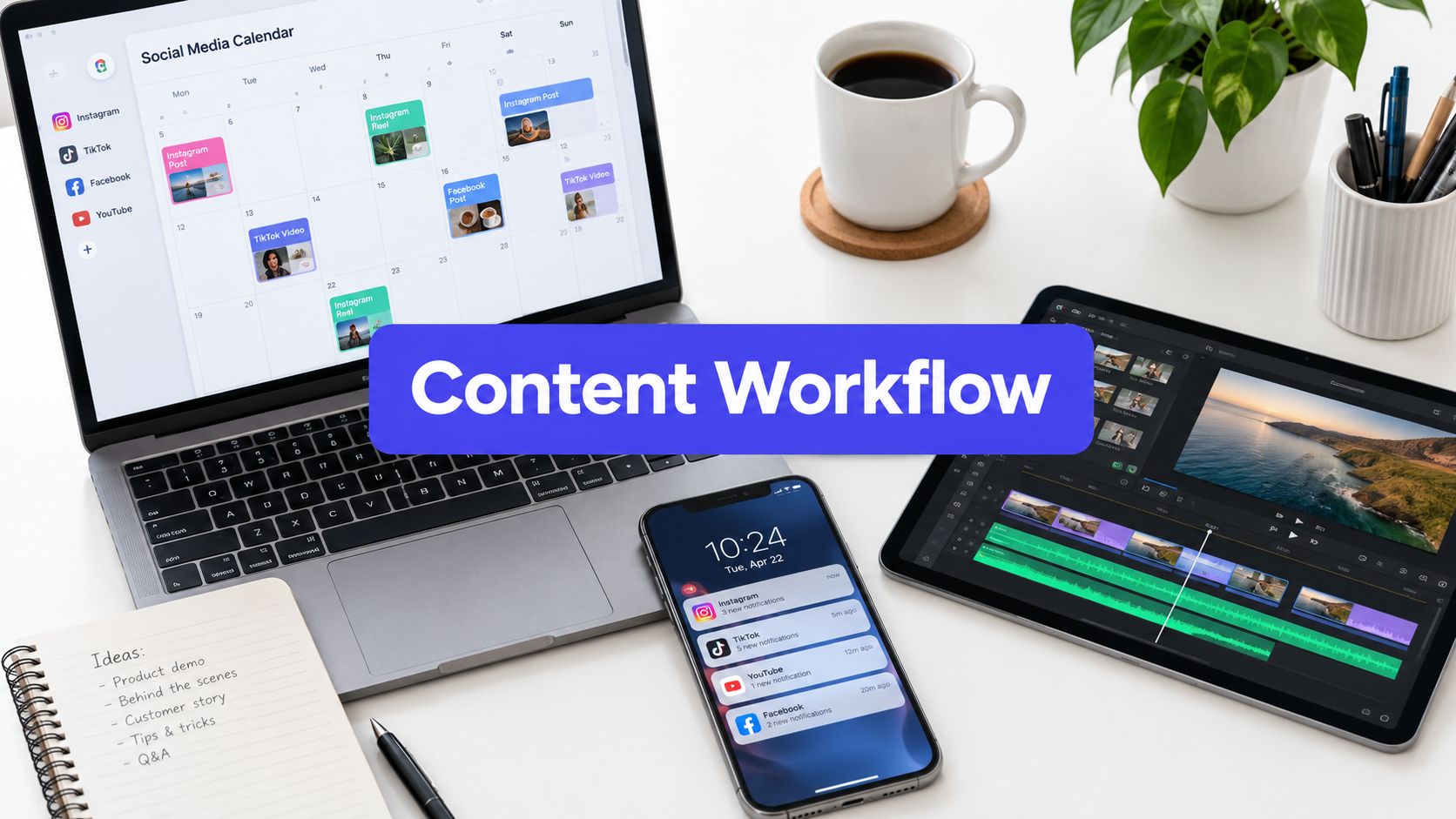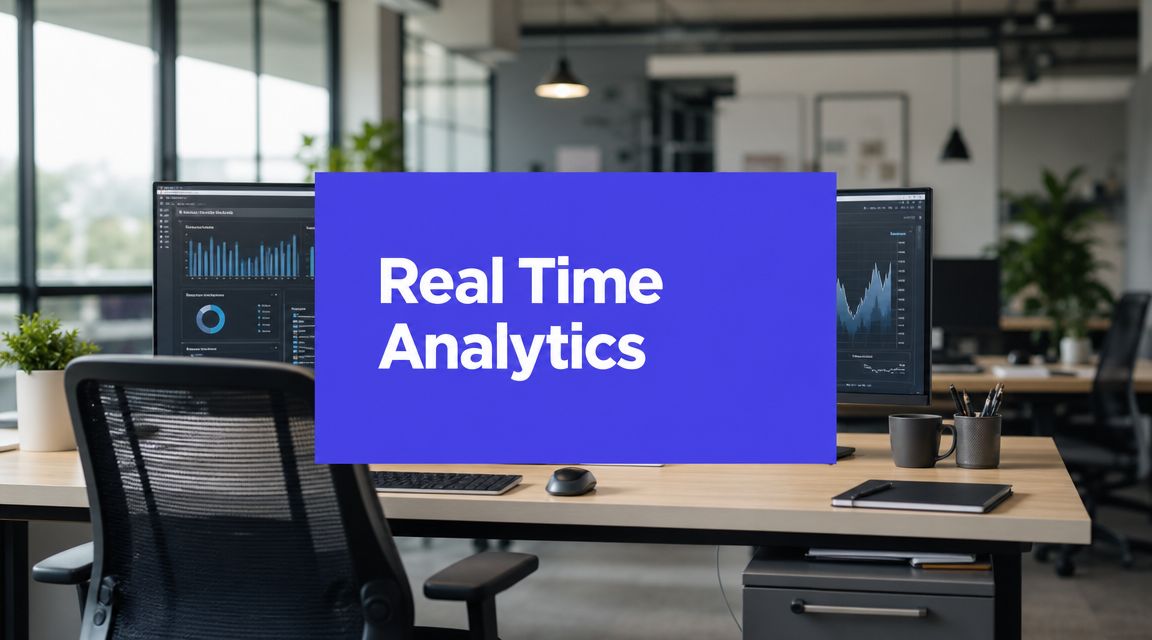












You approve a post at 9 a.m. By noon, the audience has moved on, comments have shifted tone, and the creative that looked strong in yesterday's report is already underperforming on the platform that matters most today.
That's the practical problem behind the question what is real time analytics. Organizations typically don't struggle because they lack data. They struggle because the data arrives after the useful moment to act has passed.
For social media teams, that delay shows up everywhere. You publish based on last week's “best time to post.” You boost a format that worked yesterday. You spot a comment spike after the thread has already gone sideways. The report is accurate, but it's late. In social, late data often creates tidy explanations for missed opportunities.
The Problem with Yesterday's Data
A common workflow still looks like this. A social manager pulls performance numbers from yesterday, reviews top posts, drafts today's content, and schedules the next batch. On paper, that sounds disciplined. In practice, it means today's decisions are based on a market that no longer exists.
Social platforms don't wait for reporting cycles. Audience attention shifts by the hour. A post can pick up unusual traction early, stall unexpectedly, or attract the wrong kind of response while the team is still looking at a static dashboard. If the only useful view arrives after the fact, the team is managing history, not performance.
That's why real-time analytics matters. IBM describes it as a process that continuously collects high-frequency data from sources like social media, integrates and processes those streams, then triggers alerts, automated responses, and dashboard updates so teams can act immediately instead of reviewing events later through retrospective BI (IBM's explanation of real-time analytics).
What this changes for a social team
Real-time analytics closes the gap between what's happening and what you can still influence.
A social team can use that loop to make live choices such as:
- Adjusting post distribution: If one platform is responding faster than another, the team can shift attention while the content is still circulating.
- Changing community response priority: A sudden wave of questions or complaints can move from “we'll cover it in tomorrow's report” to “we need a response pattern now.”
- Reworking campaign timing: If engagement starts clustering around a different window than expected, the next posts don't need to follow the old schedule.
Yesterday's data is useful for analysis. It's weak for intervention.
The distinction is simple but important. Traditional reporting tells you what happened. Real-time analytics gives you a chance to do something before the moment disappears.
Understanding Real-Time Analytics at its Core
The easiest way to understand real-time analytics is to stop thinking about dashboards and start thinking about navigation.
A printed map helps before you leave. A GPS helps while you're driving. The map isn't useless, but it can't react when traffic changes. Real-time analytics works like the GPS. It keeps taking in fresh signals, recalculates, and helps you change course while the trip is still in progress.

Fresh enough to act on
The technical phrase that matters here is time-to-insight. Splunk frames real-time analytics as a short time-to-insight window, ranging from under one second for critical cases to a few minutes for dashboard updates, and emphasizes that it isn't just faster reporting because it lets organizations act before the opportunity disappears (Splunk on real-time data and action windows).
For marketers, that means the question isn't just whether data is fast. It's whether it is still actionable.
If a dashboard tells you a Reel is taking off while the audience is actively engaging, you can still amplify it, respond to comments, cut a follow-up, or reuse the angle on another channel. If you learn that tomorrow, you haven't optimized performance. You've documented it.
Real time is not the same as live-looking
Some tools feel live because charts refresh often. That doesn't always mean the underlying pipeline supports immediate decisions. A dashboard can look current and still be too delayed for campaign changes that need quick action.
A practical way to evaluate this is to ask:
- How fresh is the input? Are platform events arriving continuously or in delayed syncs?
- How quickly is it processed? Can the system interpret changes while they're unfolding?
- What action follows? Does the team get a prompt, alert, or decision cue, or just a prettier report?
If you're building your own reporting habits, a solid baseline is knowing how to track social media analytics consistently across platforms. Real-time analytics builds on that foundation. It doesn't replace measurement discipline. It shortens the delay between signal and response.
Practical rule: Data is only “real time” in a useful sense if your team can still change the outcome.
That's the core idea. Not speed for its own sake. Speed tied to action.
How Real-Time Analytics Actually Works
Under the hood, real-time analytics is less mysterious than it sounds. The system does three jobs in sequence. It ingests events, processes them as they arrive, and makes the result visible or usable right away.
Tinybird describes modern real-time analytics architecture as built on data streaming technologies, real-time databases, and real-time APIs, which let teams answer complex questions within milliseconds instead of waiting for traditional batch workflows to collect and load data first (Tinybird's guide to real-time analytics architecture).
Ingestion
This is the collection layer. Data comes in from social platform APIs, webhooks, publishing tools, ad systems, websites, and comment streams.
For a social team, ingestion might include:
- Post performance events: Impressions, clicks, reactions, shares, saves, and watch activity.
- Engagement signals: Comments, replies, mentions, and message volume.
- Campaign context: Creative type, publishing time, audience segment, or paid versus organic status.
If this intake happens on a delayed schedule, the rest of the stack can't become meaningfully real time. Slow input creates stale output.
Processing
At this point, the stream yields insight. The system doesn't just store events. It interprets them while they're still arriving.
For example, it can detect patterns like:
- A sudden rise in comment volume on a post that usually receives light discussion
- A drop in click activity after a creative change
- A platform-specific spike that suggests content format and audience intent are aligned right now
Teams often misunderstand the difference between analytics and reporting. Reporting summarizes completed activity. Stream processing evaluates live activity.
Visualization and action
The last stage is what the team sees. That could be a live dashboard, an automated alert, or a signal pushed into a workflow tool.
The best setups don't stop at charts. They support decisions. A manager doesn't need another panel that says engagement changed. They need a view that helps answer, “Do we post again, reply now, pause spend, or leave this alone?”
A well-built social media analytics dashboard should make those decisions easier by connecting current performance to clear context like platform, format, and timing.
Streaming versus batch
The most useful mental model is the difference between streaming analytics and batch processing.
| Attribute | Streaming Analytics (Real-Time) | Batch Processing (Traditional) |
|---|---|---|
| Data arrival | Continuous flow of events | Data collected first, processed later |
| Processing trigger | Runs as data comes in | Runs on a schedule or after a data load |
| Freshness | Current enough for immediate action | Historical by the time analysis is available |
| Best use | Alerts, live optimization, active monitoring | Trend analysis, retrospective reporting, periodic summaries |
| Social media fit | Community response, live campaigns, timing adjustments | Weekly reviews, monthly reporting, postmortems |
What works and what doesn't
What works is a narrow pipeline tied to a real decision. For example, monitoring current content performance by platform and posting window is useful because the team can still change distribution or scheduling.
What doesn't work is trying to make every metric real time. That usually creates a noisy system with too many moving parts and not enough operational clarity.
Most teams don't need every chart updated instantly. They need a small set of signals that tells them when to intervene.
That's the architectural trade-off in plain terms. Real-time analytics becomes valuable when the pipeline is fast enough and the outputs are selective enough.
Actionable KPIs for Social Media Teams
Most social dashboards are crowded with numbers that look important but don't help anyone make a same-day decision. Follower totals, broad reach summaries, and generic engagement recaps have their place, but they rarely tell a team what to do next.
A stronger live dashboard focuses on change, not just totals.

The signals worth watching during the day
Four KPI categories tend to matter most when a team wants to act in the moment:
- Engagement velocity: Not total engagement, but how quickly a post is picking it up. Fast early interaction often matters more for live decisions than cumulative numbers shown later.
- Sentiment direction: You don't need perfect sentiment scoring to be useful. What matters is noticing whether replies and mentions are turning more positive, more frustrated, or more confused while the conversation is still active.
- Live conversion behavior: If social content is tied to clicks, signups, or purchases, the useful question is which creative and platform combination is moving people now.
- Audience activity peaks: Average “best times” are a decent planning aid. A live team also needs to know when the audience is unusually active today.
What each KPI should trigger
A KPI becomes useful when it maps to an action.
| KPI | What it tells you | Likely action |
|---|---|---|
| Engagement velocity | Whether a post is accelerating or stalling | Repost, extend, reply fast, create follow-up content |
| Sentiment direction | Whether discussion quality is improving or deteriorating | Escalate responses, clarify messaging, pause promotion |
| Live conversion behavior | Which content is driving desired actions | Shift budget, prioritize winning creative, stop weak variants |
| Audience activity peaks | When attention is present right now | Move publishing slots, change response coverage, adjust cadence |
A social media analytics report template can help teams separate these action metrics from slower summary metrics. That matters because not every KPI belongs in a live operating view.
Metrics to keep out of the live decision layer
Teams get into trouble when they overload the dashboard.
Keep these in retrospective reporting unless they directly support a current action:
- Total follower growth: Useful for trend review, weak for same-hour intervention.
- Broad monthly reach: Good for strategic evaluation, not for minute-to-minute choices.
- All-platform averages: Helpful for leadership summaries, often too blunt for live optimization.
The practical test is simple. If a metric changes, can someone on the team do something about it today? If the answer is no, it probably doesn't belong in the immediate data layer.
The Benefits and Challenges of Going Real-Time
Real-time analytics can make a team sharper. It can also make a team frantic if the setup is wrong.
The upside is obvious when decisions have short shelf lives. Teams can respond to audience shifts faster, tune campaigns while they're active, and catch issues before they become expensive distractions. The downside is that speed increases the cost of weak processes. If ownership is unclear, better data just creates faster confusion.

Where real-time helps
The biggest benefits usually show up in operational work, not in polished reporting.
- Immediate decisions: Teams can react while a campaign is still live.
- Proactive issue handling: Comment spikes, confusion, or backlash are easier to manage early.
- Better customer experience: Faster replies and smarter timing improve how the brand feels in-market.
- Live optimization: Teams can put more attention behind content that's working and reduce effort on content that isn't.
Where teams get stuck
The hard part isn't understanding the concept. It's making it usable.
Three problems show up often:
Too many signals
If every chart blinks, nothing stands out. Teams stop trusting the dashboard because it asks for attention constantly.No action owner
An alert without a responsible person is just noise. If sentiment drops, who responds? If one platform spikes, who changes distribution?Messy integration
Social data rarely lives in one clean place. Publishing tools, ad systems, comment streams, and web analytics all move at different speeds.
Fast data without operating rules leads to analysis paralysis, not agility.
A more realistic adoption model
The teams that benefit most don't begin with a giant monitoring project. They start with one or two high-value decisions.
A good starting point is often:
- Live campaign monitoring for active launches
- Comment and mention watchlists for brand risk
- Posting-time optimization for content teams with frequent publishing volume
That narrower approach gives the team a chance to build habits around response, escalation, and interpretation before adding more complexity.
Real-time analytics is powerful when it supports a clear operating rhythm. It underdelivers when it becomes a technical trophy with no practical workflow attached.
Real-Time Analytics Use Cases for Social Media
The value of real-time analytics becomes obvious when something is actively moving. A flat weekly chart won't show the pressure. A live campaign will.

Crisis management before the pile-on
A post starts attracting negative replies. At first, it looks like normal disagreement. Then the tone changes. Questions repeat. People begin quote-posting it with criticism instead of engaging with the original message.
A retrospective report will explain that clearly tomorrow. That's not useful.
A real-time setup helps the team see the shift while the thread is still recoverable. The response might be a clarification comment, a pause on paid amplification, an internal escalation, or a decision to archive and repost with cleaner wording. The point isn't that the tool solves the problem. The point is that it shortens the time between public signal and team response.
Live campaign optimization while spend is still active
In this context, real-time analytics often earns its keep fastest.
A brand launches several social creatives tied to the same offer. One format starts attracting strong click intent on one platform. Another gets attention but weak downstream action. A third falls flat. If those signals surface during the campaign window, the team can shift budget, re-prioritize creative, or adjust the next publishing wave.
That's the difference between optimizing performance and writing a nicer postmortem.
Here's a short explainer that shows the broader idea in motion:
Trend response without guessing
Trend-driven teams deal with a different problem. Timing matters more than certainty.
A topic starts picking up traction. The team sees related content formats gaining interaction, audience replies referencing the trend, and a cluster of activity on a specific platform. Real-time analytics won't tell you whether to join every trend. It will tell you whether your audience is responding to one now, on which channel, and in what format.
That changes the workflow from “Should we make something for this?” to “We're seeing a live signal. Can we produce a relevant version quickly enough?”
How this shows up in social tools
In practice, teams need this insight inside the systems they already use to publish and review performance. For example, PostSyncer includes real-time analytics that surface performance by platform, content type, and timing, which is useful when teams want to decide what to schedule next based on what's working now rather than what worked last week.
That matters most for teams managing multiple channels. The operational question is rarely abstract. It's usually something like: Which format is winning today, where should the next post go first, and which active conversation needs a response before it escalates?
In social, the best use case for real-time analytics is simple. It helps the team act while the audience still cares.
From Faster Data to Smarter Decisions
The most useful way to answer what is real time analytics is this. It's a system for reducing the delay between signal and action.
That sounds technical, but the core issue is operational. Startree makes the key point well: for marketers, the question isn't just whether something is real time, but how quickly performance changes enough that the content plan should change. The value comes from matching analytics speed to decision latency, the period in which a data point is still actionable for work like post timing, ad bidding, and community management (Startree on decision latency and action windows).
The takeaway for social teams
If your reporting only helps you explain results after the window has closed, you're not using analytics to shape performance. You're using it to narrate the past.
A better approach is to ask:
- Which decisions in our workflow expire quickly?
- What signals would help us act sooner?
- Who owns the response when those signals change?
Those questions usually lead to a more practical setup than chasing a fully instrumented real-time stack from day one.
Start with the decision, not the dashboard
Not every team needs to monitor everything at once. They need a small set of live signals attached to real responsibilities. Start with campaign monitoring, audience timing, or engagement risk. Build a repeatable response habit. Then add complexity only when the team can use it.
Faster data is useful. Faster, smarter decisions are what justify the effort.
If your team wants a simpler way to schedule content, monitor performance across networks, and shorten the gap between insight and action, explore PostSyncer. It gives marketers one workspace for publishing, engagement, and analytics so you can make better social decisions while campaigns are still in motion.