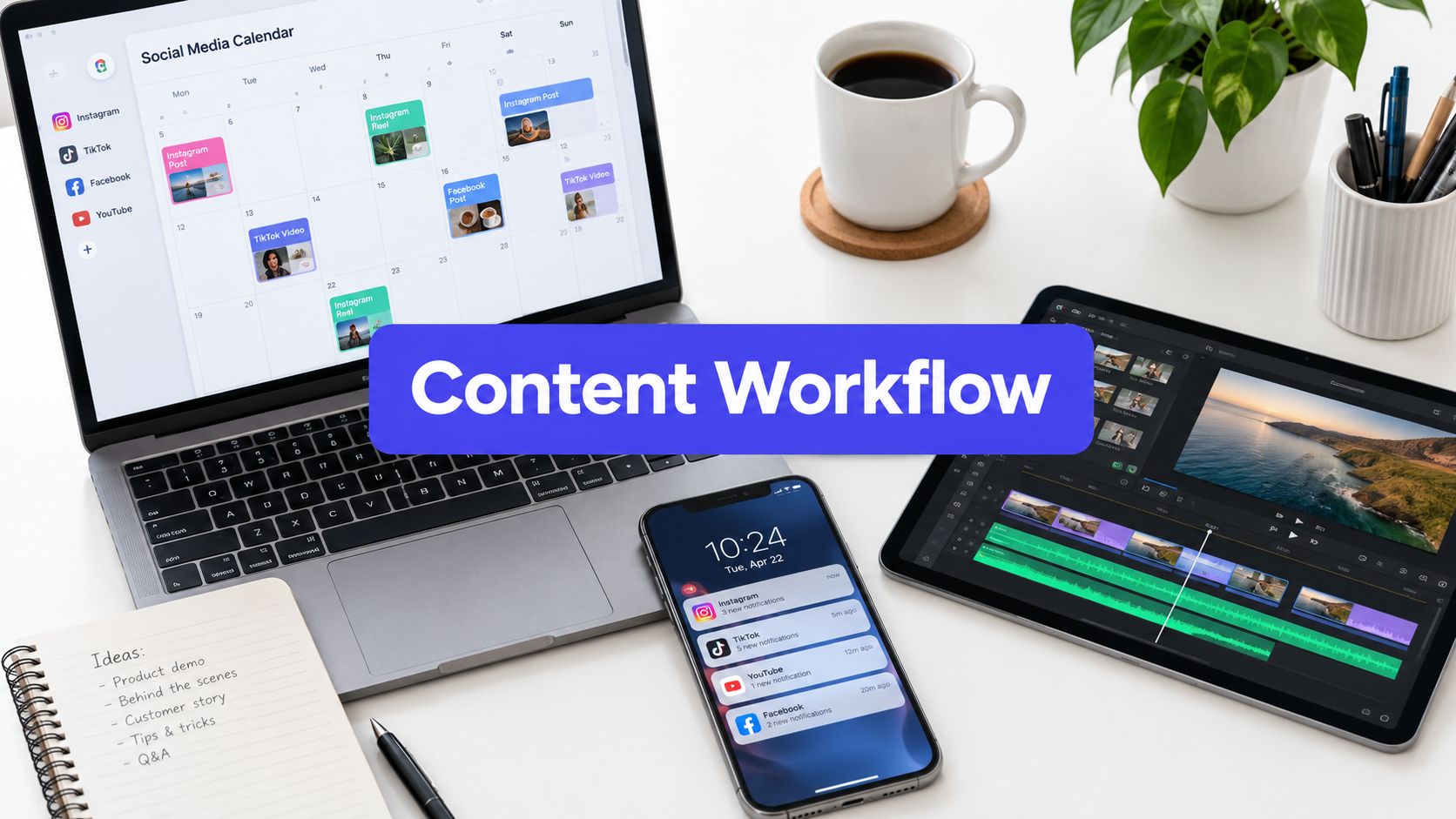












Most advice on how to get more followers is outdated the moment it hits publish. It tells you to post more, chase trends faster, and push your follower count up like that number alone proves you’re winning.
It doesn’t.
A big audience that doesn’t care, doesn’t click, and doesn’t engage is mostly decoration. Social teams learned that the hard way. As of 2025, 73% of brands prioritize engagement rate and audience quality over raw follower count, according to Influencer Marketing Hub research summarized here. That shift matches what I’ve seen in practice. Reach is less loyal to follower size than it used to be, and the accounts that grow steadily usually earn attention post by post.
If you want more followers in 2026, stop treating growth like a single-platform trick. Treat it like a system. Build a profile that converts, create content people want to stop for, distribute it across multiple networks without diluting it, and measure what moves.
The Follower Growth Playbook for 2026
If your plan is “post more and hope,” you’re already behind.
The old playbook assumed follower count was the main signal. Build a huge audience, and the platforms would keep feeding your content to that audience. That logic has weakened. Algorithms now lean harder on behavior signals like watch time, retention, saves, shares, comments, and repeat engagement. A follower who never interacts is less valuable than a smaller group that consistently responds.
That’s why the most useful answer to how to get more followers starts with a contradiction. Don’t optimize for followers first. Optimize for audience quality first. Followers become the result, not the target.
Practical rule: If a tactic inflates your numbers but lowers relevance, it usually makes future growth harder.
This changes how you judge content. A post that brings in the wrong people can hurt more than it helps. You get vanity growth, weaker engagement signals, and a blurrier understanding of who you’re serving. I’d rather see an account earn fewer, better followers from clear positioning than collect random attention from broad content that nobody remembers.
It also changes how you build your workflow.
What works now
A modern growth system usually has four traits:
- Clear audience targeting: People know who the account is for within seconds.
- Consistent content themes: The account earns trust because the value is recognizable.
- Native distribution across platforms: The same idea gets reshaped for different feeds.
- Fast feedback loops: You learn from engagement patterns and adjust quickly.
What usually fails
Here’s where teams waste time:
| Common move | Why it underperforms |
|---|---|
| Chasing follower milestones | It rewards quantity over fit |
| Posting identical content everywhere | It ignores platform behavior |
| Constantly changing topics | It confuses both users and algorithms |
| Relying on hacks | Short-term spikes rarely build durable growth |
If LinkedIn matters in your mix, it helps to study how idea packaging changes by network. A good companion resource is this AI-powered LinkedIn growth tool, not because LinkedIn is the whole answer, but because it shows the same larger truth: growth comes from message-market fit, not just output volume.
The accounts that keep growing aren’t lucky. They run a repeatable system. That’s the only reliable way to get more followers without burning out.
Build Your Foundation with Audience and Content Pillars
Most accounts don’t have a content problem. They have a positioning problem.
If a stranger lands on your profile and can’t tell who you help, what you post, and why they should care, your content has to work twice as hard. That’s why Follower Conversion Rate, or FCR, matters so much. According to the verified creator framework summarized from this YouTube source, accounts that optimize their bio, profile picture, and highlights for a clear value proposition can increase follower growth by 25-40% in 30 days without ads, and profiles that pass a “3-second audit” convert 3x better.

Start with one audience, not everyone
Don’t define your audience as “small business owners” or “creators.” That’s too broad to guide content. Useful audience definitions describe a person with a recurring problem and a reason to care now.
A better framing looks like this:
- Role: solo consultant, ecommerce founder, in-house marketer, local business owner
- Stage: just starting, inconsistent posting, growing but disorganized, managing multiple brands
- Pain point: no content ideas, weak conversion from profile visits, inconsistent publishing, scattered analytics
- Desired outcome: attract qualified followers, build authority, create content faster, turn engagement into leads
When you get this specific, content decisions get easier. You know what examples to use, what jargon to avoid, and what promises you can make credibly.
Build a small set of pillars
Most strong accounts run on 3 to 5 content pillars. That’s enough variety to avoid repetition and enough focus to stay memorable.
For example, a social media manager might use:
Content strategy
Teach planning, messaging, and topic selection.Execution workflows
Show how posts get created, reviewed, scheduled, and reused.Platform-specific lessons
Share what changes between Instagram, TikTok, LinkedIn, Threads, and X.Analytics and testing
Break down what to track and how to improve based on results.Behind-the-scenes proof
Share process, audits, examples, and lessons from real campaign work.
If you need help shaping those pillars into repeatable themes, this guide to social media content pillars examples is useful because it turns abstract categories into actual posting lanes.
A weak account usually says many things once. A strong account says a few useful things repeatedly, from different angles.
Audit your profile like a landing page
Treat your profile as a conversion asset, not a business card. The profile has one job. Turn curiosity into a follow.
Check these pieces:
- Bio clarity: State who you help and what kind of value you publish.
- Visual identity: Use a profile image people can recognize at small size.
- Pinned content: Lead with posts that prove your expertise fast.
- Highlights or featured sections: Organize your best material so visitors can binge.
- Single next step: Make the follow decision easy. Don’t distract with five competing asks.
A lot of people obsess over content volume while leaving their profile vague. That’s backwards. If your profile doesn’t convert, better content just sends more people into a leaky bucket.
Create Hook-First Content That Stops the Scroll
Most content loses before it starts.
The problem usually isn’t quality. It’s packaging. You may have a smart point, a useful tutorial, or a strong opinion, but if the opening doesn’t create immediate tension or relevance, people keep scrolling and never discover the value.

What a hook needs to do
A hook earns the next second. That’s it.
On short-form video, the opening line, first visual, and on-screen text have to answer one silent question fast: “Why should I care?” On carousels, your first slide has to create enough curiosity or utility that the swipe feels obvious. On text posts, the first line has to frame a problem, disagreement, or payoff.
Good hooks usually do one of these jobs:
- Name a painful mistake: “Most brands don’t need more content. They need better packaging.”
- Challenge common advice: “Posting every day won’t fix a weak content strategy.”
- Promise a practical outcome: “Three changes that make a profile easier to follow.”
- Open a loop: “The post that looked average brought the best followers. Here’s why.”
- Call out a specific audience: “If you manage multiple social accounts, stop copying captions across platforms.”
Match the hook to the format
Different formats reward different openings. Don’t write every hook like a tweet.
| Format | Strong opening style |
|---|---|
| Short video | Spoken pain point plus on-screen claim |
| Carousel | Contrarian first slide or checklist promise |
| Text post | Sharp opinion or concise lesson |
| Story sequence | One question that invites replies |
| Thread or long caption | Problem first, context second |
A useful creative exercise is to write ten hooks before you write the body. That forces you to find the strongest frame before you spend time producing the rest.
Build from tension, not decoration
A lot of creators waste the opening on aesthetics. Nice shot. Slow intro. Clever line. None of that matters if the viewer doesn’t understand the payoff.
I like this structure for Reels and TikToks:
Hook
State the tension immediately.Proof or context
Explain why this matters.Actionable takeaway
Give one usable idea, not five shallow ones.Clean CTA
Invite the next step. Follow for more, comment a keyword, or save it.
If you’re producing short video regularly, voice delivery matters more than people admit. If you want a cleaner process for spoken intros or want to record voice narration for TikTok clips, that workflow can help tighten delivery and make your hooks easier to follow.
Hook examples that actually work
Here are a few practical rewrites.
Weak: “5 social media tips for growth”
Stronger: “Your content isn’t underperforming because of the algorithm”
Weak: “How I manage multiple platforms”
Stronger: “The mistake that makes cross-posting look lazy”
Weak: “Instagram bio tips”
Stronger: “Most bios fail the 3-second test”
Stop opening with what the content is. Open with why the viewer should care.
A simple way to keep your pipeline full is to turn each topic into multiple hook angles. One topic can become a warning, a checklist, a myth-buster, a comparison, or a short story. If you need a bank of prompts to work from, these content creation ideas are a solid starting point.
Later in the editing process, study how strong creators front-load value in video. This breakdown is worth watching before your next batch:
Scale Your Reach with Cross-Platform Repurposing
The fastest way to burn out is to treat every platform like a separate content business.
The smartest teams don’t create from scratch five times. They build one strong idea, then adapt it so each network gets a version that feels native. That’s the difference between lazy cross-posting and effective repurposing.
Platform sprawl is now a growth issue, not just an operations issue. According to the verified summary from Buffer’s Instagram growth resource, businesses using multi-platform tools see 3.2x faster follower growth, and brands without a unified system miss an estimated 40% of potential follower conversions across their account portfolio.
Create once, adapt deliberately
A single content asset can become a week of distribution if you break it down properly.

Say you record one short video about follower growth mistakes. You can turn it into:
- Instagram Reel: punchy cut, bold subtitle hook, short caption
- TikTok: faster pacing, direct spoken opener, lighter editing style
- LinkedIn post: written lesson with a business framing
- Threads post: tighter, conversational summary with one sharp takeaway
- X post: condensed opinion plus a reply thread
- Carousel: the same lesson split into swipeable steps
The core idea stays intact. The wrapper changes.
Use a repurposing matrix
This is the framework I use with teams that manage multiple brands.
| Original asset | Best repurpose | What to change |
|---|---|---|
| Short video | Reel, TikTok, Shorts | Hook, captions, pacing |
| Webinar or podcast | Clips, quote graphics, threads | Pull one point per asset |
| Blog post | Carousel, LinkedIn post, thread | Lead with one argument, not the whole article |
| Customer question | FAQ post, Story, short video | Keep the answer tight and specific |
When teams skip this adaptation step, content looks syndicated instead of intentional. Audiences can tell.
If you want a broader framework for this workflow, this guide to content repurposing does a good job of separating reuse from duplication.
Keep a central command system
The operational side matters more than most creators think. Once you’re handling multiple formats, multiple channels, and multiple approval loops, memory won’t save you. You need one system where draft ideas, publish dates, account ownership, and performance all live together.
That’s also why many “how to get more followers” articles feel incomplete. They focus on isolated tactics and ignore workflow design. But if your process is fragmented, good ideas don’t get distributed well enough to compound.
A practical setup includes:
- One calendar: See what’s going live and where.
- One asset library: Store source clips, captions, and versions.
- One approval flow: Especially important for agencies and in-house teams.
- One analytics view: Compare formats and channels without spreadsheet chaos.
For a deeper explanation of the strategy behind this, this piece on what content repurposing is is worth reading.
Repurposing works when the idea travels well and the execution changes enough to fit the room.
Turn Engagement into a Follower Growth Engine
Content gets attention. Engagement converts attention into momentum.
A lot of accounts post decent material and still stall because they treat publishing like the whole job. It isn’t. Growth accelerates when people interact with your content, see that interaction acknowledged, and start participating themselves. That participation becomes distribution.
The clearest example is a well-run UGC challenge. According to the verified data from Contesimal’s Instagram growth article, UGC challenges can produce 3-5x the follower growth of a standard post. The same source notes that micro-influencers can see 15% engagement rates, converting 20-30% of participants’ audiences into new followers when the challenge is easy to join and participant content gets featured.

How the flywheel works
Here’s the basic chain:
- You publish content worth responding to.
- People comment, remix, or share their version.
- You feature or reply to them quickly.
- More people see active participation and join in.
- The account starts feeling alive, not just informative.
That last point matters. People follow communities faster than they follow static content libraries.
Design lower-friction participation
Most community campaigns fail because they ask for too much effort.
If you want users to create with you, make the prompt simple. Give them a clear starting format and a reason to join. A challenge that asks for a complicated edit, long caption, or niche inside joke will narrow the field too much.
Better prompts usually look like:
- Recreate this in your style
- Show your version of this workflow
- Answer this prompt in one post
- Use this format and tag your result
The lower the barrier, the easier it is for people to participate without overthinking.
Feature people early and often
The fastest way to kill a participation campaign is silence.
When someone comments, posts an entry, or tags your brand, respond. When they create something good, feature it. That signals that joining the conversation has a payoff beyond a like. It also gives you a stream of social proof that feels more trustworthy than self-promotion.
A practical community rhythm looks like this:
- Day one: Launch the prompt clearly.
- Next phase: Reply to comments with enough energy to invite more.
- Mid-campaign: Repost strong entries and mention what made them work.
- Late phase: Compile highlights and point back to the original challenge.
If you want people to contribute, show them you’re paying attention.
Don’t outsource all the humanity
Automation helps with volume. It doesn’t replace judgment.
I’m a fan of using systems to keep engagement manageable, especially for teams that handle many accounts. But templated replies can flatten your voice fast. Use saved responses for common questions, route spam out of the way, and prioritize meaningful comments that deserve real replies. The point isn’t to answer everything instantly. The point is to make people feel seen often enough that they come back.
When engagement becomes part of the operating system, not an afterthought, follower growth stops feeling random. It starts behaving like a flywheel.
Measure and Iterate with Growth Experiments
If you’re serious about how to get more followers, stop asking, “What’s the trick?” Start asking, “What variable am I testing?”
That shift changes everything. Good social growth is less magic than disciplined iteration. You don’t need a lab-grade process, but you do need a habit of testing one thing at a time and learning from the result.
The mistake I see most often is random improvement. Teams change the hook, format, caption length, posting time, thumbnail, and CTA all at once. Then they can’t tell what worked. That’s not experimentation. That’s guessing with extra steps.
What to test first
Start with variables that meaningfully affect discovery and conversion:
| Variable | What you’re trying to learn |
|---|---|
| Hook style | Which opening earns more attention |
| Content format | What your audience prefers to consume |
| CTA phrasing | What gets more follows, comments, or saves |
| Topic angle | Which framing attracts the right audience |
| Publish timing | When your audience is most responsive |
Run simple tests. Hold the topic steady and change the hook. Hold the format steady and change the CTA. Keep notes. After a few rounds, patterns become obvious.
Judge content by the right signals
Follower count is a lagging outcome. It matters, but it shouldn’t be your first diagnostic.
The metrics I pay attention to most are qualitative unless I have reliable platform data in front of me. Did the content attract the right comments? Did people save it, share it, or ask follow-up questions? Did profile visits seem more qualified? Did one post pull in discussion while another only collected passive views?
That’s also why the broad platform shift matters. Legacy advice still treats growth as a publishing problem. In practice, it’s a measurement problem too. If you don’t know what resonated, you can’t repeat it.
The goal isn’t to post more experiments. It’s to run cleaner ones.
Apply the same mindset to emerging platforms
This matters even more outside the largest networks. Verified reporting on emerging platforms says Bluesky and Threads saw a 150% user surge in the last year, and creator reports indicate that targeted commenting can yield 15-20% better follower conversion rates on these less-saturated networks, according to Whole Whale’s social media growth article.
That doesn’t mean every brand should rush in blindly. It means smaller platforms still reward curiosity and early behavior mapping. You can test tone, posting cadence, reply strategy, and topic fit without competing in the noisiest possible environment.
A practical approach looks like this:
- Pick one platform to explore thoroughly
- Post a narrow set of ideas
- Comment on adjacent accounts consistently
- Track what starts conversations, not just what gets seen
- Move winners back into your broader content system
The teams that keep growing aren’t the ones with perfect instincts. They’re the ones that build feedback into the work.
If you want one place to plan, publish, repurpose, and analyze that system across your channels, PostSyncer is built for exactly that workflow. It helps creators, marketers, and agencies manage multi-platform content from a single workspace so follower growth becomes a repeatable process instead of a daily scramble.