












When a negative comment pops up, your response needs to be a careful mix of empathy, speed, and a clear path to making things right. The game plan is simple but powerful: acknowledge their frustration, offer a genuine apology for what happened, and then guide the conversation to a private channel to sort out the details. It's a move that both calms the immediate situation and shows everyone watching that you're accountable.
Why Responding to Negative Comments Is a Non-Negotiable Strategy
Ignoring a negative comment is like hoping a small fire will just burn itself out. It almost never does. Instead, your silence acts like fuel, telling the unhappy customer—and anyone else reading—that you either don't care or can't fix the problem. That kind of inaction can do serious damage to your brand's reputation and, ultimately, your bottom line.

It comes down to basic psychology. Customers who take the time to complain in public are really looking for one thing: validation. They want to be heard. They want to feel like their bad experience actually matters. A quick response meets that fundamental need head-on. Ignoring them? That just reinforces their feeling of being wronged.
The True Cost of Silence
The fallout from staying quiet is very real and measurable. We've seen data showing that brands that ignore criticism can watch their engagement drop by up to 25% on later posts. On the flip side, being proactive pays off big time.
A 2023 Sprout Social study revealed something pretty telling: brands that responded to 80% of negative comments within 24 hours saw customer satisfaction scores jump by 30%. Even better, their positive mentions increased by 15% over just six months.
This isn't just about playing defense; it's about seeing the opportunity. Every single negative comment is a chance to:
- Show off your great customer service: Proving you're committed to solving problems builds trust with your entire audience, not just the person who complained.
- Get unfiltered feedback: These comments are a direct line into your customers' biggest headaches, offering priceless intel for improving your products or services.
- Turn a critic into a fan: When you effectively solve a customer's problem, they can become even more loyal than someone who never had an issue in the first place.
A thoughtful response does more than just appease one person. It sends a powerful public message that your brand listens, cares, and takes responsibility. This is the foundation of a resilient brand reputation.
Shifting from Reactive to Proactive
The real goal here is to shift your mindset from fear to strategic engagement. Stop seeing negative feedback as an attack and start seeing it as a critical data point. A single complaint can snowball fast, which makes having a solid response plan a non-negotiable part of your communications strategy.
For bigger issues that start gaining traction, having a clear process is absolutely essential. Our guide on social media crisis management provides a framework for handling those more widespread challenges. By equipping your team with the right tools and a proactive mindset, you can turn negative interactions into genuinely positive outcomes for your brand. That's the key to building lasting customer relationships in a world where everyone is watching.
Crafting the Perfect Response with the AART Method
Knowing you should respond to a negative comment is one thing. Knowing exactly what to say is a whole different ballgame. When emotions are high—both yours and the customer's—it’s incredibly easy to get defensive or just miss the mark completely.
This is where a solid framework becomes your best friend. It helps you stay consistent, empathetic, and effective, every single time.
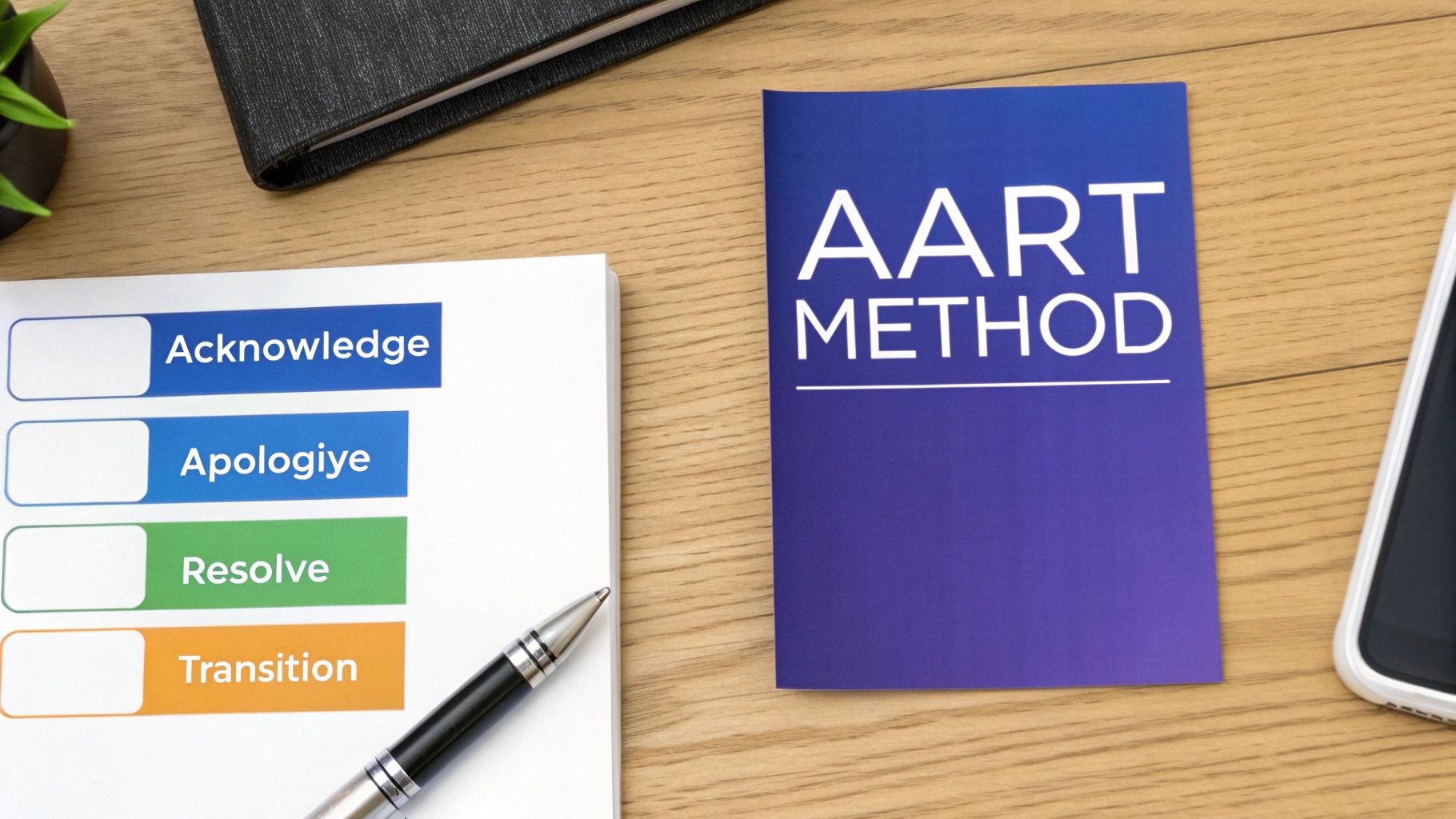
I’ve always been a fan of the AART Method. It’s a simple, repeatable process that helps de-escalate tension and lets you take back control of the conversation. It stands for Acknowledge, Apologize, Resolve, and Transition. Let's walk through how it works in the real world.
Acknowledge Their Experience
First things first: you have to show the customer you actually heard them. This step is all about validation. We’ve all seen those generic, copy-paste replies, and they just add fuel to the fire.
Real acknowledgment gets specific. Use the person's name and mirror their core complaint back to them. It’s a small detail that proves you’re a human who took the time to read their comment.
- Weak Acknowledgment: "We’re sorry for any inconvenience."
- Strong Acknowledgment: "Hi Sarah, thank you for reaching out. It sounds incredibly frustrating that your package arrived damaged and the contents were unusable."
See the difference? The second one immediately shows you get it, which starts rebuilding a tiny bit of trust right away.
Apologize with Sincerity
The word "apologize" can be tricky. You don’t always have to admit your company was at fault, especially if the facts are still murky or the customer is mistaken. The trick is to separate an apology for an error from an apology for their experience.
If your company messed up, own it. A simple, "We're sorry, we made a mistake here," can be incredibly powerful. But if you're not sure what happened, you can still express genuine empathy for their frustration.
"I’m sorry to hear about the trouble you had with our new software update. It’s definitely not the smooth experience we want for our users, and I understand why you're upset."
This type of apology validates their feelings without prematurely accepting blame for something you need to investigate. It’s a crucial distinction that keeps you professional while still being compassionate. If you're looking to really dig into this, you might want to check out a comprehensive negative review response guide that covers this in more depth.
Resolve by Taking It Offline
The public comment section is never the right place to hash out account numbers, order details, or other personal info. The goal here is simple: move the conversation to a private channel like DMs, email, or a phone call. This protects the customer's privacy and pulls a potentially explosive exchange out of the public eye.
Be direct and crystal clear about what happens next.
- Product Complaint Example: "We absolutely want to make this right for you, David. Could you please send us a DM with your order number and a photo of the item? We'll get a replacement shipped out right away."
- Service Issue Example: "Hi Maria, I’m so sorry you had this experience at our downtown location. Our regional manager would like to connect with you personally. Can you please email the details to support@brand.com so we can follow up directly?"
Giving them a specific contact point and a clear action shows you're serious about solving the problem, not just talking about it.
Transition to a Positive Note
The final step, "Transition," is your chance to reframe the entire interaction. After you’ve addressed the complaint and offered a path forward, you can gently pivot the conversation. This isn't about being salesy; it's about ending the public exchange on a constructive, positive note.
A couple of ways I like to do this are by reinforcing our brand’s commitment to quality or by genuinely thanking the customer for bringing the issue to light. It frames their feedback as a gift, not an attack.
| Transition Type | Example Scenario | Sample Response Language |
|---|---|---|
| Commitment to Quality | A customer complains about a bug in a recent app update. | "...Once we connect in DMs, our tech team will look into this immediately. We're always working to improve the app, and your feedback is a huge part of that process." |
| Highlighting Improvement | A user points out a flaw in a product's design. | "...We appreciate you bringing this to our attention. Feedback like this helps us make better products, and we'll be sharing your comments directly with our design team." |
This last piece shows that you don't just see negative comments as attacks—you see them as opportunities. Once your team learns how to respond to negative comments using the AART method, you’ll be able to handle just about anything with confidence, turning potential PR fires into standout moments of customer service.
A one-size-fits-all approach to negative comments is a recipe for disaster. The rapid-fire, character-limited world of X demands a totally different touch than the buttoned-up environment of LinkedIn. Knowing how to handle negative feedback means understanding the unique culture of each platform where your audience hangs out.
Your tone, speed, and even the format of your reply have to adapt to the platform’s norms. A stuffy, corporate-sounding reply on a visual-first app like Instagram can feel completely out of place, while a casual, emoji-filled response on LinkedIn might just undermine your brand's credibility.
The secret is to match the medium's energy while staying true to your brand voice.
Responding on Instagram and Facebook
Instagram and Facebook are all about visuals and community. Comments usually pop up directly under your photos, Reels, or inside dedicated community groups, which puts your public response on full display.
Instagram Best Practices: When a negative comment appears on a post or Reel, a public reply using the AART method is usually the best first move. It shows everyone else you're on top of things. But if the issue involves sensitive info, your public reply should be a quick pivot to DMs. Something like, "We're so sorry to hear this happened. Please send us a DM with your order details so we can sort this out for you right away." works perfectly.
Facebook Community Groups: Feedback inside a Facebook Group you manage can feel more personal. Tackle these comments quickly and transparently. It's a great chance to reinforce your community guidelines if you need to, but always lead with empathy before you take any moderation action.
On both platforms, time is of the essence. People are checking these apps on their phones all day, so a swift initial reply can stop a small fire from turning into an inferno.
Navigating X (Twitter) and YouTube
X and YouTube bring their own unique challenges. X is all about speed, while YouTube is a space where depth and real engagement are king.
On X, brevity is everything. Your first response needs to be fast and to the point. If you need more than the character limit to explain, use a thread to lay out the extra context. It keeps the information organized and avoids a messy back-and-forth. Just acknowledge their tweet, apologize or empathize, and steer them toward DMs to fix it.
YouTube comments are a different beast entirely. Commenters often leave long, detailed critiques or questions.
Responding to an in-depth negative comment on YouTube shows you respect the time and effort the viewer put into their feedback. Make sure you acknowledge their specific points instead of just dropping a generic reply. It signals to your whole community that you're actually listening.
A thoughtful, detailed reply that addresses the core of their critique can turn a critic into a loyal supporter. It also cements your expertise and dedication to your audience, which is a huge credibility booster for your channel.
Maintaining Professionalism on LinkedIn
LinkedIn is where business gets done, and your responses absolutely have to reflect that. The tone should stay polished, respectful, and laser-focused on a solution, even when you're facing down direct criticism.
Steer clear of casual slang or overly emotional language. The goal is to be empathetic but always professional.
- Example Scenario: A user comments on your company's latest post, complaining that a new software update is buggy and has totally messed up their team's workflow.
- Effective Response: "Hi [Name], thank you for sharing your experience with the new update. I'm sorry to hear it's caused disruption for your team—that is certainly not our intention. Our technical support lead would like to connect with you directly to troubleshoot. I'll reach out via a private message to get the best contact details for you."
This response does it all: it acknowledges their frustration, offers a clear path to a fix, and moves the nitty-gritty details to a private channel. It's a masterclass in protecting your brand's reputation on a platform where professionalism is paramount.
Let's be real: while the goal is always to respond and resolve, not every comment deserves a reply. It’s a hard truth, but some feedback crosses a line from constructive criticism into something far more destructive.
Your job isn't just to be a customer service rep; it's to be the guardian of your community, your brand, and frankly, your team's mental health. This is where having a clear, consistent moderation policy becomes non-negotiable.
Knowing when to step outside the standard response framework and instead moderate, delete, or escalate a comment is a crucial skill for any social media manager. A well-defined policy removes the guesswork during high-stress moments, ensuring you act decisively and fairly every single time. This isn’t about silencing dissent—it’s about maintaining a safe and productive space for genuine conversation.
Drawing the Line Between Feedback and Abuse
First things first, you need to learn how to distinguish between different types of negative comments. A legitimate complaint, even an angry one, usually comes from a place of genuine customer frustration. Trolling, on the other hand, is designed solely to get a rise out of you. Spam is just irrelevant self-promotion, and hate speech is an outright attack.
Your internal moderation policy should clearly define each of these categories, complete with examples your team can reference.
- Valid Feedback: A customer is upset about a product defect, a shipping delay, or bad service. Action: Respond publicly using your established framework. This is a chance to show you're listening.
- Trolling: Someone posts inflammatory, off-topic, or baiting comments with zero intention of having a real discussion. Action: Do not engage. Ever. Feeding a troll only gives them the attention they crave. Hiding the comment is often a better move than deleting it, as the troll won't be notified, which helps prevent them from escalating.
- Spam: The comment is packed with irrelevant links, promotes another business, or is clearly a bot post. Action: Delete and block the user immediately. There's absolutely no value in leaving spam on your page.
- Threats or Hate Speech: The comment includes personal attacks, doxxing (sharing private info), threats of violence, or discriminatory language. Action: Delete and report the user to the platform instantly. Make sure you grab a screenshot of the comment before you remove it for your records.
This decision-making flow helps your team figure out the right action based on the comment's nature and potential impact.
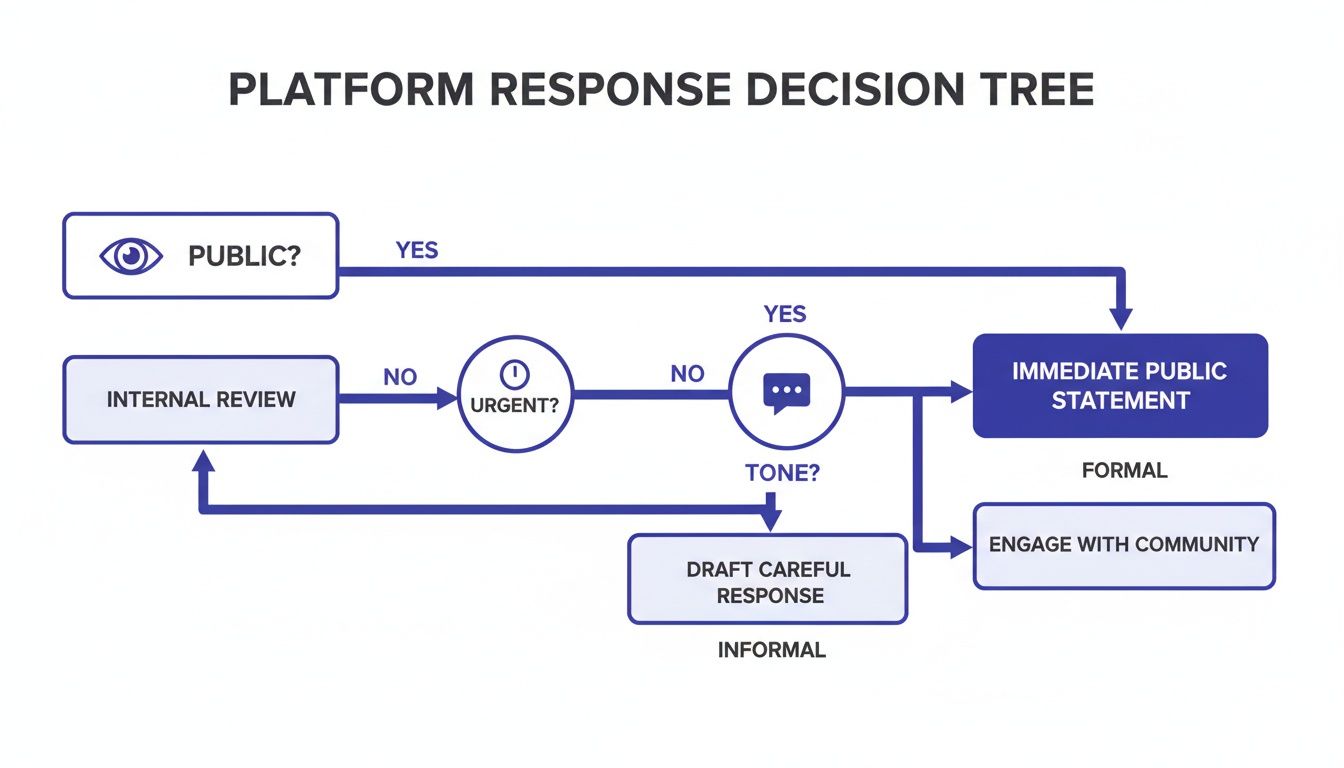
A visual guide like this can be a lifesaver, helping your team quickly assess whether a comment needs a public reply, a private message, or immediate moderation.
Action Guide: Respond, Moderate, or Delete?
To make things even clearer, here’s a quick-reference table to help your team make the right call in the heat of the moment. This little matrix breaks down common scenarios and the best way to handle them.
| Comment Type | Recommended Action | Rationale & Example |
|---|---|---|
| Legitimate Complaint | Respond Publicly | Shows accountability and helps others with the same issue. Ex: "My order arrived broken." |
| Angry but Valid Rant | Respond Publicly, Move to DM | Acknowledge their frustration publicly, then resolve the specifics privately. Ex: "This is the WORST service ever, I've been on hold for an hour!" |
| Trolling/Baiting | Hide or Ignore (Do Not Engage) | Trolls feed on attention. Starve them of it. Hiding is better than deleting to avoid a bigger fight. Ex: "Your logo is ugly, this company is a joke." |
| Spam/Bot Comments | Delete & Block User | This is just noise. It clutters your feed and offers no value. Ex: "Follow my page for free crypto!" |
| Hate Speech/Threats | Screenshot, Delete, Report & Block | Zero tolerance. Protect your community by removing it immediately and reporting it to the platform. Ex: Any comment with slurs, threats, or harassment. |
| Off-Topic & Derailing | Hide or Gently Redirect | If it's not harmful but just off-topic, hiding it can clean up the thread. A gentle redirect might work if the user is genuine. Ex: A political rant on a post about a new product. |
Think of this table as your playbook. When a comment comes in that makes your stomach drop, pull this up and follow the script. It keeps your response consistent and professional, no matter what gets thrown at you.
Building an Escalation Workflow
Sometimes, a single comment is just the tip of a much larger iceberg. A social media manager needs to know exactly when to sound the alarm and loop in other departments. Your escalation workflow should be a simple, clear chart that outlines who to contact and under what circumstances.
Your escalation plan is your emergency response system. It should clearly state that any comment involving legal threats, credible safety concerns, or accusations of illegal activity must be immediately flagged for leadership and your legal or PR team.
This isn't just about managing a PR fire. The online world has a very real impact. Research from The Cybersmile Foundation consistently shows the deep connection between social media and well-being. Creating a safe digital space isn't just a nice-to-have; it's part of a brand's core responsibility.
A solid escalation plan might look something like this:
- Community Manager Assessment: This is your first line of defense. They identify the comment's category (feedback, troll, threat) and handle it according to the policy.
- Tier 1 Escalation (Customer Support Lead): Multiple complaints about the same product issue or a service failure get flagged. The support lead can spot widespread problems before they blow up.
- Tier 2 Escalation (Marketing/PR Head): The issue starts gaining public traction, with news outlets or influencers picking up the story.
- Tier 3 Escalation (Leadership/Legal): The situation involves serious legal threats, safety issues, or has the potential to cause significant, lasting brand damage.
By having these clear rules for advanced social media comment moderation, you empower your team to handle most situations with confidence. It also ensures the major threats are managed by the right people, protecting your brand's reputation and fostering a much healthier online community.
Taming the Chaos: How PostSyncer Streamlines Your Workflow
Let's be real—responding to every negative comment is non-negotiable, but trying to manage that feedback across Instagram, Facebook, X, and a dozen other platforms is a recipe for burnout. The constant tab-switching is a massive time-suck, making a consistently fast response feel almost impossible. This is exactly where a good tool stops being a "nice-to-have" and becomes a total game-changer.
PostSyncer pulls you out of that chaotic mess and puts you back in control. Instead of chasing notifications all day, you get to monitor every single comment from one central dashboard. This unified inbox is more than just a convenience; it saves you countless hours of grunt work and makes sure no unhappy customer ever slips through the cracks.

This consolidation is all about speed, and speed matters. A 2024 study of 1,000 brands found that replying to negative feedback within an hour boosted engagement by 40% and improved sentiment by 25%. With PostSyncer's real-time monitoring, your team can actually hit those critical benchmarks and turn potential PR fires into genuine, positive interactions.
Let AI Handle the First Draft
Speed is one half of the equation; quality is the other. PostSyncer’s AI tools can generate empathetic, on-brand draft replies in seconds. Think about it: instead of staring at a blank text box, your team gets a thoughtfully crafted starting point they can quickly tweak and personalize. It’s the perfect blend of automation’s efficiency and the human touch that makes a reply feel authentic.
You can learn more about how to use an AI Reply Generator to keep your brand voice consistent while drastically cutting down response times. It's a smart way to scale your engagement without sacrificing the quality of your interactions.
By automating that first draft, you free up your team to nail the most important part: personalization. The AI builds the foundation, and your team adds the specific empathy that actually solves the problem and makes the customer feel heard.
While PostSyncer is built specifically for social media management, it’s always a good idea to know about other top AI workflow automation tools that can help streamline different parts of your business.
Built for Teams and Agencies
If you're an agency juggling multiple clients or a brand with a strict approval process, PostSyncer has the collaboration features you need. Every response can be reviewed and approved before it goes live, which is crucial for maintaining brand consistency and preventing any off-script replies.
You can also use campaign labeling to track sentiment around specific marketing efforts. For example, by tagging all comments related to a new product launch, you get a direct pipeline into what your audience really thinks. It’s an incredibly valuable way to see what's landing and what isn't, straight from the source.
Here's a quick look at what this looks like in practice:
- Unified Inbox: See and manage every comment from every platform in one clean, organized view.
- AI Drafts: Generate high-quality, on-brand starter replies to kickstart your workflow.
- Approval Queues: Ensure every public response gets a second look from a team lead or client before it’s published.
- Campaign Labeling: Organize feedback and track sentiment tied to specific business goals.
By putting a system like this in place, you’re building a scalable process for managing comments. It empowers your team to handle negativity like pros, turning what used to be a stressful, reactive chore into a structured, proactive strategy for building loyalty.
Turning Negative Feedback into Your Greatest Asset
Look, I get it. Nobody likes getting negative comments. But what if I told you that every single complaint is actually free, unfiltered market research? It’s true. These frustrated messages are a goldmine, pointing directly to your brand’s blind spots.
Smart brands don’t just do damage control; they collect data. The real magic happens when you turn that stream of complaints into a structured feedback loop that fuels real, tangible business improvements.
Start simple. Use analytics tools or even just a basic spreadsheet to track the feedback you’re getting. Are you noticing patterns? Maybe multiple people are hitting the same product bug, complaining about slow shipping, or getting lost on a specific page of your website. That’s your roadmap for what to fix first.
Channeling Feedback for Real Change
Once you start seeing those patterns emerge, the crucial next step is getting that intel to the right people on your team. You need a simple, clear system for routing this feedback so it actually leads to action instead of getting lost in a random Slack channel.
Here’s a practical way to break it down:
- Product Flaws: Tag these comments and shoot them straight over to your product development or engineering teams. This is a direct line to making the user experience better.
- Service Gaps: If people are complaining about slow support responses or unhelpful agents, that feedback needs to go directly to customer service leadership. It's exactly what they need to improve training and internal processes.
- Marketing & Messaging: Seeing a lot of confusion around a new promotion or a product’s features? That's a huge red flag for your marketing team to rethink their copy and creative.
By systematically analyzing what your critics are saying, you transform their negativity into a strategic roadmap for growth. This proactive approach not only fixes current problems but also prevents future ones from ever happening.
It’s also worth remembering the bigger picture of online life. Research tied to the U.S. Surgeon General's 2023 advisory showed that spending over three hours a day on social media is linked to a doubled risk of poor mental health.
When your brand handles negativity with empathy and grace, you’re not just managing your reputation—you’re contributing to a healthier, more positive online space. This resonates deeply with consumers who value responsible community management, building a kind of loyalty that money can’t buy. You can dig into more of these insights from the Pew Research Center's work on teens and social media. This isn't just about putting out fires; it's about building a more resilient, customer-obsessed brand from the ground up.
Frequently Asked Questions
When you're in the trenches of social media management, you know that negative comments come in all shapes and sizes. Having a game plan for the most common—and trickiest—scenarios is crucial. It helps your team stay consistent, confident, and on-brand, no matter what's thrown at them.
Here are a few of the "what if" questions we get all the time.
What Should I Do If a Negative Comment Is Completely False?
It's tempting to get defensive when someone posts something that's just plain wrong. Take a breath. The best approach is to correct the record publicly, but with a cool, polite tone.
State the facts clearly and then offer to take the conversation offline. Something like this works wonders: "Hi Jamie, thanks for your comment. We wanted to clarify that our products are actually made with locally sourced materials. You can find more details on our website [link], but we'd be happy to answer any other questions in a DM!"
This clears up the misinformation for anyone else reading, but it shuts down the potential for a public back-and-forth.
How Should I Respond to Negative Comments About Price?
Ah, the price complaint. This one requires a gentle touch. Your goal isn't to justify the price tag but to reinforce the value behind it.
Start by acknowledging their point of view, then pivot to what makes your product worth it.
You could say something like: "We understand your concern about the price. We’ve invested in premium, ethically sourced ingredients to ensure the best possible quality. We also offer a starter size if that's a better fit for your budget right now."
See what that does? It shifts the focus from cost to quality and even offers a helpful, lower-cost alternative.
Is It Ever Okay to Use Humor in a Response?
This is a high-risk, high-reward play. It all comes down to your brand's established voice and the nature of the comment itself. If your brand is known for being witty and the comment is more of a lighthearted jab, a clever reply can be brilliant—it can even go viral.
But if the customer has a serious issue, like a major product failure or a sensitive complaint, humor is the absolute wrong move. It will make you look unprofessional and, worse, like you just don't care.
When in doubt, always default to a sincere, empathetic response. The damage from a bad joke gone wrong is far greater than the potential win.
Trying to manage every single comment with the right tone, on time, can feel overwhelming. PostSyncer brings it all together with a unified inbox and AI-powered reply suggestions, helping your team deliver the kind of consistent, high-quality responses that build a brand instead of breaking it.
Take control of your social media conversations and see how it works at https://postsyncer.com.