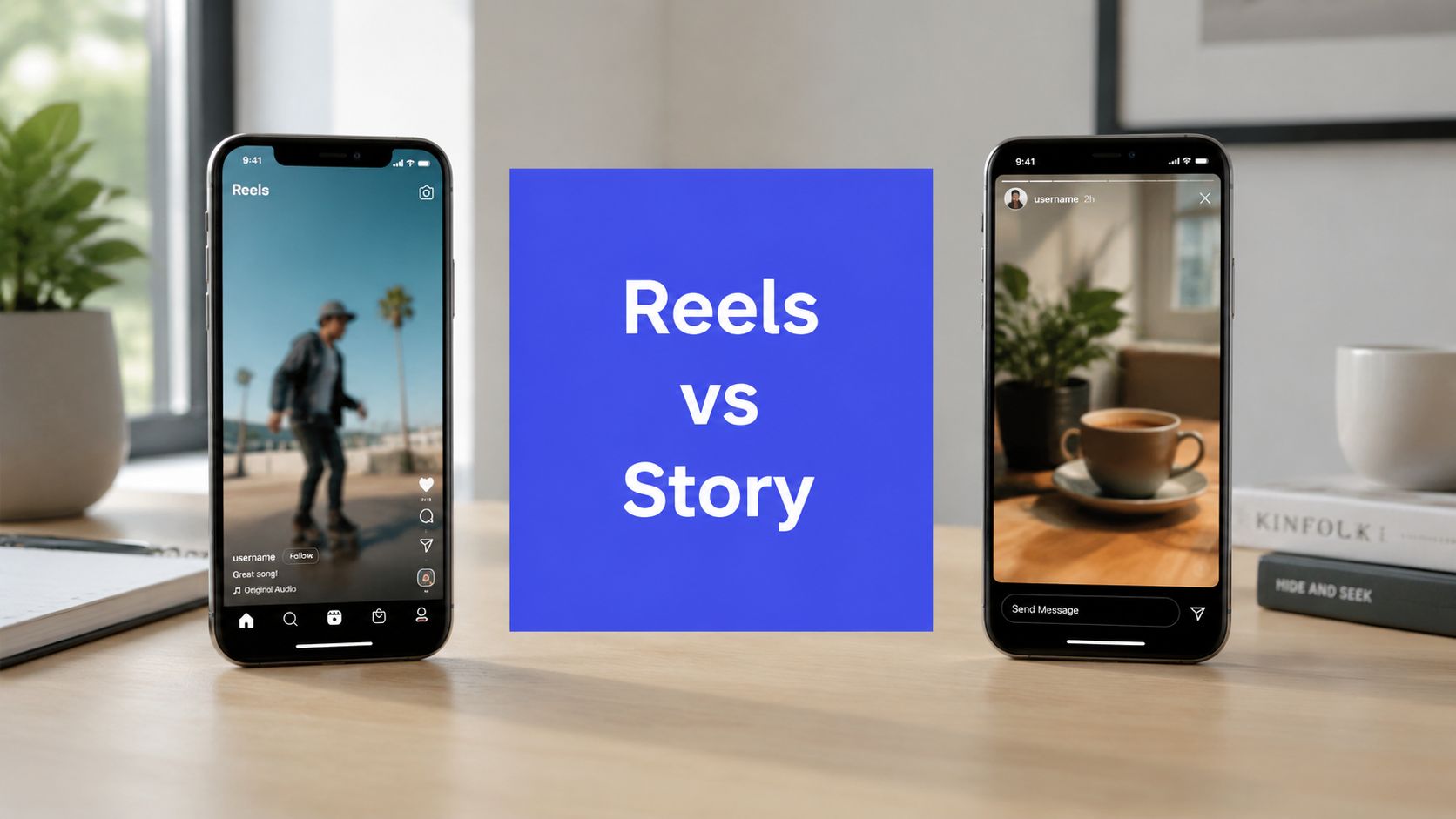












You've got a strong vertical video ready to publish. The hook works. The edit is clean. The caption is drafted. Then the key decision shows up: should this live as a Reel or a Story?
That choice affects who sees it, how long it works for you, and what action it can realistically drive. A Reel can introduce your brand to people who've never heard of you. A Story can push an already interested follower toward a reply, a click, or a purchase. While these theoretical distinctions are understood, the practical difficulty often arises with content scheduling. Reels and Stories are frequently treated as separate content buckets instead of a connected journey.
That's the mistake. When considering the Reels vs Story Instagram decision, the best answer usually isn't one or the other. It's what role each format should play next.
The Constant Question Reels or Stories
The daily Instagram workflow often breaks at the same point. You have one good piece of content and two possible homes for it. If you post it as a Story, you put it in front of people who already know you and are more likely to engage quickly. If you post it as a Reel, you give it a shot at broader discovery, but you also ask that content to perform for a colder audience.
That's why the format decision shouldn't start with “What did I make?” It should start with “What job do I need this content to do?”
Start with the content job
Use a Reel when the job is to:
- Earn attention from non-followers
- Explain a topic fast
- Package an idea so people save or share it
- Create an asset that keeps working beyond today
Use a Story when the job is to:
- Stay top of mind with current followers
- Add context, personality, or urgency
- Prompt a reply, tap, or quick reaction
- Support a launch, offer, or update that matters right now
A lot of weak Instagram performance comes from assigning the wrong job to the wrong format. Teams post casual, low-context clips as Reels and wonder why discovery stalls. Or they hide valuable educational content in Stories where it disappears before it compounds.
Practical rule: If the content needs strangers to understand it instantly, build it as a Reel. If the content works better when the viewer already knows your brand, put it in Stories.
The real tension is reach versus depth
Reels and Stories aren't just different placements. They reward different kinds of behavior. Reels are built to widen the top of the funnel. Stories are built to deepen the middle and bottom of it.
That's the tension often felt without naming it. Do you want more people to find you, or do you want the people already watching to move closer to action?
When you answer that clearly, the format choice usually gets easier. When you don't, your Instagram calendar becomes a stream of content that looks active but doesn't build momentum.
A Quick Comparison for Busy Creators
If you need the short version, this is it. Reels are the discovery format. Stories are the relationship format.
| Factor | Reels | Stories |
|---|---|---|
| Primary role | Reach new people | Nurture current audience |
| Main audience | Non-followers and mixed audiences | Existing followers |
| Lifespan | Longer-term asset on profile | Short-lived, time-sensitive format |
| Best for | Education, entertainment, brand discovery | Updates, offers, behind-the-scenes, interaction |
| Success signal | Broad distribution and viewer retention | Replies, taps, sticker interaction, direct response |
| Creative standard | Strong hook, clearer structure, tighter edit | Lower polish, faster posting, more conversational tone |
| CTA style | Follow, save, share, visit profile | Reply, tap link, vote, react |

The fastest way to choose
One expert framing gets to the heart of it. Instagram Reels are primarily optimized for reach and discovery, while Stories are optimized for relationship depth and interaction density, and Influencer Marketing Hub's breakdown of Reels vs Stories recommends judging Reels by non-follower reach, with non-follower reach above 70% as a strong sign that Instagram is distributing the Reel beyond your current audience.
That one lens can clean up a lot of confusion. If you expect a Story to behave like a discovery engine, you'll be disappointed. If you expect a Reel to do the same job as a direct-response Story sequence, you'll misread performance.
What this means for your calendar
Treat the two formats differently on purpose:
- Plan Reels around themes. Build them around topics your next audience needs to understand.
- Use Stories in sequence. Think in clusters, not single frames. One Story rarely does the whole job.
- Match polish to purpose. Reels usually need a cleaner opening and stronger pacing. Stories can feel lighter and more immediate.
- Choose KPIs that fit the format. A good Reel and a good Story won't “win” on the same metric.
The practical takeaway is simple. If your content calendar doesn't separate discovery content from nurture content, you're probably asking every post to do too much.
How the Algorithm Treats Reels and Stories
The biggest operational difference in the Reels vs Story Instagram debate isn't creative. It's distribution.
Reels are built for Instagram's discovery system. Stories are built for continuity with people who already follow you. If you ignore that distinction, your reporting becomes noisy and your optimization gets sloppy.

Reels run on broad distribution logic
Reels have become a core attention format on Instagram. Teleprompter's 2025 Instagram Reels statistics roundup says Reels were estimated to account for about 35% of total Instagram usage time by 2025, with some 2026 roundups placing that figure closer to 46% to 50%, and notes that by 2026 Reels are projected to account for nearly 50% of total time spent on the platform. The same source says Reels reach about 36% more users than carousels and 125% more than photo posts.
That matters because Instagram gives Reels more chances to travel. A good Reel doesn't just serve your followers. It gets tested with people who have shown interest in similar content. That's why a Reel needs to make sense without backstory. The algorithm can distribute it to viewers who have no context on who you are.
For most brands, this changes the creative brief:
- Lead faster. The opening has to clarify the topic immediately.
- Reduce dependence on inside context. New viewers won't understand your recurring jokes, offer history, or product shorthand.
- Create for saves and shares. Discovery content spreads when it feels useful, surprising, or worth sending.
If you're refining that process, this guide to video marketing for social media is a useful companion because it helps structure short-form video around platform behavior instead of generic video advice.
Stories run on follower familiarity
Stories work differently. They sit inside the daily viewing habits of people who already chose to follow you. The content doesn't need to introduce your brand from scratch. It needs to keep the relationship active.
That gives you more creative freedom and less need for heavy editing, but it also creates a constraint: Stories usually won't solve a reach problem on their own.
Reels are where Instagram tests your content with strangers. Stories are where your brand proves it deserves continued attention from people who already opted in.
Here's the embedded walkthrough if you want a visual explanation of format behavior:
What to optimize for in each format
The algorithm rewards different signals in practice.
For Reels, focus on:
- Immediate clarity
- Watch-through momentum
- Shareable framing
- Profile-worthy packaging
For Stories, focus on:
- Sequencing
- Interaction prompts
- Recency
- Easy next steps
A common mistake is posting a Reel that behaves like a Story. It starts too slowly, assumes prior knowledge, and buries the point. The opposite mistake is posting Stories that behave like mini feed posts, too polished to feel timely and too stiff to invite response.
Instagram doesn't treat those formats as substitutes. Your content operations shouldn't either.
Creative Approaches and Engagement Features
Reels and Stories may both use vertical video, but they ask for different creative instincts.
A Reel needs to win attention from someone who may have no relationship with your brand. A Story can assume familiarity and move faster into tone, context, and direct interaction. That's why copying the same footage into both formats without reworking it usually produces average results in both.
What Reels need to work
Strong Reels usually have three things: a sharp opening, a single clear idea, and an edit that removes anything nonessential.
That doesn't mean every Reel must be trend-heavy or overproduced. It means the viewer should understand the payoff quickly. Educational Reels work when the promise is obvious. Entertaining Reels work when the setup is immediate. Product Reels work when the use case is visible without explanation.
Use Reels for content like:
- How-to clips that teach one concept well
- Opinion-led takes that frame a problem clearly
- Product demonstrations that show the result, not just the object
- Trend adaptation when the trend naturally fits your brand
What Stories do better
Stories shine when you want movement, not just exposure. They're built for small decisions and small interactions that add up: a reply, a poll tap, a link click, a quick reaction, a DM.
That's one reason they still matter so much commercially. Sprout Social's Instagram stats page notes that in Q2 2025, Stories accounted for 44% of U.S. Instagram ad impressions, compared with 21% for Reels and 31% for the Feed, which reinforces their role in frequent, conversion-focused contact.
So if you're running a launch, sale, announcement, or trust-building sequence, Stories often carry more of the actual work than the Reel does.
A polished Reel can create interest. A Story sequence can turn that interest into action because it gives people a closer, lower-friction way to respond.
Build with the native strengths
For Reels, think like an editor. For Stories, think like a conversation designer.
A practical way to separate them:
- Reels need a headline. If you can't describe the Reel's promise in one line, the concept probably isn't tight enough.
- Stories need progression. One frame sets context, another adds proof, another asks for action.
- Reels reward replay value. Save-worthy tips, concise demonstrations, and memorable framing help.
- Stories reward responsiveness. Polls, question prompts, product context, quick updates, and casual proof all work better here.
If you're posting more often, creative execution details matter too. Safe framing, text placement, and cropping mistakes can subtly hurt both readability and retention. This guide on Instagram Reels size and safe areas is useful for avoiding those format-level errors before you publish.
Building a Cohesive Instagram Funnel
Most Instagram advice stops too early. It says Reels are for discovery and Stories are for engagement, which is true, but incomplete. The more useful question is what happens after discovery.
That's where the strategy gets interesting. Mixcord's analysis of Instagram Reels vs Story points to the key gap: when to use a Reel to attract attention and then use Stories to nurture that audience with urgency, offers, or trust-building content across a multi-step journey.

Stage one pulls people in
At the top of the funnel, the Reel does the hard job. It earns the first view from someone who didn't plan to interact with you.
That Reel should focus on one of three outcomes:
- Clarify a problem your audience recognizes
- Show a useful result they want
- Establish a distinct point of view they'd follow for more of
The Reel doesn't need to say everything. In fact, it usually shouldn't. It needs to create enough relevance that the viewer checks your profile, follows, or remembers your brand.
Stage two turns attention into trust
Once someone follows, Stories become far more important. They allow you to add the things a Reel often strips out for speed: nuance, personality, social proof, process, timing, and direct prompts.
A simple Story nurture sequence might include:
- Behind-the-scenes context showing how you work
- Common objections answered casually
- Audience interaction through questions or polls
- Offer framing with urgency or a clear next step
This is also where operational consistency matters. If you're managing multiple content types and want to line them up intentionally, an Instagram scheduler helps map discovery content and follow-up sequences on the same calendar.
A workable handoff between formats
The handoff from Reel to Story should be deliberate, not accidental.
Here's a practical version:
| Funnel stage | Format | Content job |
|---|---|---|
| Awareness | Reel | Reach new viewers with a focused idea |
| Interest | Story | Add context and show brand personality |
| Consideration | Story | Address questions, objections, proof |
| Action | Story | Use direct prompts, links, or urgency |
Many brands miss conversions. They post a strong Reel, get attention, and then leave their Stories empty or generic. New followers arrive and see no active narrative to join.
If a Reel brings people to your profile, your Stories should tell them what kind of account they just followed and what they should do next.
That's the most effective strategic use of both formats together. Reels widen the door. Stories guide the next step.
Your Final Decision Framework and Workflow
If you want a clean operating rule, use this: pick the format based on the next action you want, not the asset you already made.
That shifts the decision from production convenience to business intent. It also keeps you from forcing every piece of content into the same publishing habit.

Use Reels when the upside is discovery
Markerly's benchmark-style comparison of Reels and Stories engagement reports that Reels can deliver roughly double the video view rate of Stories, with average engagement ranging from 2% to 8% for Reels versus 1% to 7% for Stories. That's a useful signal for top-of-funnel planning.
Use a Reel when:
- You're explaining a core concept. This works well for coaches, SaaS brands, creators, and service businesses with repeat questions.
- You're introducing a product or offer to colder audiences. The Reel acts like the first touchpoint.
- You have content that earns saves or shares. Lists, demos, transformations, and sharp opinions fit here.
- You want an asset that keeps producing profile visits over time.
Don't use a Reel just because you shot video. If the clip depends on context, timing, or follower familiarity, it may be a weak Reel and a strong Story.
Use Stories when the upside is action
Choose Stories when the content is stronger as an immediate interaction than as a broad distribution play.
Good Story scenarios include:
- Flash offers and short windows. The disappearing format supports urgency naturally.
- Behind-the-scenes moments. These humanize the brand without needing a polished frame.
- Traffic and conversion prompts. Stories are better suited to direct next steps.
- Community maintenance. User-generated content, responses, quick updates, and reactions belong here.
A lot of marketers underuse Stories because they compare raw reach with Reels and stop there. That's the wrong comparison. Stories don't need to win on scale to be strategically valuable. They need to move the audience you already have.
A simple pre-publish checklist
Before posting, ask these five questions:
Is this content for strangers or followers?
If strangers need to understand it, start with a Reel.Does this need urgency?
If yes, Stories usually fit better.Will this still matter next week?
If yes, it likely deserves Reel treatment.Is the main goal a response or a reach event?
Response points to Stories. Reach points to Reels.Do I have a follow-up ready?
If you publish a Reel, your Stories should be active enough to receive the attention it generates.
A realistic weekly workflow
You don't need a complicated system. You need a repeatable one.
A practical workflow looks like this:
- Batch Reels around recurring audience questions. Build a small bank of discovery assets.
- Post Stories around what's happening now. Use them for launches, reactions, proof, updates, and daily contact.
- Promote the Reel inside Stories. Give current followers a reason to watch and engage early.
- Turn Story responses into future Reels. Questions and objections often reveal your next strong discovery topic.
For teams handling multiple brands or a heavier publishing schedule, one tool can simplify the handoff. PostSyncer is an option for planning and scheduling Instagram formats alongside other networks, with a visual calendar and analytics that help separate content performance by format instead of lumping everything together.
The final call
If you're still stuck between the two, default to this principle:
- Use Reels to earn attention.
- Use Stories to cash in that attention.
That's the strategic answer to the Reels vs Story Instagram question. Not which format is better. Which format is right for this moment in the audience journey.
If you want to run that workflow without juggling separate planners, drafts, and posting windows, PostSyncer gives you one place to schedule Reels and Stories, organize your calendar, and review performance by content type so your Instagram strategy stays connected from discovery to conversion.