












Return on investment from social media isn't just a buzzword; it's the real, hard cash your social marketing efforts bring back to the business. Calculating your ROI on social media is about drawing a straight line from every dollar you spend to tangible results like new leads and actual revenue—not just a pile of likes and shares. It's the ultimate proof that your social strategy is a profit generator, not just another expense.
Moving Beyond Likes to Real Financial Impact

It’s time to stop justifying our social media efforts with vanity metrics. For way too long, marketers have pointed to growing follower counts and impressive engagement rates as proof of success. While those numbers are great for showing audience interest, they don’t exactly pay the bills or convince stakeholders who need to see a clear return on their money.
This guide is for the marketers and agency owners out there who are tired of that conversation. We're going to bridge the gap between social activity and what leadership actually cares about: profit, leads, and real growth. We’ll shift the focus from simple engagement to bottom-line business results, making it clear that your social strategy is a direct contributor to the company’s success.
Why Proving ROI Matters More Than Ever
In a world where every marketing budget is under a microscope, being able to prove financial impact isn't just a "nice-to-have" anymore. It's about survival. Without a clear ROI, your social media budget is always on the chopping block. But with it? You can justify more spending, get the green light for new campaigns, and earn a real seat at the decision-making table.
The stakes have never been higher, but the opportunity is massive. With global social media ad spend projected to blow past $276.72 billion in 2025, the potential for incredible returns is sitting right there. The top brands are already seeing returns between 3x and 5x on their ad spend, turning social platforms into absolute revenue machines.
The core challenge isn't that social media lacks value; it's that marketers often fail to measure and articulate that value in a language that executives understand—the language of money.
To really get past the surface-level metrics, you first have to nail down how to measure social media engagement in a meaningful way. That's the foundation. Once you have that, you can start putting a dollar value on those interactions. Our guide will show you exactly how to connect those dots, and you can dive deeper into the specific social media engagement metrics that are essential for any ROI calculation.
By the time you're done here, you’ll have a solid framework to turn abstract data into a powerful story of financial return. You'll be ready to prove your budget's worth and scale your success with confidence.
The Core Formulas for Calculating Social Media ROI
To really get a grip on your social media ROI, you have to be willing to do a little math. Don't worry, though—the main formula is much simpler than you might think. It’s a direct, no-nonsense way to see if your efforts are actually making money.
The most fundamental formula for calculating social media ROI is this:
(Profit − Investment) / Investment × 100 = Social Media ROI %
Think of it like running a bake sale. Your Investment is the cost of all your ingredients—the flour, sugar, eggs—plus the time you spent baking. The Profit is what you earned from selling the cakes, after subtracting what you spent on those ingredients. This simple formula tells you exactly how much you made back on every dollar you put in.
What Really Goes Into Your "Investment"?
One of the most common mistakes I see is people only counting their ad spend as the investment. That's a huge oversight. A true ROI calculation needs to include every single cost tied to your social media activities. This is the only way to get a number that reflects the real financial picture.
Your total investment should absolutely include:
- Ad Spend: The money you're putting directly into paid campaigns on platforms like Meta, TikTok, or LinkedIn.
- Content Creation: What did you pay your graphic designers, copywriters, or videographers? Any freelancer costs go here.
- Tools and Software: Don't forget the subscription fees for your social media management platform (like PostSyncer), analytics tools, or design software.
- Team Salaries: This is the one most people miss. Calculate a proportional amount of the salaries for your social media managers and strategists based on the hours they dedicate to social media.
Tallying all these costs gives you an honest look at your spending. It stops you from accidentally reporting a massively inflated ROI that doesn't hold up under scrutiny. Of course, before you can even start calculating, you need to know what to measure. To get started, you should identify the 10 crucial metrics to track carousel post performance.
Defining Profit and Attributing Value
Profit is the other half of the coin. For e-commerce brands, it’s pretty straightforward: revenue generated directly from sales that came from your social media campaigns. You can track this with things like UTM parameters and conversion pixels, which connect a click on a social post to a final purchase.
But profit isn't always about a direct sale. You can—and should—assign monetary values to other key actions.
For example, if you know that 1 in 10 leads from your website becomes a customer with an average value of $1,000, then every single lead is worth $100. Or, if an email subscriber has an average lifetime value of $50, then each sign-up from social media adds that much to your profit column.
Assigning these values is a game-changer because it lets you calculate ROI even for top-of-funnel campaigns that aren't designed for immediate sales.
Going Beyond the Basic ROI Formula
While that core ROI formula is your North Star, a few other metrics give you a more granular look at performance, especially when it comes to paid ads. Two you absolutely need to know are Return on Ad Spend (ROAS) and Cost Per Acquisition (CPA).
Return on Ad Spend (ROAS): This is a laser-focused metric. It ignores all other costs (like salaries or tools) and just looks at the return from your paid ads. It answers one simple question: "For every dollar I put into ads, how many dollars did I get back?"
- Formula:
(Revenue from Ads / Ad Spend) × 100
- Formula:
Cost Per Acquisition (CPA): This tells you exactly how much it costs, on average, to get one new customer from a specific campaign. It’s a great measure of efficiency.
- Formula:
Total Campaign Cost / Number of New Customers
- Formula:
These formulas all work together to paint a complete financial picture. Let's walk through a quick example for an online store to see how it all connects.
Sample ROI and ROAS Calculation for an E-commerce Campaign
This table breaks down how to apply these formulas to a hypothetical social media campaign, showing the clear financial outcomes.
| Metric | Description | Calculation | Example Value |
|---|---|---|---|
| Total Revenue | Total sales generated from the Instagram ad campaign. | N/A (Tracked via pixel) | $5,000 |
| Total Investment | Includes ad spend, content creation, and a portion of staff time. | $1,000 (Ads) + $250 (Content) | $1,250 |
| Social Media ROI | The overall return on the total investment for the campaign. | ($5,000 - $1,250) / $1,250 * 100 | 300% |
| ROAS | The return specifically from the money spent on advertising. | $5,000 / $1,000 * 100 | 500% (or 5x) |
As you can see, the ROI and ROAS tell two different but related stories. The 300% ROI shows that the entire effort was highly profitable, while the 500% ROAS shows that the ad creative and targeting were incredibly effective. Using both gives you the full context you need to make smarter decisions.
Building Your ROI Measurement Framework

Knowing the formulas is one thing. Actually using them, week in and week out, is a whole different ball game. This is where a structured, repeatable measurement framework comes in. It’s what turns ROI calculation from a dreaded one-off project into a standard, almost effortless, part of your workflow.
Think of it like building a house. You’d never just start throwing up walls and hope for the best, right? You need a blueprint—a detailed plan that maps out every step from the foundation to the roof. This framework is your blueprint for proving the ROI on social media.
The whole process really boils down to one simple rule: you can't measure what you haven't defined. Vague goals like "boost engagement" are dead ends because you can't tie them to real money. A solid framework always starts with crystal-clear business objectives.
Step 1: Set Clear Business Goals
Before you even think about tracking a single like or share, you have to define what success actually looks like in business terms. Your social media goals can't exist in a vacuum; they must be a direct extension of your company’s bigger picture, whether that's generating leads, acquiring customers, or driving sales.
The trick is to make them S.M.A.R.T. (Specific, Measurable, Attainable, Relevant, and Time-bound). This is how you transform a fuzzy idea into a tangible target you can hit.
- Vague Goal: "Get more leads from social media."
- S.M.A.R.T. Goal: "Generate 50 marketing qualified leads (MQLs) from our organic LinkedIn content in Q3, keeping the cost per lead under $75."
See the difference? Now you have a clear finish line. You know exactly what to measure and what "good" looks like, which is the foundation for your entire ROI analysis.
Step 2: Implement Essential Tracking Mechanisms
Once you know your destination, you need the right tools to map the journey. For social media, this means setting up the tracking that connects what happens on the platform (a click) to what happens off it (a purchase). Without this connection, trying to attribute sales to social media is just pure guesswork.
There are two tools here that are absolutely non-negotiable:
- UTM Parameters: These are little snippets of code you add to the end of a URL. They act like breadcrumbs, telling your analytics software exactly where a visitor came from—down to the specific social media post, campaign, or even the link in your bio.
- Conversion Pixels: This is a piece of code (like the Meta Pixel) you place on your website. It tracks what users do—like adding an item to their cart or completing a purchase—and reports that action back to the social platform. This is what directly links an ad view to a conversion.
Setting up proper tracking is like installing a GPS in your car before a long road trip. It’s the only way you’ll ever know which routes actually got you to your destination and which were just dead ends.
Step 3: Choose Your Attribution Model
With your tracking in place, the next question is how you give credit for a sale. A customer might see your Instagram post on Monday, click a Google Ad on Wednesday, and finally buy after opening an email on Friday. So, who gets the credit? This is what attribution modeling solves.
Some common models include:
- Last-Touch: Gives 100% of the credit to the very last touchpoint before the sale. It’s simple, but it massively undervalues the role social media plays in building initial awareness.
- First-Touch: Gives all the credit to the very first interaction. This is great for highlighting the channels that introduce people to your brand.
- Multi-Touch (e.g., Linear, Time-Decay): This is the most balanced approach. It spreads the credit across multiple touchpoints in the customer's journey, giving you a much more realistic view of how all your channels work together.
The right model really depends on your business. A B2C brand focused on impulse buys might be perfectly fine with last-touch attribution. But a B2B company with a six-month sales cycle? They need a multi-touch model to understand the full, complex journey.
Step 4: Establish a Reporting Routine
Finally, a framework is useless if you don't use it consistently. You need to get into a rhythm of collecting, analyzing, and reporting on your data. For most businesses, a monthly review hits the sweet spot—it’s frequent enough to spot trends and make adjustments without getting bogged down in tiny daily fluctuations.
Your report shouldn't just be a data dump. It should tell a clear story that connects your initial goals to the final results. Highlight the big wins, be honest about any shortfalls, and—most importantly—provide actionable recommendations for what to do next. This is how reporting stops being a chore and becomes your secret weapon for continuous improvement.
Choosing the Right Attribution Model for Your Business
Attribution is, without a doubt, the trickiest—and most critical—part of nailing down your social media ROI. It’s all about giving credit where credit is due. Think of yourself as a detective, piecing together the clues that show which specific touchpoints convinced a customer to finally pull the trigger and make a purchase.
Let’s use a quick analogy. Imagine a customer’s path to buying your product is like a soccer game. The player who scores the goal gets all the glory, right? But what about the midfielder who made the perfect pass? Or the defender who started the whole play from the back of the field? If you only credit the goal-scorer, you’re missing the bigger picture of how the team actually won.
Attribution modeling is the exact same concept. It helps you see which of your marketing channels—social media, email, Google ads—played a part in that "win" (the conversion). Without it, you might accidentally cut the budget for a channel that’s quietly setting up all the big sales.
Last-Touch Attribution: The Finish Line
The most straightforward and common model is Last-Touch Attribution. In our soccer game, this gives 100% of the credit to the player who kicked the ball into the net. It assigns the entire conversion to the very last thing a customer did before buying.
If someone clicks your Facebook ad and buys right away, this model is perfect. It’s simple to track and understand, which is why it’s the default for many analytics platforms.
But that simplicity is also its biggest flaw. It completely ignores every other touchpoint the customer had along the way. That Instagram Reel they watched last week? The blog post they read yesterday? Last-touch says none of that mattered, which can seriously undervalue the awareness-building work your social media is doing.
First-Touch Attribution: The Starting Gun
On the flip side, you have First-Touch Attribution. This model gives 100% of the credit to the very first interaction that introduced a customer to your brand. In our game, this is the defender who first won the ball and kicked off the attack.
This model is fantastic for figuring out which channels are your best lead generators. If your primary goal is to get your brand in front of new people, First-Touch will show you exactly which social campaigns are successfully making that first impression.
The problem? It gives zero credit to anything that happened after that initial introduction. It tells you how the journey began but leaves you clueless about what actually nurtured the lead and sealed the deal, a massive blind spot when you’re trying to calculate the real ROI on social media.
Multi-Touch Attribution: The Team Effort
This is where things get a lot more sophisticated—and a whole lot more accurate. Multi-Touch Attribution is the gold standard because it acknowledges that modern customer journeys aren't a straight line. Instead of giving all the credit to a single player, it recognizes the entire team's contribution.
There are a few different ways to slice the pie with a multi-touch model:
- Linear: This is the "everyone gets a trophy" model. It gives equal credit to every single touchpoint along the customer’s path. It’s fair, balanced, and acknowledges that each step had a purpose.
- Time-Decay: This model gives more credit to the touchpoints that happened closer to the sale. The click right before the purchase gets the most credit, the interaction before that gets a little less, and so on. It’s great for shorter sales cycles.
- U-Shaped (Position-Based): This model gives the most credit to the very first and very last interactions (usually 40% each), then splits the remaining 20% among all the touchpoints in the middle. It values both the introduction and the final push to convert.
To help you decide which approach fits best, let's break down the most common models.
Comparing Social Media Attribution Models
This table breaks down the pros, cons, and best-use cases for common attribution models to help marketers choose the right one.
| Attribution Model | How It Works | Best For | Potential Drawback |
|---|---|---|---|
| First-Touch | 100% credit goes to the first channel the user interacted with. | Measuring top-of-funnel brand awareness and demand generation. | Ignores all nurturing and conversion-focused touchpoints. |
| Last-Touch | 100% credit goes to the last channel the user interacted with before converting. | Simple tracking and understanding which channels close deals. | Undervalues the channels that build initial awareness and trust. |
| Linear | Credit is split equally among all touchpoints in the journey. | B2B or brands with long sales cycles where every interaction matters. | Can treat a passive view and an active click as equally important. |
| Time-Decay | Credit increases for touchpoints closer to the conversion. | Shorter sales cycles and promotion-heavy campaigns. | Devalues early-stage interactions that were critical to the journey. |
| U-Shaped | Gives 40% credit to the first touch, 40% to the last, and splits 20% among the middle touches. | Businesses that value both the initial lead source and the final conversion driver. | The middle touchpoints that nurture the lead can be undervalued. |
Ultimately, choosing the right model comes down to what makes the most sense for your business and how your customers actually behave.
Choosing the right attribution model is less about finding a perfect answer and more about finding the model that best reflects your customer's actual buying journey.
For a B2B company with a six-month sales cycle, a Linear or Time-Decay model gives a much more realistic view of how social media chips in over time. But for a DTC brand driving impulse buys with flash sales, a Last-Touch model might actually be good enough.
Properly tracking all these touchpoints starts with smart link management. A great first step is to use a powerful UTM generator to create traceable links for every single campaign you run.
By moving beyond the overly simple models, you'll get a much clearer picture of how your social media efforts are really impacting your bottom line. And that lets you invest your time and money with way more confidence.
How PostSyncer Centralizes Your ROI Measurement
Alright, so you've got the formulas and the frameworks down. That’s the first big win. But now comes the hard part: putting it all into practice without getting lost in a mess of spreadsheets and disconnected data. This is where theory meets reality, and it's exactly why a dedicated tool isn't just a nice-to-have, but a necessity.
Think about it. Trying to track ROI manually is like trying to cook a gourmet meal by running to a different store for every single ingredient. It’s chaotic, it’s slow, and you’re bound to forget something. You're pulling numbers from Facebook, then LinkedIn, then Google Analytics, then your expense reports... it's exhausting. PostSyncer is designed to bring all those ingredients into one clean, organized kitchen.
Unify Your Data with an Integrated Analytics Dashboard
Let's be honest, the single biggest time-waster in calculating ROI on social media is the mind-numbing task of manual data collection. Exporting CSVs, trying to standardize metrics, and pasting everything into a master spreadsheet isn't just tedious—it's practically begging for human error. One wrong copy-paste and your entire analysis is shot.
PostSyncer’s unified Analytics Dashboard gets rid of that whole grueling process. It automatically pulls performance data from all your connected social profiles into one intuitive spot.
This means you get a complete picture of your efforts without ever having to leave the platform. You can instantly see everything that matters, from engagement on a specific post to overall follower growth and traffic referrals. You get to spend your time actually analyzing insights, not just chasing down numbers.
This centralized view helps you immediately spot which platforms are pulling their weight and where you might need to make some tweaks. For a deeper look, check out our guide on building the perfect social media analytics dashboard.
Isolate Campaign Performance with Custom Labels
To get an ROI number that actually means something, you have to compare apples to apples. The investment and return you expect from a huge product launch are completely different from an ongoing, evergreen content strategy. If you lump all their results together, you just get a blended average that tells you nothing.
PostSyncer solves this with a simple but incredibly powerful feature: Campaign Labels. You can tag every single post that’s part of a specific initiative.
- Product Launch: Tag all announcement posts, behind-the-scenes content, and testimonials with a "ProductLaunchQ3" label.
- Evergreen Content: Use an "EvergreenBlog" label for all posts that promote your core educational articles.
- Holiday Sale: Apply a "HolidayPromo2024" label to all your promotional content for a specific sales event.
When the campaign is over, you just filter your analytics by these labels. Instantly, you can isolate the total investment and the direct return for that specific campaign. This gives you a crystal-clear, segmented view of what's really moving the needle.
Ensure Perfect Attribution with Automated UTM Tracking
We've already covered how attribution is the backbone of any real ROI measurement. If you can't prove a sale came from a specific social post, you can't count it. But manually building UTM codes for every link you share is a recipe for disaster—it's slow, and one typo can break your entire tracking chain.
PostSyncer takes care of this for you. You can set up UTM parameters that are automatically added to every single link you schedule. This guarantees that every click is correctly tagged and tracked right inside your Google Analytics.
By automating UTMs, you create a perfect, unbroken trail from a social media click all the way to a final conversion, leaving no doubt about the source of your revenue.
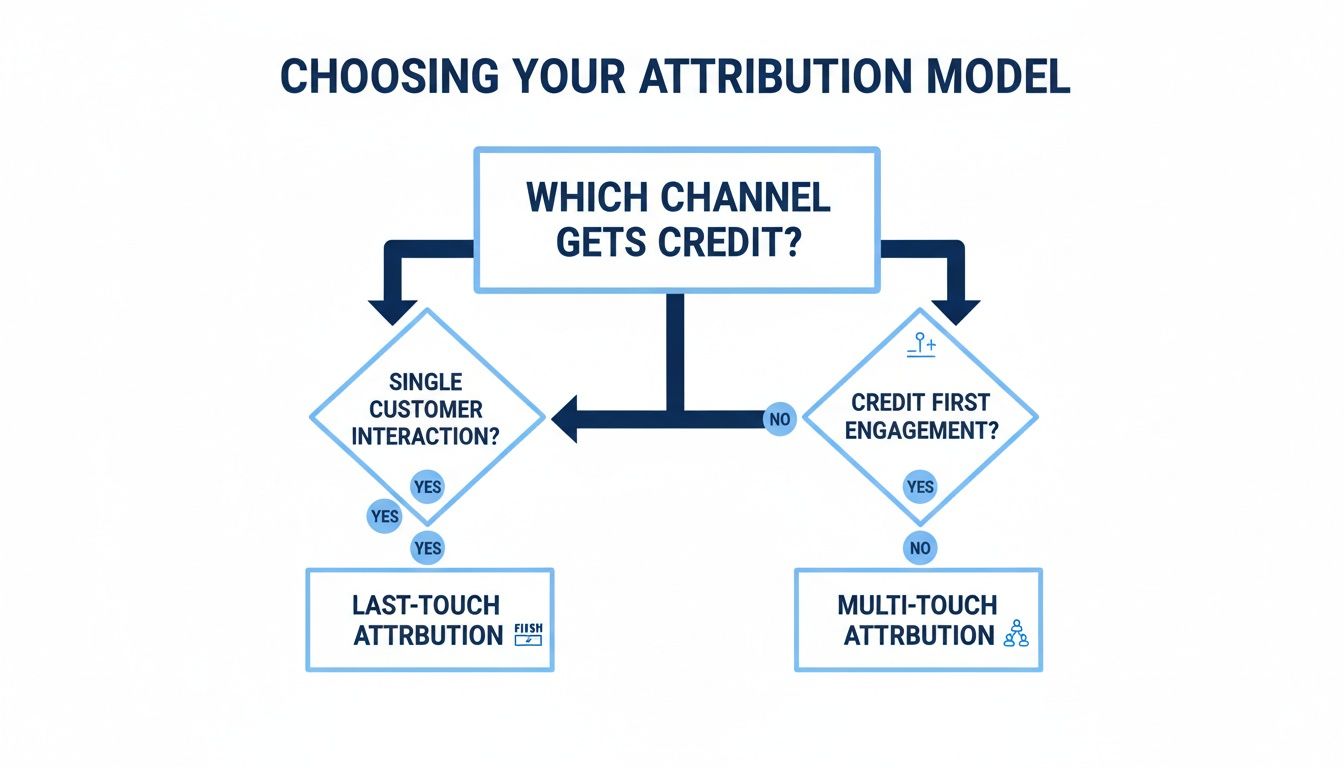
This decision tree helps visualize how different models assign credit—a puzzle that accurate UTM tracking is essential for solving.
Streamline Stakeholder Communication
At the end of the day, proving ROI isn't just about knowing the numbers yourself; it's about communicating them effectively to your boss, your clients, or the leadership team. PostSyncer’s Scheduled Reporting feature automates this entire process. You can build custom reports that highlight the most important KPIs and have them automatically sent out on a weekly or monthly basis.
And for agencies juggling multiple clients, the Multi-Workspace Dashboards are a total game-changer. It gives you a high-level command center to monitor performance and prove value across every single client account at once, saving countless hours and making your impact undeniable.
Common Questions About Measuring Social Media ROI
Even with the best framework, calculating your social media ROI can feel like you're trying to solve a puzzle in the dark. It’s totally normal to hit a few walls or run into questions that seem to have no easy answer. This section is all about tackling those common hurdles head-on, giving you clear, practical answers so you can measure your impact with confidence.
Think of these as the final checks before you present your numbers. Nailing these details means your ROI calculations won't just be accurate—they'll be solid enough to stand up to scrutiny when the tough questions start coming from stakeholders.
How Do I Measure the ROI of Organic Social Media?
This is the big one. Without a direct ad spend to anchor your numbers, measuring organic social media feels a bit abstract. It's definitely trickier than tracking a paid campaign, but it's far from impossible to prove the value your organic efforts bring to the table. The trick is to stop thinking about ad metrics and start focusing on the tangible value your organic traffic creates.
The most straightforward way to start is by getting serious about tracking conversions from your organic channels. You have to connect the dots between a post you made and a valuable action someone took on your website.
Here are a few ways to do just that:
- Use Unique UTM Parameters: This is non-negotiable. Create specific UTM codes for the link in your bio and for any links you share in your organic posts. This lets you isolate that traffic in Google Analytics and see exactly which visits, sign-ups, or sales came directly from your unpaid content.
- Assign a Monetary Value to Goals: Not every conversion is a direct sale, and that's okay. Figure out the average value of a lead (Lead Value = Total Sales Revenue / Total Leads) or what a new email subscriber is worth to your business. Once you have that number, you can assign a clear dollar value every time organic social generates one of those actions.
- Track Assisted Conversions: Don't sleep on this report in Google Analytics. The "Assisted Conversions" report shows you every time organic social was a touchpoint in a customer's journey, even if it wasn't the final click before a purchase. This is powerful proof that your organic efforts are teeing up sales down the line.
What Is a Good ROI for Social Media Marketing?
Everyone wants to know the magic number, but the honest answer is: it depends. There’s no universal benchmark for "good" social media ROI. What one company considers a home run might be a total loss for another. It all comes down to your industry, your profit margins, and your specific business model.
A high-margin software business might be ecstatic with a 300% ROI. On the other hand, a low-margin e-commerce brand might need to hit a 1000% ROI just to turn a profit after accounting for the cost of their products.
The most important benchmark isn't what some other company is doing—it's your own progress. The real goal is to get better every quarter, not to chase a generic industry average.
That said, having a few general targets can be a helpful starting point:
- Overall Marketing ROI: A common goal for marketing as a whole is a 5:1 ratio, which is a 500% ROI. This simply means you're making $5 for every $1 you put in.
- Return on Ad Spend (ROAS): For paid social ads specifically, a ROAS between 3x and 5x is often seen as a solid performance.
The best approach? Figure out your baseline ROI right now, and then make it your mission to beat that number with every new campaign and strategy you launch.
What Are Common Mistakes to Avoid When Calculating ROI?
The road to an accurate ROI calculation is paved with potential mistakes. Knowing what they are ahead of time can save you from reporting skewed numbers that lead to bad decisions. Getting the process right is just as crucial as the final number itself.
Steer clear of these four classic blunders:
- Focusing on Vanity Metrics: This is the oldest mistake in the book. Presenting likes, shares, and follower counts as ROI is a non-starter. While they can signal a healthy and engaged audience, they mean absolutely nothing to the bottom line if you can't link them to actual business results like leads and sales.
- Forgetting to Include All Costs: So many marketers only count their ad spend when calculating the "Investment." This is a massive oversight. A true ROI calculation has to include everything: your social media tools, content creation costs (like freelance fees or stock photos), and a proportional slice of your team's salaries. Forgetting these costs will give you a dangerously inflated ROI.
- Using a Flawed Attribution Model: Relying only on last-click attribution will almost always make social media look like it's underperforming. Social media is often the very first place a customer discovers your brand, but last-click gives all the credit to whatever they clicked right before buying.
- Failing to Set Clear Goals: If you don't have clear, measurable goals from the start, you have nothing to measure against. A vague goal like "increase engagement" is useless for an ROI calculation. A specific goal like "generate 100 qualified leads from our LinkedIn campaign" gives you a concrete target to measure your success against.
How Often Should I Report on Social Media ROI?
Finally, you need to find the right reporting rhythm. Report too often, and you'll end up overreacting to normal daily blips. Report too infrequently, and you could miss key trends or opportunities to fix something that's broken.
The ideal frequency really depends on your business cycle and the kind of campaigns you’re running.
- Monthly Reporting: For most businesses, this is the sweet spot. It gives you enough data to spot real trends and see how you’re performing without getting bogged down in daily noise.
- Campaign-Based Reporting: If you're running a short-term push, like a flash sale or a product launch, you should measure ROI as soon as it's over to understand its immediate impact.
- Quarterly Reporting: For bigger, long-term goals like brand awareness, a quarterly check-in makes more sense. It allows you to see the cumulative effect of your strategy over a more meaningful stretch of time.
Ready to stop guessing and start proving the value of your social media? PostSyncer brings all your analytics into one place, automates UTM tracking, and gives you scheduled reports to make calculating your ROI easier than ever. Start your free 7-day trial today and see the difference for yourself!