








So, you've poured your heart and soul into creating the perfect Instagram post. The photo is stunning, the caption is witty, and the hashtags are on point. You hit "Share" and… crickets. Sound familiar?
We've all been there. It’s one of the most frustrating feelings for a creator. The hard truth is that even the most incredible content can fall flat if you post it at the wrong time. Generally speaking, the sweet spots on weekdays tend to be between 11 AM and 1 PM and again from 7 PM to 9 PM. These are the times when people are often taking a lunch break or winding down for the evening, scrolling through their feeds.
But that’s just a starting point.
Why Your Instagram Posting Time Is a Strategic Advantage
Think of your Instagram feed like a retail store. You wouldn't throw open your doors at 3 AM and expect a flood of customers, right? Choosing when to post isn’t just a tiny detail; it’s a massive strategic decision. It's easy to fall into the trap of thinking, "If the content is good enough, it'll find its audience." But that mindset ignores how Instagram actually works.
The platform's algorithm gives a huge advantage to posts that get a rush of engagement right after they go live. That first hour is make-or-break. The likes, comments, and shares you get in that initial window send a powerful signal to Instagram that your content is worth showing to more people.
Posting when your audience is asleep or busy is like performing to an empty theater. Your masterpiece gets buried in the feed before anyone even has a chance to see it.
Finding Your Audience’s Golden Hour
Every single account has its own unique "golden hour"—that perfect window when their followers are most active, scrolling, and ready to engage. This peak time isn't random; it's shaped by a few key things that define your audience's behavior.
- Where Your Followers Live: If your audience is scattered across the globe, a 9 AM post in New York is a sleepy 6 AM in Los Angeles. You could be missing a massive chunk of your audience right from the start.
- Your Niche and Industry: A B2B tech company will likely find its audience engaged during the 9-to-5 grind. On the other hand, a popular local restaurant will probably see a spike in engagement on evenings and weekends when people are making dinner plans.
- The Daily Grind: Think about your followers' daily routines. Are they students checking their phones between classes? Parents scrolling after putting the kids to bed? Commuters killing time on the train? Their lifestyle dictates when they're online.
The goal here isn't just to post for the sake of posting—it's to post with purpose. When you start to understand these factors, you can sync up your content with your audience's digital life. It's how you make sure your message doesn't just get sent, but that it actually lands with maximum impact.
This guide is going to walk you through exactly how to pinpoint that perfect timing for your account.
Finding the Universal Best Times to Post on Instagram
When you're just starting out or your audience is scattered across the globe, you don’t have any personalized data to work with. And that’s totally okay. Think of it like a chef using a classic, time-tested recipe before they start adding their own unique flair. Universal data gives you that solid, reliable starting point.
These "best times" have been figured out by looking at millions of posts and interactions, and they reveal some pretty clear patterns in how people behave online. They usually line up with the natural lulls in a typical day—that morning commute scroll, the lunchtime digital catch-up, and the evening wind-down. For new accounts, these windows offer the best shot at catching people while they’re actively browsing.
This simple flow chart really shows how timing is the first domino to fall when it comes to building engagement and growth.
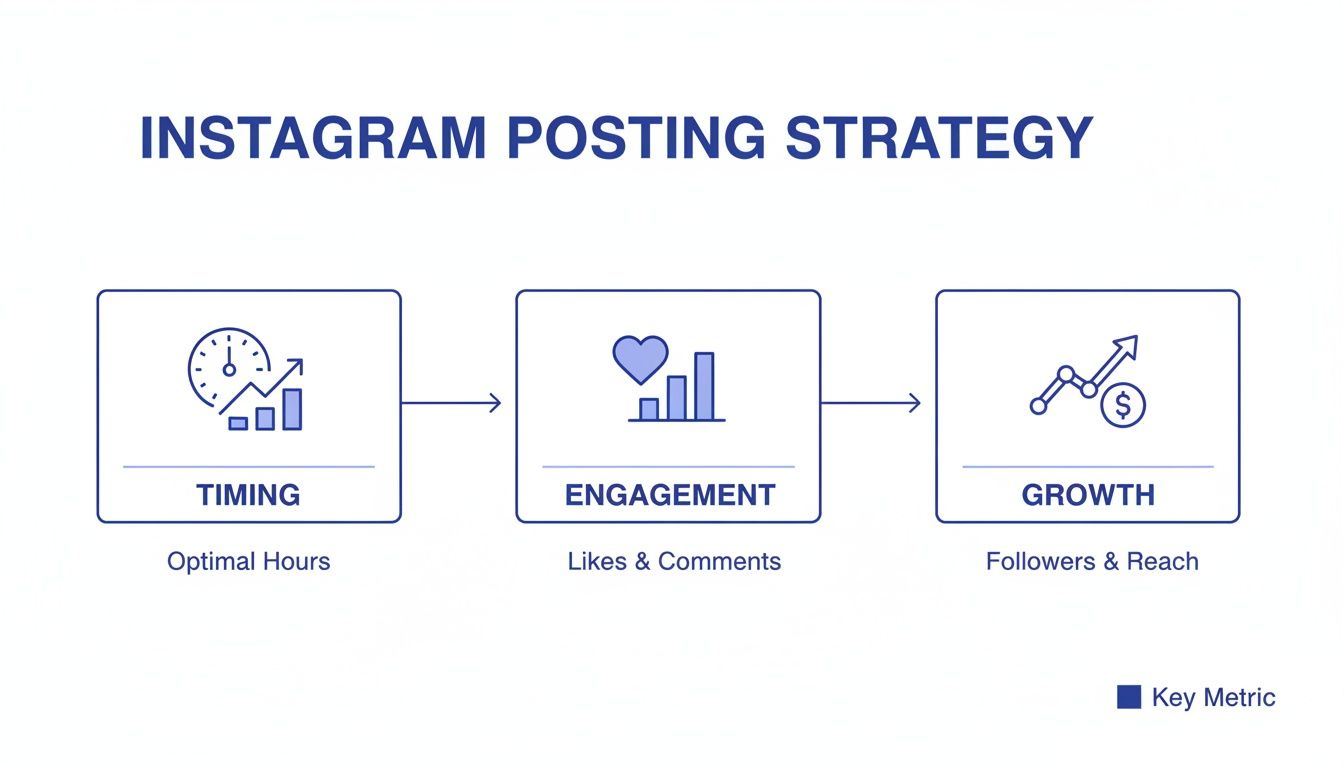
As you can see, getting your timing right is the foundation you build everything else on—from strong engagement all the way to sustainable growth.
General Posting Times to Test
Look, every audience is unique, but massive studies have uncovered some clear high-engagement periods that work for almost everyone. These are the perfect baseline for your first stab at a posting schedule.
Broad global data shows that Tuesdays through Thursdays often get the best engagement, especially between 11 AM and 6 PM. Wednesdays, in particular, seem to be a sweet spot, with strong activity from 11 AM to 6 PM and another burst from 7 PM to 9 PM. Other research backs this up, pointing to midweek afternoons as prime time. Weekends, on the other hand, tend to be quieter, especially on Saturdays.
Think of the table below as your quick-reference guide for the first few weeks. Just treat these times as your local time zone and see what happens.
General Best Times to Post on Instagram by Day
| Day of the Week | Primary Posting Window (Local Time) | Secondary Posting Window (Local Time) |
|---|---|---|
| Monday | 3 PM - 9 PM | - |
| Tuesday | 11 AM - 6 PM | 7 PM - 9 PM |
| Wednesday | 11 AM - 6 PM | 7 PM - 9 PM |
| Thursday | 11 AM - 6 PM | - |
| Friday | 10 AM - 5 PM | - |
| Saturday | 11 AM - 1 PM | 4 PM - 6 PM |
| Sunday | 4 PM - 6 PM | - |
Remember, these are powerful starting points, not permanent rules etched in stone. For a more detailed look, you might want to check out our complete guide covering the best times to post across all the major platforms.
And while this article is all about Instagram, the core idea of finding the best timing applies everywhere. You can use similar principles to explore optimal posting times for TikTok and get your content seen there, too. Now, the next step is to use these benchmarks to start gathering your own data.
How Your Follower Count Shapes Your Posting Strategy
Let’s get one thing straight: a universal, "perfect" time to post on Instagram just doesn't exist. As your audience grows, the rules of the game change entirely, and your strategy has to evolve right along with it. Your follower count isn't just a number to brag about; it’s a powerful indicator of your account's pull in a very crowded room.
Think of it like a band trying to get noticed. A small indie group isn't going to book the stadium for a primetime Saturday show. Instead, they'll play smaller, late-night gigs, building a loyal following in a less competitive space. Meanwhile, the global superstar—the mega-influencer—can command the stage whenever they want, knowing their massive fanbase will show up in force.
This is exactly how you should think about your Instagram timing. Smaller accounts often see way more traction by posting in off-peak hours, while bigger players can drop content during the busiest times and still come out on top.
Tailoring Your Timing to Your Account Size
The logic here is pretty simple. If you have a small following and post at 3 PM on a Tuesday, you're not just posting—you're competing. You’re up against every major brand and creator fighting for a sliver of attention on the feed. By shifting your schedule to less conventional hours, you give your content a real fighting chance to be seen by the people who already follow you.
On the flip side, accounts with huge followings have earned their stripes. The algorithm already trusts them and prioritizes their content. They can post during the digital rush hour and still crush it because their audience is literally waiting for their next post to drop.
Don't fight for attention during peak hours if you don't have the audience to back you up. Instead, find the less crowded windows where your voice can be heard loud and clear. This is strategic posting in action.
Data-Backed Posting Times by Follower Count
Recent data backs this up completely. A huge analysis of over six million Instagram posts found that while the best overall time to post is around 5 AM, the real magic happens when you segment by audience size.
For example, Nano-influencers (1K-5K followers) do surprisingly well posting at 5 PM on weekdays, catching people right as they're clocking out. Micro-influencers (5K-25K) find their sweet spot much later, around 11 PM or midnight. It sounds counterintuitive, but this late-night strategy helps them dodge the daytime chaos and connect with a smaller, more engaged night-owl crowd. You can dig deeper into these audience-specific insights over at Later.com.
Here’s a quick look at how the strategy shifts as an account scales up:
- Mid-Tier (25K-100K): These accounts start to capture peak engagement on Sunday and Monday at midnight.
- Macro (100K-500K): The Sunday and Monday at midnight window remains a powerhouse for this group, too.
- Mega (500K+): With a massive audience, they can own primetime, seeing huge success at 10 AM on Mondays.
Figuring out where you fit is the first step in moving from generic advice to a personalized schedule that actually gets results.
Using Instagram Insights to Find Your Personal Best Times
While global data offers a fantastic starting point, it’s like using a map of the entire country to find your local coffee shop. To get real precision, you need to zoom in on your own neighborhood. This is where Instagram Insights, the platform's free, built-in analytics tool, becomes your most valuable asset.
This tool is the bridge from educated guesses to data-driven decisions. It shows you exactly when your followers are online, scrolling, and most likely to engage with your content. You can finally stop wondering what time to post on Instagram and start knowing for sure. The best part? This data is readily available to anyone with a Business or Creator account.
Navigating to Your Audience Data
Finding your personal peak times only takes a few taps. Think of it as getting a backstage pass to your audience's daily habits.
- Head to your Instagram profile and tap the Professional Dashboard button right below your bio.
- From there, tap on Account Insights for a bird's-eye view of your performance.
- Select the Total Followers metric to dive deeper into who your audience is.
- Scroll down to the bottom, and you'll find the goldmine: the Most Active Times section.
This is where the magic happens. Instagram lays it all out for you in a simple bar chart, showing the hours and days your followers are most active. This isn't theoretical data from a study; it's a direct reflection of your unique audience's behavior over the past week.
This screenshot shows a typical "Most Active Times" chart you'll find inside the app.
The darker blue bars signal higher activity. It's easy to see that for this account, engagement really picks up around 6 PM and 9 PM on most days.
Translating Insights into a Posting Schedule
Once you have this chart in front of you, the next step is to turn those colorful bars into a concrete posting schedule. Look for consistent patterns. Is there a spike every weekday around lunchtime? A surge of activity on Sunday evenings? These are your golden windows.
Key Takeaway: Your goal is to post about an hour before these peak times. This gives the algorithm enough time to process your content and start distributing it, ensuring it hits your followers' feeds right as they're logging on.
A common mistake is only looking at one day's data. Be sure to switch between the "Hours" and "Days" views to get the full picture. A single day might be an anomaly, but a week's worth of data reveals the reliable trends you can count on.
While Instagram Insights is powerful, it offers a pretty basic overview. For anyone serious about digging deeper and comparing metrics over longer periods, exploring some of the best social media analytics tools can unlock more detailed reports and strategic recommendations. These platforms often combine your personal data with broader industry trends to give you an even sharper edge.
Why Posting Frequency and Timing Go Hand in Hand
Nailing the perfect time to post on Instagram is a huge win, but it's only half the battle. Think of it like a popular coffee shop that figures out its busiest hour is 8 AM. If it only opens its doors once a week at that perfect time, it’s still leaving a ton of money on the table. The same logic applies to your content; timing is powerful, but consistency is what builds momentum.
The Instagram algorithm is smart, and it definitely rewards accounts that show up consistently. Every single post you share at the right time is a signal that your account is active and provides fresh value. This regular activity not only keeps your brand top-of-mind for your followers but also tells Instagram that you're a reliable source of content worth showing to more people.
The Shift Towards Higher Frequency
That old fear of "spamming" your followers with too much content? It's quickly becoming a thing of the past. In reality, the accounts that are really crushing it are posting more, not less.
Recent data shows this trend is only picking up steam. For instance, Instagram powerhouses with over 50,000 followers ramped up their output to an average of 9.3 posts per week—a huge jump from just 6.5 the year before. It’s the same story for accounts in the 10,000 to 50,000 follower range, which boosted their weekly posts from 3.1 to 5.1. You can dig into more of these account size and frequency findings on Statista.
This surge makes the strategy crystal clear: posting more often is essential for staying visible in today's crowded feeds. The more you post, the more chances you get to connect with your audience when they're actually online and scrolling.
Key Takeaway: Stop thinking of frequent posting as annoying your followers. Instead, see it as consistently showing up with valuable content right when they're most likely to see and appreciate it.
Of course, keeping up a high posting frequency without letting your quality slip is the real challenge. This is where having a solid scheduling tool like PostSyncer becomes a total game-changer. It lets you plan and line up your content way in advance, so you can maintain a consistent, high-impact schedule without the daily scramble.
Automate Your Posting Schedule with AI-Powered Tools
Let's be honest: trying to manually track your best posting times and then actually be online at that exact moment is more than just a hassle—it's completely unsustainable. This is exactly why modern social media management tools have gone from a simple convenience to a core part of any serious strategy. They turn the guesswork of finding the right time to post into a data-driven science.
These platforms do a lot more than just send you a reminder. They use AI to dig into your account's unique performance data, learning exactly when your audience is most likely to engage. They can even predict future peak windows with startling accuracy. This means you can schedule your content to go live at the perfect moment, automatically, without ever having to hit "share."
This isn't just about saving time; it's about maximizing precision. AI scheduling ensures every single post gets the best possible launch, capturing that crucial initial engagement the algorithm loves so much.
This level of smart automation completely changes your workflow. You can plan out your content weeks or even months in advance, feeling confident that each post is being deployed for maximum impact. It frees you up to do what you do best: create killer content instead of constantly watching the clock.
How AI Elevates Your Strategy
AI-powered scheduling tools are so much more than a simple calendar. They bring features to the table that give you a real competitive edge by making your entire process smarter, not just faster.
A few key features often include:
- Predictive Scheduling: The AI crunches your past engagement numbers and flat-out tells you the best times to post for your specific audience.
- Advanced Analytics: You get much deeper insights into what's working, helping you understand which content formats resonate and when.
- Collaborative Calendars: If you work with a team, everyone can plan, approve, and schedule content in one central hub, keeping your brand voice perfectly consistent.
For marketers looking to streamline their workflow and hit those peak engagement windows every time, exploring AI-powered scheduling tools such as LunaBloom AI can be a total game-changer.
If you want to take a deeper dive into how this tech actually works, our guide on automating Instagram posts breaks down the entire process and its benefits. By bringing these tools into your workflow, you stop posting reactively and start building a proactive, intelligent strategy.
Got Questions About Your Instagram Schedule?
Even with a solid game plan, a few questions always seem to pop up when you're trying to nail down the perfect Instagram schedule. Let's tackle the most common ones so you can fine-tune your approach and post with confidence.
Do Reels Need a Different Posting Time Than Feed Posts?
Yes, they often do. While your audience’s general activity is a great starting point, Reels are all about entertainment. Think about when you personally kick back and scroll for fun—it's usually during downtime like evenings (8 PM to 11 PM) or on the weekends.
The best move is to test both. Use your Instagram Insights for a baseline, but don't be afraid to experiment by dropping Reels during those peak entertainment hours. An AI-powered scheduling tool can also zero in on this for you, analyzing your Reels' performance data to find their own sweet spot.
Pro Tip: It all comes down to user intent. People scroll their feed to catch up, but they watch Reels for discovery and a good laugh. Schedule your content to match the mindset your audience is in.
How Do I Handle Followers in Different Time Zones?
This is a huge one for anyone with a global audience. If your followers are split between, say, New York and Paris, your 9 AM post in the US is already 3 PM in France. The first thing you should do is head to your Instagram Insights and check the "Top Locations" report.
If you’ve got a significant split, you have a couple of solid options:
- Post Multiple Times: Schedule unique posts designed to hit the peak engagement times for each of your major audience regions.
- Find the Overlap: Look for a time that catches the most people at a reasonable hour. For example, late morning in the US often works well because it catches your European audience in their evening.
This is exactly the kind of problem scheduling tools were built to solve. They let you map out posts for different time zones without having to be online around the clock.
How Long Should I Test a New Posting Time?
Give it at least two to four weeks. I know it's tempting to judge after a day or two, but a single post is never enough data. Engagement can swing wildly based on the content itself, a trending topic, or even a holiday you forgot about.
Stick with a new, consistent schedule for a few weeks straight. Afterward, you can compare the average engagement (likes, comments, shares) against your old schedule's performance. This longer testing period smooths out the random highs and lows, giving you a real, honest look at what’s working.
Stop guessing and start scheduling with precision. PostSyncer's AI-powered "Best Time to Post" feature analyzes your unique audience data to automatically publish your content for maximum impact. Plan your entire calendar, collaborate with your team, and watch your engagement grow. Start your free 7-day trial of PostSyncer today.