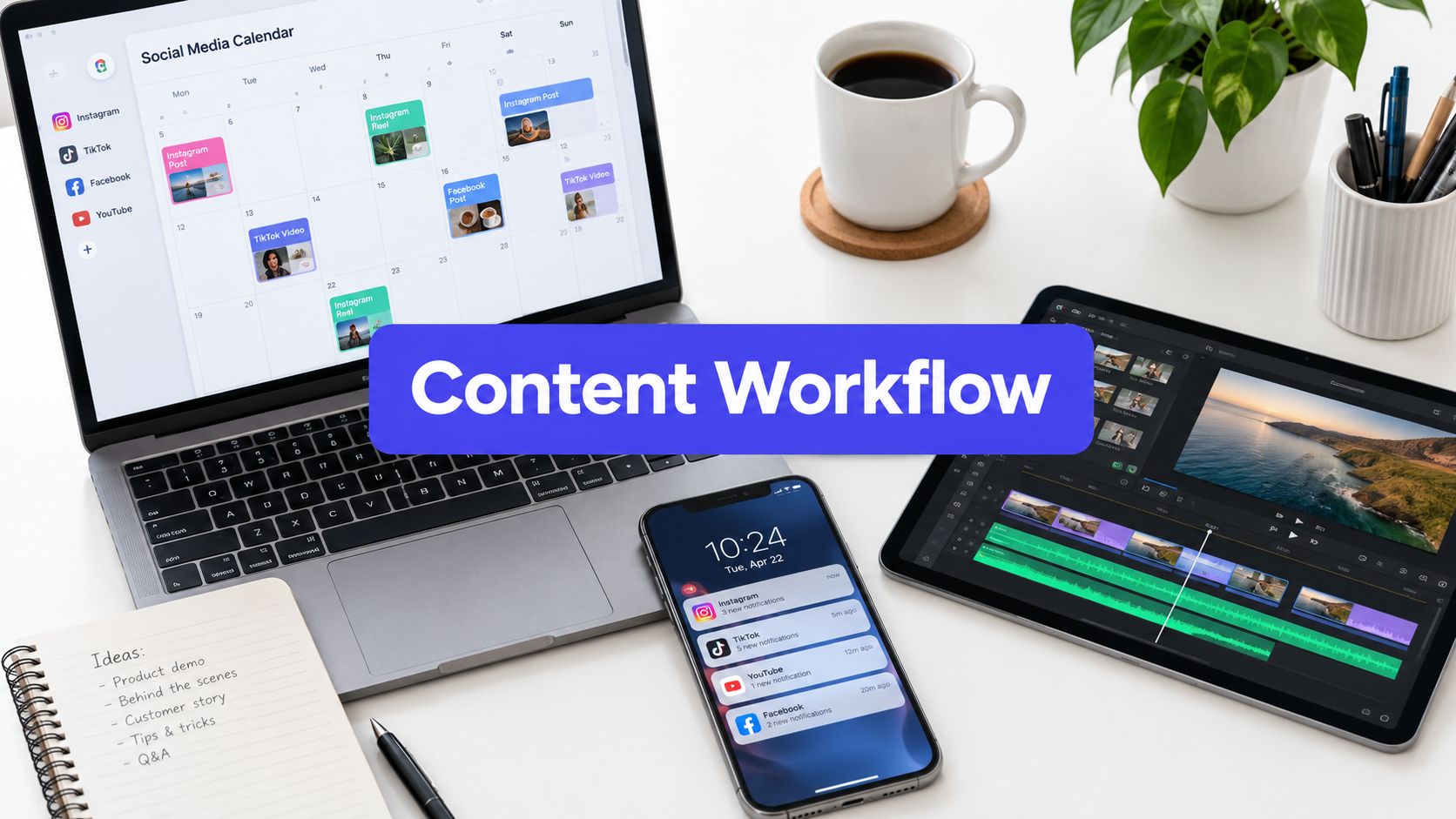











We’ve all been there: staring at a blank content calendar, the pressure mounting. That familiar dread is exactly why automated social media posts have gone from a "nice-to-have" to an absolute necessity for anyone serious about growth. It’s a shift away from the frantic, manual scramble to a smarter, scheduled system that delivers consistency without the burnout.
Why Smart Marketers Automate Social Media

Let's be real: keeping up with every social network is a beast. Juggling brainstorming, creating content, scheduling, and then trying to make sense of the analytics... it's a recipe for exhaustion. This is where a solid automation workflow completely changes the game.
And forget that old myth about automation being robotic or impersonal. Modern automation is all about building a reliable content engine. It’s designed to handle the repetitive heavy lifting so your creative energy can go where it really counts: talking to your community and building your brand.
To really get what this means in practice, let's look at the difference between the old way and the smart way of managing social media.
Manual VS Automated Social Media Workflows
| Task | Manual Workflow (The Old Way) | Automated Workflow (The Smart Way) |
|---|---|---|
| Posting | Log into each platform daily to publish content. | Schedule weeks of content in one session. |
| Content | Create new content for every single post. | Repurpose evergreen content automatically. |
| Timing | Guess the best times or post when you're free. | Publish at optimal, data-driven times for each network. |
| Approvals | Clunky email chains and spreadsheet tracking. | Streamlined, in-app approval flows. |
| Analytics | Manually pull data from each platform into a spreadsheet. | Unified dashboard with cross-platform performance data. |
| Consistency | Inconsistent posting when schedules get busy. | Flawless consistency, even during weekends or holidays. |
See the difference? One is a constant struggle, while the other is a system built for scale and sanity.
Reclaim Your Most Valuable Asset: Time
The biggest win from automation? You get your time back. Instead of the daily grind of logging in and posting, you can batch-schedule weeks—or even months—of content in one focused session.
Think about what you could do with an extra 5-10 hours a week:
- Actually Engage: Spend that time in the comments and DMs, building real connections.
- Analyze and Pivot: Dive into your analytics to see what’s working and double down on it.
- Get Creative: Finally have the headspace to work on that big campaign idea or experiment with new video formats.
Achieve Unbreakable Consistency
Consistency is currency on social media. Every algorithm rewards it. When you post on a regular schedule, you signal that you're an active, valuable account, which keeps you top-of-mind with your audience. But trying to maintain that rhythm manually is a constant battle.
Automated social media posts make this effortless. A tool like PostSyncer becomes your digital publishing partner, ensuring your content goes live at the perfect time, every time—even if you’re on vacation.
This isn’t just a good idea; it’s the standard. A 2025 report revealed that a staggering 96% of social media pros now use AI tools in their workflows, and 72.5% rely on them daily. It's how agencies scale from a few posts to over 72 posts per week without burning out their teams. You can see the full breakdown in the state of AI in social media report from Metricool.
Automation isn’t about replacing the marketer; it's about empowering them. It handles the repetitive tasks so you can focus on the strategic work that drives real growth. Your content remains human-led, but its delivery becomes machine-efficient.
Building Your Automated Content Engine

Let’s be real—automation is useless if the content you're pushing out is random and unplanned. The secret to making automated social media posts actually work for you is building a powerful content engine. Think of it as a well-oiled machine that consistently feeds your scheduler high-quality, relevant material.
It all boils down to strategy. Before you even think about writing a caption, you have to know what you’re trying to achieve on each platform. Is your LinkedIn goal to drum up B2B leads and establish your authority? Or is your Instagram all about telling visual stories to drive e-commerce sales?
Your goals will shape every piece of content you create and automate. A SaaS startup, for instance, would build an engine fueled by case studies and industry data. A fashion brand, on the other hand, will lean heavily on user-generated content, behind-the-scenes looks, and product showcases.
Define Your Core Content Pillars
Your content pillars are the 2-4 recurring themes your brand will become known for. These are the foundational topics that guide your content, create consistency, and let your audience know exactly what to expect from you.
Imagine a fitness coach. Their pillars might look something like this:
- Workout Tutorials: Quick, punchy videos showing proper exercise form.
- Nutrition Tips: Simple and healthy recipes shared through carousels.
- Client Success Stories: Powerful before-and-afters and glowing testimonials.
- Motivational Mindset: Short text posts or threads to inspire and encourage.
When you have defined pillars, the "what should I post today?" panic disappears. Instead, your thought process becomes, "It's Tuesday, so it's time for a Nutrition Tip." This kind of structure is an absolute game-changer for automation.
With 5.45 billion people now on social media, cutting through the noise is a monumental task. Over 80% of content discovery is now driven by algorithms, so feeding them a steady stream of quality content is non-negotiable. Interestingly, high-quality automated posts can still pull in solid engagement rates between 1.4% and 2.8%. You can dig into more stats about AI's impact on social media on ElectroIQ.
A content engine isn't just a folder of ideas; it's a strategic library of assets, categorized and ready for deployment. Your goal is to build a system where you can schedule a month's worth of diverse, on-brand content in a single afternoon.
Build Your Evergreen Content Library
Once your pillars are set, it’s time to start stockpiling your evergreen content library. This is your treasure trove of posts that stay relevant long after they’re published, independent of fleeting trends. This is the fuel for your automation engine.
Your library should be a healthy mix of formats:
- In-depth how-to guides from your blog.
- Customer testimonials and rave reviews.
- Answers to your most frequently asked questions.
- The story behind your brand or "day in the life" content.
- Foundational industry stats and knowledge.
The trick is to keep this library organized. If you're using a tool like PostSyncer, you can build out a content library and use labels to categorize every single post for easy access.
Use Labels To Organize Everything
Labels are the secret weapon for creating a perfectly balanced content mix. By assigning a label to each piece of content based on its pillar and format (e.g., Nutrition-Tip and Carousel), you set the stage for smart automation.
This system lets you build a schedule that practically runs itself. In PostSyncer, you can set up your calendar to pull content from specific labels on designated days.
Example Automated Schedule Using Labels:
- Mondays: Post one item from the
Motivational-Mindsetlabel. - Tuesdays: Post one item from the
Nutrition-Tiplabel. - Wednesdays: Alternate between the
Workout-TutorialandClient-Storylabels. - Fridays: Post an engaging question labeled
Community-Engagement.
This simple workflow ensures your feed stays varied and on-strategy without you having to manually pick and choose posts every day. Your content engine hums along in the background, publishing the right mix of content to keep your audience hooked and your brand top-of-mind.
Generating High-Quality Content With AI
Let's be real: the hardest part of social media management is the relentless need for new content. It's a creative grind that can easily lead to burnout. This is where AI stops being a buzzword and becomes your most valuable assistant, helping you generate a stream of high-quality material for your automated social media posts.
Forget the generic, robotic text you might be picturing. The smartest way to use AI today is as a powerful repurposing engine. I'm talking about taking a single, long-form asset—like a deep-dive blog post, a customer case study, or even just a product page—and letting AI spin it into a dozen unique, platform-ready posts.
Turn Any Source Into Social Gold
The real magic of today's AI, like the Content Agent built right into PostSyncer, is its ability to understand and break down existing content. You can feed it almost anything, and it will pull out the core ideas to build an entire campaign's worth of posts.
Say you just published a blog post, "10 Time-Saving Tips for Remote Teams." You can drop that URL into the AI and watch it generate:
- An X (Twitter) Thread: A perfectly formatted thread, breaking down each tip into its own tweet, complete with the right hashtags.
- An Instagram Carousel: A multi-slide post, with each slide dedicated to a single tip, along with a compelling summary caption.
- A LinkedIn Article: A more professional, thought-leadership summary that pulls out the key takeaways for a business-focused audience.
- A TikTok Video Script: A quick, punchy script with a strong hook, key points, and a clear call-to-action for a short-form video.
This isn't some futuristic concept; it's how smart marketers are working right now. In fact, 83% of marketers say generative AI helps them produce significantly more content, while 78% use it for brainstorming and 72% rely on it for drafting posts.
Tailoring Tone And Format Across Channels
You already know that a one-size-fits-all strategy doesn't work. A post that kills it on LinkedIn will almost certainly flop on TikTok. This is where you need to get specific with your AI prompts. Instead of a vague "write a post," you need to give the AI clear directions.
Let's take a case study about a successful client project. Here's how you'd guide the AI for different platforms:
- For LinkedIn: "Create a professional LinkedIn post from this case study. Focus on the business challenge, our solution, and the final results (35% increase in efficiency). Keep the tone formal and add B2B hashtags like #ProjectManagement and #DigitalTransformation."
- For Instagram: "Generate a 3-slide Instagram carousel concept from this case study. Slide 1 needs a hook about the client's problem. Slide 2 should visualize our solution. Slide 3 must feature the main result and a client quote. Write a friendly, inspiring caption."
- For X (Twitter): "Draft a 4-part thread summarizing this case study. Kick it off with a bold claim about the result. Each tweet after that should briefly explain a step we took. End with a question to get a conversation started."
The key is to treat the AI as a junior copywriter. You provide the raw material and the strategic direction (platform, tone, format, goal), and it handles the initial drafting, saving you hours of work.
This strategic prompting is what separates bland, generic AI content from social posts that actually perform. For teams that want to dig deeper, an LLM monitoring API can be a huge asset. It helps you track the performance of your AI models, ensuring the content they produce stays on-brand and effective over time.
Going Beyond Text Generation
The best AI tools are no longer limited to just text. The latest versions can create multimedia content that can supercharge your automated social media posts. For instance, PostSyncer’s AI can analyze a product page on your website and automatically generate a short promotional video, complete with stock footage, text overlays, and background music.
This is a game-changer. It dramatically lowers the barrier to entry for video, which is absolutely essential for gaining traction on platforms like TikTok, Instagram Reels, and YouTube Shorts. Once you learn how to use these tools, you can fill your content calendar with a rich mix of formats that used to take a whole team to produce. For more on this, check out our deep dive on AI for social media content creation.
Ultimately, using AI to generate content is all about achieving scale and efficiency without sacrificing quality. It gives you the power to maintain a consistent, high-impact presence across all your channels by working smarter, not harder.
Mastering Your Automated Scheduling Workflow
Alright, this is where the magic happens. You've got your strategy and your content library—now it's time to connect the dots and make them work for you. A brilliant plan is one thing, but a seamless automated scheduling workflow is what turns that plan into a powerful, consistent social media presence that practically runs itself.
The heart of any solid scheduling process is a good old visual calendar. Tools like PostSyncer give you that essential bird's-eye view of your entire month across every channel. You can instantly spot content gaps, make sure you're balancing your content pillars correctly, and avoid bombarding your audience with the same type of post over and over. A quick glance tells you if you have enough videos, educational carousels, and community questions teed up for the week.
This visual approach is also the key to unlocking some more advanced scheduling techniques that can really boost the performance of your automated social media posts.
Setting Up Recurring Time Slots
This is one of the most powerful automation features out there, and it’s a total game-changer. Instead of scheduling every single post by hand, you build a "set it and forget it" weekly template that aligns with both your content strategy and your audience's peak activity times.
For example, your weekly rhythm might look something like this:
- Mondays at 9 AM: A motivational quote from your
Mindsetcategory to kickstart the week. - Tuesdays at 1 PM: A value-packed educational carousel from your
How-Tocategory. - Thursdays at 4 PM: A short, fun video from your
Behind-the-Scenescategory. - Fridays at 11 AM: An open-ended question from your
Communitycategory to spark conversation.
Once you set up these recurring slots, your scheduling tool will automatically grab the next available post from the right content library and drop it into the queue. This is what smart automation is all about—it creates consistency and variety with almost zero manual effort. It’s the engine that turns your raw content into a perfectly orchestrated social feed.
This is especially efficient when you use AI to expand on your core content, turning one idea into multiple, unique posts for your schedule.

The takeaway here is pure efficiency. A single piece of content can be intelligently repurposed, saving you a ton of time while keeping your automated schedule packed with fresh material.
Building In Approval Workflows
If you're working with a team or running an agency, you know that brand consistency is everything. A single accidental "rogue post" can do real damage. That's why approval workflows, a core feature in platforms like PostSyncer, are absolutely critical.
An approval workflow simply adds a review step before anything goes live. A junior team member can draft the posts for the week, and they’ll automatically be sent to a manager for a final once-over. The manager can approve, reject, or leave notes for edits right inside the platform. Say goodbye to messy email threads and lost comments in spreadsheets.
An effective approval workflow is your brand's safety net. It empowers team members to create content freely while ensuring every single post that goes public is polished, on-brand, and error-free.
Customizing for Platform-Specific Nuances
Finally, a truly masterful workflow respects the unique quirks of each social network. You can't just copy and paste the same post everywhere and expect it to work. The best social media scheduling software lets you customize for each platform.
- Instagram: Schedule your first comment to publish with your post. This is perfect for dropping your hashtags in immediately without cluttering up the caption.
- LinkedIn: Easily format and schedule multi-image carousels (as PDFs), which the platform's algorithm loves.
- X (Twitter): Queue up an entire thread to post automatically, setting timed intervals between each tweet to make it feel like you're posting live.
- TikTok & Reels: Upload your video and set a custom thumbnail to make sure it grabs attention right from the start.
By taking a few extra seconds to tailor each post within your scheduling tool, you're playing to each platform's strengths. This ensures your content not only looks native but also performs better, driving more engagement and reach. It’s this attention to detail that separates a basic scheduling tool from a true partner in your automation strategy.
Analyzing Performance To Optimize Your Strategy
Getting your automation up and running feels great, doesn't it? But the real magic happens next. Mastering automated social media posts isn't about setting and forgetting; it’s about creating a smart feedback loop. You post, you measure, you learn, and you refine. This is how you turn a simple scheduler into a powerful growth engine.
First things first, let's look past the vanity metrics. Likes and follower counts are nice for a quick ego boost, but they won't tell you if your strategy is actually driving business results. To really prove the value of your work, you need to understand how to measure marketing performance by focusing on metrics that connect directly to your bottom line.
Identify Metrics That Actually Matter
Drowning in data is easy. The trick is to zero in on the numbers that tell a clear story. This is where a unified dashboard, like the one in PostSyncer, becomes your best friend. It brings all your data from every platform into one clean, easy-to-read space.
Here are the core metrics I always keep an eye on:
- Reach vs. Impressions: Are your posts finding new eyeballs (reach), or are they being shown to the same audience multiple times (impressions)? Both are valuable, but they tell you different things about your content's journey.
- Engagement Rate: This is the percentage of people who saw your post and actually did something—liked, commented, or shared. It's a fantastic indicator of how much your content is truly connecting.
- Click-Through Rate (CTR): For anyone trying to drive traffic to a website or landing page, this is everything. How many people are actually clicking the links you share?
- Follower Growth Rate: Don't just count new followers. Track your month-over-month percentage growth. This gives you a much better sense of your momentum.
Watching these key numbers gives you a quick and accurate pulse check on your entire automated strategy.
Uncover Your Top-Performing Content
With your key metrics in hand, it's time to put on your detective hat. Your goal is to find your "winners"—the specific pieces of content that are firing on all cylinders with your audience. A good analytics dashboard will let you slice and dice the data to uncover these gems.
Start by looking for patterns. Ask yourself:
- Which content pillars are generating the most comments and shares? Maybe your educational carousels are sparking more conversation than your behind-the-scenes clips.
- What formats are killing it on each network? Are your TikTok videos outperforming your Instagram Reels? Do simple text updates on X get more traction than image posts?
- What time of day brings the highest reach? You might find your LinkedIn audience is online at 9 AM, while your Instagram followers are scrolling at 8 PM.
Even with slick automation, engagement rates will naturally vary. Industry benchmarks hover between 1.4%-2.8%, but certain content types can be absolute breakout stars. For instance, Instagram carousels can hit 1.92% engagement, and we've seen LinkedIn carousels pull in a staggering 11.2x more impressions than other post types.
Your analytics dashboard is a roadmap. It shows you exactly what your audience wants more of. Ignoring this data is like driving blind—you might get somewhere eventually, but it won’t be efficient.
Conduct Monthly Performance Reviews
Turn this analysis from a one-off task into a consistent habit. Set aside time once a month for a performance review. This isn't about building a giant, intimidating report. It's about answering a few simple questions to make your automation smarter for the month ahead.
I like to use a simple "Keep, Stop, Start" framework.
- Keep: Pinpoint your top 2-3 posts from the last 30 days. What did they have in common? Double down on that style, topic, or format.
- Stop: Now find your worst-performing posts. Is there a common thread? Maybe a certain content pillar just isn't landing. It might be time to retire it or rethink your approach.
- Start: Based on what you've learned, what's one new experiment you can run next month? Try a new format, test a different posting time, or explore a fresh content angle.
This straightforward review cycle ensures your automated social media posts are always improving. You're moving beyond guesswork and making data-backed decisions that will compound your results over time. For an even deeper dive, check out our complete guide on social media analytics and reporting.
Alright, so you've automated your content calendar and your posts are firing off on schedule. Job done, right?
Not even close. Publishing content is only half the story. The real work—and where the true value lies—is in building an actual community around your brand. But keeping up with comments, DMs, and mentions across every platform can feel like a losing game of digital whack-a-mole.
That's where you start thinking of automation not just for publishing, but for engagement. It’s about letting the tools handle the noise so you can jump into the conversations that matter.
The first step? A unified social inbox. Seriously, this is a non-negotiable. Tools like PostSyncer pull every interaction—Facebook comments, Instagram DMs, X mentions, you name it—into a single, manageable feed. No more tab-switching chaos or that nagging fear you missed a glowing review (or an urgent question).
Using AI To Manage The Chaos
Once everything is flowing into one place, you can get smart about filtering it. This is where AI-powered rules become your new best friend, automatically sorting incoming messages so you don't have to.
Think about how this works in the real world:
- Filter Out the Junk: Instantly hide comments loaded with spammy links or offensive words. Your comments section stays clean without you ever lifting a finger.
- Handle the FAQs: People constantly asking about your hours or shipping policies? Set up an AI-powered auto-reply to give them an instant, helpful answer.
This isn’t about turning your brand into a robot. It’s about being radically efficient. In fact, research shows that 17% of social media pros already use AI to handle comment responses, which frees them up for more meaningful work. You can dig into more stats on how AI is being used in social media over at ElectroIQ.
The point of automation in engagement isn't to replace you. It's to act as your frontline filter. It clears out the repetitive stuff so you can pour your limited time and energy into high-value conversations.
Turning Followers Into Relationships
A top-tier engagement strategy is more than just quick replies. It’s about actively tracking your interactions with key people—influencers, loyal customers, and brand advocates who are driving the conversation.
This is why many of the best social media tools now build a lightweight contact CRM right into their social inbox. It’s a game-changer.
Imagine seeing a comment from a super-fan. Instead of just replying, you can click their profile to see their entire interaction history, add internal notes about their feedback, or tag them as a VIP. That context is pure gold.
It’s the difference between a generic "Thanks!" and a personalized, "Thanks, Sarah! So glad you loved that last feature. We've got another update coming next month I think you'll be really excited about." That one small touch transforms a fleeting interaction into a memorable experience and turns your automated posting schedule into a powerful relationship-building engine.
Frequently Asked Questions About Social Media Automation
Let's clear the air. Whenever social media automation comes up, a few of the same questions and worries tend to surface. If you're on the fence, you’re not alone. Let's tackle those common concerns head-on.
Will Automated Posts Hurt My Engagement?
This is the big one, and the short answer is no—not if you're smart about it. The old myth that automation is an engagement killer comes from the early days when people used it to spam their feeds with generic, low-effort content. That’s not the goal anymore.
Today, automation is about maintaining consistency. By scheduling your best content to go live at peak times, you actually give your engagement a serious lift. You’re simply automating the delivery, not the soul of your content.
Think of it this way: your strategy and content creation are still 100% human. Automation just makes sure that hard work gets seen by the right people at the right time, every time.
How Many Platforms Should I Automate?
It’s easy to think you need to be everywhere at once, but that's a quick recipe for burnout. My advice? Start small and be great on the 2-3 platforms where you know your audience actually hangs out.
Master your workflow there first. Get a solid, repeatable process down. Once that’s running smoothly, expanding is much easier. With a tool like PostSyncer, adding a new network like Threads or Pinterest later on doesn't mean starting from scratch. You just plug it into the system you've already built.
Ready to put these strategies into practice and reclaim your time? PostSyncer provides all the tools you need to build a powerful, automated social media engine. Start your free trial today and see the difference.