











Most advice on how many views to make money on TikTok gives you a number and stops there. That's the wrong way to think about TikTok income.
Views matter, but they don't pay well on their own. What pays is a monetization system built around the right audience, the right content format, and the right offer. A creator can post a video that racks up attention and still make almost nothing from direct platform payouts. Another creator with a smaller audience can earn from product sales, LIVE support, or brand work because their content attracts buyers, not just scrollers.
That difference is where most creators get stuck. They chase viral reach when they should be building a revenue engine.
The Hard Truth About Making Money from TikTok Views
Creators ask for a view number because it feels measurable. Income on TikTok rarely works that cleanly.
TikTok does offer direct earnings through the Creator Rewards Program, but access starts with eligibility rules and content requirements, not a simple public-view milestone. You need the right account status, enough recent activity, and videos that fit the program's format before views can turn into payout at all. That catches a lot of creators off guard, especially after a viral post that looks profitable from the outside.

The hurdle isn't the view count itself
A high public view count does not guarantee meaningful revenue. TikTok filters what counts, how long people watched, whether the traffic is valid, and whether the content meets monetization rules.
That distinction matters more than new creators expect.
I've managed accounts where a video pulled hundreds of thousands of views and earned very little from platform payout. I've also seen a much smaller video produce affiliate sales within hours because the audience was specific, the offer matched the content, and the viewer intent was stronger. From a business standpoint, the second video was the better asset.
That is why so many creators feel misled by view-based advice. They are chasing distribution metrics while TikTok and advertisers are rewarding retention, originality, trust, and purchase intent.
A practical way to evaluate TikTok traffic:
- Raw views help reach: They give the algorithm more data and can grow awareness.
- Qualified views affect direct payout: Low-retention or invalid traffic limits what you can earn from the platform.
- High-intent views drive better revenue: These viewers click product links, convert in TikTok Shop, join LIVE sessions, and make brand deals easier to close.
Views still matter. They just matter differently depending on the monetization path.
If the only question is "how many views do I need," the strategy is already too narrow. A better question is which views come from the right audience, on the right content, with a clear way to turn attention into revenue.
Decoding TikTok Payouts Per 1000 Views
Start with the earnings example, because it resets expectations fast.
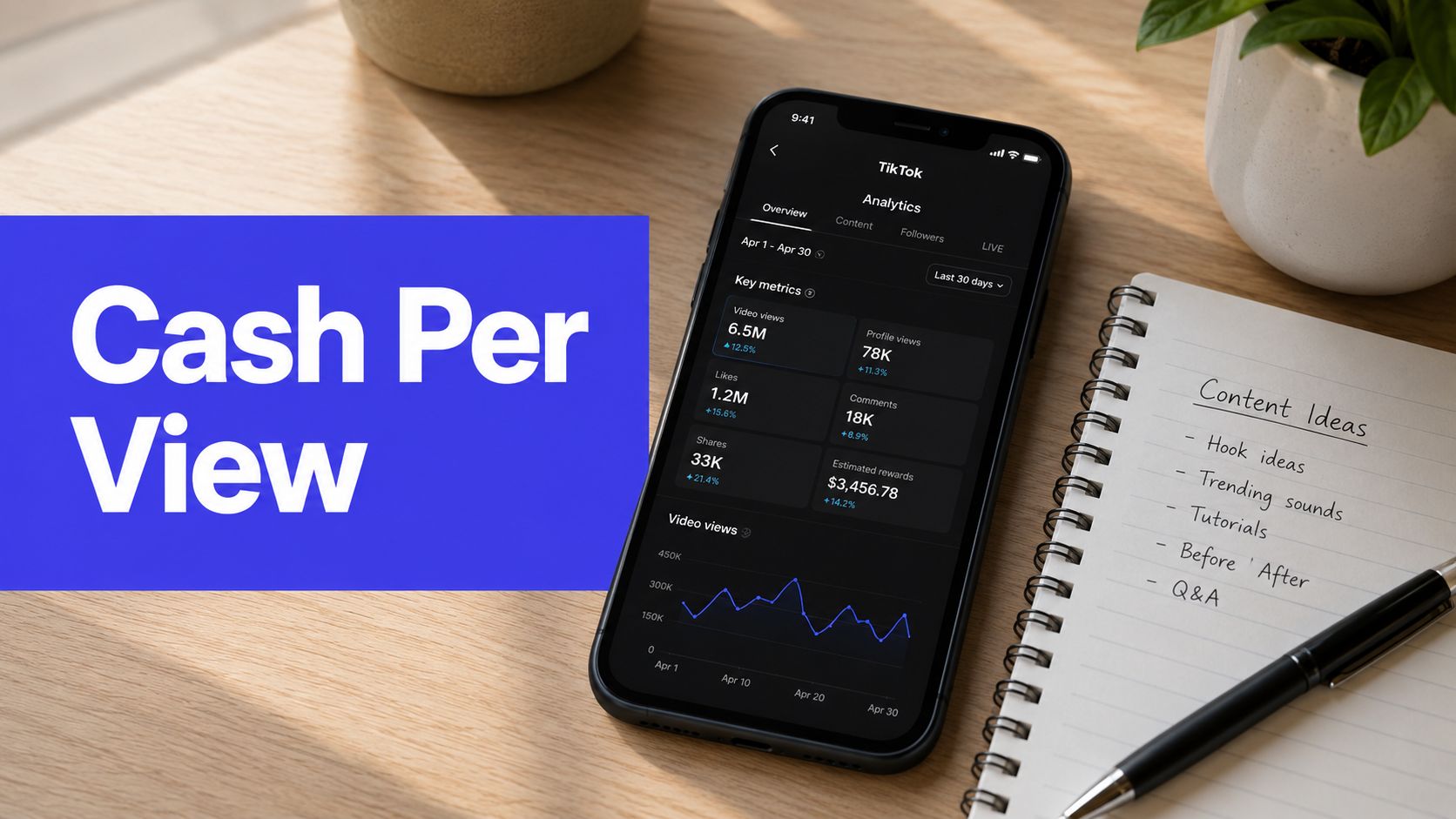
A million views can look huge in the app and still produce a payout that would not cover much beyond basic production costs. The old Creator Fund often paid about $20 to $40 per million views, and the newer system can pay more, but direct view revenue is still modest for the average creator, as noted earlier from The Marketing Agency's payout analysis.
The reason is simple. TikTok does not pay on headline views the way many creators assume.
Qualified views are the real denominator
TikTok's Creator Rewards Program documentation makes the rule clear. Revenue depends on qualified views, not total public views. TikTok also requires 1,000 unique For You feed views that are longer than 5 seconds before a video generates revenue, and it excludes traffic tied to dislikes, fraud, or promoted distribution, according to TikTok Creator Rewards Program documentation.
That changes the math more than new creators expect.
A video with strong public reach can still underperform financially if a large share of viewers scrolls quickly, comes from the wrong traffic source, or fails TikTok's qualification filters. In practice, this is why two videos with similar view counts can produce very different payouts.
What the payout range actually means
Here is the cleaner way to read TikTok view revenue:
| Scenario | Practical outcome |
|---|---|
| Legacy Creator Fund | Very large view counts often turned into small payments |
| Creator Rewards Program | Higher earning potential, but still limited if you rely on platform pay alone |
| Low-retention traffic | Public views look healthy while qualified views stay weak |
| Strong niche audience | Direct payout may stay moderate, but monetization options improve outside the fund |
I tell creators to calculate from the filtered number, not the vanity number. If the program pays based on qualified attention, raw reach is only the starting point.
Base income projections on qualified views, or your forecast will be inflated from day one.
The real takeaway for creators
TikTok's payout system rewards originality, watch time, and valid For You traffic. It does not reliably reward volume by itself.
That is why view count is a weak planning metric for direct earnings. Use Creator Rewards income as extra revenue when it comes in. Build your actual strategy around content that holds attention, attracts the right audience, and creates a path to higher-value monetization.
Smarter Monetization Strategies Beyond View Counts
Raw views are a poor target if the goal is revenue.
I manage creator accounts that get modest reach and still outsell larger pages because their content drives action. A smaller account with clear product fit, buyer trust, and repeatable offers often earns sooner than a bigger account waiting on platform payouts.
Creators do not need to sit on the sidelines until they qualify for every built-in monetization feature. The better move is to match the account to the income model it can support now.
Creators with smaller followings often have four practical revenue paths:
- TikTok Shop affiliate: Works well for creators who can review, demo, compare, or recommend products without forcing the pitch.
- LIVE Gifts: Works best when the audience shows up for the creator, not just the topic.
- Brand partnerships: Good for niche accounts that already influence opinions, even if total reach is still modest.
- Owned offers: Services, digital products, coaching, memberships, or lead generation for a business.

The money usually follows intent, not reach.
A creator who posts skincare routines, kitchen tool demos, or budgeting tips has a clearer path to sales than a general meme account with higher views. That does not make entertainment accounts worthless. It means their monetization path is usually slower unless they build a strong personal brand, a loyal community, or an offer outside the app.
Where creators usually make more than platform pay
TikTok Shop affiliate is the fastest route for many smaller creators because it connects content to a purchase. One good demo can produce commissions long after the post slows down. The trade-off is trust. Weak recommendations hurt conversion and damage audience confidence fast.
LIVE Gifts reward interaction. Creators who can answer questions, react in real time, and keep a room active tend to do better here than creators who only perform well in edited short videos.
Brand deals depend less on follower count than many creators assume. Brands care about audience fit, content quality, clean positioning, and whether the creator can influence a specific buyer. A niche creator with a consistent angle is often easier to sell to sponsors than a broad page with mixed traffic.
Owned offers usually have the best margins. A creator who sells templates, courses, consulting, or a service business keeps more control than someone relying on platform rules or campaign-by-campaign sponsorships.
If content quality is still inconsistent, fix that before pushing monetization. Strong offers fail on weak videos. Creators who need to improve their packaging and retention should study a practical process for creating TikTok videos that hold attention and convert.
Compare the monetization options
| Method | Access point | What matters most | Best fit |
|---|---|---|---|
| Creator Rewards Program | Higher threshold, longer videos, qualified views | Original content and view quality | Creators already producing consistent long-form TikToks |
| TikTok Shop affiliate | Lower entry barrier in many cases | Purchase intent and trust | Product-led niches like beauty, home, fitness, gadgets |
| LIVE Gifts | Community-focused format | Loyalty and interaction | Creators who can hold attention live |
| Brand deals | No fixed platform threshold | Niche fit and audience quality | Creators with a strong identity and clear market relevance |
The right question is not how many views it takes to make money on TikTok.
The better question is which revenue model fits the audience you already have.
Here's a practical comparison in motion:
The strategic trade-off
Direct platform pay is simple to understand, but it puts the platform in control of your ceiling. Alternative monetization takes more setup, but it usually gives the creator more room to grow.
A smaller audience that buys is worth more than a larger audience that only watches.
That is why niche accounts often outperform broader entertainment accounts on revenue per view. They connect attention to an action. Click, purchase, inquiry, signup, or booked call.
If an account is still below a major payout threshold, that is not a reason to wait. It is a reason to build trust, test offers, improve conversion content, and get the account ready for affiliate income, LIVE revenue, and brand partnerships.
Actionable Strategies to Increase Your TikTok Revenue
The creators who earn consistently usually don't chase random virality. They build a system.
That system starts with choosing a niche that has both audience demand and commercial intent. If people watch your videos and never need anything from your category, monetization stays hard. If they watch because they want advice, product guidance, transformation ideas, or trusted recommendations, revenue becomes much easier to engineer.

Build for trust before scale
A lot of creators copy formats that get attention but don't build buyer trust. That's why their content gets reactions without producing income.
Focus on these moves instead:
- Choose a monetizable topic: Product-led niches, problem-solving content, tutorials, comparisons, and recommendation-based content usually convert better than broad novelty.
- Create repeatable content series: Viewers trust accounts that feel consistent. Series also help you train the audience on what to expect.
- Use longer videos with a purpose: If you're aiming for direct payout eligibility, longer content has to hold attention and stay original. Don't stretch weak ideas.
- Make the next step obvious: Your CTA should fit the content. A product demo should lead to a product link. A service tip should lead to an inquiry or resource.
- Study winning formats: If you need help improving your production flow, this guide on how to create TikTok videos is a good reference point for tightening format, hooks, and execution.
Optimize content for conversions
The best revenue-focused TikTok content does one of three things well:
- It solves a problem: Viewers save it because it helps.
- It proves a result: Viewers believe the recommendation.
- It reduces purchase hesitation: Viewers feel ready to act.
That means your hook shouldn't just chase curiosity. It should attract the right person. A broad hook can pull in empty traffic. A specific hook often brings fewer viewers, but better ones.
Field note: Revenue content usually looks less flashy than viral trend content. It wins because it answers a buying question clearly.
Treat your profile like a storefront
Most creators underuse their profile. They think of it as a gallery, when it should work like a landing page.
Audit these elements:
- Bio clarity: People should know what you talk about and why they should follow.
- Content grouping: Organize around recognizable themes so visitors can binge a topic.
- Offer alignment: If you promote products, partnerships, or services, your recent videos should support that path.
- Comment mining: Questions from viewers often reveal what to film next and what people are close to buying.
Stop measuring success by view count alone
A video with moderate reach can still be one of your highest-value assets if it pulls in the right audience and triggers action.
The creators who last on TikTok usually build around consistency, audience trust, and monetization fit. That's much more durable than riding a few lucky spikes.
Using Analytics and Scheduling to Fuel Your Growth
If you're serious about earning on TikTok, instinct isn't enough. You need to know which videos attract the right viewers, which topics hold attention, and which posting windows give your content the best chance to perform.
Native TikTok analytics can help you spot useful patterns. Look at which videos bring comments with buying intent, which topics get saves, and which formats attract the strongest retention. The goal isn't just more output. The goal is better decisions.

What to watch in your data
Not every strong-looking video is useful for revenue. I pay closer attention to pattern signals such as:
- Topic fit: Which subjects keep attracting the same kind of viewer.
- Engagement quality: Are people asking follow-up questions, not just dropping emojis.
- Traffic behavior: Which videos seem to push profile visits or product curiosity.
- Posting consistency: Whether strong content is being published often enough to compound.
A data-driven workflow matters because TikTok performance is volatile. If you rely on memory, you'll repeat weak formats and miss the ones that move your business forward.
Execution is where most teams break down
Most creators and small teams don't fail because they lack ideas. They fail because they post inconsistently, miss good timing windows, and lose track of what worked.
That's where scheduling and cross-platform planning become useful. A structured workflow lets you queue content ahead of peak times, repurpose winning videos into shorts for other channels, and compare performance without juggling everything manually. If you're refining your timing strategy, this guide on the best time to post on TikTok is a practical place to start.
The creators who treat posting like a business process usually outperform creators who treat every upload like a one-off experiment.
When your content calendar, publishing workflow, and analytics live in one system, you spend less time scrambling and more time improving the content that drives revenue.
Building a Sustainable Creator Business on TikTok
The question isn't really how many views to make money on TikTok. The better question is how to turn attention into a business.
Direct platform payouts can be useful, but they shouldn't be the foundation of your plan. A durable TikTok business comes from a clear niche, content that builds trust, and revenue streams that don't depend on one algorithm outcome. That includes affiliate offers, LIVE support, sponsorships, and your own products or services.
The creators who stay profitable usually think like operators, not just performers. They study what their audience responds to, repeat what converts, and cut what only looks good on the surface. They also track whether content creates business results, not just platform metrics. If you want a better framework for that, this guide on how to measure social media ROI helps connect content activity to actual outcomes.
TikTok can absolutely become a meaningful revenue channel. But views are only the start. Value, trust, and strategy are what get you paid.
If you want to turn TikTok into a repeatable growth channel instead of a posting scramble, PostSyncer gives you one place to plan content, schedule posts, repurpose winners across platforms, and track what's working. It's built for creators, marketers, and teams that want a cleaner workflow and better consistency without adding more manual work.