









In the modern work environment, the right tools are a competitive advantage. But with countless options all promising to organize your workflow, how do you cut through the noise and find what truly works? The goal isn't just to be busy; it's to be effective. A well-chosen productivity system can reclaim hours, align your team, and amplify your impact.
This guide moves beyond generic feature lists to provide a detailed analysis of the best productivity apps available today. We’ll dive deep into project managers, note-takers, automation tools, and more, helping you build a cohesive system that actually fits your workflow.
Instead of just listing features, we offer a practical framework for choosing the right app combination. Each entry includes:
- A concise breakdown of what the app does best.
- Honest pros and cons based on real-world use.
- Specific use cases for different teams, like agencies, solo creators, or startups.
- Clear pricing and platform details, complete with screenshots and direct links.
We will explore everything from project management powerhouses like ClickUp and Asana to automation engines such as Zapier. We'll also see how a social media scheduler like PostSyncer fits into a complete productivity stack. By the end, you'll have a clear path to building a software setup that works as hard as you do, eliminating the clutter of mismatched tools and focusing your energy on what matters most.
1. PostSyncer
PostSyncer earns its place as our top pick by functioning as an all-in-one social media command center. It consolidates the entire content lifecycle - from ideation and creation to scheduling and analysis - into a single, cohesive workspace. This makes it one of the best productivity apps for any team whose workflow depends heavily on social media marketing. It supports a broad array of platforms, including TikTok, Instagram, YouTube, X (and its Communities), Threads, and even emerging networks like Bluesky and Mastodon.

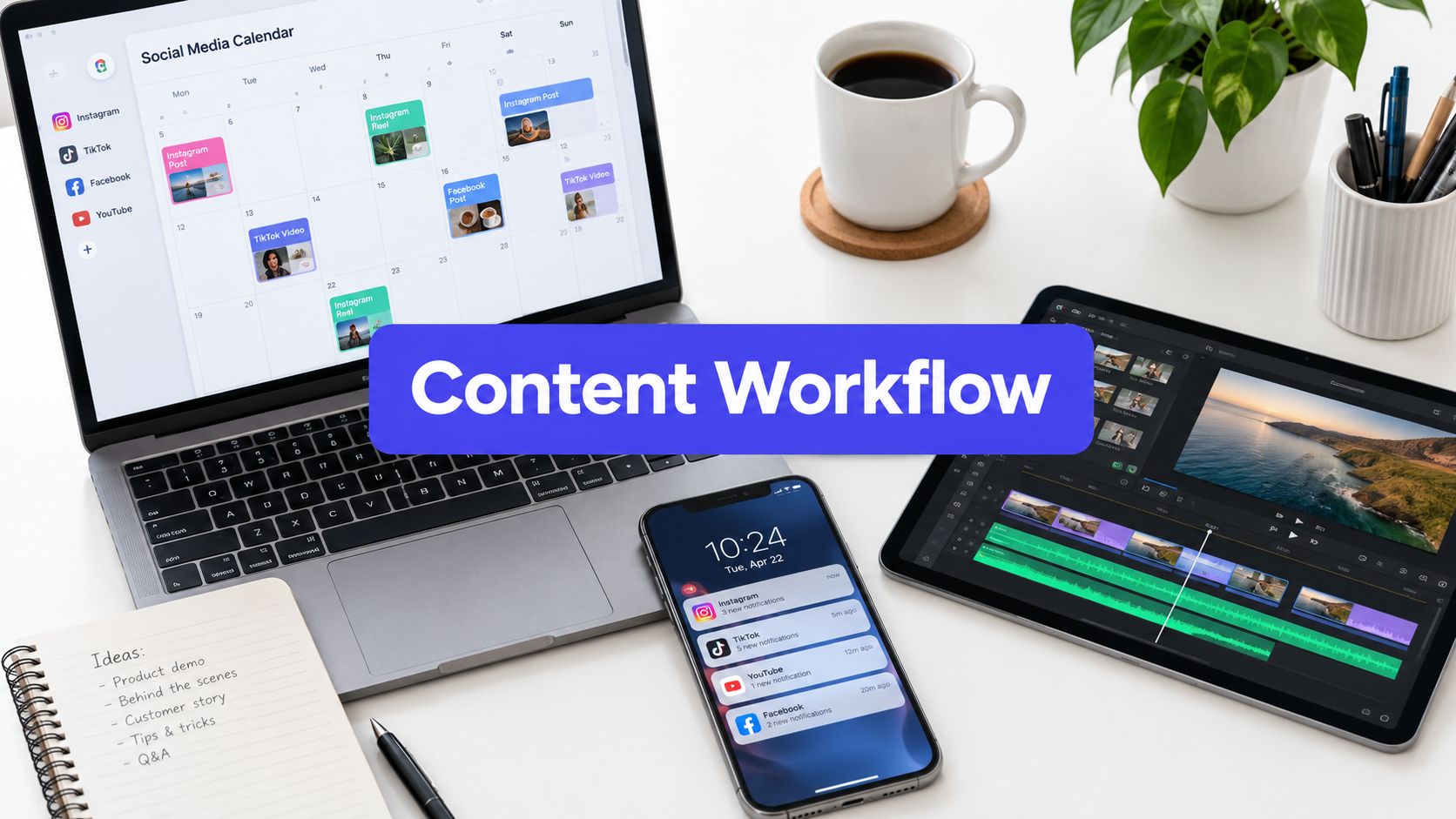
The platform’s design is centered around a "create once, share everywhere" philosophy, saving teams countless hours. Its standout feature is a powerful AI stack that dramatically accelerates content repurposing. The AI Content Agent and AI Video Creator can take a URL, PDF, image, or raw text and generate platform-specific captions, hooks, and even short-form videos. For agencies and in-house teams, its collaborative tools are a major draw. You get unlimited team members without per-seat pricing, clear approval workflows, and a visual drag-and-drop calendar that simplifies planning. To better understand how such a tool organizes your workflow, explore how a content calendar works and see the benefits of visual planning.
Key Features and Use Cases
- For Agencies: Manage multiple clients seamlessly using separate workspaces ($19/month per extra workspace). The approval workflows ensure brand consistency, and the unified inbox allows your team to manage all client engagement from one place.
- For Creators: The AI tools are a game-changer for repurposing long-form content like YouTube videos or blog posts into a week's worth of social media updates.
- For In-house Teams: The flat-rate team pricing and real-time analytics provide clear ROI without unpredictable costs. Security is enterprise-grade, with GDPR compliance, OAuth connections, and API access for custom integrations.
Pricing and Access
PostSyncer offers a 3-day free trial to test its full capabilities. Pricing is transparent, with tiered plans that provide more social accounts, AI credits, and higher API limits as you scale. Plans are available with both monthly and annual billing.
Website: https://postsyncer.com
| Pros | Cons |
|---|---|
| Comprehensive Platform Support: Publish to all major social networks from one dashboard. | Tier-Gated Features: Advanced analytics, higher API limits, and more social accounts require mid-to-high-tier plans. |
| Powerful AI Content Suite: Generate and repurpose content at scale, turning single assets into multiple social posts and videos. | Credit Limitations: AI and video credits are allocated per billing cycle and do not roll over, which may require upgrades for heavy users. |
| Team-First Pricing Model: Unlimited team members are included on all plans, avoiding expensive per-user fees. | Short Trial Period: The 3-day free trial may be brief for teams needing a more extensive evaluation period. |
| Integrated Engagement Tools: A unified inbox with AI auto-replies, spam filters, and a light CRM helps manage community interactions efficiently. | Workspace Add-on Cost: While the base plan is affordable, adding extra workspaces for new brands or clients incurs a separate monthly fee. |
2. Notion
Notion positions itself as an "all-in-one workspace," a bold claim that it largely delivers on by merging documents, wikis, and relational databases into a single, cohesive platform. It's a powerful tool for teams and solo creators aiming to consolidate disparate apps for notes, project management, and knowledge bases. Unlike structured project managers, Notion gives you the building blocks to design your own systems from the ground up.

This flexibility is Notion’s greatest strength and its main challenge. You can build a custom content calendar, track campaign progress with linked databases, and write standard operating procedures (SOPs) all in one place. This makes it one of the best productivity apps for centralizing a marketing team's entire operation, from creative briefs to performance dashboards. For an in-depth look at structuring this process, see our guide on building an effective content creation workflow.
Key Features & Considerations
- Pros: The "build-your-own" approach is extremely adaptable. The active community provides a massive library of templates to get started quickly, and it offers strong value by replacing multiple separate subscriptions.
- Cons: The freedom can lead to a messy, disorganized workspace without careful planning. Larger teams will need to establish clear governance and manage permissions to maintain order.
- Pricing: Notion offers a generous free tier for individuals. Paid plans start at $8 per user/month (billed annually) for Plus, which adds more collaboration features, and Business at $15 per user/month (billed annually) for advanced controls.
- Website: https://www.notion.so/pricing
3. ClickUp
ClickUp positions itself as the "one app to replace them all," a platform designed to consolidate project management, documents, goals, and even time tracking into a single, unified environment. It is built for teams that need a powerful, centralized hub for managing complex workflows without juggling multiple tools. Its extensive customization and multiple project views make it one of the best productivity apps for organizations that need deep visibility into their work.

The platform’s core strength is its adaptability. A marketing agency can manage multiple client campaigns using different views like Gantt charts for timelines, Kanban boards for task progression, and powerful dashboards for reporting. Features like native automations, goals, and time tracking directly support performance-oriented teams. Optional AI add-ons further extend its capabilities, offering assistance in writing, summarizing tasks, and automating repetitive actions, which helps streamline operations from top to bottom.
Key Features & Considerations
- Pros: The incredibly broad feature set provides exceptional value, especially for small to medium-sized businesses. Its deep visualization options, including portfolios and workload views, are excellent for resource planning and high-level reporting.
- Cons: The sheer number of features can feel complex at first and requires dedicated admin setup and ongoing maintenance to prevent clutter. Feature availability and user roles differ significantly across pricing tiers, so a careful review is necessary before committing.
- Pricing: A Free Forever plan is available for personal use. Paid plans start with Unlimited at $7 per user/month and Business at $12 per user/month (billed annually), which unlock more advanced features like automations and time tracking.
- Website: https://clickup.com/pricing
4. Asana
Asana is a dedicated work management platform built to bring clarity and accountability to complex projects and ongoing work. It excels at helping teams plan, track, and report on initiatives, making it a powerful choice for managing marketing programs, product launches, and cross-departmental campaigns. Where some tools offer a blank slate, Asana provides a structured yet flexible framework with views like Boards, Lists, and Timelines to visualize progress.

Its strength lies in creating a single source of truth for who is doing what by when. The addition of Asana AI helps teams generate project briefs, define smart tasks, and get status updates, further reducing manual coordination. This focus on structured execution makes it one of the best productivity apps for teams that need strong governance and clear reporting from day one, ensuring everyone stays aligned with strategic goals.
Key Features & Considerations
- Pros: The clean user experience scales well from small teams to entire departments. It offers mature governance, reporting, and admin tooling, and the unlimited free guests on paid plans are ideal for working with external collaborators.
- Cons: Many of the most impactful features, such as advanced workflows and portfolio management, are locked behind higher-priced tiers. Seat increments and the cost of add-ons like AI Teammates can significantly increase the total investment.
- Pricing: A free Personal plan is available. Paid plans start with Starter at $10.99 per user/month and Advanced at $24.99 per user/month (both billed annually), with options for Enterprise and the AI add-ons.
- Website: https://asana.com/pricing
5. monday.com
monday.com positions itself as a "Work OS," a platform designed to provide a flexible foundation for nearly any business process. It moves beyond simple project management, offering a suite of interconnected products for work management, CRM, marketing campaigns, and development. Its visual, board-centric interface allows teams to build custom workflows for everything from content pipelines to sales funnels, making it a strong contender for teams needing a central hub.

The platform's core strength is its adaptability. Through highly customizable boards, automations, and dashboards, teams can visualize data in multiple ways, such as Kanban, Gantt, and calendar views. This makes it one of the best productivity apps for cross-functional teams who need to track project dependencies and report on progress without switching tools. For instance, a marketing team can manage a campaign on one board while the sales team tracks leads generated from it on a connected CRM board.
Key Features & Considerations
- Pros: Its extensive library of templates and various board views make it quick to tailor to specific workflows. The powerful dashboards provide excellent cross-board reporting, giving a high-level overview of all team activities.
- Cons: The pricing structure, which varies by seat bundles and often requires a three-seat minimum, can be confusing; be sure to review totals at checkout. Automation and integration action limits also differ significantly across paid tiers.
- Pricing: A free plan is available for up to two users. Paid plans begin with Basic at $9 per seat/month (billed annually), followed by Standard at $12 per seat/month and Pro at $19 per seat/month, each adding more features and higher limits.
- Website: https://monday.com/pricing
6. Todoist
Todoist excels at making task management simple and fast, proving that you don't need a complex system to be productive. It’s built around a powerful quick-add feature that uses natural language to set tasks, due dates, and priorities, which significantly lowers the friction of getting organized. For individuals and small teams, it provides a clean, lightweight way to align daily actions with broader project goals.

The app's strength is its focused design, making it one of the best productivity apps for users who find comprehensive project management suites overwhelming. You can quickly capture ideas, set recurring tasks for routine work like social media checks, and organize everything with labels and filters. The addition of board and calendar layouts offers visual flexibility, while newer AI features assist in breaking down larger tasks, making it a powerful daily driver for execution. It's an ideal choice for getting started with structured productivity without a steep learning curve.
Key Features & Considerations
- Pros: The user interface is exceptionally clean and fast, ensuring quick adoption for non-technical users across desktop and mobile. Its Smart Quick Add and recurring task functions are best-in-class for rapid task entry.
- Cons: It is lighter on high-level portfolio management and advanced reporting features when compared to dedicated project management software. Its localized pricing can also require signing in to see exact USD rates.
- Pricing: A capable free plan is available for beginners. The Pro plan is $4 per user/month (billed annually) for power users, and the Business plan is $6 per user/month (billed annually) for team collaboration.
- Website: https://todoist.com/premium
7. Slack
Slack has cemented its position as the central hub for team communication, evolving far beyond a simple messaging app. It organizes conversations into dedicated channels, direct messages, and real-time audio "Huddles," creating a searchable archive of all team knowledge. For distributed teams, its combination of synchronous and asynchronous tools, like video Clips, makes it an essential part of the modern workplace.

The platform’s power is magnified by its deep integration ecosystem, connecting with over 2,000 other applications to bring alerts and actions directly into your communication flow. Recent additions of AI features on paid plans, which can summarize long threads and capture notes, further solidify its place among the best productivity apps. This focus on workflow automation makes it indispensable for agencies and in-house teams that need to react quickly and keep everyone aligned without constant meetings.
Key Features & Considerations
- Pros: The integration and workflow automation capabilities are best-in-class. Its blend of real-time and asynchronous tools like Huddles and Clips is excellent for supporting distributed teams across different time zones.
- Cons: Without clear channel organization and team norms, Slack can quickly become a source of constant notifications and noise. Its pricing and feature sets have shifted, so it's important to confirm current offerings before committing.
- Pricing: Slack offers a free plan with a 90-day message history. Paid plans begin with Pro at $7.25 per user/month (billed annually) and Business+ at $12.50 per user/month (billed annually), which adds advanced features and administration controls.
- Website: https://slack.com/pricing
8. Google Workspace
Google Workspace is the ubiquitous cloud-native suite that most teams are already familiar with, making it a foundational layer for business productivity. It bundles professional email, cloud storage, and collaborative apps like Docs, Sheets, and Slides into a single, integrated environment. For teams looking to standardize their core toolset with minimal IT overhead, Workspace offers a powerful, accessible starting point. Its real-time collaboration features remain a gold standard, allowing multiple users to edit documents simultaneously without friction.

The suite is more than just documents and email; it includes Google Meet for video conferencing and Chat for team communication, creating a connected ecosystem. Its strength lies in this seamless integration, where a file from Drive can be instantly shared in a Chat or attached to a Calendar invite. As one of the best productivity apps for cross-functional teams, it removes the barriers between communication and creation, making it ideal for organizations that prioritize ease of use and universal access across devices.
Key Features & Considerations
- Pros: The apps are incredibly familiar, requiring almost no training for new users. Real-time collaboration in Docs and Sheets is excellent, and the broad file support within Drive makes it a versatile central repository.
- Cons: The tiered plans have significant differences in storage limits and Meet participant caps, so you must carefully check your requirements. Access to Gemini AI features can also be confusing, with capabilities varying by plan and separate add-ons available.
- Pricing: Business Starter begins at $6 per user/month, with Business Standard at $12 and Business Plus at $18, offering more storage and features. Enterprise plans are available for larger organizations.
- Website: https://workspace.google.com/pricing
9. Microsoft 365 for Business
Microsoft 365 for Business is the cornerstone productivity suite for organizations deeply integrated into the Windows ecosystem or those with strict compliance needs. It bundles the classic desktop Office apps (Word, Excel, PowerPoint) with a robust set of cloud services, including Teams for collaboration, OneDrive and SharePoint for file management, and Exchange for enterprise-grade email. This makes it a go-to choice for centralizing core business operations under a single, secure license.

Unlike piecemeal solutions, Microsoft 365 provides an interconnected environment where a document created in Word can be seamlessly shared and co-edited in Teams. Its standout feature for many is the integration of Copilot, an AI assistant now available across the suite. For organizations prioritizing security and a unified software stack, it remains one of the best productivity apps, offering a familiar yet powerful toolkit. The platform's strength lies in its ability to support everything from solo entrepreneurs to large enterprises with a consistent, manageable framework.
Key Features & Considerations
- Pros: The suite offers a deep feature set with strong compliance and security options, making it suitable for regulated industries. Bundling desktop Office apps with cloud services in one license simplifies software management.
- Cons: The licensing matrix is complex, so it's critical to verify eligibility for features like Copilot and understand plan limits. Business plans are capped at 300 seats, requiring larger organizations to move to more expensive Enterprise plans.
- Pricing: Business Basic starts at $6.00 per user/month, Business Standard is $12.50 per user/month, and Business Premium is $22.00 per user/month. The Copilot for Microsoft 365 add-on is an additional $30 per user/month for eligible plans.
- Website: https://www.microsoft.com/en-us/microsoft-365/business/microsoft-365-plans-and-pricing
10. Airtable
Airtable elevates the familiar spreadsheet into a powerful relational database, offering structure and automation without the need for custom development. It serves as a no-code platform where teams can build custom applications to manage complex workflows, such as content operations, asset tracking, and campaign orchestration. Its strength lies in its ability to connect data across different tables, creating a single source of truth for interconnected projects.

Unlike a standard spreadsheet, Airtable allows you to create different views of the same data, like a calendar, gallery, or Kanban board, making it one of the best productivity apps for teams that need to visualize information in multiple ways. Marketing teams, for example, can use it to manage a content pipeline, track influencer collaborations, and build simple brief-intake forms using Airtable's Interface Designer. The platform's automations can then handle repetitive tasks, such as notifying team members when a status changes or creating records in another app.
Key Features & Considerations
- Pros: Airtable provides more structure than a spreadsheet with far less overhead than building custom software. It is excellent for rapidly developing lightweight internal tools and custom workflows.
- Cons: The per-seat billing model can become expensive as your team of editors grows. Advanced features like granular permissions, AI, and robust governance are locked behind higher-tier Business and Enterprise plans.
- Pricing: Airtable has a free plan with core features. The Team plan is $20 per seat/month (billed annually), and the Business plan is $45 per seat/month (billed annually) for more advanced needs.
- Website: https://airtable.com/pricing
11. Zapier
Zapier is the leading no-code automation platform that acts as the connective tissue for your entire software stack. By linking thousands of applications (over 7,000 and growing), it allows you to build automated workflows, or "Zaps," that handle repetitive tasks without any engineering support. It's an essential tool for eliminating manual data entry and system handoffs, making it one of the best productivity apps for creating a truly integrated digital workspace.

Its power lies in orchestrating actions across your favorite tools. For instance, you can automatically create a Trello card from a new form submission, add the respondent to a Mailchimp list, and send a Slack notification to your team. With recent additions like Zapier Tables, Forms, and AI capabilities, users can build more complex, multi-step automations that previously required custom development. This makes Zapier perfect for teams looking to reclaim time and focus on higher-value work.
Key Features & Considerations
- Pros: The immense integration catalog means you can connect almost any tool for quick automation wins. The task-based pricing model provides a clear path for scaling as your automation needs grow.
- Cons: High-volume workflows can become expensive, so it’s important to monitor task usage closely. Complex Zaps with branching logic may benefit from more robust version control and monitoring than the platform currently offers.
- Pricing: Zapier provides a free plan for simple, single-step Zaps. Paid plans start with Starter at $19.99/month (billed annually) for multi-step Zaps and increase to Professional and Team tiers for more advanced features and higher task limits.
- Website: https://zapier.com/pricing
12. Calendly
Calendly solves one of the most persistent productivity drains: the back-and-forth emails required to schedule a meeting. It is a scheduling automation platform that allows others to book time with you based on your real-time calendar availability. By sharing a simple link, you eliminate the entire scheduling dance, making it an essential tool for sales teams, recruiters, and service-based professionals.

The platform’s power extends beyond simple one-on-one meetings. You can set up round-robin events that automatically assign new leads to available sales reps or create group sessions for webinars and training. Its deep integrations with tools like HubSpot, Salesforce, and Zoom make it one of the best productivity apps for go-to-market teams, ensuring that booking data flows directly into your CRM. For advanced automation, maximizing your capabilities through robust Zapier integrations can connect Calendly to hundreds of other apps.
Key Features & Considerations
- Pros: The setup is incredibly fast, and the user experience is clean for both the host and the person booking. Automated reminders and follow-ups significantly reduce no-shows. The strong integration ecosystem supports complex revenue and marketing tech stacks.
- Cons: Advanced features, such as routing leads based on CRM data, are locked behind higher-priced tiers. Enterprise-grade controls like SSO and domain management are often exclusive to the most expensive plan.
- Pricing: Calendly offers a solid free plan for basic one-on-one scheduling. Paid plans start with the Standard tier at $10 per user/month and Teams at $16 per user/month (billed annually), adding more event types and integrations.
- Website: https://calendly.com/pricing
Top 12 Productivity Apps Comparison
| Product | Core Features | Standout Value (✨) | Quality (★) | Price / Value (💰) | Best For (👥) |
|---|---|---|---|---|---|
| PostSyncer 🏆 | Multi‑platform scheduling, AI Content Agent & Video Creator, unified inbox, visual calendar, unlimited team members | AI repurposing + “create once, share everywhere” ✨ | ★★★★☆ | Transparent tiers + AI credits; 3‑day trial 💰 | Creators, teams & agencies 👥 |
| Notion | Docs, wikis, relational DBs, embedded AI, web publishing | Flexible templates & build‑your‑own systems ✨ | ★★★★☆ | Free → Paid; strong doc value 💰 | Content ops, SOPs, campaign briefs 👥 |
| ClickUp | Tasks, Gantt/Board/Timeline, automations, time tracking, AI add‑ons | All‑in‑one PM with deep visualizations ✨ | ★★★★☆ | Affordable SMB tiers; per‑feature variance 💰 | PM teams needing reporting & resourcing 👥 |
| Asana | Boards, Timelines, Portfolios, advanced automations, AI Studio | Clean UX that scales with governance ✨ | ★★★★☆ | Tiered—best features in higher plans 💰 | Marketing programs & cross‑team launches 👥 |
| monday.com | Customizable boards, automations, dashboards, product verticals | Rapid workflow tailoring with templates ✨ | ★★★★ | Per‑seat with 3‑seat min; automation limits apply 💰 | Ops, CRM, campaigns, cross‑functional teams 👥 |
| Todoist | Task lists, natural‑language add, recurring tasks, Kanban/calendar | Low‑friction daily execution & quick adoption ✨ | ★★★★ | Low‑cost personal & Business tiers 💰 | Individuals & small teams focused on tasks 👥 |
| Slack | Channels, DMs, Huddles, Clips, 2,000+ integrations | Best‑in‑class real‑time collaboration ecosystem ✨ | ★★★★☆ | Free→Enterprise; can grow costly 💰 | Distributed & async teams, integrations first 👥 |
| Google Workspace | Gmail, Drive, Docs/Sheets/Slides, Meet, Gemini access | Familiar real‑time collaboration & low IT overhead ✨ | ★★★★☆ | Per‑user tiers; pooled storage options 💰 | Teams standardizing on Google tools 👥 |
| Microsoft 365 | Office apps, Teams, OneDrive/SharePoint, Copilot options | Desktop + cloud productivity with strong compliance ✨ | ★★★★ | Per‑user; complex licensing for Copilot 💰 | Windows‑centric & compliance‑sensitive orgs 👥 |
| Airtable | Relational bases, interfaces, automations, app ecosystem | No‑code DB + interface builder for internal tools ✨ | ★★★★ | Per‑editor billing; costs scale with seats 💰 | Content ops, asset tracking, lightweight apps 👥 |
| Zapier | Multi‑step Zaps, branching, Tables/Forms, AI orchestration | Massive integration catalog for automation wins ✨ | ★★★★ | Task‑based pricing; high volume can be pricey 💰 | Automation builders & ops teams without devs 👥 |
| Calendly | One‑on‑one & round‑robin scheduling, routing, integrations | Fast self‑serve booking with routing analytics ✨ | ★★★★ | Free→Enterprise; some features paid 💰 | Sales, interviews, client meetings & scheduling ops 👥 |
Build Your System, Reclaim Your Focus
We've journeyed through a curated selection of the best productivity apps, from comprehensive project management hubs like ClickUp and Asana to specialized powerhouses like PostSyncer and Zapier. It's clear that the market is filled with incredible tools designed to organize, automate, and accelerate your work. However, the most critical takeaway is not which app is universally "best," but which combination of apps is best for you.
The true path to heightened productivity isn't found in a single piece of software. It's built by creating a cohesive, interconnected system where each tool has a distinct purpose and communicates effectively with the others. A standalone task manager is helpful, but a task manager that integrates with your team’s communication platform (like Slack) and your file storage (like Google Workspace) becomes a central nervous system for your projects. This ecosystem approach eliminates the friction of switching between tabs, re-entering data, and losing context, freeing up valuable mental energy for strategic thinking and creative work.
From Tools to a Cohesive System
Choosing the right applications is the first step, but implementation is where most teams either succeed or fail. Simply adopting a new tool without a clear strategy often leads to more confusion, not less. To build a system that sticks, you must first audit your existing processes. Identify the bottlenecks, the repetitive tasks, and the communication gaps.
Once you understand your pain points, you can map them to the solutions we've discussed.
- Is your team struggling with project visibility? A visual-first platform like monday.com or Asana might be your answer.
- Do you need a flexible, all-in-one workspace for documentation and planning? Notion or Airtable could be the perfect foundation.
- Is manual social media posting consuming your marketing team's week? A dedicated scheduler like PostSyncer is a non-negotiable.
The key is to think of your productivity stack not as a collection of individual tools, but as a single, unified machine. Use automation platforms like Zapier to act as the connective tissue, creating "if-this-then-that" workflows that handle the busywork for you. For example, a new entry in a Google Sheet could automatically create a task in ClickUp and send a notification in Slack. This is how you move from simply managing tasks to truly optimizing your entire workflow.
Your Action Plan for Choosing the Right Apps
To avoid the common pitfall of "shiny object syndrome," where you jump from one new app to another, follow a structured selection process. Start small. Choose one or two top contenders from our list that seem to address your most significant challenge.
- Define Your Core Need: Pinpoint the single biggest productivity problem you need to solve right now. Is it task management, team collaboration, content scheduling, or something else?
- Run a Pilot Program: Don't roll out a new app to your entire organization at once. Select a small, agile team or use it for a single project. Take advantage of free trials to get a real feel for the user experience and its limitations.
- Evaluate Integration: Assess how well the new tool fits into your existing ecosystem. Does it connect with the apps you already rely on? If not, the friction it creates might negate its benefits.
- Gather Feedback: After the trial period, collect honest feedback from the pilot team. Was it intuitive? Did it actually save time? What were the frustrations? This qualitative data is just as important as the feature list.
Ultimately, the goal is to find tools that feel less like a chore and more like a natural extension of how your team works. The best productivity apps recede into the background, empowering you to focus on the work itself, not the work of managing the work. By taking a thoughtful, systematic approach, you can build a technology stack that not only gets more done but helps you and your team perform at your absolute best. To further explore tools and strategies for building a more productive system and reclaiming your focus, you might find valuable resources at StartRightNow.
Ready to reclaim hours of your week and eliminate the chaos of manual social media management? PostSyncer is the essential scheduling component of any modern productivity stack, designed to put your content strategy on autopilot. See how our intuitive platform can streamline your workflow by visiting PostSyncer and starting your free trial today.