










Before you ever hit "post," the most important work of becoming an influencer happens away from the screen. The reality is, the internet is overflowing with content, and if you're just another generic voice, you'll get drowned out. Your first real job is to carve out your own corner of the digital world.
2. Find Your Niche and Build an Authentic Brand
This is about defining a specific space where your passions and your audience's interests collide. It’s not about chasing what's popular; it's about building an identity so memorable that people can't help but stop scrolling.
Pinpoint a Niche You Genuinely Love
Let's be real: building an audience is a marathon, not a sprint. If you pick a niche just because it seems profitable or trendy, you're setting yourself up for burnout. The foundation has to be something you're genuinely passionate about—something you could talk about for hours, even if you weren't getting paid for it.
That raw passion is what fuels you on the days you don't feel creative. More importantly, your audience can feel it. That authenticity builds a connection that forced expertise never will.
Don't just go broad. You have to drill down.
- Instead of "travel," think "sustainable travel for budget-conscious solo female travelers."
- Instead of "gaming," think "indie horror game reviews and in-depth lore analysis."
Getting super-specific is what makes you the go-to person for a dedicated community that shares your exact interest. This principle isn't just for influencers; it’s a core part of the broader journey of how to become a content creator, where finding a sustainable topic is everything.
Understand Your Target Audience Deeply
Okay, you've got your niche. Now, who are you talking to? You need to know your ideal follower inside and out. Give them a name, a job, and a list of problems. This persona will help you create content that speaks directly to them.
Don't just guess. Go where your people are. Lurk in Reddit forums, join relevant Facebook groups, and read the comment sections of other creators in your space. What questions do they keep asking? What are they struggling with? Your content needs to be the answer.
The most successful influencers don't just post; they solve problems. Whether it's showing someone how to style an outfit, plan a trip, or master a new skill, your value is measured by how much you help your audience.
Craft a Memorable and Authentic Brand Identity
Your brand isn’t just a logo or a pretty color palette. It's the entire vibe. It’s how your content makes people feel. It’s a mix of your visual style, your unique voice, and the mission that drives everything you create.
A strong brand identity is what makes you instantly recognizable in a feed full of faces. It’s what makes someone stop and say, "Oh, I know them!" We have a complete social media branding guide that dives deeper into this, but let's break down the essentials.
To build a brand that sticks, you need to define a few key components. The table below outlines the core elements that will form the backbone of your identity.
Key Elements of a Strong Influencer Brand Identity
| Brand Element | Description | Actionable Tip |
|---|---|---|
| Mission Statement | A one-sentence summary of your purpose. What do you provide, and for whom? | Write it down and keep it visible. Example: "To empower beginner artists with simple, actionable digital art tutorials." |
| Visual Identity | The consistent look of your content, including colors, fonts, and photo editing style. | Create 2-3 presets or filters and stick to them. Choose a consistent font for your text overlays and graphics. |
| Brand Voice | The personality your content conveys. Are you witty, inspirational, educational, or humorous? | List three adjectives that describe your desired tone (e.g., "Empathetic, clear, and encouraging") and check your captions against them. |
| Core Values | The principles that guide your brand. What do you stand for? | Identify 3-5 non-negotiable values (e.g., authenticity, sustainability, community) that will influence your content and brand partnerships. |
Taking the time to build this foundation is what separates a fleeting trend from a lasting career. By grounding yourself in a niche you love, an audience you genuinely understand, and a brand that is 100% you, you're not just preparing for growth—you're preparing for sustainable success.
Create Content That Captures Attention
Once you've locked in your brand foundation, it's time to focus on the engine that drives your influence: your content. Great content is your currency in this world. Creating it consistently isn't just a good idea—it's non-negotiable if you want to make it as an influencer.
This is how you pull in new followers, earn their trust, and eventually build a community that actually cares about what you have to say. It's not about just posting pretty pictures. It’s about creating genuinely valuable stuff that helps your audience while staying true to who you are. Every platform speaks its own language, and getting fluent is how you stop the scroll.
Develop a Sustainable Content Strategy
Let's be real: creator burnout is the biggest threat you'll face. The only way to beat it is to build a system. The smartest way to do this is by centering your strategy around content pillars—three to five core topics that you'll talk about over and over again.
Think of it like this. A fitness influencer might build their brand on these pillars:
- Workout Tutorials: Short, punchy videos people can follow along with.
- Healthy Recipes: Meal prep ideas that are quick and don't require a culinary degree.
- Mindset and Motivation: Relatable posts about the mental side of getting fit.
These pillars become your creative guardrails. They make planning a breeze and keep your feed focused, so your audience always knows what to expect. You're not trying to reinvent the wheel every single day, just finding new ways to talk about your core topics.
Your content pillars are the guardrails for your creativity. They give you the freedom to explore ideas without straying so far from your niche that you confuse or alienate the community you've worked so hard to build.
To make your life even easier, get into a batching workflow. Block out specific days for brainstorming, another for shooting, and another for writing captions. This stops the daily scramble for "what do I post today?" and gives you more time to actually engage with your people. For a deeper dive, check out our guide on building a powerful content creation workflow.
Tailor Your Content for Each Platform
Your core message can stay the same, but your delivery has to change. What crushes it on one platform will completely flop on another. Understanding these little differences is what separates the pros from the amateurs.
- TikTok & Instagram Reels: These platforms are all about discovery through short, addictive videos. You need high-energy, trend-aware content that hooks someone in the first three seconds. Think quick-cut tutorials, funny behind-the-scenes moments, and anything relatable.
- YouTube: This is where you go deep. YouTube is the home for long-form, evergreen content that people will search for weeks or months from now. Use it to build authority with detailed tutorials, honest reviews, or vlogs that tell a bigger story.
- Instagram Feed & Stories: Your main feed is your portfolio—use it for high-quality, polished photos and carousels that nail your visual identity. Stories are the complete opposite. They're for the raw, interactive stuff like Q&As, polls, and casual daily check-ins.
This visual guide shows how to develop a brand identity that will inform your content choices.
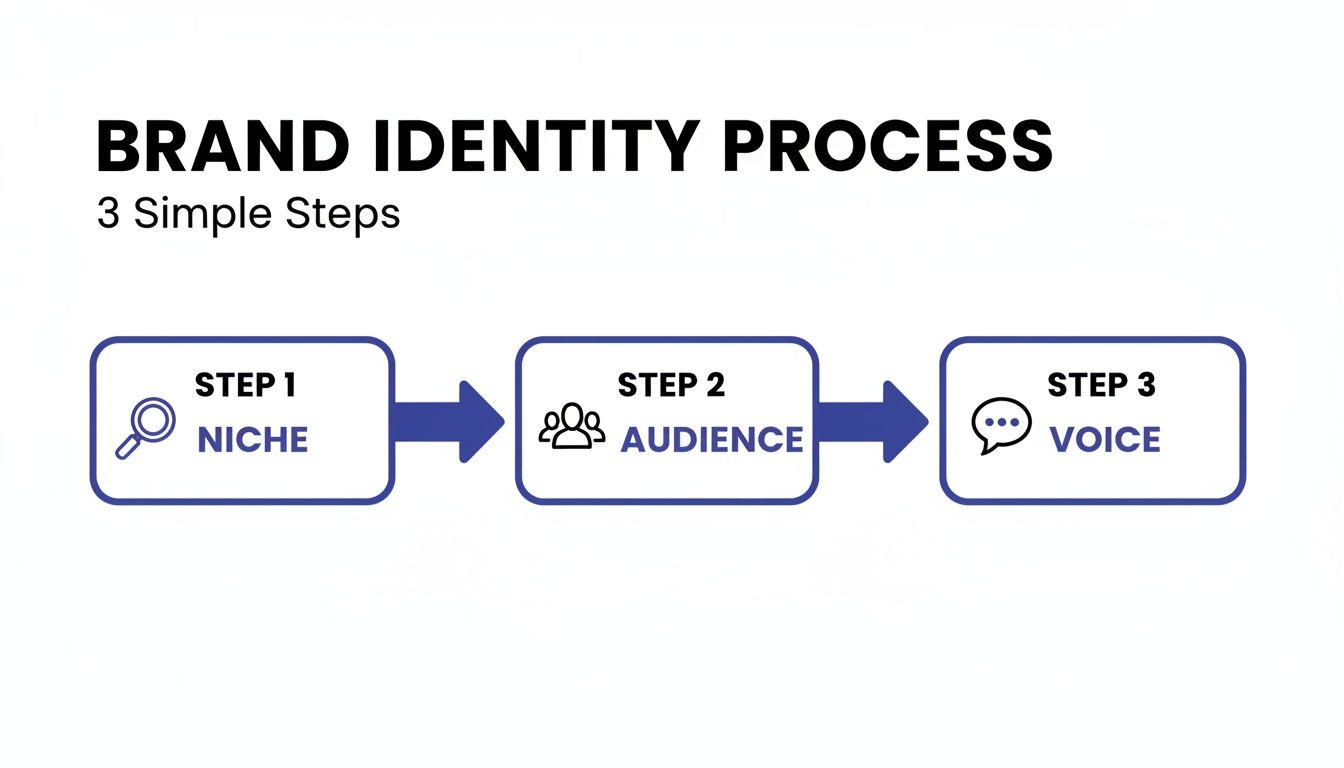
The graphic breaks down the essential steps of defining your niche, audience, and voice, which are the building blocks for every single piece of content you create.
Prioritize Consistency and Quality
Consistency is everything. I can't stress this enough. Data shows that creators who post 3-5 times a week see 2-3x higher engagement than those who post whenever they feel like it. With 86% of marketers planning to partner with influencers in 2025 (a big jump from 70% in 2021), brands are looking for reliable partners, not one-hit wonders.
And while platforms like TikTok are where you go viral—short-form video drives 73% of viral growth—don't forget that consistency without quality is just noise. You don't need a pro-level studio, but you do need to get the basics right.
- Good Lighting: Natural light is your best friend and it's free. Film near a window. If you can't, a simple ring light is a cheap investment that makes a world of difference.
- Clear Audio: Nobody will stick around for muffled, scratchy audio. Viewers will scroll on in a heartbeat. An external mic, even a basic lavalier mic you clip to your shirt, is a massive upgrade from your phone's built-in one.
- Clean Background: Your environment is an extension of your brand. Tidy up. A cluttered, distracting background takes the focus off you and your message.
Tools can help you keep that quality bar high. A platform like PostSyncer can act as your command center, letting you organize all your photos and videos in one place. Its AI Content Studio can even help you brainstorm fresh ideas based on your content pillars, so you never run out of things to say and can keep a steady stream of quality posts flowing.
Grow an Engaged and Loyal Community
Look, creating awesome content is a huge win, but it’s only half the job. The real power of an influencer isn't just a big follower number—it's the loyalty and connection you have with your community. A million followers who don't care about what you have to say are worthless. A smaller, dedicated crew that hangs on your every word? That's pure gold.
This is the point where you stop being a broadcaster and start being a community builder. It’s all about creating a two-way street where your followers feel like they're seen, heard, and part of something special. That's what builds a lasting career.
Go Beyond Likes and Follows
It's easy to get fixated on likes, but they can be a vanity metric. Real engagement lives in the meaningful interactions—the comments, the DMs, the shares. These are the signals that tell you people are truly connecting with your content, not just scrolling past it.
Think about your own feed. You probably follow hundreds of accounts, right? But which ones do you actually take the time to comment on? It's the creators who make you feel like you’re in on the conversation. That’s the vibe you need to create.
Building this kind of genuine engagement is far more valuable than a massive follower count. And brands are finally catching on. Nano and micro-influencers are often getting better results, with 73.2% of brands now working with at least 10 of them per campaign. Why? Because trust in mega-influencers is dropping, and smaller, tight-knit communities convert. Things like thoughtful comments, interactive polls, and live sessions can actually boost your audience retention by 40%. You can discover more insights about social media marketing on sprinklr.com to see the data for yourself.
Master the Art of Interaction
You can't build a community from an ivory tower. You have to be present, active, and in the trenches with your people. It's not enough to just post and ghost—that's how you get passive followers. To build true fans who will stick around, you have to engage.
Here are a few simple ways to get real conversations started:
- Respond Thoughtfully to Comments: Don't just drop a generic "Thanks!" or a heart emoji. Ask a follow-up question. Share a quick story related to what they said. Show them there's a real human on the other side of the screen.
- Use Interactive Features: Polls, quizzes, and Q&A stickers in your Stories are your best friends. These tools are literally designed to get people to tap, vote, and respond, giving you instant feedback on what they're thinking.
- Host Live Sessions: Going live on Instagram, TikTok, or YouTube is one of the most direct ways to connect. It’s unscripted, raw, and lets you talk with your audience in real-time. Use them for Q&As, behind-the-scenes glimpses, or just a casual hangout.
Think of your comment section as your community's town square. The more you show up and participate, the more vibrant and welcoming it becomes. It shows you're not just a creator; you're the host.
Implement Smart Organic Growth Tactics
While engaging with your current audience deepens those relationships, you still need to bring new people into the fold. Organic growth is all about getting your content in front of the right eyeballs without paying for ads. It's a slower burn, but it builds a much more authentic following in the long run.
This isn't about spamming hashtags or playing algorithm games. It's about strategic visibility.
Find and Use the Right Hashtags
Hashtags are basically the search engine of social media. Using them correctly is non-negotiable for discovery. The biggest mistake people make is using giant, generic tags like #travel. With hundreds of millions of posts, your content will be buried in seconds.
Instead, think in tiers. A good mix looks something like this:
- Broad Niche Tags (5-7): These relate to your overall industry (e.g.,
#digitalart,#veganrecipes). - Specific Sub-Niche Tags (7-10): Get more granular about what's in the post (e.g.,
#procreateillustration,#plantbasedmealprep). - Community-Specific Tags (3-5): Tap into an existing, passionate group (e.g.,
#womenwhohike,#indiegamedev).
This blend helps you cast a wide net while also reaching the smaller, hyper-engaged communities actively looking for exactly what you're creating.
Join Relevant Conversations
Your ideal audience doesn't just hang out on your profile; they're all over the platform. Find other accounts and hashtags in your niche and actually participate. Leave thoughtful comments on other creators' posts—and I don't mean "Great post!" Add something of value to their conversation.
This isn't about blatant self-promo. It's about being a genuine member of the community you want to lead. When you consistently show up and provide value everywhere, people will get curious and click over to your profile. Focus on giving more than you take, and you'll build a reputation that attracts followers who are there for the right reasons.
Develop Your Monetization Strategy
Once you've built a real, engaged community, the next logical step is to think about turning your influence into a sustainable career. Monetization isn't about "selling out." It's about building a smart business model that lets you keep creating the content your audience loves, moving your passion from a side project to your main profession.
The single most important rule here? Diversify. Relying on just one income stream is a recipe for disaster. Platform algorithms, brand budgets, and audience tastes can shift in an instant. A multi-pronged approach is your safety net, ensuring stability and opening up far more opportunities for growth.
Comparing Influencer Monetization Models
Not every monetization path is built the same. Some give you quick wins, while others are a slow burn that builds long-term value. The best strategy is almost always a custom blend of a few different approaches that make sense for your specific niche and audience.
Before diving in, let's look at the most common ways influencers make a living. This table breaks down the pros, cons, and who each model is best suited for.
| Monetization Model | Potential Earnings | Effort Level | Best For |
|---|---|---|---|
| Brand Sponsorships | High per project | Medium to High | Creators with a strong, engaged audience in a defined niche. |
| Affiliate Marketing | Low to High (Passive) | Low to Medium | Influencers who genuinely use and can recommend specific products. |
| Selling Products | High (Scalable) | High | Experts with a unique offering (e.g., e-books, presets, merch). |
| Services/Coaching | Medium to High | High | Specialists who can offer 1-on-1 value (e.g., fitness, business). |
Ultimately, the right mix depends on your brand's DNA. A DIY creator might crush it selling digital templates and craft kits, while a fitness influencer could build a thriving business around a personalized coaching program.
Master the Art of Brand Collaborations
A huge piece of the monetization puzzle is figuring out how to get brand deals and impress sponsors and lock in those valuable partnerships. This is where you really shift from being just a creator to being a business owner. It requires a whole new level of professionalism and strategic thinking, and it all starts with a polished media kit.
Think of your media kit as your influencer resume. It needs to be ready to go at a moment's notice.
Here’s what it absolutely must include:
- A short, punchy bio that introduces you and your brand's mission.
- Key audience demographics—who are they? (age, gender, location).
- Your core performance metrics, like follower count, engagement rate, and monthly reach.
- Showcase your best work with examples of past collaborations and testimonials.
- Clear pricing and package options for different types of content.
This single document is your proof of value. It makes it dead simple for a brand to understand why they should work with you. For a much deeper dive into this, our guide on how to get brand deals has even more tactical advice.
When you're pitching brands, shift your focus from your follower count to the value you deliver. Frame your pitch around how your highly-engaged community is their perfect target customer and how you can help them crush their marketing goals.
The data backs this up. The most effective partnerships are strategic and long-term. In fact, reports from 2025 show these kinds of collaborations outperform one-off campaigns by a whopping 2.5x in ROI. With 86% of US marketers now using influencers, the demand for authentic creators has never been higher. Don't underestimate your power if you're smaller—micro-influencers often see conversion rates 60% higher than massive accounts because of the deep trust they've built.
Price Your Work and Negotiate with Confidence
Let’s be real: figuring out what to charge is one of the toughest hurdles for new influencers. There’s no universal rate card, and your pricing will depend on your niche, engagement rate, content quality, and exactly what the brand is asking for.
As a starting point, a common formula is to charge 1-2% of your follower count for a single in-feed post. So, if you have 10,000 followers, you might start around $100-$200. But that's just a baseline. You also have to factor in the real time and effort it takes to produce amazing content.
When it's time to negotiate, know your worth. You have to be prepared to walk away from deals that don't feel right or don't offer fair pay. A brand that truly respects your work will understand that high-quality, impactful content isn't free.
And please, always get everything in writing. A formal contract protects both you and the brand by clearly spelling out deliverables, usage rights, payment terms, and timelines. This level of professionalism builds trust and paves the way for great long-term partnerships.
Scale Your Influence with Smart Tools and Analytics
If you want to turn this influencer thing into an actual career, you have to start thinking like a business owner. Passion and creativity are what get you in the door, but efficiency and smart, data-driven decisions are what keep you in the game. That means leaving the manual posting and guesswork behind.
It's time to build systems that let you scale your brand without burning out.

This is the classic "work smarter, not harder" moment. By bringing in the right tools and finally understanding the numbers that really matter, you free up your time to do what you do best: create amazing content and connect with your audience. You’re building a sustainable workflow that actually fuels your growth instead of draining your energy.
Centralize Your Workflow with a Management Platform
Juggling multiple social accounts is pure chaos. Constantly switching between apps to post, check DMs, reply to comments, and see how things are performing is a massive time-suck and a recipe for mistakes. A social media management platform like PostSyncer becomes your mission control, pulling everything into one clean dashboard.
Instead of scrambling to post in real-time every single day, you can sit down and plan out your content weeks ahead on a visual drag-and-drop calendar. This gives you a bird's-eye view of your entire strategy, ensuring your feed feels balanced and intentional. It’s the difference between being reactive and being strategic.
The whole point of a good tool is to automate the repetitive grunt work so you can pour your energy into the creative stuff. When you aren't in a daily panic to post, you have the mental space to think bigger about your brand and where it's headed.
Use Smart Scheduling to Maximize Reach
Posting at random times is like shouting into an empty room. Smart scheduling tools analyze data to pinpoint the exact times your specific audience is most active on each platform, then automatically publish your content during those golden hours. It’s a simple change that can give your initial visibility and engagement a massive boost.
For example, an AI-powered scheduler might discover your Instagram crowd is scrolling at 7 PM on Wednesdays, while your TikTok followers are most active during their Friday lunch break. Trying to track this manually is a nightmare, but a good platform just handles it for you. Every single post goes out with the best possible chance to pop off.
Focus on Analytics That Actually Drive Growth
It’s way too easy to get lost in a sea of data. Vanity metrics like your raw follower count can feel good, but they don't tell the whole story. A few key performance indicators (KPIs), on the other hand, reveal the true health of your influence. Obsessing over these numbers is how you figure out what’s working and what’s a waste of time.
Here are the metrics that should be on your radar:
- Engagement Rate: This is your #1 health metric, hands down. It’s the percentage of your audience that actually interacts with your content—think likes, comments, shares, and saves. A high engagement rate with a smaller following is infinitely more valuable to brands than a massive, silent audience.
- Reach and Impressions: Reach is the number of unique people who saw your post. Impressions are the total number of times it was seen (one person could see it multiple times). Tracking reach shows you how well you’re breaking out of your bubble and getting discovered.
- Click-Through Rate (CTR): When you drop a link in your bio, Stories, or anywhere else, the CTR measures what percentage of people who saw it actually clicked. This is a crucial number for affiliate marketing, selling your own products, or driving traffic for brand partners.
Turn Data into Actionable Content Decisions
Analytics aren't just boring numbers on a screen; they are direct feedback from your audience. They’re telling you exactly what they want to see more of. By setting aside time to review your performance, you can start making smarter, data-backed decisions about what to create next.
For example, did that behind-the-scenes Reel you almost didn't post get double the engagement of your typical content? That’s a massive clue. Your audience wants more of that. Did a carousel post explaining a tricky concept get an unusually high number of saves? They’re telling you they see you as a valuable, educational resource.
This feedback loop is how you stop guessing and start creating content that consistently hits the mark. It strengthens your community, deepens their trust, and drives real, sustainable growth. You stop hoping your audience likes something and start giving them exactly what they’re asking for, one data point at a time.
Got Questions About Becoming an Influencer? We've Got Answers
The path to becoming an influencer is rarely a straight line. It's filled with common questions and a ton of conflicting advice. If you're just starting out, getting clear, direct answers can save you months of guesswork and help you focus on what actually moves the needle.
Let's cut through the noise and tackle the questions I hear most often from aspiring creators.
How Many Followers Do I Need to Be an Influencer?
This is probably the number one question people ask, and the answer might surprise you: you don't need a massive following to be a "real" influencer. The game has changed. Brands are now laser-focused on genuine engagement, making smaller, tight-knit communities incredibly valuable.
- Nano-influencers (1k-10k followers): These creators are in high demand. Why? Their communities are often built on deep trust, which leads to fantastic conversion rates for the right brand partners.
- Micro-influencers (10k-100k followers): At this level, you’ve got a significant reach but can often still maintain that strong, personal connection with your audience.
Honestly, you can start landing paid partnerships with as few as 1,000 engaged followers. The key is being in a specific niche where your audience is a perfect match for a brand's product or service.
How Long Does This Actually Take?
Be very skeptical of anyone promising you overnight success. It just doesn't happen. For most creators, it takes a solid one to two years of consistent, high-quality work before they start generating a stable income.
Of course, this timeline depends on a few things, like how competitive your niche is, the quality of your content, and how effectively you're growing your community.
Treat this journey like a marathon, not a sprint. The creators who make it are the ones who show up consistently, day in and day out, focused on providing real value. Growth is just the natural result of that commitment.
What Gear Do I Really Need to Start?
You already have everything you need. Seriously. Your smartphone is more than capable of producing stunning photos and high-quality video, which means your initial investment can be practically zero.
Instead of drooling over expensive cameras and lenses you don't need yet, pour your energy into two areas that have a much bigger impact on how professional your content looks and feels.
- Good Lighting: This is completely non-negotiable. Natural light from a window is your best friend—and it's free. If you're stuck in a dark space, a simple ring light is an affordable buy that will instantly make your photos and videos look a hundred times better.
- Clear Audio: Here’s a pro tip: people will forgive grainy video, but they will absolutely not tolerate bad audio. A cheap lavalier mic that clips onto your shirt will make you sound infinitely clearer than your phone's built-in microphone.
Master the tools you've already got in your pocket. You can always upgrade your gear later on.
Ready to streamline your content workflow and scale your influence? PostSyncer provides all the tools you need—from AI-powered scheduling to in-depth analytics—in one central platform. Start your free trial today and take control of your social media.