











Before you write a single headline or design one graphic, your content strategy needs a rock-solid foundation. This is where the real work begins—the part that separates content that succeeds from content that just exists.
Think of it like building a house. You wouldn't just start hammering boards together without a blueprint, right? This initial phase is all about gaining clarity and setting a clear direction so you don't end up creating random posts and videos that go nowhere.
Building Your Content Strategy Foundation

This foundational work ensures every blog post, video, or social update is purposefully aligned with tangible business outcomes, rather than just adding to the noise online. Let's break down the three core pillars you need to establish first.
Defining Your Goals and Business Objectives
First things first: what are you actually trying to achieve? It's time to move beyond vague aspirations like "get more followers" or "increase traffic." A strong strategy is always tied to specific, measurable business outcomes.
Your goals need to be quantifiable and have a direct impact on your bottom line. For example, instead of a fuzzy goal like "improve brand awareness," get specific: "increase organic search visibility for our top 5 keywords by 20% in the next quarter." Much better.
Here are a few examples of strong, actionable goals to get you thinking:
- Generate 50 qualified leads per month from our blog.
- Increase email newsletter subscriptions by 30% over the next six months.
- Reduce customer support tickets by 15% with a new FAQ and tutorial video series.
- Drive 100 demo requests through targeted case studies and white papers.
A well-defined goal acts as your North Star. Every time you're about to create a piece of content, ask yourself: "Will this move us closer to our primary objective?" If the answer is no, it's not the right priority. Simple as that.
Understanding Your Ideal Customer
Once your goals are locked in, you need to know exactly who you're talking to. This is where creating detailed buyer personas becomes absolutely critical. And I'm not just talking about basic demographics like age and location.
You need to dig into the psychographics—their motivations, their biggest challenges, and their professional goals.
What keeps your ideal customer up at night? What are their biggest pain points related to your industry? Where do they hang out online to get information and advice? Answering these questions is how you create content that genuinely resonates, making your brand a trusted resource instead of just another company trying to sell something.
The global content marketing market is booming, projected to grow from $413.2 billion in 2022 to an astounding $2 trillion by 2032. This explosive growth is precisely why a structured, audience-focused approach isn't optional anymore. It's essential for cutting through the noise.
Conducting a Competitive Analysis
Finally, a solid foundation requires a good, hard look at what your competitors are doing. The goal here isn't to copy them—it's to spot opportunities they've missed.
Analyze their content to figure out:
- What topics are they covering successfully?
- What content formats (blogs, videos, podcasts) are they leaning on?
- Where are their content gaps? What important topics are they completely neglecting?
Identifying these gaps gives you a massive strategic advantage. If a key competitor has amazing blog content but zero video tutorials, you’ve just found a potential opening. This analysis helps you carve out a unique space and offer value that no one else is providing. For a deeper dive, you can explore this guide on how to develop a content marketing strategy.
To wrap up this foundational stage, here's a quick reference table to make sure you have your bases covered.
Defining Your Core Content Strategy Pillars
| Pillar | Key Question to Answer | Example |
|---|---|---|
| Business Goal | What specific, measurable outcome will this content drive? | "Increase qualified leads by 25% in Q3." |
| Ideal Customer | Who are we trying to reach and what problem do they have? | "Marketing managers at SaaS startups struggling with lead gen." |
| Competitive Gap | What are our competitors ignoring that we can own? | "They all write blog posts, but none offer a free video course." |
Nailing these three pillars before you move on is the difference between a content plan that delivers real results and one that just spins its wheels.
Auditing Your Content to Find Hidden Gems
Before you can build a solid content strategy for the future, you have to get honest about your past. A content audit isn't about getting lost in endless spreadsheets; it's a strategic hunt for what's already working, what's falling flat, and where your biggest opportunities are hiding in plain sight.
You’re probably sitting on a goldmine of existing assets—blog posts, social media updates, videos, and guides. This audit process helps you take stock of everything you've got and measure its performance against the goals you've already set.
Think of it as a much-needed health check for your entire content library.
Gathering Your Existing Content Assets
First things first, you need to create an inventory of everything you've published. A simple spreadsheet works perfectly for this. The key is to be absolutely thorough. Don't just pull your blog posts; make sure to include every single piece of content that represents your brand online.
For each piece of content, you'll want to capture a few key details:
- Content Title and URL: The basics—what it is and where it lives.
- Content Format: Is it a blog post, a video, an infographic, or a case study?
- Publication Date: This helps you quickly spot older content that might need a refresh.
- Key Metrics: Pull in the important data, like page views, time on page, conversion rates, and social shares.
Gathering this data gives you a complete, unbiased picture of your content landscape. It takes all the guesswork out of the equation and sets the stage for a much deeper analysis.
Analyzing Performance and Identifying Gaps
With your inventory ready, you can start looking for patterns. The goal here is to categorize your content based on how it’s performing. Which articles are driving the most traffic? Which videos are converting leads? And just as importantly, which posts are complete duds?
A simple framework I love to use involves sorting content into three main buckets. This approach keeps you from getting overwhelmed and gives you clear, actionable next steps for every single asset.
The real purpose of an audit isn't just to see what you have. It’s about making decisive, data-backed choices about what to do next. It transforms a messy, neglected content library into a powerful strategic asset.
And remember, you're not just auditing your website content. Social media is a massive part of your digital footprint and needs its own evaluation. For a deep dive into that specific process, check out our guide on how to conduct a social media audit.
The Keep, Update, or Scrap Framework
Okay, it’s decision time. Every single piece of content in your inventory should fall into one of these three categories. This ensures you have a crystal-clear plan for moving forward.
1. Keep High-Performing Content
These are your absolute winners—the articles, videos, and posts that consistently bring in traffic, engagement, and leads. Don't just leave them be; you should be promoting these heavily. These proven assets are also perfect candidates for repurposing into new formats.
2. Update Underperforming Content
This category holds so much hidden potential. These are pieces on highly relevant topics that, for whatever reason, just aren't hitting the mark. Maybe the information is outdated, the SEO is weak, or the format is just plain boring. A solid refresh can breathe new life into them.
- Real-World Example: An old blog post titled "Top Marketing Trends of 2021" covers a great topic but is obviously outdated. By updating it with current statistics, fresh examples, and better on-page SEO for "Top Marketing Trends of [Current Year]," you could quickly turn it into a top performer.
3. Scrap Outdated or Irrelevant Content
Let's be real: some content just isn't worth saving. This includes posts about old company news, long-expired promotions, or topics that are no longer relevant to your audience or business goals. Deleting this low-quality content can actually improve your site's overall SEO health.
Completing this audit ensures that every new piece of content you create is built on a foundation of proven success, not just wishful thinking.
Developing Content Pillars and Topic Clusters
Throwing random content at the wall and hoping something sticks is a recipe for disaster. If you want to build real authority, you need a structured approach that shows search engines—and your audience—that you're an expert. This is where the pillar-cluster model becomes your secret weapon.
Instead of just chasing whatever trend is hot this week, this model helps you build a deep, interconnected library of content. Think of it like creating a mini-encyclopedia on the topics your brand wants to own. You become the definitive source for your audience's biggest questions.
Establish Your Core Content Pillars
First things first, you need to define your content pillars. These are the broad, foundational topics that are absolutely central to your brand and what your audience cares about. We're not talking about specific keywords here, but the big-picture themes you want to be known for.
For instance, a SaaS company in the project management space wouldn't just pick "software" as a pillar. That's way too generic. A smarter approach would be to build their strategy around pillars like these:
- Project Management Methodologies: This opens the door to cover everything from Agile and Scrum to Kanban and Waterfall.
- Team Collaboration: A perfect pillar for exploring tools, techniques, and best practices for making teams work better together.
- Productivity and Time Management: Here, they can offer advice on how people and teams can get more done, efficiently.
These pillars are the columns holding up your entire content house. They have to be tied directly to your business goals and the problems you solve for customers. For more ideas on how this works across different niches, you can check out these social media content pillars examples to see the concept in action.
Your pillars should have a long shelf life. Aim for topics that will stay relevant for years. This allows you to continuously build out your authority and expertise around them without having to start from scratch every few months.
Brainstorm and Validate Topic Clusters
Once your pillars are set, it’s time to brainstorm topic clusters. These are the specific, keyword-focused articles that branch off from each main pillar. Every cluster piece takes a deep dive into a smaller sub-topic, answering a very specific question your audience has.
Let's go back to our SaaS company. Under their "Project Management Methodologies" pillar, their topic clusters could look like:
- "A Beginner's Guide to Agile Sprints"
- "Kanban vs. Scrum: What's the Real Difference?"
- "How to Implement a Waterfall Model for Small Projects"
- "Best Practices for Running a Daily Stand-up Meeting"
Each of these cluster posts would then link back to the main pillar page. This creates a powerful internal linking structure that search engines love, as it signals that you have comprehensive knowledge on the subject.
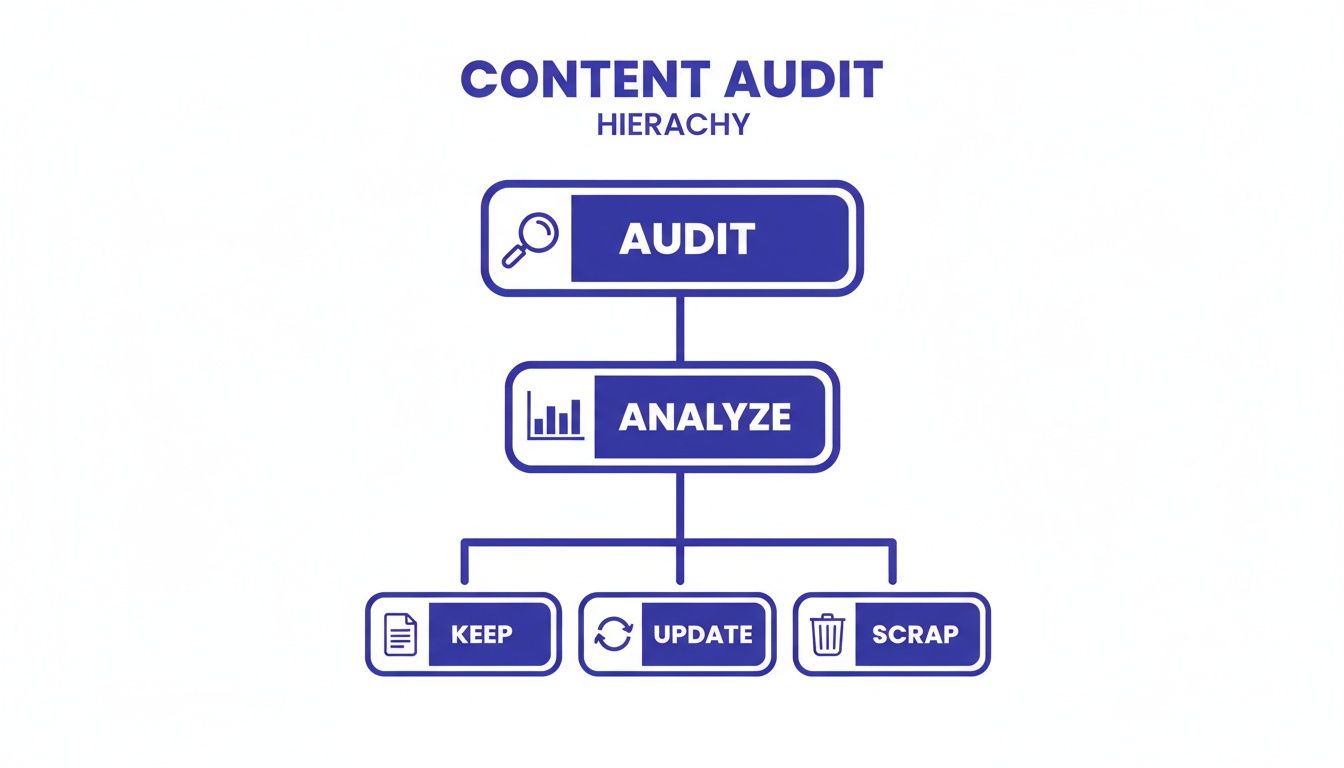
This diagram breaks down the decision-making process into three simple outcomes—Keep, Update, or Scrap. It’s a handy framework for figuring out what to do with your existing content, which often helps you spot great candidates for new pillars and clusters.
Validating Your Cluster Ideas with Data
Brainstorming is great, but it's not enough. You have to make sure people are actually searching for the topics you've come up with. This is where good old-fashioned keyword research separates the pros from the amateurs.
Fire up your favorite keyword research tool and check the search volume for your cluster ideas. A topic might sound brilliant in a meeting, but if nobody is looking for it, your content won't drive any organic traffic. You're looking for that sweet spot: keywords with decent search volume and a competition level you can realistically tackle.
Actionable Tip: Don't just stop at your keyword tool. Go directly to Google and look at the "People Also Ask" and "Related Searches" sections for your pillar topics. This is a goldmine for finding cluster ideas that directly answer user questions, ensuring your content perfectly matches search intent.
By combining broad, authoritative pillars with specific, data-backed clusters, you stop just making content and start building a strategic asset. This organized framework doesn't just boost your SEO; it creates a valuable, easy-to-navigate resource that keeps your audience coming back for more.
Choosing Channels and Formats That Actually Convert
Look, creating amazing content is only half the battle. If your brilliantly crafted blog posts and videos never reach the right people, they might as well not exist. It's easy to fall into the trap of trying to be everywhere at once, but a winning content strategy is all about making deliberate choices about where you show up and what you share.
The goal is to move from a "spray and pray" approach to a focused, surgical strike. That means figuring out the specific channels where your ideal customers actually spend their time and aligning your content formats with how they prefer to consume information. A solid strategy ensures your content not only gets seen but also drives real action.
Pinpointing Your High-Impact Channels
First things first: where does your audience live online? Answering this question is the foundation of a distribution plan that works. A B2B software company targeting enterprise tech leaders will find its audience on LinkedIn, not TikTok. On the flip side, a direct-to-consumer brand selling trendy apparel will likely get far more traction from Instagram Reels.
Your audience research from the early stages is crucial here. Go back to your buyer personas and map out their digital hangouts.
- Professional Networks: For B2B audiences, LinkedIn is almost always the top choice. It's the perfect place for sharing in-depth articles, industry reports, and company news.
- Visual Platforms: Think Instagram, Pinterest, and TikTok. These are non-negotiable for brands with a strong visual identity, excelling with high-quality images, short-form videos, and tutorials.
- Community Forums: Don't sleep on niche communities. Places like Reddit or dedicated industry forums can be goldmines for connecting with highly engaged users who are actively looking for solutions.
- Email Newsletters: This is your channel. It’s the most direct line to your most loyal audience and is absolutely ideal for nurturing leads and sharing exclusive content.
Don't just guess where they are. Dig into your analytics, run customer surveys, and pay attention to where the real conversations in your industry are happening. This data-driven approach keeps you from wasting time and money on platforms that won’t deliver.
Matching Content Formats to Audience Habits
Once you know where to post, you need to decide what to post. The format of your content should be a perfect match for both the platform's strengths and your audience's habits. A 3,000-word technical guide will fall flat on Instagram, and a 30-second dance trend video isn't going to convert serious leads on LinkedIn.
Choosing the right format is about reducing friction. You want to make it as easy as possible for your audience to engage with your message in a way that feels completely natural to them on that specific channel.
For example, think about how a single topic—like "improving team productivity"—could be adapted into different formats for various channels:
- Blog Post: A long-form, SEO-optimized article titled "10 Actionable Strategies to Boost Team Productivity" designed to capture organic search traffic.
- Infographic: A visually engaging summary of those 10 strategies, perfect for sharing on Pinterest or in a LinkedIn post to grab attention quickly.
- Short-Form Video: A snappy 60-second Instagram Reel or TikTok demonstrating one of the 10 productivity tips in action.
This multi-format approach lets you maximize the reach of a single core idea by tailoring it to how people actually behave on different platforms.
To make this even clearer, let's break down which formats work best on the most popular channels. This isn't a set of rigid rules, but it's a fantastic starting point for planning your content.
Matching Content Formats to Distribution Channels
| Channel | Primary Audience | Optimal Content Formats | Goal |
|---|---|---|---|
| B2B professionals, industry leaders, job seekers | In-depth articles, case studies, whitepapers, infographics, text-based posts, short professional videos. | Build authority, generate leads, network. | |
| B2C consumers, visual-focused demographics (Millennials/Gen Z) | High-quality images, Reels, Stories, carousels, user-generated content. | Build brand identity, drive e-commerce, engage community. | |
| YouTube | Broad demographic, search-intent users | Long-form videos, tutorials, webinars, product demos, vlogs, customer testimonials. | Educate, entertain, build a loyal following. |
| TikTok | Primarily Gen Z and younger Millennials | Short-form vertical videos (15-60 seconds), trends, challenges, behind-the-scenes content. | Increase brand awareness, drive viral engagement. |
| Blog/Website | Search engine users, existing customers, prospects | Long-form articles, guides, case studies, research reports, pillar pages. | Drive organic traffic (SEO), capture leads, establish expertise. |
| Email Newsletter | Your most engaged and loyal audience | Exclusive content, roundups, personal letters, special offers, company updates. | Nurture leads, drive repeat business, build relationships. |
Thinking through this table helps you avoid that classic mistake of creating one piece of content and just blasting it everywhere. Instead, you're strategically crafting assets designed to win on each specific platform.
The Undeniable Rise of Video Content
While a mix of formats is key, ignoring video is simply no longer an option. The data shows a dramatic shift in user behavior, making video a must-have for any modern content strategy.
Video platforms, especially YouTube, have seen explosive engagement. In fact, video has seen a reported 79% growth in importance over the past year, far outpacing other social networks. This trend makes it crystal clear: prioritizing video is essential for meeting consumers where they are. You can discover more insights on why video is dominating content marketing.
Whether it’s short-form tutorials on TikTok, in-depth webinars on YouTube, or customer testimonials for your website, video is uniquely effective at grabbing attention and building a genuine connection with your audience.
Building a Sustainable Content Workflow
An ambitious content strategy without a practical workflow is just a wish list. Seriously. This is where your big ideas meet reality—transforming your plans from a static document into a predictable, scalable content engine that keeps delivering.
Without a system, chaos takes over, deadlines get missed, and quality suffers. This operational focus is what separates professional content teams from those who just wing it. It's about building a machine that turns ideas into high-quality, published content, month after month.

Establish Your Content Calendar
Think of your content calendar as the single source of truth for your entire team. It’s way more than just a list of due dates; it’s a strategic command center that helps you plan ahead, align on topics, and kill those last-minute scrambles for good. A well-maintained calendar gives everyone a clear view of the entire production pipeline.
Your calendar should track several key stages for each piece of content:
- Ideation: The initial concept or keyword target.
- Briefing: The detailed outline and requirements are created.
- Drafting: The content is being written or produced.
- Review/Editing: The draft is being checked for quality and accuracy.
- Design: Any necessary graphics or videos are being created.
- Publishing: The content is scheduled to go live.
- Promotion: The plan for distributing the content is executed.
This level of detail ensures everyone knows the status of a project at a glance, eliminating confusion and bottlenecks before they happen.
Define Clear Roles and Responsibilities
A smooth workflow depends on everyone knowing their exact role. Ambiguity is the enemy—it leads to dropped balls and duplicated effort. Clearly defining who does what is absolutely essential for accountability and efficiency, especially as your team grows.
A typical content team might include these roles:
- Content Strategist: Owns the overall strategy, plans the calendar, and analyzes performance.
- Writer/Creator: Researches and produces the primary content (articles, scripts, etc.).
- Editor: Reviews for grammar, style, tone, and factual accuracy.
- Designer: Creates all visual elements, from social graphics to infographics.
- Social Media Manager: Handles promotion and distribution across all channels.
In smaller teams, one person might wear multiple hats, but documenting these responsibilities is still critical. For a deeper look into structuring these operational steps, you can explore our guide on building an effective content creation workflow.
Craft Actionable Content Briefs
I can't stress this enough: a great content brief is the blueprint for a successful piece of content. It’s a simple document that ensures the creator understands the strategic goals before they even start working. This one step prevents so many major revisions and ensures every piece hits its intended mark.
Your content brief is the ultimate alignment tool. It translates strategic goals into clear, actionable instructions, guaranteeing that every piece of content is created with purpose from the very beginning.
A solid brief should always include:
- Primary Keyword & Secondary Keywords: The main SEO targets.
- Target Audience Persona: Who are we talking to?
- Key Talking Points: Essential topics or data points that must be included.
- Call to Action (CTA): What do we want the reader to do next?
- Internal Linking Suggestions: Relevant existing content to link to.
This upfront planning is a total game-changer. It empowers your writers and creators to work more autonomously while staying perfectly aligned with your strategy. This systematic approach is also why more companies are investing heavily in their content operations.
Content marketing budgets are climbing, which shows just how vital a solid strategy is for driving business success. In early 2024, nearly 45% of marketers globally planned to increase their content marketing budgets, signaling a strong commitment to this field. This investment isn't just for creating more content; it's for building the workflows and teams needed to produce it effectively and at scale.
Measuring Performance and Optimizing for Results
Let’s be real: your content strategy isn't a "set it and forget it" document you write once and file away. Think of it as a living, breathing part of your marketing that needs regular check-ups to stay healthy and deliver real value. This is where measurement comes in—not to drown you in spreadsheets, but to give you clear signals on what’s working so you can do more of it.
Without tracking performance, you’re just guessing. You're throwing content at the wall and hoping something sticks. A solid optimization loop, however, turns those guesses into strategic, data-backed decisions. This continuous cycle of measuring, learning, and refining is what separates the content programs that drive growth from the ones that just fizzle out.
Connecting Content to Business Objectives
The key is to ignore the fluff and focus on metrics that actually tie back to your business goals. Vanity metrics like "likes" and "shares" feel good, but they don't pay the bills. Instead, you need to prioritize KPIs that clearly show how your content is impacting the bottom line.
- Lead Generation Metrics: Are your blog posts, guides, and webinars turning readers into potential customers? Track things like form submissions, demo requests, and ebook downloads that come directly from your content.
- Conversion Rate: This one is huge. Of all the people who read a specific blog post, what percentage actually took the next step you wanted them to? A high conversion rate is a powerful indicator of effective content.
- Search Rankings: Keep a close eye on where you stand for your target keywords. Climbing the search engine results pages (SERPs) directly translates to more organic visibility and, ultimately, more traffic.
The real win is when you can connect a specific piece of content to a specific business outcome. When you can confidently say, "This case study generated 15 qualified leads this quarter," you've proven the value of your entire strategy.
Of course, getting those rankings means keeping up with how search is evolving. To make sure your content really performs, it's critical to understand the nuances of optimizing content for AI-driven search results.
Building Your Performance Dashboard
You don't need some ridiculously complex, expensive system to track your results. Honestly, a simple dashboard in Google Analytics or your social media tool can give you a clear, at-a-glance snapshot of what’s going on.
The trick is to focus on a handful of core metrics that align with the goals you set way back at the beginning of this process.
Then, get into a rhythm. Set a consistent time to review this data—monthly or quarterly works for most teams. This regular check-in is your moment to spot trends, identify which content pillars are hitting home, and make smart decisions about where to pivot next. This iterative process is the engine that will power your content strategy for the long haul.
Got Questions? We've Got Answers
Even the most detailed roadmap can leave you with a few questions. When you're in the weeds of building a content strategy, it's natural for things to pop up. Here are some of the most common ones I hear from clients and colleagues.
How Often Should I Be Posting New Stuff?
Everyone wants a magic number, but the honest answer is: consistency beats frequency every single time. Seriously. It’s a million times better to publish one fantastic, well-promoted blog post every single week than to churn out five half-baked posts that nobody ever sees.
Take a hard look at your team and your resources. What can you realistically commit to? For a small business, that might be one solid blog post and a handful of social updates each week. A bigger team with more hands on deck might be able to tackle daily content across a few different channels.
The only publishing schedule that works is the one you can actually stick to without your quality taking a nosedive. An abandoned blog sends a worse message than one that posts a little less often but always delivers.
Okay, But How Long Until I See Real Results?
I get it, you want to see a return on your effort. But content marketing is a marathon, not a sprint. While a clever social media post might give you a quick bump, the real, meaningful results from things like SEO and organic traffic usually take a good six to nine months to really start cooking.
Think of it like planting a tree in your backyard. You have to water it and be patient before it’s big enough to provide any shade. The trick is to watch the leading indicators—are your keyword rankings slowly climbing? Are you seeing small but steady upticks in organic visitors? Those are the signs that you're on the right path.
What's the Real Difference Between Content Strategy and Content Marketing?
This one trips a lot of people up! They’re definitely two sides of the same coin, but they are not the same thing.
Here's how I break it down:
- Content Strategy is your high-level game plan. It’s the why and the who. This is where you define your goals, your ideal customer, your brand voice, and the core topics you want to be known for. It's the blueprint for the entire house.
- Content Marketing is the action. It's the how and the where. This is the hands-on work of actually creating, publishing, and promoting the blog posts, videos, and social updates that your strategy called for. It's the process of building the house, brick by brick.
Simply put, your strategy is the compass that makes sure every single piece of content you create is pointing in the right direction.
Ready to put that brilliant strategy into motion? PostSyncer gives you all the tools you need to plan your calendar, schedule your content, and see what's working—all in one place. Start your free trial today and build a content machine that actually gets results.