












Throwing content at the wall and hoping it sticks is a recipe for disaster. Before you can find your audience, you first have to know exactly who you’re looking for.
So many social media strategies fizzle out because they start with vague assumptions—like "we're targeting millennials"—without ever digging into what defines their best customers. It all begins with looking inward at your business goals and the people who are already buying from you.
This isn't just a data-gathering exercise. It’s about setting a strategic foundation that guides every single piece of research you do from here on out. Nailing this first step is crucial if you want to achieve product-market fit. Get it wrong, and you'll burn through your budget marketing to people who were never going to convert anyway.
Start With Your Business Objectives
Your marketing goals are the compass for your audience research. What are you actually trying to accomplish?
Are you trying to blow up brand awareness? Drive immediate sales? Build a hardcore community of loyal fans? Each goal requires a completely different type of person.
For example, if your goal is to sell a high-ticket service, you need to find an audience with disposable income, not just a bunch of people who like your memes. Connecting your goals to specific audience traits from the get-go ensures every dollar is spent reaching people who can actually move the needle.
This simple alignment helps you avoid a classic pitfall: racking up likes and comments that do absolutely nothing for your bottom line. To make this connection clearer, think about how your goals should shape the questions you ask.
Connecting Business Goals to Audience Characteristics
This table breaks down how a specific business objective translates directly into the kind of audience data you need to be hunting for.
| Business Goal | Audience Question to Answer | Data to Collect |
|---|---|---|
| Increase direct sales by 20% | Who has the purchasing power and immediate need for our product? | Income level, job title, recent life events (e.g., new homeowner), online shopping behavior. |
| Grow a loyal community | Who is most likely to engage, share content, and become a brand advocate? | Social media habits, interests, values, brand affiliations, past engagement rates. |
| Boost brand awareness | Where can we find a large, relevant group of potential new customers? | Media consumption habits, platforms they frequent, influencers they follow, geographic location. |
| Launch a new feature | Which existing customers are most likely to adopt and benefit from this update? | Product usage data, past feedback, professional challenges, expressed interest in similar tools. |
See the pattern? The goal dictates the "who," and the "who" dictates the data.
Analyze Your Current Customer Base
Your existing customers are a goldmine of information. Seriously. They already chose you over everyone else, so figuring out what they have in common is the fastest way to build a profile of your ideal buyer.
Start digging for patterns in their:
- Demographics: What are the common age ranges, locations, job titles, or income levels? Don't just guess.
- Behaviors: How did they find you? What was the first thing they bought? What content do they engage with most?
- Pain Points: What problem are you really solving for them? Read through support tickets, sales call notes, and customer reviews. The language they use is pure gold.
Key Takeaway: Your best customers—the ones who are profitable, loyal, and sing your praises—are the blueprint. Focus on cloning them, and you'll build a growth engine that lasts.
This initial process isn't complicated. It’s a logical flow from your goals to your existing data, which then allows you to define who you’re going after.
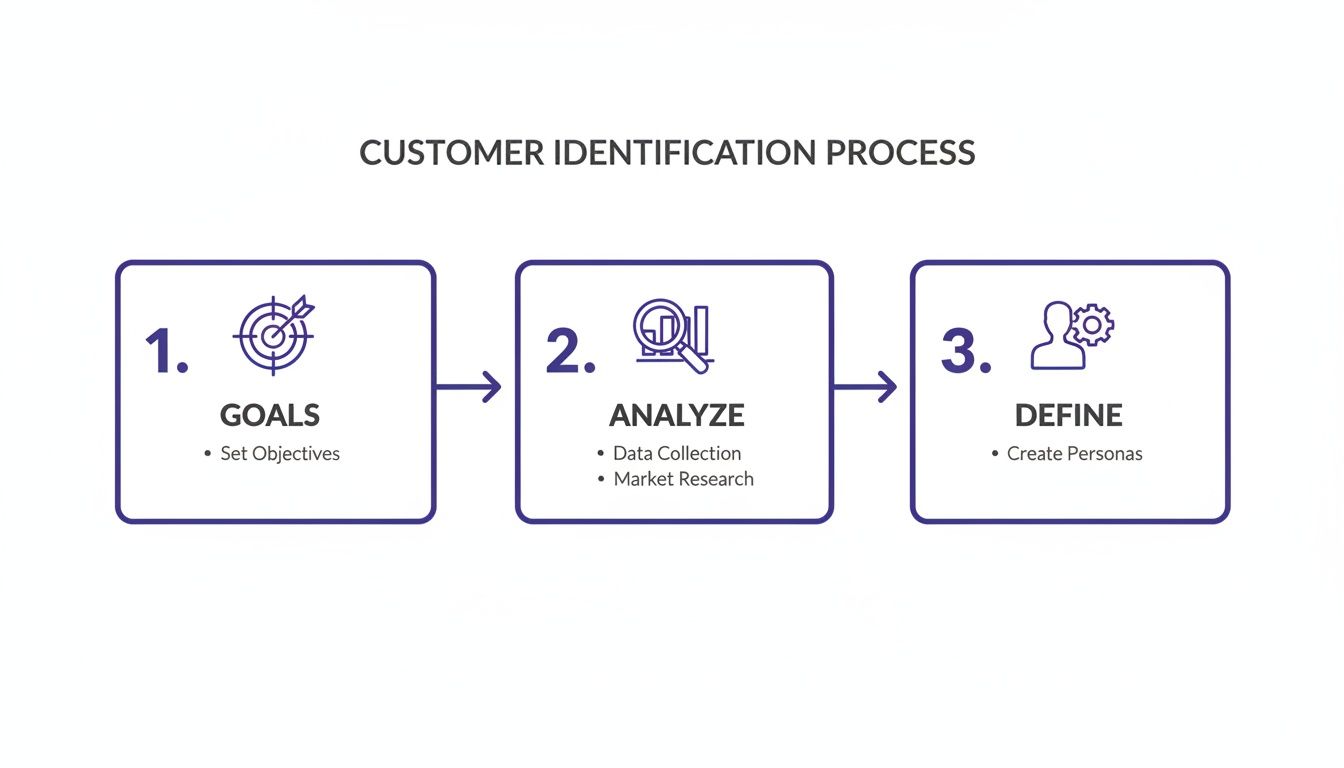
This simple visual makes it clear: effective audience identification is a strategic journey, not a one-off task. By first getting crystal clear on what you want to achieve, you can be far more effective in finding the people who will help you get there.
Using Quantitative Data to Map Your Audience Landscape

While analyzing your existing customers gives you a solid gut-check, quantitative data is where you get the hard numbers to really scale your efforts. This is the moment you move from an informed hunch to a data-backed strategy. These numbers tell the story of who, what, and where your audience is hanging out online right now.
The best part? You probably already have access to some incredibly powerful tools to do this. The analytics dashboards built right into your social media platforms and website are goldmines of insight, just waiting to be explored.
Diving into these reports gives you a clear, objective picture of your audience's digital footprint. This data-driven approach is critical when you're trying to identify a target audience because it pulls your personal bias out of the equation. Instead of assuming who your customers are, you can see concrete evidence.
Dig Into Your Social Media Analytics
Your social channels are a direct line to your community, and the native analytics tools are surprisingly robust. Platforms like Meta Business Suite (for Facebook and Instagram), X Analytics, and TikTok Analytics offer incredibly detailed demographic breakdowns of your followers and the people engaging with your content.
You'll want to look for key data points that paint a clearer picture:
- Age and Gender: See which age brackets and genders make up the bulk of your followers.
- Location: Pinpoint the top cities and countries where your audience lives. This is a game-changer for local businesses or brands thinking about expansion.
- Active Hours: Find out the exact days and times your followers are most active online. This is crucial for optimizing your posting schedule.
Let’s take Instagram as an example. The platform has over 1.4 billion monthly users, with the largest groups being 18-24 (31.7%) and 25-34 (30.6%). But knowing that engaged audiences are often dominated by women aged 25-34 can completely change how you build a campaign. You can get a deeper dive into how Instagram's demographics can shape your marketing on ayrshare.com.
These aren't just abstract statistics; they're clues. If you discover that 70% of your engaged audience is women aged 25-35 living in major cities, that insight should directly influence your ad targeting, content tone, and even the imagery you choose. To really get a handle on these tools, check out our complete guide on social media analytics and reporting.
Uncover Website Visitor Behavior with Google Analytics
Social media analytics show you who follows you, but Google Analytics (GA4) tells you who is actively seeking you out. This free tool gives you a ton of information about the people visiting your website.
Connecting your site to GA4 lets you go way beyond just page views. You can access detailed demographic reports showing visitor age, gender, and location. More importantly, you can track their behavior once they land on your site.
Pro Tip: Spend time in the Acquisition reports in GA4. They show you exactly how people found you—whether it was an organic search, a social media click, or a referral from another site. This helps you figure out which channels are driving the best traffic.
Look at which pages or blog posts are the most popular. Are visitors who land on a specific service page more likely to fill out a contact form? Answering questions like these helps you build a profile of a high-intent visitor, a key piece of your target audience puzzle.
Conduct a Smart Competitor Analysis
Your competitors have already done some of the heavy lifting for you. By analyzing their audience, you can quickly spot market gaps, see what resonates with a shared audience, and find opportunities to make your own brand stand out.
Don't just glance at their follower count. Dive deep into their content and see who is actually engaging.
- Who is commenting? Click on the profiles of people leaving comments. What are their job titles? What other brands do they follow? What are their interests?
- What content performs best? Identify their most-liked and most-shared posts. This is a dead giveaway for what topics, formats, and messaging styles are working in your niche right now.
- Where are the gaps? Look for questions their audience is asking that are going unanswered. That's a golden content opportunity for you to swoop in and provide value.
This isn't about copying your competitors. It's about smart reconnaissance—using their public-facing data to refine your own understanding of the market and carve out your unique space within it.
Uncovering Customer Motivations with Qualitative Research
If quantitative data draws the map, qualitative research tells you the stories behind the landmarks. While numbers are great for telling you what people are doing, this is where you dig into the why. It's how you stop looking at your audience as a set of statistics and start seeing them as real people.
This isn't about spreadsheets; it's about conversations. This is where you uncover the real-world frustrations, motivations, and goals that drive your audience. By talking to them—not just about them—through interviews, surveys, and social listening, you build genuine empathy that becomes the emotional core of your entire social media strategy.
The Power of a Good Conversation: Customer Interviews
Honestly, there is no substitute for a direct conversation. Talking to your customers, both the happy ones and the ones who churned, is one of the most eye-opening things you can do. The goal isn't just to hear them praise your product but to uncover insights you never even thought to look for.
To get the real story, you need to ask open-ended questions that get them talking. Ditch the simple yes/no queries and try prompts that encourage storytelling instead:
- "Can you walk me through the moment you first realized you needed something like our product?"
- "What was the biggest headache you were dealing with before you found us?"
- "Paint me a picture of what a 'win' looks like for you when using our tool."
Questions like these get past the surface-level fluff. You'll hear the exact words and phrases they use to describe their problems, which is pure gold for writing ad copy, social posts, and landing pages that actually connect.
Designing Surveys That People Actually Finish
While interviews give you depth, surveys give you scale. A well-designed survey helps you spot patterns across a much larger slice of your audience. The trick is to find the right balance between multiple-choice questions and those priceless open-text fields.
Don't just ask someone to rate their experience on a scale of 1-10. Always follow it up with an open-ended question like, "What is the one thing we could do to make your experience better?" I promise you, the real magic is hidden in those text boxes.
When you build your survey, keep it short and sweet. Respect their time. A quick, focused survey is way more effective than a 30-minute beast that no one will finish. Zero in on one or two key areas you need to understand better, whether that’s their content preferences, buying triggers, or biggest professional hurdles.
Eavesdropping Ethically: Social Listening
Your audience is already out there talking—you just have to know where to listen. Social listening means tuning into social media channels, forums, and review sites for mentions of your brand, your competitors, and the keywords that define your space.
This goes way beyond just tracking brand mentions. You’re tapping into raw, unfiltered conversations where people share what they really think. Digging through Instagram comments, Reddit threads, or G2 reviews can show you:
- Common Pain Points: What problems are people constantly complaining about in your industry?
- Feature Wishlists: What solutions are they practically begging for?
- Their Natural Language: How do they talk about their needs? Mirroring this language in your content is a superpower.
Places like Reddit and Quora are treasure troves for this kind of research. To go even deeper into community discussions, some specialized forum search engine tools can be incredibly helpful for sifting through all the noise. The insights you pull from these real-world chats are powerful. One of the best ways to activate these insights is by encouraging customers to share their own stories, which is the foundation of great user-generated content campaigns.
You also can't ignore the geographic and demographic data available on the platforms themselves. For example, LinkedIn has over 1 billion members across the globe. The US leads with 230 million users, but India is right behind with 130 million. Knowing that the largest age group is 25-34 (making up 50.6% of users) is critical. For a brand with a global audience, this means you might create career-growth content specifically for young professionals in India, acknowledging their massive user base and driving much higher engagement.
Putting a Face to the Data: Crafting Your Buyer Personas

So, you've done the hard work. You've got a pile of survey responses, interview notes, and analytics reports. But right now, it's just raw potential. Data sitting in a spreadsheet doesn't sell anything. The magic happens when you translate that information into a tool your whole team can actually use: the buyer persona.
This is where abstract numbers become a living, breathing profile of your ideal customer. A persona is basically a semi-fictional character you build from your research, representing a core segment of your audience. It gives a name, a face, and a story to the stats, making it infinitely easier to create content for the real people you're trying to reach.
Think about the shift from "females aged 25-34" to "Marketing Manager Molly." Instantly, you're picturing a person, not a demographic slice. This is the crucial leap you need to make when you identify your target audience, because it forces everyone—from marketing to sales—to think about the customer first.
Weaving Together Numbers and Stories
The most powerful personas are a blend of both types of research. Your quantitative data (the "what") gives you the skeleton—demographics, behaviors, and broad patterns. But it's the qualitative data (the "why") that adds the heart and soul—their goals, frustrations, and motivations.
Start by looking for the overlaps. Did Google Analytics show a traffic spike from Austin, Texas, while your interviews revealed that the tech scene there is struggling with a problem your software solves? Boom. That's a connection you can build on.
Group similar survey answers and interview quotes. You'll quickly start to see patterns emerge around common pain points or goals. These clusters are the building blocks for your primary and secondary personas.
Key Takeaway: A persona isn't a fantasy profile of who you wish your customer was. It's a research-backed snapshot of who they actually are, built from the evidence you've gathered.
Don't be afraid to create two or three different personas if the data points to multiple distinct groups. A scrappy startup founder has completely different needs than a corporate marketing director, even if they both use your product.
Building Your Persona Template
To make your personas genuinely useful, you need to structure the information in a clear, digestible way. A simple template keeps things focused and makes the profiles easy for anyone on your team to understand. Forget bloated, 10-page documents; just capture what actually matters for making marketing decisions.
Here's a straightforward template to get you started:
- Name and Photo: Give them an alliterative name ("Startup Sam") and grab a stock photo. It sounds silly, but it makes the persona feel real.
- Demographics: Pull in the key details from your quantitative data—age, job title, income level, location, etc.
- Goals: What are they trying to accomplish? List 1-3 primary goals, both professional and personal.
- Frustrations (Pain Points): What's getting in their way? List their top 1-3 frustrations.
- Motivations: What's driving their choices? Are they motivated by efficiency, growth, recognition, or security?
- Watering Holes: Where do they spend their time online? Name specific social platforms, blogs, influencers, or forums they follow.
That last point about "watering holes" is pure gold for social media managers. Knowing which platforms your persona lives on is half the battle. For example, YouTube's 2.504 billion monthly users are perfect for deeper, long-form content, especially since 21.7% are aged 25-34 and spend nearly 49 minutes a day on the site. In stark contrast, Snapchat, with nearly 40% Gen Z users, demands a completely different, younger-focused approach. You can dig into more social media demographics to refine your targeting on sproutsocial.com.
From Persona to Actionable Strategy
Once they're built, your personas become the North Star for all your marketing efforts. Every social media post, blog article, and ad campaign should be created with a specific persona in mind. This is how you guarantee your message actually connects.
Start asking your team questions like:
- Would "Marketing Manager Molly" find this post useful?
- What kind of headline would stop "Startup Sam" from scrolling on LinkedIn?
- Does this ad speak directly to the main frustration we identified for our primary persona?
This persona-driven mindset is the foundation of a killer content plan. To see how these profiles directly feed into what you should be creating and scheduling, check out our guide on how to create a content strategy. When you use personas consistently, you stop just making content and start making the right content for the right people—turning all that research into real results.
Putting Your Audience Research to the Test on Social Media

Alright, you've done the heavy lifting and built out some solid buyer personas. But creating them isn’t the finish line—it’s the starting pistol. Your research and profiles are really just well-educated guesses. Now it's time to see if they hold up in the real world.
And there's no better laboratory for this than social media.
Think of it this way: your audience is never static. Market trends shift, customer needs evolve, and what connected with people six months ago might completely miss the mark today. This is why you can't just "set and forget" your audience strategy. It has to be a living, breathing part of your workflow.
Your personas are your map. Now, you need to get on the ground and see if the terrain actually matches what’s on paper.
Use Paid Ads as Your Proving Ground
While organic reach is the dream, paid social ads give you a level of surgical precision that’s perfect for testing. Platforms like Meta (for Facebook and Instagram) and LinkedIn let you build hyper-specific audiences using the exact traits you outlined in your personas. This is your chance to see if "Marketing Manager Molly" is actually out there and if she responds to what you're saying.
You don't need a massive budget for this. The goal isn't to drive huge sales from the get-go; it's to gather data. Start with small A/B testing campaigns.
- Test Audience Segments: Create two identical ads. Show one to an audience you've built based on job titles and the other to an audience based on their listed interests. Which one delivers a lower cost-per-click (CPC) or a higher click-through rate (CTR)?
- Test Your Message: Run the same ad creative to the same audience but switch up the copy. Does a headline focused on a pain point work better than one that highlights a key benefit?
- Test Creative Formats: Does your target persona engage more with a polished graphic, a casual, user-generated-style video, or a simple, punchy text post?
The key is to isolate just one variable at a time. This way, you get clean data that tells you exactly what resonates and what doesn't. You’ll quickly move from thinking you know your audience to knowing what they actually click on.
Monitor Your Engagement Metrics Like a Hawk
Every like, comment, share, and save is a vote from your audience. They're telling you, post by post, what they want to see more of. Your analytics dashboard is a direct feedback channel, and you need to listen closely.
But don't just glance at your overall engagement rate. You need to dig into the performance of individual posts to spot the real patterns.
- High Shares: This is gold. When someone shares your content, they're staking their own reputation on it. What was the topic? Was it a controversial take, a helpful list, or a funny meme?
- High Saves: This signals that your content is genuinely useful—something your audience wants to come back to. It’s a huge win for any educational or tutorial-style content.
- Meaningful Comments: Look past the one-word replies. When people start asking follow-up questions or sharing their own stories, you’ve struck an emotional chord. Pay attention to the exact words and phrases they use.
Key Insight: Don't just look at what performed well; you have to ask why. Was it the clever hook in the first sentence? A surprising statistic? The super-actionable tip at the end? Deconstruct your wins so you can build a repeatable formula.
Dive Into the DMs and Comments
Your quantitative data tells you what happened, but your comment sections and DMs tell you the story behind it. This is where your qualitative research continues in real-time. The questions people ask and the feedback they give you are priceless.
If five different people ask the same question after a post, that's not a coincidence—it's a bright, flashing sign. You've either found an area of confusion you need to clarify or, even better, the perfect topic for your next piece of content.
This direct feedback loop is where the magic happens. If you launch a campaign targeting "Startup Sam" but your comments are flooded with questions from a totally different group, your initial persona might need a serious rethink. That’s not a failure. It’s a crucial insight that saves you from wasting time and money on the wrong people. The process to identify your target audience is all about constant learning, and social media is your most valuable classroom.
Got Questions? We've Got Answers
When you're deep in the weeds of audience research, a few common questions always seem to pop up. Let's tackle the ones I hear most often from social media managers and agency pros, so you can get unstuck and back to building a killer strategy.
How Often Should I Actually Look at My Audience Personas?
Think of your personas as living, breathing documents—not something you create once and file away forever. I recommend giving them a thorough review at least once a year.
That said, don't wait for a calendar reminder if something big happens. A major shift in your marketing performance, a new product launch, or a push into a new market are all immediate triggers to dust off those personas and see if they still hold up. A quick quarterly pulse check on your analytics is also a great habit; it helps you spot small trends before they become massive shifts.
What if My Research Shows I Have Multiple Target Audiences?
First off, congratulations! Discovering several distinct audience segments is a good thing. It means you have more opportunities to connect with people in a meaningful way. Don't let it overwhelm you.
The key is to prioritize. Ask yourself:
- Which group has the most potential to be profitable?
- Which segment aligns best with our brand's long-term vision?
- Where's the biggest growth opportunity for us in the next 12 months?
Start by building out a primary persona for your main focus. Then, create one or two secondary personas for the other important groups. This allows you to stop using a generic, one-size-fits-all message and start tailoring specific campaigns for each segment. Trust me, this targeted approach almost always leads to better engagement and conversions.
What Are Some Free Tools for Audience Research?
You can uncover a goldmine of insights without touching your budget. It’s all about knowing where to look and how to piece the data together.
Here are a few of my go-to, no-cost resources:
- Google Analytics: This is your command center for understanding who’s visiting your website, how they found you, and what content they're actually reading.
- Native Social Media Analytics: Tools like Meta Business Suite (for Facebook and Instagram) or LinkedIn Analytics are packed with rich demographic and behavioral data about your followers.
- Google Trends: Perfect for spotting what's gaining traction in your industry. You can see rising interest in topics and keywords, which helps you stay one step ahead.
- Online Forums: Spend some time lurking on niche subreddits on Reddit or browsing relevant questions on Quora. You’ll get direct, unfiltered access to the exact language and pain points of your potential customers.
My Product Appeals to a Broad Audience. How Do I Narrow It Down?
Having a product with mass appeal is a great "problem" to have, but for marketing to really hit home, you need focus. The trick isn't to market to everyone. It's to market to your best customers.
Who are your biggest fans? Think about the people who are most profitable, loyal, and vocal about their love for your brand. These are the ones who get the most value from what you do. Dig into that group and find the common threads—their demographics, what drives them, and the problems you solve for them.
Build your primary persona around this "ideal customer" profile. When you market directly to the people who already love you, your message becomes stronger, more authentic, and will naturally attract more people just like them.
Ready to turn all these audience insights into a powerful social media strategy? With PostSyncer, you can schedule tailored content, track performance by audience segment, and manage all your profiles from one place. Start your 7-day free trial today and see how easy it is to connect with the right people.