










Writing a great social media bio is simple in theory but tricky in practice. You have just a few lines to grab someone's attention and tell them exactly who you are, what you do, and why they should care. Get it right, and you’ve got a new follower. Get it wrong, and they’re gone in a flash.
Think of it as your digital first impression—it has to count.
Your Digital Handshake: Why Your Bio Matters
Your social media bio is your digital handshake. In a sea of endless scrolling, it’s often your first and only shot to make a real connection. Those few lines aren't just a description; they're a strategic tool designed to communicate your value and convince someone to stick around.
A huge part of that handshake is your professional headshot. It’s the face that goes with the words. A high-quality, professional photo, like the examples you see in guides for powerful women business headshots, works hand-in-hand with your bio to build instant credibility and create a first impression that feels both polished and authentic.
The First Impression Is Everything
People form opinions in milliseconds online. A clunky, confusing, or incomplete bio is an instant turn-off, causing potential followers to scroll right past without a second thought. But a strong one? That piques their curiosity and invites them to see what else you have to offer.
This tiny patch of digital real estate does some heavy lifting:
- It introduces you: Quickly tells visitors who you are and what your brand is all about.
- It builds credibility: Highlights your expertise, key achievements, or what makes you unique.
- It filters your audience: Attracts the right people while gently signaling to others that this isn't the account for them.
- It drives action: A well-placed call-to-action can send traffic directly to your website, blog, or latest product.
Before we dive deeper, let’s quickly break down the key elements. Think of this table as your cheat sheet for crafting a bio that works.
Core Components of an Effective Social Media Bio
| Component | Purpose | Example |
|---|---|---|
| Headline/Value Prop | Clearly states who you are and what you do. | "Helping SaaS startups scale with content marketing." |
| Keywords | Improves discoverability in platform searches. | "Fitness Coach," "SEO Strategist," "Vegan Recipes" |
| Personality/Tone | Shows your human side and brand voice. | "Fuelled by coffee & code." ☕ |
| Call-to-Action (CTA) | Tells users what to do next. | "↓ Grab your free guide" |
| Link | Directs traffic to a key destination. | Link to your website, Linktree, or latest offer. |
Getting these pieces right turns your bio from a simple description into a powerful marketing tool.
Connecting in a Hyper-Connected World
The sheer scale of social media is mind-boggling. As of 2025, there are over 5.24 billion user identities floating around the globe. That competition for attention is fierce. Even more telling, among internet users, social media penetration hits an incredible 94.2 percent—meaning almost everyone online is on these platforms. You can dig into the numbers yourself in the full 2025 global overview report.
Your bio is the gateway to your entire social media presence. It sets expectations and tells visitors exactly what they will get by following you.
This is why a polished bio isn’t just a "nice-to-have." It’s your chance to cut through the noise and connect with the right people. For brands and individuals, it’s a non-negotiable part of any solid social media branding guide, forming the foundation of a memorable online identity.
Tailoring Your Bio for Each Platform
A bio that works wonders on LinkedIn will almost certainly fall flat on TikTok. It's a classic mistake to treat your social media bio like a one-size-fits-all statement. In reality, every platform has its own unwritten rules, audience expectations, and technical limits that completely change the game.
Adapting your message isn't just a nice-to-have; it's a core part of writing a bio that genuinely connects with people. A professional, keyword-stuffed LinkedIn summary is designed to catch the eye of recruiters and industry peers. On the flip side, a punchy, emoji-filled Instagram bio is all about showing personality and funneling traffic to your link-in-bio tool.
The fundamental building blocks of a great bio—clarity, value, and a call to action—are universal. But how you put them together has to change with the territory.
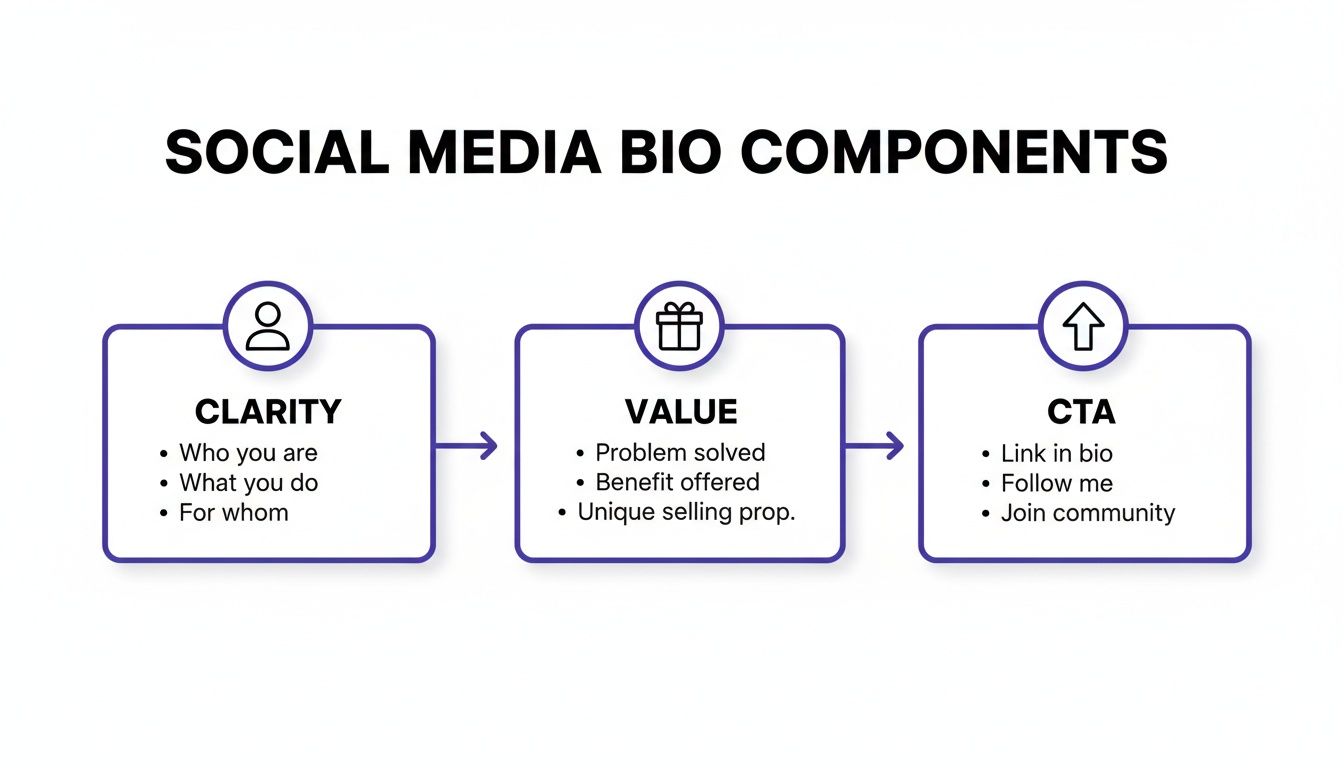
This really drives home the point: no matter the platform, your core message has to be crystal clear. Mastering this means learning to speak the native language of each network you're on.
To make this easier, I've put together a quick comparison table that breaks down the key differences you need to know.
Social Media Bio Platform Comparison
| Platform | Character Limit | Key Features | Strategic Focus |
|---|---|---|---|
| 2,000 | Long-form text, keyword optimization, rich media | Professional credibility, networking, SEO | |
| 150 | Emojis, hashtags, one clickable link | Personality, visual branding, link-in-bio traffic | |
| TikTok | 80 | Short, punchy text, emojis, one clickable link | Authenticity, trendiness, driving clicks |
| X (Twitter) | 160 | Hashtags, mentions, links | Timeliness, conversation, brand voice |
| 101 | Short intro, longer "About" section | Community building, brand story, broad appeal |
This table is your cheat sheet for quickly understanding the unique demands of each platform. Now, let's dig into the specifics.
LinkedIn: Your Professional Showcase
Think of your LinkedIn "About" section as your digital resume and professional story rolled into one. You’ve got a generous 2,000 characters to work with, so use it to detail your expertise, highlight key accomplishments, and state your professional mission. The tone here should be authoritative but still approachable.
- Keywords are Everything: Recruiters and peers live on LinkedIn search. Weave in relevant industry keywords like "content strategy," "SaaS growth," or "project management" to make sure you show up.
- Show, Don't Just Tell: Instead of just listing job titles, quantify your impact. Use concrete phrases like "Grew organic traffic by 150%" or "Led a team that launched three major products."
- Make it Scannable: Let's be real, nobody reads a wall of text. Use bullet points or special characters to break things up and make your summary easy for busy people to digest.
A killer LinkedIn bio is less about playful emojis and more about establishing instant credibility. It tells the story of your professional value.
Instagram and TikTok: The Personality Hubs
On Instagram (150 characters) and TikTok (80 characters), it's all about making a fast, memorable impression. The vibe is casual, creative, and personality-driven. Brevity is your best friend, and visual cues like emojis do a lot of the heavy lifting.
These platforms are often the primary drivers of off-platform traffic. Since you only get that one precious clickable link, your call-to-action (CTA) needs to be impossible to miss.
Pro Tip: I always use directional emojis like 👇 or ➡️ to literally point people's eyes to my link. It’s a simple visual trick, but I've seen it make a real difference in click-through rates.
This is where your brand's unique voice needs to shine. Are you witty? Inspiring? A bit weird? Your bio should communicate that in a split second.
X (Formerly Twitter) and Facebook: The Hybrid Approach
X (160 characters) and Facebook (101 characters for the short bio) are the middle ground. X is fast-paced and conversational, making it a great spot for a bio that's both professional and personable. You can easily mix in keywords, a dash of personality, and a link.
Facebook, with its absolutely massive user base, calls for a slightly different approach. The audience is incredibly diverse. Facebook leads the pack with over 3 billion monthly active users, while Instagram has crossed the 2 billion mark. Meanwhile, TikTok has become a primary news source for 52% of U.S. adults, which shows just how differently each platform is used.
This massive variance in who uses each platform is exactly why you can't just copy and paste. For a much deeper look into who's on each network, our guide on social media demographics by platform is full of valuable insights.
- For X: Combine your value prop with a relevant hashtag and your main link. It’s a simple but effective formula.
- For Facebook: Use the short bio for a quick, punchy introduction and then flesh out your full story in the longer "About" section.
Ultimately, ditching the one-size-fits-all mindset is the first real step toward crafting a social media bio that doesn't just sit there—it actively works for you, growing your audience and helping you hit your goals.
Defining Your Unique Value Proposition
So, what makes you the one person someone has to follow? A killer bio goes way beyond your job title. It needs to instantly signal your unique value, making your profile a magnet for the right people. This is your chance to pinpoint the exact problem you solve or the benefit you deliver.
Your unique value proposition (UVP) is the absolute heart of your social media bio. Think of it as the promise you're making to every single person who lands on your profile. It’s not just about what you do; it’s about why anyone should care. A weak UVP makes your bio blend into the noise, but a strong one makes your ideal follower think, "Finally! This is exactly who I've been looking for."

Getting this statement right is your north star for crafting a bio that truly connects. It sharpens your message and makes sure every character counts.
The "I Help X Achieve Y by Doing Z" Formula
One of the most effective tricks I've seen for crystallizing a UVP is a simple, proven formula. The "I help X achieve Y by doing Z" structure is a fantastic starting point because it forces you to stop talking about yourself and start focusing on your audience.
Let's break it down:
- X (Your Audience): Who are you really for? Get specific. "Businesses" is too broad. Try "first-time SaaS founders" or "busy moms who miss the gym."
- Y (The Outcome): What’s the result? Focus on the transformation, not the service. Instead of "email marketing services," think "doubling their email list."
- Z (Your Method): How do you make the magic happen? This is your secret sauce. It could be "through data-driven content" or "with 15-minute home workouts."
This isn't a rigid rule you have to copy and paste. It's a mental framework to get you thinking clearly and concisely about the value you offer.
Practical Examples of Strong Value Propositions
Seeing this formula in the wild makes it click. Whether you’re a freelancer, a brand, or a creator, the core principle is the same—it’s all about the audience’s win.
For a Freelance Designer:
- Generic: "Graphic Designer & Brand Strategist"
- Value-Driven: "I help e-commerce brands (X) create unforgettable unboxing experiences (Y) with sustainable packaging design (Z)."
For a SaaS Company:
- Generic: "The best project management software"
- Value-Driven: "Helping remote teams (X) finish projects on time, every time (Y) by simplifying their workflow (Z)."
For a Content Creator:
- Generic: "Travel blogger and vlogger"
- Value-Driven: "Showing solo travelers (X) how to see the world safely and on a budget (Y) through detailed travel guides (Z)."
See the difference? The value-driven examples immediately speak to a specific person’s goals. They don’t just state a job; they promise a solution.
Your UVP should speak directly to your audience's pain points or desires. It’s the hook that convinces them you understand their world and have something valuable to offer.
If you're looking to speed up the process, exploring tools for AI social media content creation can be a huge help, especially when you're trying to nail down that perfect value proposition.
Moving Beyond the Formula
While the "X-Y-Z" model is a powerful tool, don't let it box you in. The real goal is to communicate your unique value in a way that feels authentic to you and your brand's voice.
Here are a few other angles to play with:
- Highlight a Credential: "Award-winning chef sharing Michelin-star secrets for home cooks."
- Showcase a Specific Achievement: "Helped 1,000+ students land their dream tech job."
- Emphasize a Unique Perspective: "Mindfulness coach breaking down mental wellness with a no-fluff, science-backed approach."
- Focus on a Feeling: "Your daily dose of calm in a chaotic world. 🧘♀️"
The key is to push past a generic label and give people a compelling reason to stick around. Ask yourself: What really makes me different? What specific result can people expect from following me? Answering those questions is how you write a bio that doesn't just describe what you do—it sells why you're the only one who does it your way.
Using Keywords and CTAs to Drive Action
Once you've nailed your value proposition, it's time to put your bio to work. A killer social media bio is more than just a passive description; it's an active tool for growth. By strategically weaving in the right keywords and adding a compelling call-to-action (CTA), you can turn your profile into a magnet for the right people and guide them exactly where you want them to go.
Think about it: your bio is often the last thing someone reads before they decide whether to follow you or click that precious link. It's the final push that converts a curious visitor into an engaged follower or a new customer. Without a clear next step, they're just going to keep scrolling.

Help People Find You with the Right Keywords
Keywords aren't just for Google anymore. Every social media platform is its own search engine. People are constantly looking for accounts that cater to their interests, whether it's "vegan recipes," "startup marketing," or "freelance graphic designer." Tucking those terms into your bio is one of the easiest wins for getting discovered.
So, what words would your ideal follower type into the search bar? The goal is to sprinkle these terms in naturally, without sounding like a robot.
- Get Niche: Instead of just "business coach," try "SaaS founder coach." Getting specific helps you attract a much more qualified audience.
- Spy on Your Peers: Check out what keywords similar accounts in your space are using. This is a great way to find terms you might have overlooked.
- Bake Them In: The best approach is to make keywords a seamless part of your "I help X achieve Y" statement. Something like, "Helping e-commerce brands boost sales with Shopify SEO."
Optimizing your bio with the right keywords is like putting up a giant, flashing sign that helps the right people find you effortlessly.
Crafting a Call-to-Action That Actually Works
Your call-to-action is arguably the most critical part of your entire bio. It's where you look your audience in the eye and tell them exactly what to do next. A bio without a CTA is a dead end. A bio with a strong one becomes a doorway to your website, your email list, or your latest offer.
The way people shop has changed dramatically. Back in 2018, only about 30 percent of consumers bought products directly through social media. By 2025, that number is expected to hit 46 percent. This shift makes the CTA in your bio more important than ever, turning it into a direct pipeline for sales.
Pro Tip: Your CTA should always align with your main business goal right now. Are you trying to grow your email list? Drive traffic to a new blog post? Promote a flash sale? Pick one clear action to avoid confusing your visitors.
Different CTA Styles for Different Goals
Not all CTAs are created equal. The right one depends entirely on your brand's personality and what you're trying to achieve at the moment. The language you use can make a huge difference in how people respond, so it pays to be intentional. If you want to go deeper on this, check out our guide on copywriting for social media.
Here are a few styles I've seen work really well:
Direct & Urgent: This style creates a little FOMO (fear of missing out) and is perfect for limited-time offers or high-value downloads.
- Example: "👇 Shop our flash sale now!"
- Example: "Grab your free template before it's gone!"
Soft & Inviting: This is a lower-pressure approach that focuses on building community or providing value. It's great for creators and service-based businesses.
- Example: "Come say hi in our free community 💬"
- Example: "Ready to grow? Let's chat."
Curiosity-Driven: This type of CTA piques interest and makes people need to know more. It's a fantastic way to drive traffic to your content.
- Example: "Find out the #1 mistake new creators make 👇"
- Example: "See the full story on our blog."
Making the Most of Your One Link
Most platforms only give you one clickable link in your bio, so you've got to make it count. This is where link-in-bio tools are a lifesaver. Services like Linktree or Later—or even just a custom landing page on your own website—let you turn that single link into a gateway for all your important stuff.
This strategy means you can direct people to multiple places without constantly swapping out your bio link. You can feature your latest blog post, a popular YouTube video, your product pages, and your newsletter sign-up all at once. Your CTA can then be a simple, evergreen "↓ Click the link below for all the goods!"
When you combine smart keywords with a powerful CTA, your social media bio transforms from a static introduction into a dynamic tool that actively grows your audience and your business around the clock.
Nail Your Voice and Tone
Once you’ve sorted out your value proposition and sprinkled in the right keywords, it's time for the final, most human touch: personality. In a sea of cookie-cutter profiles, your voice is what makes you stick. The tone of your bio isn’t just about the words; it’s about the feeling you leave people with.
This is where you distill your brand’s entire vibe into a few powerful lines. Are you the witty, slightly irreverent friend? The trustworthy, seasoned expert? Or the minimalist, chic trendsetter? Getting this right creates an instant spark, making your target audience feel like they’ve finally found their people.
Striking the Right Balance
The real art is finding that sweet spot between professional and personable. A bio that’s all business can feel cold and distant. On the flip side, one that’s too casual might not build the credibility you need to be taken seriously. The perfect mix comes down to who you're talking to and what platform you're on.
Think about a financial advisor. On LinkedIn, their tone needs to be sharp, authoritative, and trustworthy. But over on Instagram? They might lean into a more educational and approachable voice, breaking down complex money topics for a younger audience. Same expertise, just a different delivery.
The goal here is authenticity. Your bio's tone should be a genuine preview of the content and value someone gets when they follow you. A mismatch feels off, and that’s a surefire way to get a quick unfollow.
Thinking about this balance is a make-or-break step when you're figuring out how to write a social media bio that actually connects.
Using Language to Shape Perception
The specific words you pick are your most powerful tools for setting the tone. Seriously, a few small tweaks can completely change how your profile lands.
Let's imagine a coffee shop and see this in action:
- Playful & Energetic: "Your daily dose of happy juice. ☕ Come for the coffee, stay for the vibes."
- Artisanal & Sophisticated: "Single-origin beans, expertly roasted. We're here to elevate your coffee ritual."
- Community-Focused & Welcoming: "Your neighborhood living room. Brewing community, one cup at a time."
Each bio is for the exact same business, but they speak to completely different people. The first one is calling out to the trendy, social crowd. The second is for the coffee purist who geeks out on tasting notes. The third is for locals looking for a cozy spot to hang out. Your word choice is like a filter, attracting exactly the right followers.
The Role of Emojis and Formatting
Words aren't your only tool. Formatting and emojis are huge for conveying tone, especially on visual-first platforms like Instagram and TikTok. They add a splash of personality and make your bio way easier to scan.
- Emojis: Think of emojis as digital body language. A simple 🌱 can hint at a focus on sustainability, while a 🚀 instantly suggests growth and ambition. Just make sure they reinforce your message, not just clutter the space.
- Line Breaks: Spacing out your bio into a list-like format feels clean, modern, and super easy to digest. It’s a great way to highlight different parts of your brand without creating a wall of text.
- Custom Fonts (Proceed with Caution): While custom fonts can definitely make you stand out, they can be a nightmare for accessibility and screen readers. If you're going to use them, keep it minimal—maybe for a single word or a short phrase.
At the end of the day, your voice and tone are the glue that holds your entire profile together. It’s what makes your bio feel like it was written by a real person and helps you build a genuine connection from the very first glance.
Testing and Refining Your Bio for Better Results
Think your social media bio is finished once you hit "save"? Think again. The best profiles treat their bio not as a static statement, but as a living, breathing part of their marketing. It’s a dynamic tool that should evolve right along with your goals.
It's time to stop guessing what works and start measuring. A simple, yet incredibly powerful, way to do this is with A/B testing. The whole idea is to change one single element at a time and see how it affects your key metrics. This approach isolates what's truly making a difference and gives you clear, undeniable data to work with.
What to Test and How to Do It
You can test just about any part of your bio, but you'll get the most bang for your buck by starting with the elements that directly impact user action. Even tiny tweaks in these areas can lead to some surprisingly big gains in traffic and engagement over time.
Here are a few high-impact elements I always recommend starting with:
- Your Opening Hook: Try swapping your current opener for something totally different. You could pit a direct value prop against a question, or a bold statement against a specific credential. For instance, you might test "Helping founders scale" versus "Scaled 3 startups to $1M+."
- Your Call-to-Action (CTA): This one is huge. Test different action verbs and phrasing. Does "Download my free guide" outperform "Get your free guide"? Does a direct command work better than a softer, curiosity-driven nudge?
- Emoji Usage: Run a version of your bio with emojis against one without. For some brands, a well-placed emoji can boost relatability and draw the eye to your link. For others, it might clash with a more professional tone. Only testing will tell you for sure.
- Link Phrasing: The text right before your link matters more than you think. Compare something straightforward like "See my work here 👇" with a more benefit-driven "Get the full story on my blog."
Pick one element, run each version for a set period—maybe two weeks—and track the results like a hawk.
The goal of testing isn’t to find the one “perfect” bio that lasts forever. It's to build a system of continuous improvement that keeps your profile perfectly tuned to whatever your current objectives are.
Key Metrics to Track
When you're digging into the data, vanity metrics like likes and views won't give you the full picture. You need to focus on the numbers that show how well your bio is actually doing its job: getting people to take action.
- Link Click-Through Rate (CTR): This is the ultimate test of your CTA's power. It tells you exactly what percentage of profile visitors clicked your link. Most link-in-bio tools and URL shorteners like Bitly provide this data.
- Profile Visits to Follower Conversion: How many new followers are you getting for every 100 people who visit your profile? This shows how compelling your overall first impression is. Many platforms, like Instagram, offer this in their native analytics.
- Referral Traffic: Pop over to your website analytics. How much traffic is coming directly from each of your social profiles? If you see a jump in referral traffic from Twitter right after changing your bio there, you’ve found a winner.
Got Questions About Your Social Media Bio? We’ve Got Answers.
Even with the best framework, you're bound to hit a few specific roadblocks when you’re staring at that empty bio field. It happens. Let's clear up some of the most common questions that pop up, so you can finalize your profile with total confidence.
These are the details that can make or break a first impression, and getting them right is easier than you think.
How Often Should I Actually Update My Bio?
The short answer? Your bio is a living document, not a set-it-and-forget-it piece of text.
Anytime something major changes in your business—a new product launch, a pivot in your services, or a big campaign you're running—your bio should be the first thing you update. It keeps your audience in the loop and shows you’re on top of your game.
Beyond those big moments, I recommend giving it a quick review at least once a quarter. This is just a simple check-in to make sure it still aligns with your current goals. A quarterly refresh keeps it from feeling stale and signals to anyone who lands on your profile that you're active and relevant.
To Emoji or Not to Emoji?
This is a classic question, and the answer really comes down to your brand and the platform you're on.
On a network like LinkedIn, you’ll want to keep it professional. Emojis should be used sparingly, if at all. A single, well-placed emoji might add a subtle touch, but go overboard and you risk looking out of place.
Now, on platforms like Instagram, X (formerly Twitter), or TikTok, emojis are practically the local dialect. They’re fantastic for injecting personality, breaking up text to make it more readable, and drawing a user's eye straight to your call to action or link.
A great rule of thumb is to use emojis to add clarity or a dash of brand flavor—think a 📸 for a photographer or a 📈 for a marketing consultant. They should always enhance your message, not just serve as decoration.
What's the "Best" Link to Put in My Bio?
The single most effective link is the one that supports your most important goal right now. Is your priority to drive traffic to a new blog post? Sell a new product? Get sign-ups for a webinar? That's the link you should feature.
But if you’re like most businesses, you have more than one thing you want people to see. Constantly swapping out that one link can be a real pain.
This is where a link-in-bio tool becomes your best friend. Instead of just one destination, you can create a simple, clean landing page that houses all your important links. Your portfolio, your latest article, your shop, your contact form—everything is just one click away for your followers. It's the most strategic and user-friendly approach, hands down.
Ready to stop guessing and start growing? PostSyncer provides all the tools you need to schedule content, analyze performance, and manage your entire social media presence from one place. Start your free 7-day trial today.