











Ever scrolled through your Reels feed and wondered why some videos blow up with millions of views while others seem to vanish into thin air? It's not just luck. The answer lies deep within the Instagram Reels algorithm.
Think of the algorithm as a highly personal content DJ for every single user on the platform. Its goal isn't just to show you what's popular; it's to curate a unique, ridiculously engaging playlist just for you, based on everything Instagram knows about your habits and preferences.
The entire system runs on prediction. From the moment you tap the Reels tab, the algorithm kicks into high gear, analyzing thousands of data points to guess which videos you're most likely to watch all the way through, laugh at, and send to your friends. It's a fast-paced game that heavily rewards content that can grab and hold a viewer's attention.
The Great Pivot To Short-Form Video
Instagram's intense focus on Reels wasn't some happy accident. The feature was rolled out in August 2020 as a direct answer to the meteoric rise of TikTok, and it completely upended the platform's priorities.
This shift pushed short-form video to the absolute front of the line. By early 2023, Meta was already reporting that views on Reels had doubled across its platforms in just six months. That's all the proof you need: the algorithm now has a massive preference for video over static images, and it rewards creators who have mastered the art of the Reel.
How Your Reel Gets Seen (Or Not)
When you hit "Post" on a new Reel, the algorithm doesn't just blast it out to all your followers. It's much smarter than that. Instead, it puts your video through a multi-stage trial to see if it's got what it takes to go big.
- The Initial Test Run: First, your Reel gets shown to a small, hand-picked audience. This group includes some of your most engaged followers and other users the algorithm predicts will like your content based on their past viewing habits.
- The Performance Review: In those first critical hours, the algorithm is watching. It's measuring every interaction this test group has with your video, looking for positive signals like high watch time, completion rates, shares, and saves.
- The Verdict: Go Big or Go Home: If the initial engagement is strong, the algorithm gets the green light to push your Reel to a much wider audience on the Reels tab and Explore page. But if those early signs are weak, its reach gets throttled—fast.
This process flow shows exactly how it works, from the initial post to its potential to go viral.
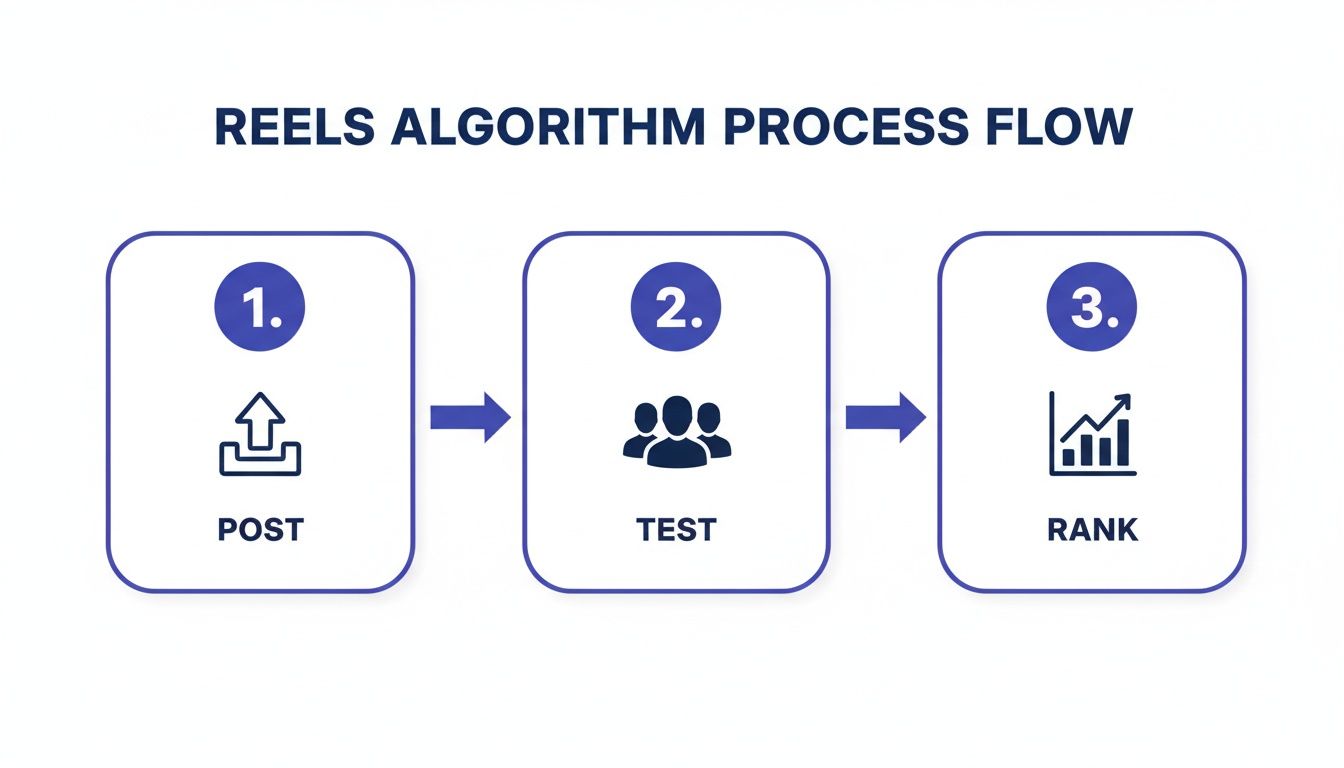
As the visual shows, every single Reel has to prove its worth in that initial test before the algorithm decides to give it a bigger stage. This is also where you might run into trouble. If you feel like your content is stuck and never reaching new people, it's worth learning how to know if you're shadowbanned.
Key Takeaway: The first few hours after you post a Reel are make-or-break. The algorithm uses that early performance data as the main signal to decide whether your content is good enough to be promoted to thousands—or even millions—of new viewers.
Primary Instagram Reels Algorithm Ranking Signals
To really crack the code, you need to understand the specific signals the algorithm is looking for. We've boiled down the most important factors into this quick-reference table.
| Ranking Signal | What It Measures | How to Optimize for It |
|---|---|---|
| User Activity | Tracks what a user has liked, shared, saved, and commented on in the past. | Create content that aligns with the specific interests, trends, and aesthetics that are popular within your niche. |
| Watch Time & Completion Rate | Measures how long users watch your Reel and if they finish it. The single most important metric. | Hook viewers in the first 1-2 seconds. Use storytelling, suspense, or quick cuts to keep them engaged until the very end. |
| Interaction History | Looks at whether a user has previously interacted with your content. | Nurture your existing community. Create content that encourages repeat engagement from your current followers. |
| Information About the Reel | Analyzes the audio, visual elements (pixels and frames), and caption (keywords, hashtags). | Use trending audio, high-resolution video, and relevant keywords/hashtags to give the algorithm context about your content. |
| Information About You | Considers your profile's overall engagement and popularity signals. | Post consistently high-quality content to build a strong reputation with the algorithm and your audience. |
Ultimately, the algorithm is trying to answer one question for every user and every Reel: "Is this video entertaining and relevant enough to keep this person on the app?" Nail that, and you're on your way to winning the Reels game.
Why Watch Time Is Your Most Important Metric
While the Instagram Reels algorithm looks at a lot of different signals, one metric towers above them all when it comes to deciding your content's fate: watch time.
Think of your Reel's launch like a movie's opening weekend. Likes and comments are like getting good reviews—which is great—but the real sign of a blockbuster is how many people actually stay in their seats until the credits roll. If your audience is swiping away after just a few seconds, you're sending a loud and clear message to the algorithm that your content isn't hitting the mark.
On the flip side, when viewers watch your Reel all the way through—or better yet, watch it again—you’ve struck gold. This is the ultimate proof that your content delivers value. You’re basically telling the algorithm, "This is so good, people can't get enough," and that's exactly the kind of stuff Instagram wants to push to keep users glued to the app.
The Power of Completion and Rewatch Rates
Let's get a little more specific. Two key pieces of watch time are what the Instagram Reels algorithm really obsesses over. These are the "super signals" that can take a Reel from a few hundred views to a viral hit.
- Completion Rate: This is simply the percentage of your video that people watch. A high completion rate means you held their attention from start to finish and delivered on the promise you made in your hook.
- Rewatch Rate: This one is huge. It tracks when people watch your Reel more than once. A rewatch is one of the strongest positive signals you can send, telling Instagram your content was either incredibly entertaining, super useful, or just so visually captivating it demanded a second look.
Recent analysis shows that these metrics are more dominant than ever. The algorithm now heavily weights relative watch time, rewatch rate, and completion rate when scoring content. This is why shorter Reels, somewhere between 7 and 90 seconds, often do so well—it's just easier to get someone to finish a shorter video, with many hitting an 80% or higher completion rate. You can find more insights about recent updates and how they're shaking up content strategy.
Hooking Viewers in the First Three Seconds
You have a sliver of a moment to stop the scroll. The first three seconds of your Reel are everything; they absolutely have to grab a viewer's attention. A weak opening all but guarantees a low watch time.
Start with a bold claim, a stunning visual, a question they can't ignore, or a sound that makes them pause. This initial hook is your one shot to convince someone your video is worth their time. If you drop the ball here, the rest of your amazing content will never even be seen.
A Reel’s success is often decided before the four-second mark. If your hook doesn't land, the algorithm has already moved on to content that can.
This is exactly why shorter Reels (often 7-15 seconds) tend to outperform longer ones. The barrier to completion is much lower. It’s far easier to convince someone to watch a quick 10-second clip all the way through—and then watch it again—than it is for a full 90-second video.
Shares and Saves: The High-Value Engagement Signals
Moving beyond watch time, two other actions carry serious weight with the Instagram Reels algorithm: shares and saves. These aren't passive views; they represent active, high-intent engagement that tells a powerful story.
- Shares: When someone shares your Reel, they’re putting their personal stamp of approval on it and broadcasting it to their own network. This is a massive signal of resonance that helps your content find new audiences through a trusted source.
- Saves: A save means your content was so valuable that the viewer wants to come back to it later. This is a tell-tale sign of great educational content, tutorials, or inspiring ideas. The algorithm sees saves as proof of high-quality, evergreen content that's worth distributing far and wide.
When you focus on creating Reels that people not only finish but also feel an urge to share or save, you’re giving the algorithm undeniable proof that you’ve created a winner.
Creating Reels the Algorithm Wants to Promote
Okay, understanding the theory behind the Instagram Reels algorithm is one thing. But actually putting it into practice? That’s what separates stagnant accounts from the ones that go viral.
Creating content the algorithm loves isn't about chasing every fleeting trend. It’s about mastering the core building blocks of a high-performing video. It's time to move from just knowing the rules to actively playing the game. Let's break down the non-negotiable elements that make a Reel genuinely algorithm-friendly.
Master the Technical Foundations
Before you even think about your hook or your call to action, you have to nail the technical details. The algorithm has clear preferences for quality and format, and ignoring them is like trying to run a marathon with your shoes untied. It's just not going to work.
Your first job is to create clean, high-resolution video. The algorithm is designed to push visually appealing content and will absolutely sideline blurry or pixelated footage.
Most importantly, shoot everything in a vertical 9:16 aspect ratio (1080 x 1920 pixels). This format fills the entire phone screen, giving viewers an immersive experience. It also prevents what I call the "dead screen" problem—those ugly, static borders that scream low-effort content.
Critical Mistake to Avoid: Never, ever upload a Reel with a watermark from another platform, especially TikTok. The algorithm is built to spot these watermarks and will immediately tank your video's distribution, often showing it to just a handful of your existing followers.
Tap into Trends with Audio and Effects
Trending audio is easily one of the most powerful discovery tools you have. When you use a popular sound, you're essentially plugging your Reel into a massive, ongoing conversation happening across the entire platform.
The algorithm uses audio as a core way to categorize content, lumping all videos with the same sound together. This is huge, because it gets your content in front of people who have already shown interest in that trend, giving you a massive head start on engagement.
- Find Trending Audio: Keep an eye out for the small, upward-facing arrow next to a sound's name on other Reels. That's your signal that it’s hot right now.
- Save Sounds for Later: When you stumble upon a sound you like, save it immediately. You'll build a library of go-to options for future content.
- Use Effects Strategically: Just like audio, trending AR filters and effects can boost your visibility. They show the algorithm you’re an active participant in the platform's current culture.
Design for Sound-Off Viewing
While tons of people watch Reels with the sound blasting, a huge chunk of users are scrolling in silent environments—on the bus, in a waiting room, or late at night. If your video needs audio to make sense, you're losing their attention and, more importantly, their watch time.
This is where on-screen text and clear captions become your best friends. Use bold, easy-to-read text to tell your story, deliver key messages, or just provide context. For a deeper dive on this, you can learn more about how to create Instagram Reels that are built to hold attention.
This simple step ensures your message lands with every single viewer, sound on or off, which directly translates to higher completion rates.
Implement a Smart Hashtag Strategy
Hashtags aren't just a finishing touch; they're a critical tool for telling the Instagram Reels algorithm exactly what your content is about. Using them the right way helps the system categorize your video and serve it to the right people—the ones most likely to actually engage with it.
Forget the old "copy and paste 30 random tags" method. It’s lazy and ineffective. It's time to get strategic.
A balanced hashtag strategy uses a mix of different tag types to hit both broad and niche audiences. A good rule of thumb is to aim for 5-10 highly relevant hashtags per Reel.
| Hashtag Type | Purpose | Example |
|---|---|---|
| Broad (2-3 tags) | Connects your Reel to larger, popular topics for initial visibility. | #ContentMarketing, #SocialMediaTips |
| Niche (3-5 tags) | Targets a specific community interested in your video's subject. | #ReelsForBusiness, #VideoMarketingStrategy |
| Branded (1-2 tags) | Builds community and organizes your own content library. | #YourBrandName, #YourCampaignName |
This layered approach gives the algorithm crystal-clear signals about your content's topic and who it's for. That’s how you get your video in front of people who will find it valuable—which is the entire point.
Analyzing Your Performance to Refine Your Strategy

Making great content is only half the job. The creators who truly succeed don't just post content and hope for the best; they dive into their results to figure out what actually connects with their audience and the Instagram Reels algorithm. This is what separates random viral hits from consistent, predictable growth.
Think of your Instagram Insights as a direct feedback channel. It’s not just a page of vanity metrics; it's the algorithm and your viewers telling you exactly what they liked and what they scrolled past. Learning to interpret this data is how you stop guessing and start creating smarter, more impactful Reels.
This is how you build a repeatable formula for success, turning raw numbers into your biggest strategic advantage.
Decoding Your Key Reels Metrics
Your Instagram Insights dashboard is packed with data, but not every number tells the same story. If you want to sharpen your strategy, you need to know which metrics actually matter and what they’re trying to tell you. Let's break down the big ones.
These numbers give you the full story of your Reel's performance, from its initial discovery to how deeply it connected with viewers.
- Plays (or Views): This is simply the total number of times your Reel was played. A big number feels good, but it's a surface-level metric. It tells you what happened, but not why.
- Reach: Now this is a metric with some weight. It shows you the number of unique accounts that saw your Reel at least once. This gives you a much clearer picture of its true discoverability.
- Saves: When someone saves your Reel, they're bookmarking it for later. That’s a massive signal to the algorithm that your content is valuable, educational, or inspiring.
- Shares: A share is the ultimate endorsement. People who share your content are doing the work for you, spreading it organically. The algorithm loves this and rewards it by pushing your Reel out to even more new audiences.
Understanding the difference here is critical. For instance, high reach with low engagement might mean your hook grabbed attention, but the content itself fell flat. On the other hand, high saves on a Reel with lower reach suggests you’ve hit a nerve with a niche audience—now you just need a better discovery strategy. The key is utilizing analytics to understand customer behavior so you can make informed decisions.
Connecting Data to Creative Choices
The real magic happens when you tie the analytics back to your creative process. Every metric is a clue, helping you understand how your audience reacted to specific things you did in your video.
Let's say you post a quick tutorial Reel and it gets an unusually high number of saves. That’s your audience screaming for more educational, step-by-step content. Or maybe you post a funny, relatable Reel that gets tons of shares—that tells you you've tapped into a powerful emotion.
Key Takeaway: Your analytics aren't just numbers; they're a direct reflection of audience behavior. A high save count means "teach me more," while a high share count means "this is so me."
Use this feedback loop to double down on what’s working. Did a particular audio clip lead to a spike in reach? Find similar sounds. Did your 10-second Reels have a way better completion rate than your 30-second ones? It's time to experiment with shorter, punchier formats.
A Simple Framework for A/B Testing
To get better consistently, you have to experiment with purpose. A/B testing is just a straightforward way to compare two versions of something to see which one performs better. The trick is to only change one thing at a time.
- Test Your Hooks: Make two Reels with the exact same content in the middle, but change only the first three seconds. Maybe one starts with a question and the other with a bold statement.
- Experiment with Audio: Post a similar video concept twice. Use a massively trending sound for one, and a more niche, aesthetic audio clip for the other.
- Vary Your Video Length: Take one core idea and turn it into two Reels: a snappy, 10-second summary and a more in-depth 25-second version.
Once your tests are live, check the analytics to see which version won on key metrics like watch time and shares. This methodical approach takes the guesswork out of creation and lets you systematically improve based on real data. If you want to go deeper on this, check out our guide on social media analytics and reporting.
Optimizing Your Posting and Scheduling Routine
So you've created a Reel with a killer hook and packed it with value. That's a huge win, but your work isn't quite done. When you hit "publish" is just as critical as what’s in the video itself. Posting at the right moment gives your Reel the initial burst of engagement it needs to signal to the Instagram Reels algorithm that it's worth showing to a much wider audience.
You’ve probably seen articles promising to reveal the single “best time to post,” but here’s the truth: it doesn't exist. The perfect time for a fitness coach targeting early risers is completely different from a gaming creator whose audience is up late. Your goal isn't to find some universal magic hour; it's to discover your audience's unique peak activity times.
This is where your own data becomes your most powerful asset. Forget the generic advice. You'll get way better results by digging into your Instagram Insights to find the precise days and hours your followers are most likely to be scrolling.
Finding Your Audience's Prime Time
Instagram actually gives you everything you need to make a data-backed decision. You just have to know where to look. Tucked away in your account’s analytics is the key to pinpointing when your community is online and ready to engage.
Here’s how you can find this crucial data:
- Head to your profile and tap on your Professional Dashboard.
- Select Total Followers to get a detailed breakdown of your audience.
- Scroll down to the Most Active Times section. You'll see a chart that shows audience activity by both the day of the week and the hour of the day.
Think of this chart as your personalized roadmap. See those dark blue bars? They show the hours with the highest concentration of active followers. These are your golden windows. Publishing your Reels during these peak times dramatically increases the chance of getting that immediate engagement the algorithm loves.
Want to go deeper? Check out our detailed guide on what time you should post on Instagram.
Key Insight: Posting consistently during your audience's peak hours doesn't just improve initial views; it trains the algorithm to associate your account with reliability and timely content, which can help your distribution over the long run.
The Power of a Consistent Posting Schedule
Posting sporadically sends mixed signals to the Instagram Reels algorithm. Dropping one Reel this week, three the next, and then going silent for a month can kill your momentum. A consistent schedule, on the other hand, tells the algorithm that you're an active, reliable creator who is regularly feeding the platform fresh content.
Consistency also helps build an audience that's genuinely engaged. When your followers know they can expect new content from you on certain days, they’re more likely to look for it, interact with it, and give you those crucial early engagement signals.
This doesn't mean you have to post every single day. The right frequency depends on your capacity and your niche. Whether it's three times a week or five, the most important thing is to choose a pace you can actually stick to.
Streamline Your Workflow with Batching and Scheduling
Trying to stay consistent can feel overwhelming, especially when inspiration doesn't strike on schedule. This is where a smart workflow can save you from burnout. The secret is to separate the creative part from the publishing part using two simple strategies.
- Batch Creation: Instead of going from idea to finished Reel every single time you need to post, set aside a dedicated block of time each week to "batch" your content. You could film several Reels in one session, edit them all in another, and then write all your captions at once.
- Scheduling: Once your content is ready to go, use a scheduling tool to plan your posts ahead of time. This lets you automatically publish your batched Reels at those optimal times you found in your analytics, ensuring you never miss a peak engagement window.
This approach transforms your content strategy from a reactive, stressful chore into a planned, efficient system. You'll free up mental energy, guarantee consistency, and give every single Reel the best possible launch.
Weekly Reels Planning and Scheduling Checklist
To help you put all this into practice, here's a step-by-step checklist for planning, creating, and scheduling a full week of Reels content for maximum impact.
| Day of the Week | Core Task | Key Objective | Helpful Tool or Feature |
|---|---|---|---|
| Monday | Ideation & Research | Generate 5-7 Reel ideas based on trends, audience questions, and content pillars. | Instagram's "Made for You" audio recommendations, AnswerThePublic. |
| Tuesday | Scripting & Prep | Write out simple scripts or bullet points for 3-4 chosen Reels. Gather props. | A simple notes app or a project management tool like Trello. |
| Wednesday | Batch Filming | Film all 3-4 Reels in a single, focused session. Change outfits to create variety. | A tripod and a ring light for consistent quality. |
| Thursday | Batch Editing | Edit all filmed Reels. Add text overlays, captions, and audio. | Instagram's in-app editor, CapCut, or InShot. |
| Friday | Caption Writing & Scheduling | Write engaging captions with CTAs. Schedule all Reels for the upcoming week. | Your Instagram Insights for "Most Active Times," a scheduling tool. |
| Saturday | Engagement & Review | Engage with comments on posted Reels. Review last week's performance. | Instagram's Professional Dashboard to track reach and engagement. |
| Sunday | Rest & Recharge | Take a break! Let your scheduled content work for you. | - |
Following a structured plan like this not only makes your life easier but also ensures you're consistently delivering high-quality content when your audience is most receptive.
Frequently Asked Questions About the Reels Algorithm
Trying to understand the Instagram Reels algorithm can feel like shooting at a moving target. Just when you think you've got it figured out, something changes. Even with a good grasp of the basics, some questions and myths just refuse to go away.
This is your go-to guide for those nagging questions. We're cutting through the noise to give you straight, simple answers so you can get back to creating.
Does the Length of My Reel Really Affect Its Performance?
It absolutely does. Instagram lets you create Reels up to 90 seconds long, but don't let that fool you. The algorithm has a massive preference for content that people watch all the way through. This is where shorter videos have a huge leg up.
Think about it: it's far easier to get someone to watch a whole 7-15 second video than a 90-second one. A high completion rate is one of the strongest signals you can send to Instagram that your content is a winner, and shorter Reels make hitting that mark much easier.
If you’re going long, your hook in the first three seconds has to be magnetic. The story has to be compelling enough to keep people from swiping away. As a rule of thumb, never make a Reel a second longer than it needs to be.
How Many Hashtags Should I Use on My Reels?
Yes, hashtags still matter. A lot. They're how you tell the algorithm what your content is about and who should see it. But the old trick of spamming 30 random tags in your caption is dead. These days, it’s all about relevance, not volume.
A much smarter strategy is to use 5-10 highly targeted hashtags. This helps your Reel find its way to a smaller, but much more interested, audience—the kind of people who will actually watch, like, and comment.
Here’s a simple mix that works:
- Broad Tags (2-3): Connects you to big, trending conversations (like #DigitalMarketing).
- Niche Tags (3-5): Aims for specific communities who are looking for your exact topic (like #ReelsTipsForBusiness).
- Branded Tags (1-2): Helps you build a community and makes your content easy to find (like #YourBrandName).
Why Did My Reel Views Suddenly Drop?
A sudden nosedive in views is scary, but it's almost never just one thing. It's usually a mix of factors, and figuring them out is the key to getting back on track.
First, Instagram is always tinkering with the algorithm. A strategy that killed it last month might not work today. Second, take a hard look at your content. Did you switch up the topics or formats that your audience fell in love with? Sometimes all it takes is one flop for the algorithm to pull back your reach.
Often, the real culprit is just plain old content fatigue. If you’ve been posting the same style of video over and over, your audience might be getting bored. The algorithm is quick to notice that dip in engagement and will adjust your reach down.
Don't forget to look at the bigger picture, too. Things like holidays, major news events, or even the time of year can mess with how many people are on the app. The best thing you can do is stay consistent, watch your analytics for patterns, and don't be afraid to try something new. At the end of the day, making genuinely good stuff is the only strategy that always works.
Ready to stop guessing and start growing? PostSyncer provides the AI-powered scheduling and in-depth analytics you need to master the Instagram Reels algorithm. Plan your content, find your best posting times, and track your performance all in one place. Start your free 7-day trial and see the difference.