







You're probably in one of two spots right now. Either you've seen creators mention the Pinterest Creator Fund and you want to know if it's still worth chasing, or you've already been posting and you're trying to figure out why Pinterest seems to care more about saves than follower count.
That second question matters more than most creators realize.
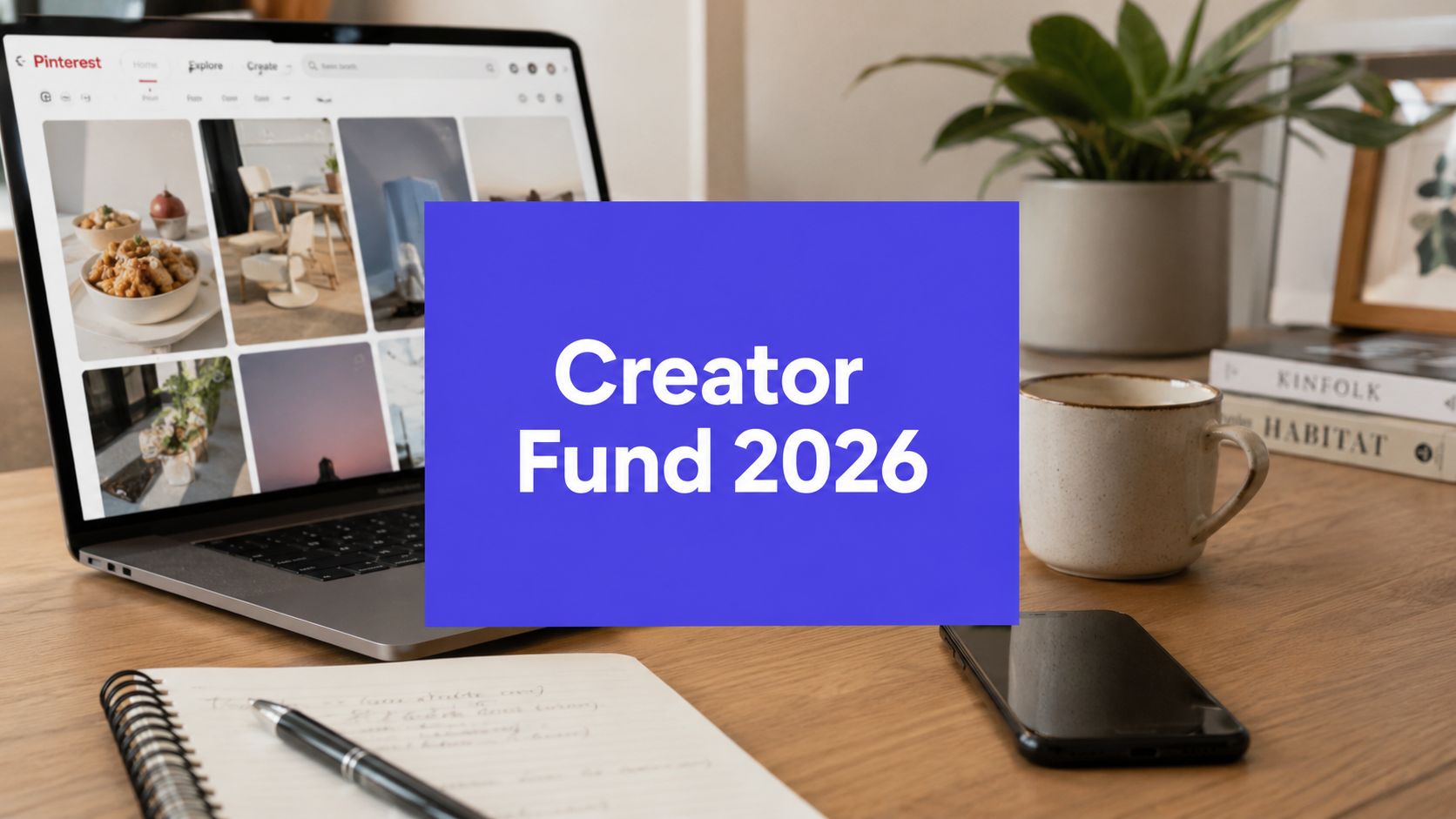
The Pinterest Creator Fund was never just about handing out money to anyone who applied. Pinterest built it like a structured growth program. If you understand the mechanics behind it, especially the platform's emphasis on Idea Pins and saves, you can make better decisions whether the fund is open to you or not. That's the difference between randomly posting and building a profile that looks fund-ready.
What Is the Pinterest Creator Fund Really About
You publish a polished Idea Pin, get decent views, and assume you're getting close to fund-level performance. Then another creator with a smaller audience gets traction because their content gets saved over and over. That gap explains what the Pinterest Creator Fund was really rewarding.
The Pinterest Creator Fund worked as a creator investment program tied to the kind of content Pinterest wanted more of on the platform. The goal was bigger than a one-time payout. Pinterest used the fund to back creators it believed could produce repeatable, useful content that kept users planning, saving, and returning.

That distinction changes how you should read the program.
Creators often approach funds like a prize. Pinterest approached this one more like a selective growth channel. It supported creators from underrepresented communities, but the larger strategy was clear. Pinterest wanted more high-retention content in categories people actively use to make decisions, organize ideas, and act later.
Why Pinterest built it this way
Pinterest behaves differently from feed-first platforms. Reach helps, but saves, revisits, and practical usefulness usually carry more weight over time. A creator who helps users solve a problem, compare options, or map out a project fits the platform better than a creator who only creates quick attention spikes.
That is the strategic layer many articles miss. The fund was not only about rewarding creativity. It was also about training the platform toward content that performs well in search, earns saves, and stays useful beyond the day it was posted.
From a strategist's perspective, that creates a clear trade-off. Entertaining content may get clicks. Save-worthy content builds a stronger case for Pinterest to promote you, support you, and keep surfacing your work.
Practical rule: Treat the Pinterest Creator Fund like a partnership application. Pinterest is evaluating whether your content makes the platform more useful.
What kind of creator this favors
The creators who fit best usually do a few things consistently:
- Teach visually with content people want to reference later.
- Package ideas clearly so the next step is obvious.
- Create in categories with planning behavior, such as home, food, style, wellness, DIY, travel, and other inspiration-led niches.
In client work, the biggest shift usually is not design quality. It is content intent. Pins that help someone do something later tend to outperform pins that are only interesting in the moment. That is why saves matter so much strategically. A save is a stronger sign of future value than a casual view.
If your content helps people plan, compare, try, buy, organize, or improve something, you are closer to the profile Pinterest has historically wanted to support. If your content is scattered, trend-chasing, or built for short bursts of attention, the platform usually gives you a weaker foundation for fund-style opportunities.
The right way to view the Pinterest Creator Fund is simple. It rewarded creators whose content habits matched Pinterest's business goals. Once you see that, the program makes a lot more sense.
How to Qualify and Apply for the Fund
You can hit the follower minimum and still be a weak candidate.
That catches a lot of creators off guard. They spend weeks trying to add followers, then realize the stronger filter is whether their recent content earns saves. For this program, Pinterest has historically signaled that useful, save-worthy content matters more than surface-level audience size.
Past creator reporting pointed to a practical baseline: at least 250 followers, 3 or more Idea Pins in the last 30 days, and 150 saves from published pins in the last 30 days. Those details have circulated widely in creator discussions around the fund. The bigger lesson is what those requirements reward. Pinterest appears to favor creators who can publish consistently and create content people want to keep.

Your eligibility checklist
Before you spend time on an application, check these four areas:
- Follower baseline: Your account should be above the reported 250-follower threshold.
- Recent output: You should have published 3+ Idea Pins in the last 30 days.
- Save activity: Your recent pins should have generated 150 saves in the last 30 days.
- Profile readiness: Your bio, visuals, niche positioning, and recent content should look current and intentional.
In practice, the third bullet is where applications usually get weaker. Getting followers is straightforward if you stay active long enough. Getting saves requires better topic selection, clearer packaging, and content that solves a problem people expect to revisit later.
Here's a useful explainer on how creators have approached the process and what Pinterest tends to look for in practice:
How to think about the application
Treat the application like a review of your last 30 days of work.
Start with your top-saving Idea Pins, not your top-viewed ones. That gives you a much better read on whether your content matches the behavior Pinterest wants to promote. A pin that gets saved often has stronger long-tail value than one that gets a quick spike of attention and disappears.
Before you apply, review your recent posts and ask:
- Which pins earned saves quickly after publishing?
- Which topics showed repeat demand across multiple posts?
- Which formats made the value obvious in the first frame?
- Does your profile make your niche clear within a few seconds?
This is also where workflow matters. If your posting is inconsistent, the application will expose it fast. Using a Pinterest scheduling workflow helps you keep Idea Pins live, test themes in batches, and maintain a visible publishing rhythm without scrambling every week.
Saves are the clearest signal here. They show that someone saw future value in your content, not just momentary interest.
What works and what doesn't
Focused repetition works. Pick a small set of themes your audience saves, then publish multiple variations with better hooks, stronger first frames, and clearer takeaways.
Random variety usually works against you. If your recent pins jump between unrelated topics, Pinterest gets a weaker signal about who your content serves and why people should keep seeing it. A strong application usually reflects a clear content system, not a burst of last-minute posting.
Understanding Payouts and Program Rewards
You get accepted, then realize the upside is broader than a one-time payment. That changes how you should plan your content and your time.
Earlier reporting on the Pinterest Creator Fund described a package that could include cash support, ad credits, equipment, and platform guidance. The exact structure has varied by market and cohort, but the pattern is clear. Pinterest has treated the program less like a simple creator bonus and more like a support system for creators it wants producing stronger native content.

Why the reward structure matters
The mechanics tell you what Pinterest values.
Cash gives you room to spend more time creating. Ad credits help you test distribution instead of relying only on organic reach. Equipment improves production quality, which matters more on a visual search platform than many creators admit. Creators often undervalue this non-cash support.
In practice, this means the fund rewards creators who can turn support into better outputs. If you use the extra resources to make clearer tutorials, stronger first frames, and more save-worthy sequences, the program can improve more than short-term income. It can improve your content system.
What payout mechanics suggest about Pinterest priorities
Some creator accounts of the program have also described performance-based rewards tied to Idea Pin production and engagement, as noted earlier in the article. Even without repeating every reported detail, the strategic signal is useful. Pinterest appears to reward content that people want to keep, revisit, and act on.
That is the key takeaway for creators.
A platform does not attach rewards to saves by accident. Saves are one of the clearest signs that a pin delivered future value, not just a quick hit of attention. If a user saves your recipe, routine, room plan, checklist, or tutorial, Pinterest has stronger evidence that your content solved a problem or helped with a decision.
| Program element | What it signals |
|---|---|
| Cash support | Pinterest wants creators to invest real time in the platform |
| Ad credits | Pinterest wants creators to test amplification, not just publish |
| Equipment or production support | Pinterest values clear, polished visual content |
| Save-linked incentives | Pinterest rewards usefulness people want to return to |
Views show reach. Saves show intent.
The trade-off creators need to understand
This reward structure favors repeatable utility. Creators in food, home, fashion, beauty, DIY, wellness, education, and similar categories usually have an easier path because their content naturally fits planning, reference, and how-to behavior.
The harder path is personality-led content with no practical takeaway. That content can still work, but it usually needs a functional layer. A strong creator on Pinterest does not just entertain. They package ideas in a way that makes someone save them for later.
That is why workflow matters so much here. If your production process helps you turn one idea into several useful pins, you are better positioned for both the fund and the results that follow.
Tips to Get Noticed and Succeed in the Program
The best argument for taking the Pinterest Creator Fund seriously is performance. Pinterest reported that fund participants saw, on average, 2.9 times more Idea Pin impressions and 72% more monthly viewers compared with their performance before joining, as covered in Digiday's report on the program's creator outcomes and expansion.
That doesn't mean the program magically fixes weak content. It means the creators who enter it have a real chance to accelerate if they already understand how Pinterest works.

Optimize for saves first
If you want to get noticed, build every Idea Pin around one question: why would someone save this instead of just scrolling past it?
Content that earns saves usually falls into a few practical patterns:
- Step-based content: recipes, routines, tutorials, checklists, before-and-after processes
- Decision content: comparisons, options, examples, mistakes to avoid
- Planning content: seasonal ideas, room plans, meal concepts, outfit formulas
- Reference content: templates, prompts, frameworks, swipeable visuals
Many creators miss the mark here. They make attractive content that doesn't create a reason to return. Pinterest doesn't just want content that looks good now. It wants content that stays useful later.
Build a repeatable workflow
Here's the workflow I'd use with any creator trying to look fund-ready:
- Pick three repeatable content pillars tied to your niche.
- Turn each pillar into recurring Idea Pin formats.
- Design the first slide for clarity, not cleverness.
- End with a payoff that makes saving the pin feel obvious.
- Review save behavior after publishing, then remake winners.
That last step is where progress happens. Don't chase novelty every week. Rebuild your strongest concepts with better hooks, stronger visual sequencing, and cleaner takeaways.
If your content team needs help creating better visual concepts for Idea Pins, this guide to video content creation tools is useful for tightening production without overcomplicating the process.
Field note: The creators who improve fastest on Pinterest usually don't publish more random ideas. They publish sharper versions of the same proven idea.
What usually fails
A few patterns tend to underperform:
- Broad lifestyle posting: no defined angle, no clear save intent
- Trend imitation: content built for another platform and lightly repurposed
- Weak first frames: attractive visuals without a clear promise
- No series structure: every pin feels isolated instead of part of a recognizable system
If you want Pinterest to see you as investable, act like a creator with a system. A profile full of disconnected experiments rarely communicates that.
Fit matters more than volume
You don't need to be everything. You need to be memorable in a category Pinterest can understand quickly.
Fashion, beauty, wellness, lifestyle, home, and food have appeared in reported fund cycles before, but the bigger lesson isn't “pick a trendy niche.” It's “make your niche legible.” If your profile instantly tells a viewer what you help them do, you're in a stronger position than someone posting more often without a clear value proposition.
Beyond the Fund Your Next Steps for Creator Growth
If you get into the Pinterest Creator Fund, great. Use it as an advantage, not as your whole business model.
If you don't get in, the same operating principles still apply. Save-worthy content can support affiliate offers, service businesses, digital products, email list growth, and brand partnerships. Pinterest rewards creators who package useful ideas clearly, and that skill compounds outside the fund.
A smarter long-term approach
Think in layers:
- Platform growth: build searchable, saveable content
- Audience trust: create repeatable formats people recognize
- Monetization: connect that attention to your own products, services, or partnerships
- Operations: make the workflow sustainable enough to keep going
A lot of creators stall because they treat content creation as the whole job. It isn't. Once your Pinterest system starts working, admin and production load go up fast. If that starts pulling you away from strategy, it may be time to scale your business with VAs so you can delegate research, formatting, publishing support, and inbox management.
If you're not eligible yet
That's not a dead end. It's a signal.
Work backward from the mechanics discussed earlier. Improve your profile packaging. Publish Idea Pins consistently. Study what earns saves. Tighten your niche. Make your content easier to revisit. The creators who eventually qualify usually don't leap there overnight. They build toward it with better systems and stronger creative judgment.
The fund is one path. It isn't the only path. The creators who win on Pinterest long term are the ones who can keep producing useful content whether a grant is available or not.
Your 2026 Pinterest Monetization Checklist
Use this as your working list if you want a cleaner Pinterest monetization plan.
Pre-application and growth basics
- Clarify your niche: A stranger should understand what you create and why it's useful within seconds.
- Prioritize saves: Build content people will want to return to, not just admire briefly.
- Publish consistently: Strong profiles usually show recent, active Idea Pin behavior.
- Upgrade presentation: Better covers, clearer hooks, and stronger sequencing often matter more than posting more often.
Metrics and review habits
- Track the right signals: Watch saves, monthly viewers, and which topics keep earning attention over time.
- Audit winners: Rework top-performing concepts instead of reinventing your strategy every week.
- Use analytics regularly: A practical social media analytics tracking guide can help you spot which formats deserve more effort.
Monetization beyond the fund
- Build parallel income paths: Don't wait on a program decision to start testing affiliate offers, products, or services.
- Prepare for brand work: If you want outside partnerships, study what agencies look for in creator positioning. This guide to top influencer marketing agencies is a useful reference for understanding how the market evaluates creators.
- Keep your workflow sustainable: The best Pinterest strategy is the one you can maintain for months, not just during an application window.
The short version is simple. Make content worth saving. Build a profile worth trusting. Create a system you can repeat.
If you want a simpler way to plan, schedule, and analyze Pinterest content alongside your other channels, PostSyncer gives you one place to manage the workflow. It's built for creators and teams who want to stay consistent, repurpose smarter, and spend less time juggling tools.