









Let's be real—managing social media can feel like a full-time job on its own. Instead of manually posting, tracking analytics, and creating reports for every platform, social media automation lets you put those repetitive jobs on autopilot. It's about using smart tools to handle the grunt work so you can get back to what really matters: creating great content and actually talking to your audience.
What Is Social Media Automation, Really?
Think of it as hiring a digital assistant who works 24/7. This isn't about letting a robot take over your brand's voice; it's about empowering your team by offloading the tedious tasks that kill creativity and drain your day.
A good analogy is a smart sprinkler system for your garden. You wouldn't stand there all day watering each individual plant, right? You set up a system to deliver the right amount of water at the right time, automatically. Automation does the same for your content, ensuring your social channels stay active and consistent, even when you're busy with other things.
How the Magic Actually Works
On a practical level, automation tools connect all your social media accounts to one central dashboard. From there, you set up simple rules and workflows that tell the software what to do and when. These actions are usually triggered by specific events, like a new blog post going live or a scheduled time slot hitting the clock.
This system can take over a whole range of crucial, yet repetitive, activities:
- Content Scheduling: You can line up posts to go live at the best times across Instagram, Facebook, LinkedIn, and more.
- Performance Tracking: The tool automatically pulls in key data like reach, engagement, and clicks, so you don't have to.
- Content Organization: You can tag and categorize your posts into campaigns, making it much easier to plan and see what's working.
By handling these routine jobs, automation frees your team to stop being button-pushers and start being creative strategists. You get to spend more time crafting compelling stories and less time just clicking "post."
It's So Much More Than a Scheduler
One of the biggest myths about social media automation is that it's just about scheduling posts in advance. While that’s a huge part of it, modern tools are so much more powerful. They act as a command center for your entire social media strategy.
For example, a platform like PostSyncer helps you orchestrate everything from a single place, making sure your brand voice is consistent everywhere. It lets your team collaborate on content, run it through approval workflows, and see all your analytics in one unified view.
This turns a mess of disconnected tasks into a smooth, integrated operation. The end result? More consistent growth and a stronger bond with your audience, because you finally have the time and energy to focus on genuine, meaningful conversations.
Of course. Here is the rewritten section, crafted to sound completely human-written, following all your specified requirements and examples.
The Strategic Benefits of Automating Social Media
Let's get real. Social media automation isn't just a neat trick for saving a few minutes here and there. It's about fundamentally changing how your team works, shifting from tedious manual labor to high-impact strategic thinking. The biggest win? Getting hundreds of hours back. Instead of being bogged down by the endless cycle of manual posting, your team is freed up to focus on what actually moves the needle—creativity, community engagement, and analyzing what's working.
This is the jump from being a simple content scheduler to a genuine brand strategist. It’s about giving your best people the space to do their best work, the kind of work that human insight and creativity excel at.
Cultivating Unbreakable Consistency
An audience rewards reliability. When you show up consistently, people learn to trust you and look forward to your content. Social media automation ensures your brand stays active and present, even when your team is off for the weekend or a holiday. This steady rhythm is what builds a loyal following.
Think of it this way: a consistent posting schedule tells your audience that your brand is dependable and alive. This is crucial for staying top-of-mind and keeping your followers engaged over the long haul.
By maintaining a constant presence, you transform your social channels from sporadic announcements into a reliable source of information and engagement that your audience learns to count on.
There's another player you need to impress: the algorithm. Platforms like Instagram and LinkedIn are designed to reward accounts that post regularly with better reach and visibility. Automation makes hitting that sweet spot almost effortless.
To put the difference into perspective, here's a quick comparison of the old way versus the new way.
Manual vs Automated Social Media Management
This table breaks down how automation transforms the daily grind of social media management into a strategic, streamlined operation.
| Task | Manual Approach | Automated Approach |
|---|---|---|
| Posting Content | Manually uploading each post to every platform at specific times. Highly prone to human error and missed slots. | Schedule hundreds of posts in advance across all channels from one dashboard. Set it and forget it. |
| Consistency | Inconsistent presence, with gaps during weekends, holidays, or busy periods. It's a struggle to keep up. | A perfectly consistent 24/7 presence, building audience trust and satisfying platform algorithms. |
| Analytics & Reporting | Juggling multiple native dashboards, trying to stitch together data from different sources. It’s a mess. | A single, unified dashboard provides a clear, comprehensive view of performance across all platforms. |
| Team Collaboration | Messy email chains, shared spreadsheets, and constant back-and-forth for post approvals. Chaos is the norm. | Centralized approval workflows and team workspaces ensure everyone is on the same page, from creation to publication. |
| Scaling | Nearly impossible to manage multiple brands or regions without a massive increase in headcount and complexity. | Effortlessly scale to manage unlimited profiles and brands with organized, cohesive workflows. |
As you can see, the shift isn't just about efficiency—it's about gaining strategic control over your entire social media ecosystem.
Gaining a Bird’s-Eye View with Centralized Analytics
Trying to manage multiple social platforms without a unified dashboard is like trying to navigate a city with five different, incomplete maps. You're constantly switching between tabs, trying to piece together a full picture of what’s going on. It’s frustrating and inefficient.
Automation platforms fix this by pulling all your performance data into one central hub.
Suddenly, you have a clear, bird's-eye view of your entire social media operation. You can instantly see which content is killing it, compare performance across channels, and spot trends as they happen—all without logging into five different apps. This is where your automation strategy stops being about just posting and starts becoming a powerful decision-making engine.
This data-driven approach is now the standard, not the exception. The market for social media automation tools shot up to $4.5 billion in 2024 and is expected to climb to $12.8 billion by 2033. With 83% of marketing departments already automating their social posting, it's clear that if you're not using data, you're falling behind. You can read more about these social media marketing automation trends to see just how fast this is becoming the norm.

Empowering Teams to Scale Cohesively
As your business grows, so does the headache of managing its social media. One brand turns into three. One client becomes ten. Without the right systems, things can get chaotic, fast. This is where automation tools built for teams really shine.
Platforms like PostSyncer are designed to turn that potential chaos into a well-oiled machine. They offer features specifically designed to help you scale without breaking a sweat:
- Unlimited Social Profiles: Hook up every single account you manage to one dashboard. No more logging in and out all day.
- Team Workspaces: Keep things tidy by creating separate, organized spaces for different brands or clients. No more mixing up content or analytics.
- Collaborative Approval Workflows: Set up a clear review process so every post gets the green light before it goes live. Say goodbye to messy email chains and "did you approve this?" Slacks.
This kind of structure empowers your team to expand its efforts without losing control. Everyone works from the same playbook, ensuring every post is on-brand, aligned with the strategy, and executed perfectly—no matter how big you get.
Building Your First Automation Workflow
Diving into social media automation can feel overwhelming at first, but your first workflow is actually pretty straightforward. Think of it like building with LEGOs. You start with a solid base, then add different blocks—each with its own job—until you have a complete, working system. The whole point is to create a repeatable process that gets content from an idea to a published post with as little friction as possible.
A great workflow isn't just about scheduling. It’s a full-blown system for creation, approval, and analysis. It brings a sense of order to the creative chaos, making sure every post is strategic, on-brand, and set up to perform well. When you map these steps out, you're building a reliable engine that will power your entire social media presence.
This diagram breaks down the core benefits you get from a well-designed automation workflow. It’s all about saving time, staying consistent, and getting insights you can actually use.
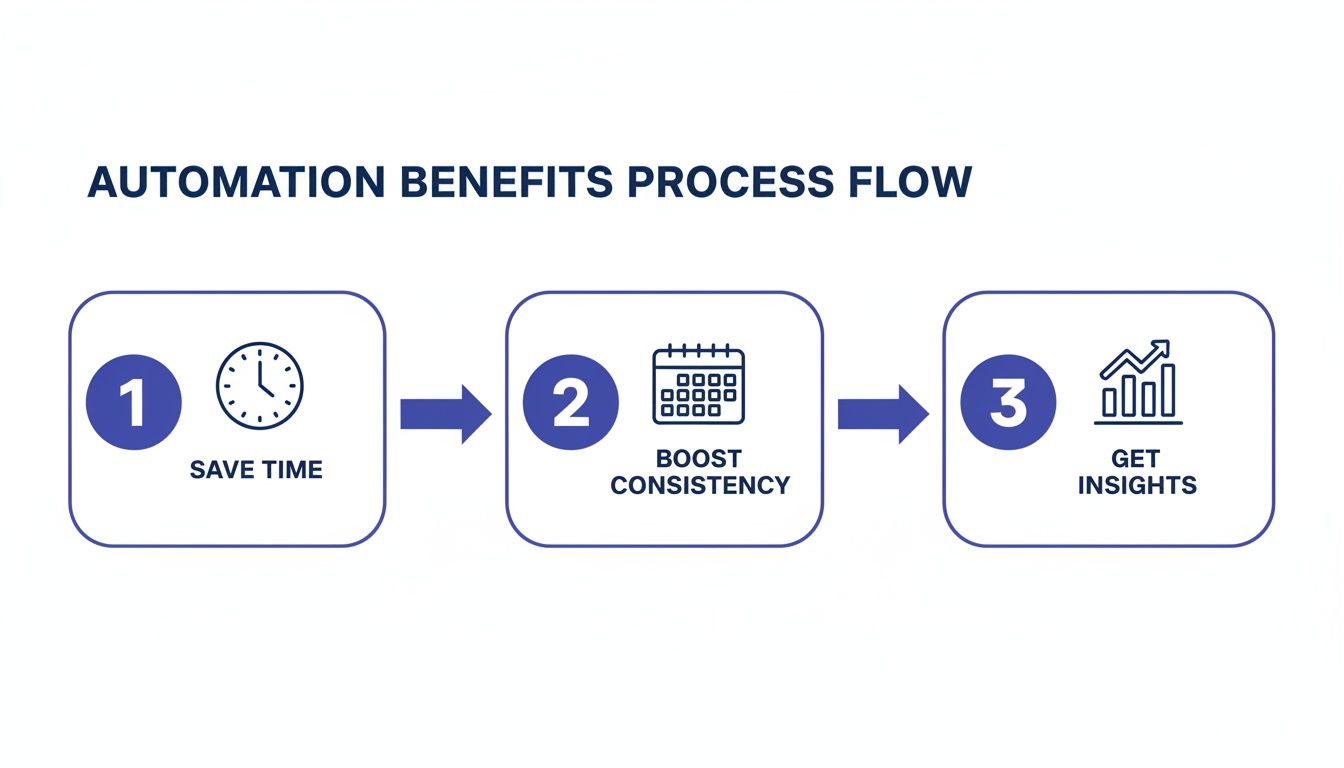
As you can see, each piece of the automation puzzle helps make your social media strategy more efficient and effective, turning those tedious, repetitive tasks into a smooth, hands-off operation.
Step 1: Content Creation and Organization
Everything starts with your content. Instead of having assets scattered across random folders and different devices, a centralized media library becomes your single source of truth. This is where you store all your approved images, videos, logos, and GIFs, making them instantly available for the whole team.
Once you have your assets organized, you need a steady stream of ideas. Many modern platforms now come with AI-powered idea generators that can suggest topics, whip up some draft captions, or find relevant hashtags. This doesn’t replace human creativity—it just supercharges it by solving that dreaded "blank page" problem.
Step 2: Planning and Approval
With your content ready to go, the next block in your workflow is planning. For this, a visual content calendar is an absolute must-have. It gives you a bird's-eye view of your entire schedule across every platform, so you can easily spot gaps, avoid posting the same thing twice, and make sure you have a balanced mix of themes and formats.
For teams—especially agencies juggling client accounts—an approval flow is non-negotiable. This feature lets you set up a simple review process with multiple stages.
- Creator Drafts Post: The social media manager creates the content and sends it off for review.
- Manager Review: A team lead or manager gives it a once-over to check for brand voice, strategy alignment, and accuracy.
- Client Approval: If you're an agency, the post then goes to the client for the final thumbs-up before it's scheduled.
This structured process catches errors before they happen and ensures every piece of content is fully vetted before it goes live, protecting the brand’s reputation. For a closer look at setting up these systems, our guide to automate social media posting offers more in-depth strategies.
Step 3: Smart Scheduling and Execution
Once a post gets the green light, it’s time for scheduling. This is where automation really starts to shine. Instead of trying to manually guess the best times to post, you can use smart scheduling queues. You just add your approved content to a list, and the platform automatically publishes it at pre-set, optimal times.
A lot of the more advanced tools use AI to analyze when your audience is most active on each network. The system then recommends the best times to post for maximum engagement, taking all the guesswork out of your scheduling.
This simple feature ensures your content reaches the largest possible audience without you having to constantly obsess over analytics. For instance, you might look into platforms that make it easy to set up more complex workflows, like automating tweet-based quests to give your engagement a serious boost.
Step 4: Analysis and Refinement
The final piece of the puzzle is the feedback loop. Publishing content is only half the battle; you have to know what's actually working. By using campaign labels or tags, you can group related posts together (e.g., "Q4 Product Launch" or "Summer Sale").
This simple trick makes it incredibly easy to pull automated reports that show you how specific campaigns performed. These insights help you answer the big questions: Did the video content crush the static images? Which platform drove the most traffic? This data then feeds right back into your content creation stage, creating a cycle of continuous improvement.
Common Automation Mistakes to Avoid
Social media automation can be an incredible ally for getting more done, but it’s a tool that requires a delicate touch. If you misuse it, you risk making your brand feel cold, distant, and completely out of touch. The whole point is to free up your time for more human connection, not to replace it altogether.
The biggest mistake I see people make is treating automation like a crockpot—they just "set it and forget it." This is where good social media strategies go to die. Your audience, the trends, and the platform algorithms are always in motion. A strategy that killed it last quarter could be totally dead in the water today.
The Pitfall of Over-Automating Engagement
One of the fastest ways to turn off your audience is by automating your direct interactions. Sure, an auto-reply can be fine for an initial "we got your message," but trying to have a real conversation with a bot is a huge misstep. Nothing screams "I don't care" louder than a generic, robotic response to a genuine comment.
Think about it: a customer takes the time to leave a thoughtful, heartfelt comment on your post, only to get back a canned, "Thanks for your comment!" That doesn't build a relationship; it actively chips away at it. These moments are golden opportunities to connect, and automation just can't replicate that human spark.
Here's the principle I live by: Automate tasks, not relationships. Let your tools flag important comments that need a human eye, but always jump in yourself for sensitive issues, tough questions, or amazing praise.
Authenticity is everything on social media. In fact, studies show that 83% of people expect a brand to reply to their comments within a day, and they can absolutely tell when a response is phoned in.
Avoiding the Content Zombie Apocalypse
Another classic blunder is scheduling your content calendar months in advance and never checking back in. This "set it and forget it" approach is a recipe for disaster. Here’s why:
- Tone-Deaf Posting: A fun, promotional post you scheduled weeks ago can look incredibly insensitive if it goes live during a major news event or a public crisis.
- Irrelevant Content: Your feed can quickly become a graveyard of stale posts that don't match what people are talking about now or where your brand is headed.
- Missed Opportunities: If you're not checking in, you're missing out on chances to join real-time conversations or jump on a trending topic relevant to your niche.
The fix? Do regular content check-ins. Your content calendar should be a living, breathing document, not something carved in stone. I recommend looking over your upcoming posts at least once a week to make sure everything still feels timely, relevant, and appropriate.
Striking the Right Balance
The most successful social media strategies find that sweet spot between machine efficiency and human authenticity. It’s never about choosing one over the other; it’s about making them work in harmony. It's about letting the machines handle what they do best—scheduling, reporting, and crunching data—so that humans can do what they do best: show empathy, be creative, and think strategically.
Here's how you keep that balance in check:
- Personalize Where Possible: Even with automated messages, use little touches like a person's first name to make the interaction feel a bit more one-on-one.
- Schedule Time for Manual Engagement: Literally block out time on your calendar every single day to just be human—reply to comments, join conversations, and thank your followers.
- Review and Adapt: Constantly look at your performance data. If an automated workflow isn't getting you results or, worse, is annoying your audience, don't be afraid to pull the plug, rethink your strategy, and try something new.
When you sidestep these common mistakes, your automation stops being a liability and starts becoming a powerful engine for growth. It frees you up to focus on what really matters: building a community that feels seen, heard, and genuinely valued.
Choosing the Right Automation Platform
Picking a social media automation tool from the sea of options out there can feel overwhelming. It’s a bit like navigating a maze without a map. Get it right, and the platform becomes a powerful extension of your team, making your life easier and your results clearer.
But get it wrong? You'll end up with workflow bottlenecks, a tool that adds complexity instead of removing it, and a hole in your budget with nothing to show for it.
Making a smart choice starts with knowing what you’re looking for. Before getting distracted by flashy features, you need to ground your decision in the core functions that will actually help you hit your goals. This isn't just about finding a scheduler; it's about investing in a command center for your entire social media strategy.
Core Features You Cannot Ignore
When you start comparing platforms, a few features are completely non-negotiable for any modern social media team. These are the fundamentals that support an effective, scalable automation strategy, no matter your industry or team size.
Here's what your initial checklist should focus on:
- Comprehensive Platform Support: Make sure the tool works seamlessly with every network where your audience hangs out. This absolutely must include easy scheduling for short-form video like Instagram Reels, YouTube Shorts, and TikTok, which are often the engine of modern engagement.
- Robust Team Collaboration Tools: Look for things like shared workspaces, approval workflows that make sense, and a central media library. These are critical for keeping your brand consistent and your team efficient, especially if you're an agency juggling multiple clients.
- Insightful and Actionable Analytics: The platform has to deliver more than just vanity metrics. You need deep, intuitive analytics that help you track what's working, understand your audience, and make smart, data-driven decisions to fine-tune your strategy.
The goal is to find a platform that empowers your team, not complicates its workflow. An intuitive user interface (UI) and reliable customer support are just as critical as the feature list itself.
Understanding Different Pricing Models
The pricing for these tools can be a real headache, often filled with hidden fees or restrictive contracts. Transparency is everything here. Some platforms use a tiered model based on how many users or social profiles you have, which can get pricey fast as you grow. Others try to lock you into long annual contracts, killing your flexibility.
A much better approach, which you’ll see with platforms like PostSyncer, is clear, contract-free pricing. This model lets you scale your plan up or down as your needs change without any penalties, giving you way more financial agility. For a full rundown of your options, our complete guide to social media automation tools breaks down various platforms and what they offer.
Matching the Platform to Your Unique Needs
There’s no single "best" platform—the right one depends entirely on your situation. A solo creator has completely different needs than a large enterprise, and your evaluation has to reflect that.
Figure out which of these profiles sounds most like you:
- For the Solo Creator: Affordability and simplicity are everything. You need a powerful tool that doesn't have a steep learning curve or a scary price tag, helping you stay consistent without the stress.
- For the Digital Agency: Your world revolves around scalability and client management. You need to be able to manage multiple brands in separate workspaces, have smooth client approval workflows, and maybe even offer white-label reporting.
- For the Enterprise Team: Security, advanced collaboration, and deep-dive analytics are your top priorities. You're looking for features like custom user permissions, detailed performance dashboards, and the ability to plug into your larger marketing tech stack.
In the end, choosing your automation platform is a strategic move that will directly impact your team's productivity and your brand's growth. By carefully looking at these core features, pricing models, and your own specific needs, you can pick a tool that doesn't just save time, but gives you a solid foundation for building a thriving social media presence.
How AI Is Transforming Social Media Automation
Think of standard social media automation like a smart sprinkler system—you set it, and it runs on a schedule. Now, imagine giving that system a meteorologist's brain. That's AI. It doesn't just stick to the plan; it analyzes, predicts, and adapts on the fly, turning your automation tool from a simple task-doer into a genuine strategic partner.
This is a huge leap forward. AI algorithms sift through mountains of data to pinpoint the absolute best times to post for your specific audience on each platform. Your content doesn’t just go out on time—it lands right when it’s most likely to make an impact.
From Blank Page to Published Post
One of the biggest breakthroughs is in content creation itself. We’ve all stared at a blank screen, right? AI content studios, like the one we've built into PostSyncer, are designed to smash that creative block to pieces. They can brainstorm topic ideas, draft killer copy that sounds like your brand, and even suggest the right visuals for the job.
This kind of intelligent help slashes content production time. Instead of building every post from the ground up, your team can start with solid, AI-generated drafts. This frees them up to produce more high-quality content, faster. Our deep dive into AI for social media marketing shows exactly how these tools can seriously boost your creative workflow.
AI isn't here to replace human creativity—it's here to supercharge it. It does the heavy lifting of brainstorming and drafting, which frees up marketers to focus on strategy, storytelling, and adding that final human polish that really makes content connect.
For businesses ready to go all-in on these capabilities, bringing in an AI automation agency can be a smart move to scale up effectively.
The Next Wave of Intelligent Automation
AI's role in social media is moving fast, and new features are popping up that offer even more power and insight. These aren't just pie-in-the-sky ideas; they're becoming standard in modern platforms.
Here’s where AI is really changing the game:
- Predictive Analytics: AI can look at market data and your past performance to forecast which topics and content formats will likely trend next. This gives you a massive head start, letting you create content that hits right as audience interest is peaking.
- AI-Driven Video Editing: Imagine uploading raw video and having an AI assistant chop it up into multiple short-form clips, perfectly optimized for Reels, Shorts, and TikTok. This is quickly becoming a reality and solves a huge production headache.
- Smart Audience Segmentation: AI tools can analyze your followers to identify small, distinct groups within your audience. This opens the door to hyper-targeted messaging, so the right people see the right content every time.
By building in these smart features, social media automation is becoming more predictive, more personal, and a whole lot smarter. It's not just about doing things faster anymore. It's about doing them better, giving you a serious competitive edge in a very noisy world.
Frequently Asked Questions
Jumping into social media automation can bring up a lot of questions. It's smart to get a handle on the details before you dive in, just to make sure you're using these tools to boost your brand, not hurt it. Let's tackle some of the most common things marketers wonder about.
We'll clear up the biggest worries and myths about putting parts of your social strategy on autopilot.
Will Social Media Automation Make My Brand Sound Robotic?
This is easily the biggest fear, but the answer is a hard no—as long as you do it right. Here's the secret: automate the tasks, not the personality. Your tools should be for scheduling, pulling reports, and keeping your content calendar tidy. The creative part, like writing those killer captions and shaping your unique voice, should always, always be human.
Think of automation as setting the stage. You're just making it easier to step into the spotlight and deliver a great performance. The best strategies out there blend the efficiency of automation with the genuine warmth of a real person, especially when it comes to replying to comments and DMs.
Is Automation Affordable for Small Businesses?
You bet it is. The old idea that automation is just for giant corporations with massive budgets is a total myth. Modern tools like PostSyncer are built with flexible, easy-to-understand pricing that grows with you. They have plans that are perfect for solo entrepreneurs, small teams, and growing agencies alike.
The money you put into a good automation tool often comes back to you surprisingly fast. Just think about it: the hours you get back from not doing manual tasks can go straight into things that actually make you money. It's a no-brainer for businesses of any size.
What Tasks Should I Never Automate?
There are definitely some lines you don't want to cross. The big one? Never fully automate direct engagement or any conversation that needs a real, empathetic human. This is your prime opportunity to build relationships, and a bot just can't fake that.
Here are a few things that should always be handled by a person:
- Responding to customer complaints: These situations need a personal touch and thoughtful problem-solving.
- Answering complex questions in DMs: Canned responses will just annoy someone looking for real help.
- Jumping into sensitive conversations: Weighing in on a serious trending topic requires a human's judgment in that exact moment.
Use your tools to flag these messages for your team, but always let a person handle the reply. That’s how you build the kind of trust and loyalty that lasts.
How Can I Measure the ROI of My Automation Tools?
Measuring your return on investment is key, and it really comes down to two things: time saved and performance gained. First, figure out how many hours you or your team are saving each week on manual work, and then put a dollar value on that time. It adds up quickly.
Second, use your platform's built-in analytics to watch your key performance indicators (KPIs). Look for improvements in the numbers that really matter to your business, like:
- Engagement Rate: Are more people actually interacting with your posts?
- Website Clicks: Is your automation driving more people to your site?
- Conversions: Are you seeing more leads or sales coming from your social channels?
A good tool makes it easy to see the positive impact it’s having on your team’s efficiency and, most importantly, your bottom line.
Ready to get your time back and build a smarter, more consistent social media presence? PostSyncer gives you the AI-powered tools to automate the boring stuff, so you can get back to what you do best—connecting with your audience. Start your free trial today and see the difference for yourself.