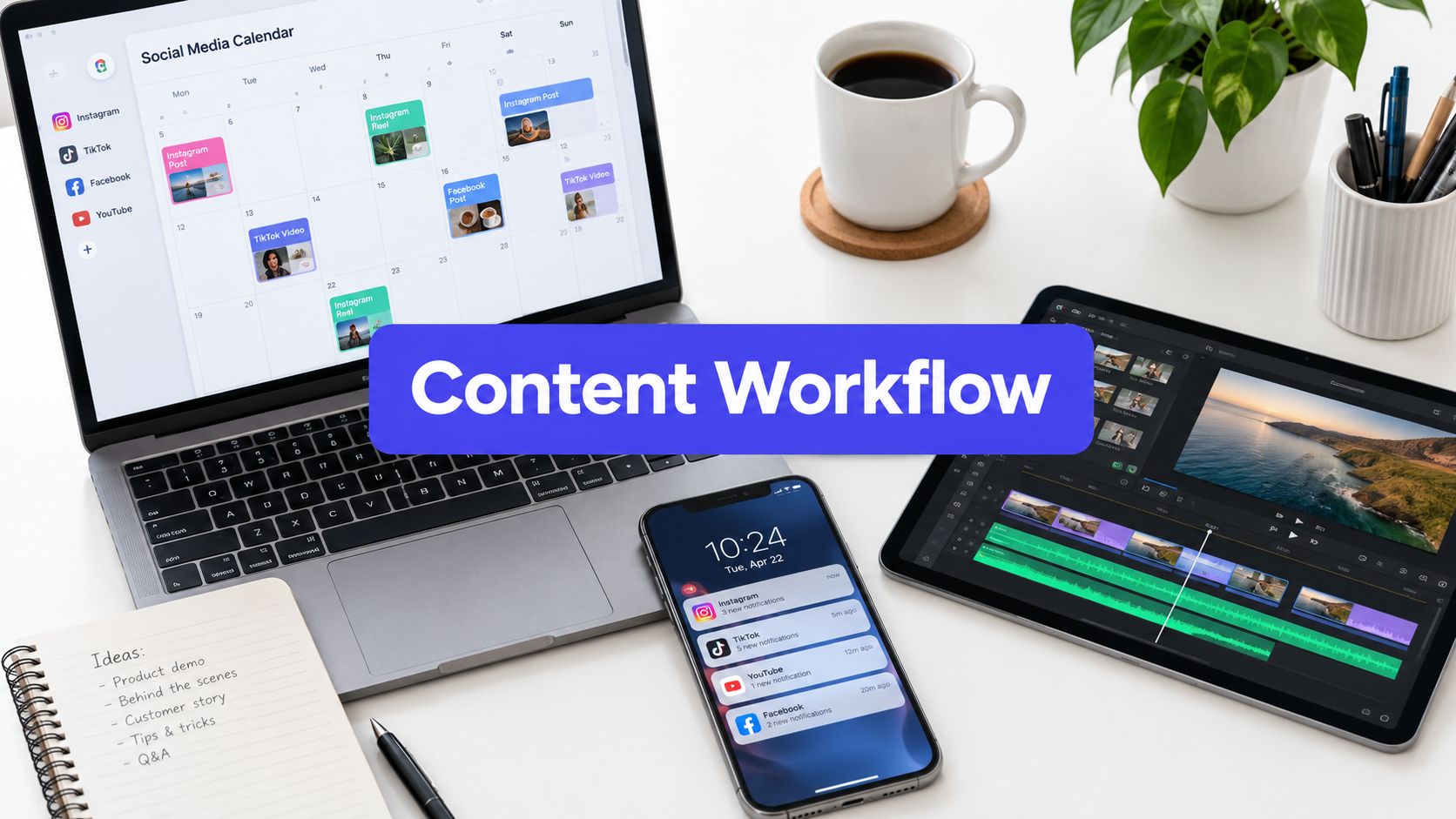









Trying to manage multiple social media accounts without the right tool feels like spinning plates. You're constantly logging in and out, copying and pasting, and hoping you don't miss the perfect time to post. It's chaotic, time-consuming, and frankly, a recipe for burnout.
This is where social media publishing tools come in. Think of them as your mission control for content. They give you a single dashboard to direct, schedule, and launch every post across platforms like Instagram, TikTok, and LinkedIn. What was once a frantic, manual juggling act becomes a smooth, strategic operation.
What Are Social Media Publishing Tools

At their heart, these platforms are designed to bring sanity to the beautiful chaos of modern social media. Instead of hopping between five different apps to share an update, you do it once, from one place. This core efficiency is exactly why they've become non-negotiable for serious brands and creators.
The numbers don't lie. The global social media management market was valued at a massive $32.48 billion in 2025 and is on track to hit $164.52 billion by 2034. That's not just growth; it's a clear signal that these tools are now essential infrastructure. If you want the full breakdown, you can dive into the social media management market analysis on fortunebusinessinsights.com.
But don't mistake social media publishing tools for simple "set it and forget it" schedulers. The best ones are complete systems that support your content from the first spark of an idea all the way to analyzing its performance and planning the next big hit.
They create a framework that keeps your brand voice consistent, prevents those awkward "oops, we forgot to post today" gaps, and, most importantly, frees up your brainpower for the work that actually matters—engaging with your community and thinking strategically.
The real magic of a publishing tool isn't just that it posts for you. It's that it gives you the structure and data to post smarter. It’s the difference between reacting to your social media and proactively building it.
Core Benefits for Different Users
Everyone loves saving time, but the true value of these tools really shines when you look at who's using them and why. A solo creator has very different needs from a bustling agency, and a good tool adapts.
To make it clearer, here’s a quick look at how different professionals get the most out of a publishing platform.
Core Benefits of Publishing Tools by User Type
| User Type | Primary Benefit | Example Application |
|---|---|---|
| Agencies | Client Management & Efficiency | Juggling 20+ client content calendars from one dashboard, complete with separate approval workflows for each. |
| Small Businesses | Brand Consistency & Time Savings | Blocking out a single afternoon to schedule a month's worth of content, ensuring a consistent online presence while focusing on running the business. |
| Solo Creators | Content Amplification & Growth | Turning one long-form YouTube video into a dozen Reels, Shorts, and TikToks to squeeze every last drop of reach out of their hard work. |
As you can see, it's not a one-size-fits-all solution. The goal is to find a tool that solves your biggest headache, whether that's managing client feedback, staying active on a tight schedule, or simply getting your content seen by more people.
The Must-Have Features of a Modern Publishing Tool

Any social media publishing tool worth its salt is built around a handful of core features. These aren't just flashy add-ons; they're the engine room of your entire operation. They’re what separates a messy, manual workflow from a focused, strategic one.
Think of these features as the essential toolkit for any serious marketer. They're designed to solve the biggest headaches we all face—from planning content and organizing assets to keeping teams aligned and proving our work actually delivers results. Let's dig into the non-negotiables.
Smart Scheduling and Visual Calendars
At the most basic level, a publishing tool has to make scheduling simple. A visual content calendar is your command center, giving you that crucial bird's-eye view of everything planned across all your networks. It’s what stops you from scrambling for last-minute posts and ensures you have a consistent, steady drumbeat of content.
But the best tools today are much smarter. They analyze when your specific audience is most active and suggest the best times to post for maximum impact. This takes the guesswork out of timing and is like putting your content delivery on a smart autopilot, making sure it lands in front of the right eyeballs at the right moment.
A Centralized Media Library
We’ve all been there: digging through endless folders and Slack channels, trying to find the right video file or the latest approved version of a graphic. It’s a massive waste of time. A centralized media library completely solves this problem. It acts as the single source of truth for all your digital assets—basically, a shared hard drive in the cloud that everyone can access right from the publishing tool.
This one feature alone is a game-changer. It lets you:
- Organize everything with tags and folders so you can find what you need in seconds.
- Keep the brand looking sharp by making sure everyone is using the correct, up-to-date logos and imagery.
- Create content faster because all your approved media is right there, ready to go.
Performance Analytics and Reporting
Putting content out into the world without tracking how it performs is like driving blind. Solid analytics are the GPS for your entire social media strategy. They tell you what's resonating, what's falling flat, and where you need to adjust your course.
The best social media publishing tools go way beyond vanity metrics like likes and follower counts. They connect what you do on social to real business goals by tracking link clicks, conversions, and how your audience is growing over time.
This constant feedback loop is what allows you to get smarter with every post. You can double down on the content formats that work, refine your messaging, and finally prove the real value of all your hard work.
Team Collaboration Workflows
The second you have more than one person touching social media content, things can get chaotic. Fast. Collaboration features bring much-needed order to that chaos. They create a dedicated space where your team can draft posts, leave feedback, and get approvals without ever leaving the platform.
Say goodbye to messy email chains and confusing spreadsheets. For agencies juggling multiple clients, these workflows are absolutely critical. They ensure nothing goes live without a sign-off, creating a clear, auditable trail of who did what and when.
Multi-Format Video Support
Short-form video is king. With platforms like TikTok, Instagram Reels, and YouTube Shorts completely dominating attention spans, your publishing tool has to be a video powerhouse. It’s no longer optional.
A modern tool needs to handle all kinds of video formats, letting you schedule and customize your clips for each network’s unique specs. The really advanced platforms are even using AI to take one long-form video and slice it up into a dozen high-impact short clips, letting you get way more mileage out of every single piece of content you create.
How to Choose the Right Publishing Tool
Picking the right social media publishing tool is less like buying software and more like choosing a new car. A freelance creator might just need a zippy scooter to get around town, while a big agency juggling dozens of clients needs a whole fleet of delivery trucks with serious logistics. The secret is matching the machine to the mission.
Before you even glance at a pricing page, you need a crystal-clear picture of your non-negotiables. Are you a one-person show where simplicity and speed are everything? Or are you part of a growing team that needs complex approval workflows and different permission levels to keep things from going off the rails? Making the wrong call can mean overpaying for features you'll never touch or, even worse, outgrowing your tool just a few months down the line.
When you're figuring out how to choose the right publishing tool, a detailed comparison of the best social media scheduling tools can give you some fantastic insights into what's out there.
Define Your Core Needs
First things first: map out your workflow. For a data-obsessed marketing team, the most critical feature might be deep analytics and custom reporting. They need to know exactly which content formats are driving clicks and conversions. On the other hand, a small business owner might just want a simple, clean interface and a great mobile app so they can schedule posts while waiting for their coffee.
Think hard about these key areas:
- Team Size and Collaboration: How many people need access? Will you need features like post-approval queues, internal comments on drafts, and different user roles?
- Platform Focus: Which social networks are the bread and butter of your strategy? The tool you choose must have rock-solid, native support for your priority channels.
- Content Types: Are you all-in on short-form video? Or do you rely more on carousels, text updates, and links? Make sure the tool handles your primary formats flawlessly.
Analyze Your Must-Have Platforms
The platforms you live on are a huge part of the decision. A massive analysis of 9.3 million posts found that Facebook still dominates, commanding a whopping 44.5% of all content published through these tools. When you add in X (Twitter), Instagram, and LinkedIn, these four giants account for over 80% of all publishing activity.
This data is exactly why all-in-one publishers are so effective—they let you manage your entire online presence from a single dashboard.
The goal isn’t to find a tool with the longest list of features. It’s to find the one with the right features that directly solve your biggest headaches and help you grow.
To help you visualize this process, here's a simple framework to compare tools based on different business needs. It’s a great way to build your own checklist before you start shopping around.
Feature Checklist for Selecting a Publishing Tool
| Feature/Criteria | Solo Creator Needs | Small Business Needs | Agency Needs |
|---|---|---|---|
| User Interface | Simple, intuitive, fast | Easy to learn, minimal training | Customizable, efficient for power users |
| Scheduling & Calendar | Basic scheduling, visual calendar | Advanced scheduling, content queues | Bulk scheduling, client-specific calendars |
| Platform Support | Core platforms (IG, FB, X) | All key platforms, including LinkedIn | Wide range, including niche platforms |
| Media Library | Simple cloud storage | Organized, taggable asset library | Shared client folders, asset management |
| Collaboration | Not applicable | 1-2 additional users, basic roles | Multiple user roles, approval workflows |
| Analytics & Reporting | Basic post-level metrics | Custom date ranges, platform reports | Branded, exportable client reports |
| Pricing | Highly affordable, low entry point | Scalable, good value for features | Tiered pricing for multiple clients/users |
This table isn't exhaustive, but it should give you a solid starting point. Use it to clarify what's a "must-have" versus a "nice-to-have" for your specific situation.
Ultimately, your selection process should be a straightforward audit of your needs versus a tool's features. Once you have your checklist ready, you can confidently evaluate different social media publishing tools and find the perfect match. To get you started, check out our guide on the top social media scheduling tools for a deeper comparison.
Building a Seamless Content Workflow
A great tool is useless without a solid process behind it. The best social media publishing tools don’t just help you post; they bring much-needed structure to your entire content operation, turning what can feel like a chaotic mess of tasks into a smooth, predictable system. This is about building an engine for consistent, high-quality output.
Think about a brand launching a new product. Instead of juggling spreadsheets, endless email chains, and a dozen shared folders, the whole process lives inside one platform. This single source of truth cuts out the friction at every stage, from brainstorming ideas to reviewing the final results. It frees up your team to focus on being creative instead of just coordinating.
Let’s walk through what that actually looks like.
From Ideation to Publishing
It all starts with an idea. Many modern tools now come with AI assistants that can help you generate captions, brainstorm hooks for a video, or suggest a handful of relevant hashtags. To really get the creative juices flowing, you can even integrate specialized tools like an AI meme generator to cook up some engaging visuals before you even think about scheduling.
Once the idea is there, it’s time for creation and collaboration. The marketing team drafts a few posts and pulls approved images or videos from a central media library. No more "Hey, where's that logo file again?" emails. Team members can drop comments, ask for edits, and give the final sign-off right on the content drafts, leaving a clear trail of who did what.
When it's ready to go, the content gets scheduled across all your networks from a single visual calendar, often with timing optimized for when each platform’s audience is most active.
This whole process of choosing and integrating a tool boils down to a few key steps.

As you can see, a successful workflow always starts by making sure the tool's features line up perfectly with what you’re trying to achieve.
Engagement and Analysis
The job isn’t done just because a post is live. The next critical piece is engagement. A unified inbox is a game-changer here, pulling all your comments, DMs, and mentions from every platform into one clean feed. This lets your community manager respond to everyone quickly without constantly jumping between apps. No more missed messages or frustrated customers.
Finally, you close the loop with analysis. The team can jump into the analytics dashboard and see exactly which posts hit the mark.
By tracking metrics like click-through rates, reach, and engagement by content type, they gather the data-driven insights needed to refine their strategy for the next campaign.
This feedback loop is what turns social media from a guessing game into a repeatable science. Every post teaches you something for the next one, making your whole process smarter and more effective over time. For more tips, check out our guide on creating a streamlined content creation workflow that saves time and boosts results.
Measuring the ROI of Your Publishing Tool
So, you're thinking about investing in a social media publishing tool. It's easy to see it as just another monthly expense, but that's the wrong way to look at it. A good tool isn't a cost center; it's a revenue-driving asset. The real question is, how do you prove it? That's where measuring the Return on Investment (ROI) comes in.
The most immediate and obvious return is time savings. Seriously, sit down and calculate how many hours your team spends just logging into different platforms, crafting posts, and hitting "publish" every single day. By automating that grind, a publishing tool hands those hours back to your team. Suddenly, they have more time for things that actually move the needle—like strategy, creative brainstorming, and genuinely engaging with your community.
Calculating Tangible Returns
Beyond just clawing back time, these tools are designed to produce real, measurable business outcomes. The analytics dashboard is your secret weapon for understanding content performance. It helps you stop throwing content at the wall to see what sticks. Instead, you can pinpoint exactly which posts are driving clicks and engagement, then double down on what’s working. That's how you get higher reach and more effective campaigns.
This data-first mindset is also a game-changer for lead generation. When you use a tool to schedule posts with tracked links and clear calls-to-action, you can finally connect the dots between your social media activity and actual website traffic or sales. A simple Facebook post is no longer just a post; it's a measurable entry point into your sales funnel. If you want to dive deeper into the nuts and bolts, check out our guide on how to measure social media ROI for the specific formulas.
A publishing tool transforms your social media from a content-posting machine into a predictable lead-generation engine. It shifts the conversation from "How many likes did we get?" to "How much revenue did that campaign generate?"
Maximizing Your Investment
Don't sleep on the financial value of brand consistency, either. A steady, professional presence builds trust and keeps you top-of-mind with your audience. A publishing tool ensures your brand never goes dark, maintaining that critical momentum that fosters long-term customer loyalty.
This is especially true when it comes to paid ads. With global social media ad spend projected to smash $219 billion in 2026, you can't afford to guess. We also know that shoppable videos convert 1.7x better than static images. A tool that helps you schedule and optimize this kind of high-impact content is essential for getting the most out of every single ad dollar. You can see more compelling stats like these in this report on social media marketing statistics on newmedia.com.
When you connect the dots between the features and these financial outcomes, it becomes crystal clear just how powerful the ROI of a good publishing tool really is.
Why PostSyncer Is Your All-In-One Solution
Throughout this guide, we’ve talked about the real-world frustrations that kill social media momentum. The constant time crunch, the messy workflows, the creative blocks, and that nagging pressure to be always on. These aren't just small annoyances—they're genuine roadblocks to growth.
And that’s exactly where the right social media publishing tools can completely change the game.
PostSyncer was built from the ground up to solve these exact problems. It’s not just another scheduler. Think of it as your command center, designed to give you back your time and actually amplify your results. Instead of juggling a dozen different apps, you get a single, unified platform that handles your content from idea to analysis.
A Narrative of Solutions
Let's connect the dots between the pain points and the features. Feeling disorganized? The visual content calendar and centralized media library finally bring some order to the chaos. Struggling with creative burnout? Our AI Content Agent is there to generate fresh ideas, captions, and images on demand. It turns that dreaded blank page into a finished post in seconds.
For agencies and teams, the pain of collaboration is all too real. PostSyncer tackles this head-on with an unlimited-seat model. This means your entire team can work together without costs spiraling out of control, supporting seamless approval workflows that keep everyone on the same page.
PostSyncer doesn't just give you tools; it provides a smarter workflow. It’s about turning manual, repetitive tasks into a streamlined, automated process so you can focus on strategy and community.
Trying to manage engagement across multiple platforms can feel like a losing battle. The unified inbox pulls all your comments and DMs into one clean feed. Meanwhile, our broad network support—covering everything from TikTok and Instagram to up-and-coming platforms like Bluesky—ensures you can be everywhere your audience is, without the headache.
Ultimately, PostSyncer ties it all together. It helps you plan, create, collaborate, publish, and analyze from one spot. By connecting these pieces, you can finally build a consistent, high-impact social media presence without burning out. It's time to stop spinning plates and start building real momentum.
Got Questions? We've Got Answers
Diving into the world of social media publishing tools can definitely bring up a few questions, especially when you're trying to nail down the right fit for your strategy. Here are some straightforward answers to the questions we hear most often from marketers, both new and seasoned.
How Many Accounts Can I Actually Connect?
This really boils down to the specific tool and which plan you’re on. Some of the entry-level plans might cap you at a handful of social profiles, which is totally fine for a solo creator or a small business just finding its feet.
But then you have platforms like PostSyncer, which were built from the ground up with scale in mind. They offer features like multi-workspace setups designed specifically for agencies or bigger companies juggling several brands. This lets you connect and neatly organize dozens of profiles without it turning into a chaotic mess.
Will Using a Scheduling Tool Wreck My Engagement?
This is a classic myth, but the short answer is a hard no. Any reputable publishing tool plugs directly into the official, approved APIs from social networks like Instagram and LinkedIn. What that means for you is that your scheduled content is treated exactly the same as a post you published on the fly from your phone.
The real key to great engagement isn't how you post, but what and when you post. These tools are your secret weapon, helping you optimize both by showing you which content is crushing it and what your audience's peak engagement times are.
Are Social Media Publishing Tools Secure?
Absolutely. The top-tier tools treat security as a top priority because they know they're handling the keys to your most valuable digital real estate. When you're weighing your options, there are a couple of non-negotiable security features you should be looking for.
Here’s what to check for to make sure your accounts and data are locked down:
- Official Login Methods: The tool should use secure, official login protocols like OAuth. This means you authorize access without ever handing over your password. It's a huge security win.
- Data Compliance: Look for platforms that are upfront about how they handle your data and are GDPR compliant. Transparency is a good sign.
Platforms like PostSyncer are built on these security measures, giving you peace of mind that your credentials and brand assets are kept safe.
Ready to stop juggling tabs and start building a smarter social media workflow? PostSyncer gives you the all-in-one platform you need to plan, create, and publish content that actually grows your brand. Start your free trial today.