










In 2024, just showing up on social media isn't enough to get noticed. You need a real strategy. Solid social media planning is what transforms random, chaotic posts into a reliable growth engine for your brand.
It’s the difference between shouting into the void and having a meaningful conversation that actually drives results.
Let's break down the essential pillars of a great plan. This is the roadmap we'll follow.
The Core Components of a Social Media Plan
| Component | What It Achieves |
|---|---|
| Audience & Goals | Defines who you're talking to and what you want to accomplish. |
| Content Pillars | Establishes the core topics your brand will consistently own. |
| Content Calendar | Organizes your posting schedule for consistency and strategic timing. |
| Workflow & Tools | Streamlines content creation, scheduling, and publishing. |
| KPIs & Analytics | Measures what’s working so you can double down on success. |
Each of these components builds on the last, creating a powerful framework that turns your social media from a time-sink into a strategic asset.
Why Proactive Social Media Planning Matters Now

Simply “being on social media” is a recipe for being ignored. The days of posting on a whim and hoping for the best are long gone. Without a structured plan, you’re just adding to the noise, not cutting through it.
This isn’t about creating rigid rules that kill creativity. It’s about building a smart framework that frees you up to focus on what actually works.
Beat the Content Scramble
We’ve all been there—that 4 PM panic when you realize you haven’t posted anything all day. A social media plan completely eliminates this stress.
By planning your content in advance, even just a week or two, you ensure a steady stream of valuable posts goes live without any last-minute scrambling. This consistency builds trust with your audience; they know when to expect content from you, which keeps your brand top-of-mind.
Maintain a Consistent and Powerful Brand Voice
Your brand's voice is its personality. Is it witty and informal? Or authoritative and educational? Planning ensures this voice stays consistent across every single post and platform.
When you don’t have a plan, different team members—or even just you on different days—can end up posting with wildly different tones. That inconsistency confuses your audience and weakens your brand identity.
Key Takeaway: Planning isn't just about scheduling; it's about strategic alignment. It ensures every post, story, and comment reinforces your brand identity and moves you closer to your business goals.
Turn a Time-Sink into a Strategic Asset
The online world is more crowded than ever. As of 2024, there are an astonishing 5.66 billion social media user identities globally, with 93.8% of internet users logging on every month. This massive audience is a huge opportunity, but only if you approach it strategically. You can dig deeper into the impact of these social media marketing statistics and what they mean for your brand.
A well-executed plan transforms social media from a chore into a measurable, results-driven part of your business. It lets you:
- Allocate Resources Wisely: Know exactly where your time, energy, and budget are going.
- Measure Performance: Track what works and what doesn't to get smarter with every post.
- Achieve Tangible Goals: Drive real-world results like website traffic, leads, and sales.
Building Your Strategy and Defining Goals
Before you even think about posting a single photo or drafting a caption, we need to pump the brakes. Social media planning has to start with two simple but critical questions: Who are you trying to talk to, and what do you actually want to happen?
Without clear goals, your plan is just a glorified to-do list. A real strategy is a roadmap that ties every single action—every post, every story, every comment—back to a real business outcome.
This means getting way more specific than "increase engagement." For an e-commerce shop, a solid goal sounds like, "Achieve a 4% click-through rate from Instagram Stories to our product pages." For a B2B company, it might be, "Generate 20 qualified leads per month through our LinkedIn content." See the difference?
Key Insight: Your goals drive everything. They tell you which platforms to use, what content to make, and which numbers to watch. A sales goal pushes you toward platforms with shopping features, while a lead-gen goal points you straight to professional networks like LinkedIn.
Define Your Target Audience
You can't create content that hits home if you don't know who you're aiming for. One of the most powerful things you can do is build a simple audience persona. This goes beyond basic demographics—it’s about digging into their motivations, their biggest headaches, and how they spend their time online.
Think about these two very different people:
E-commerce Persona (B2C): Meet "Sustainable Sarah," 28. She's a professional living in the city who seeks out eco-friendly products and follows brands that share her values. You’ll find her on Instagram and TikTok, where she loves behind-the-scenes content and trusts authentic creator collaborations.
B2B Persona: This is "Startup Steve," 35. He’s a SaaS founder on the hunt for scalable tools to boost his team's productivity. He lives on LinkedIn and X (formerly Twitter), reads industry reports, and responds to content that gives him practical, no-fluff business advice.
Knowing the difference between Sarah and Steve is everything. "Sustainable Sarah" wants to see your ethical supply chain in action. "Startup Steve" just wants a case study proving ROI. You can find a complete roadmap for building out your plan with our social media marketing plan template.
Analyze the Competitive Field
Once you know your audience, it's time to peek over the fence and see what your competitors are up to. The goal here isn't to copy them—it's to spot the gaps they're leaving wide open. Pick 2-3 direct competitors and 1-2 brands you admire in your space.
As you look at their profiles, ask yourself:
- What are their main content pillars? Are they all about tutorials, user-generated content, or office culture?
- Where are they strongest? Which platform gets them the most real, authentic engagement?
- What's their brand voice like? Professional and buttoned-up, or witty and informal?
- Where are they dropping the ball? Are they completely ignoring a platform where your audience hangs out? Are their comment sections a ghost town?
This quick analysis will show you exactly where you can shine. Maybe all your competitors are fighting for attention on Instagram, leaving a massive opportunity for you to become the go-to expert on LinkedIn.
As you build your presence, don't forget how AI is changing the game. Your strategy should include optimizing for AI recommendations—it's the new frontier of discovery. With global social media ad spend expected to blow past $219 billion by 2026, a sharp, well-defined plan isn't just nice to have; it's essential for seeing any return on your investment.
Alright, you've got your strategy mapped out. Now for the fun part: actually creating the content that will bring it to life. This is where your content pillars and a solid content calendar come into play.
Think of content pillars as the main categories you'll consistently talk about. They're the core subjects your audience can always expect from you, turning your brand into a reliable source of expertise.
This is what stops the daily, "What on earth do I post today?" panic. Instead of scrambling for random ideas, you'll have a proven framework that keeps your content focused, consistent, and valuable.
Brainstorming Your Core Themes
Your best content pillars live at the sweet spot between what your brand is known for and what your audience is dying to know. If you run a service-based business, like a marketing agency, this is what that might look like:
- Behind-the-Scenes: Show your team in action, how a project comes together, or just a day in the life. It’s a fantastic way to humanize your brand and build real trust.
- Success Stories: Nothing sells like results. Share client wins and case studies that showcase the real-world impact of your work. This is social proof in its most powerful form.
- Insider Tips & Tricks: Give away some of your best-kept secrets. Sharing actionable advice positions you as an expert people will turn to again and again.
- Industry Insights: Chime in on the latest trends and news. It shows you’re not just participating in your industry—you’re helping to lead it.
Having these pillars gives you a deep well of ideas to pull from, so you're never starting from a blank page. For a deeper dive, check out our complete guide on how to use social media content pillars.
Structuring Your Content Calendar
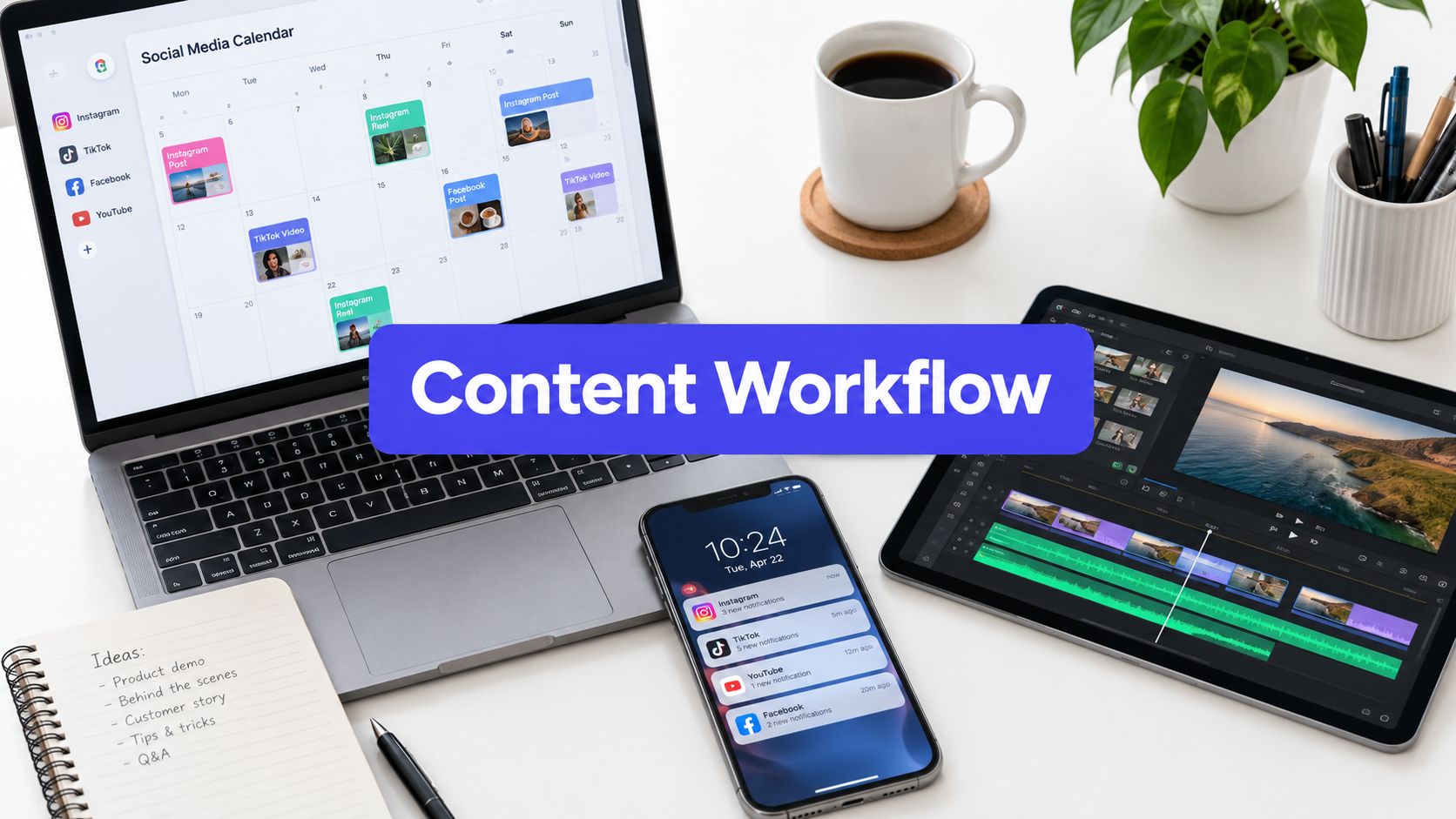
With your pillars defined, the next move is organizing everything in a content calendar. This is your mission control—a visual map of what you’ll post, where you’ll post it, and when.
A good calendar isn't a rigid rulebook; it's a flexible guide. You wouldn't want to post 3 success stories back-to-back, right? A calendar helps you rotate through your pillars, mixing in educational, entertaining, and promotional content to keep your feed fresh and engaging.
You can use a simple spreadsheet or a visual planner like the one built into PostSyncer. The goal is to see your week or month at a glance, making it easy to spot gaps and maintain a cohesive brand story.
A content calendar's true power isn't just in scheduling—it's in strategic distribution. It guarantees your audience receives a well-rounded diet of content that educates, inspires, and converts, preventing content fatigue and keeping them coming back for more.
To give you a clearer picture, here’s how a service-based business might mix up its content throughout the week.
Sample Weekly Content Calendar Mix
| Day | Instagram/TikTok (Visual) | LinkedIn/X (Text & Professional) | Facebook (Community & Links) |
|---|---|---|---|
| Monday | Insider Tip: Quick Reel on a productivity hack | Industry Insight: Analysis of a new trend | Community Poll: "What's your biggest marketing challenge?" |
| Wednesday | Behind-the-Scenes: Carousel of a team brainstorm | Success Story: Client testimonial with key metrics | Blog Link: Share an in-depth "Insider Tip" article |
| Friday | Success Story: Visual case study video | Insider Tip: In-depth professional advice in a thread | Behind-the-Scenes: Fun "end of week" team photo |
This kind of structured approach makes sure you’re hitting all your key themes on the right platforms, tailored to what performs best on each. It’s how you turn that big-picture strategy into consistent, high-impact content that actually gets results.
Streamlining Your Content Creation Workflow
Alright, so you've got your strategy and your content pillars sorted. Now for the fun part: turning those big ideas into a steady stream of actual posts. This is where we move from planning to doing, building a repeatable system that keeps you from scrambling for content at the last minute.
The secret? Stop creating one post at a time. It's a recipe for burnout. Instead, the pros rely on two core concepts: batching and repurposing. This just means you'll set aside dedicated time to create a bunch of content at once, then slice and dice your bigger ideas into smaller posts.
Master the Art of Content Repurposing
Let me be clear: repurposing isn’t about being lazy. It's about working smarter. One fantastic piece of content—like a detailed case study or a webinar—should fuel your social media for weeks, not just for a single day.
Think of that big asset as a goldmine. You can chip away at it to create tons of different posts, each tailored to a specific platform.
- Key Statistics as Graphics: Pull the most surprising numbers from your case study and design simple, shareable graphics. These are perfect for LinkedIn and Instagram.
- Webinar Clips as Reels: Cut your webinar recording into powerful, 60-second tips. Instant content for Instagram Reels, TikTok, and YouTube Shorts.
- Insightful Quotes for X: Grab the best quotes from your expert and spin them into a thought-provoking thread on X (formerly Twitter).
- Behind-the-Scenes Photos: Did you take photos during the webinar recording or client interview? Share them in a carousel post on Facebook to add a human touch to your brand.
This flow—from your core pillar, to your calendar, to your individual posts—is what makes a content system truly efficient.

As you can see, your foundational themes (Pillars) directly feed your schedule (Calendar), which then gets broken down into the specific assets (Posts) you'll publish.
Build an Efficient Scheduling System
Once you have a folder full of repurposed assets, the final piece of the puzzle is scheduling them out. This is where your content calendar really comes to life, and frankly, a visual scheduling tool is non-negotiable here.
Tools like PostSyncer give you a bird's-eye view of your entire week or month. You can drag and drop posts into place, tweak captions for each network, and make sure you have a healthy mix of content from all your pillars. It’s the best way to avoid accidentally posting three sales-heavy messages in a row.
Your goal is to create a system where you can sit down and schedule an entire week’s worth of high-quality, varied content in a single session. This frees up your mental energy during the week for more important tasks, like engaging with your community.
For example, a marketing agency could block off every Monday morning for this. They’d take all the repurposed assets from last week's blog post—the video clips, quote graphics, and text snippets—and schedule them across LinkedIn, Instagram, and X for the entire week. Done.
By batching your creation and automating your distribution, you transform a chaotic daily chore into a predictable, low-stress system. This is how you finally get ahead of your content calendar and stay there.
Fostering Community and Managing Engagement

So you've perfected your content and your posting schedule is running like clockwork. That's a huge win, but it’s only half the job. If you’re just publishing posts and walking away, you’re missing the entire point of social media. The real magic happens in the comments and DMs.
Without a plan for engagement, you're essentially just broadcasting into an empty room. The brands that truly succeed are the ones that are responsive, human, and conversational. This doesn't mean you have to be chained to your phone 24/7. It just means you need a smart system to manage all those interactions without them completely derailing your day.
From Broadcast to Conversation
First things first, you need a mental shift. Stop seeing comments and DMs as a chore. Every single one is a golden opportunity to build a real relationship. A quick, thoughtful reply can easily turn a passive scroller into a loyal advocate for your brand.
But let's be real: trying to manually track every notification across Instagram, Facebook, and LinkedIn is a fast track to burnout. This is where a unified inbox becomes your best friend. Tools like PostSyncer are a lifesaver, pulling all your comments and direct messages into one clean feed. No more app-switching madness—just one place to manage every conversation.
Sparking Meaningful Interactions
Don't just sit back and wait for people to talk to you. Your social media plan should be built to deliberately spark conversations. It’s easier than you think.
Here are a few tactics I’ve seen work wonders:
- Ask Open-Ended Questions: Ditch the simple "yes/no" questions. Instead of "Do you like our new feature?" ask, "What’s one way our new feature could make your workflow even better?" You’ll get much richer insights and more engagement.
- Run Community Polls: People love giving their opinion. Use Instagram Stories or LinkedIn polls to get quick feedback. It’s a low-effort way for your audience to engage and feel like they’re part of your brand's journey.
- Encourage User-Generated Content (UGC): Actively ask your followers to share photos or stories using your product. When they do, feature them! This gives you a steady stream of authentic content and provides powerful social proof that money can't buy.
Your social media plan shouldn't just schedule posts; it should schedule conversations. Block out 15-20 minutes twice a day—once in the morning, once in the afternoon—just for community engagement. This focused time is far more effective than randomly checking your phone all day.
Managing Engagement Efficiently
As your brand grows, the volume of comments and messages will, too. This is a good problem to have, but you need an efficient system to handle it. A unified inbox lets you quickly filter out spam and set up simple automations for common questions.
Think about all the time you'll save by using an AI-powered auto-reply for things like, "What are your business hours?" This frees you up to handle the conversations that actually move the needle: answering a detailed product question, personally thanking a super-fan, or turning a customer complaint into a public win. That’s how you build a brand people feel genuinely connected to.
Measuring What Matters to Optimize Your Plan
A social media plan isn't something you create once and forget. Think of it as a living, breathing strategy that needs constant attention. If you’re not looking at the data, you’re just guessing. To really make progress, you have to move past the vanity metrics—like follower counts—and zero in on the numbers that actually move the needle for your business.
It’s easy to get excited about a post with hundreds of likes. But the real question is, did that post lead to anything tangible? The shift from asking "How many likes did we get?" to "How many people clicked our link and signed up?" is where real growth happens. That's how you start connecting your social media efforts to actual ROI.
Identifying Your Core KPIs
Don't get bogged down trying to track every single metric. I've seen countless teams get lost in analytics paralysis. Instead, focus on a few key performance indicators (KPIs) that tell you the most important parts of the story.
- Engagement Rate: This is your gut check. It’s the percentage of your audience that’s actually interacting with your content through likes, comments, and shares. A high engagement rate tells you one thing loud and clear: your content is hitting the mark.
- Click-Through Rate (CTR): This metric shows how many people saw your post and were compelled enough to actually click your link. It’s a direct measure of how persuasive your content and call-to-action are.
- Conversion Rate: This is the bottom-line number. It tracks how many people took the action you wanted them to take after clicking, whether that’s buying a product, downloading a guide, or booking a call.
When you track conversions, you’re drawing a direct line from your social media activity to your revenue goals. A strong conversion rate is proof that your content isn’t just being seen—it’s actively driving business.
A Real-World Analytics Review
Let's walk through a scenario I see all the time. Imagine you're running social for an e-commerce brand. You pull up last month's report and a few things jump out.
You notice your "Insider Tips" content pillar has a 15% higher engagement rate than your "Behind-the-Scenes" content. You also see that your Instagram Reels drove twice as many clicks to the website as your static image posts did.
The data is practically telling you what to do next. Your action plan is simple: dial back the behind-the-scenes content for a bit and double down on creating more Insider Tip Reels. This is what a data-driven pivot looks like in the real world. You’re not just throwing content at the wall; you’re making informed decisions to make your next month even more effective than the last.
For a deeper dive into this, you can explore advanced strategies for social media analytics and reporting that help connect all the dots.
By getting into a regular rhythm of analyzing your performance and tweaking your content calendar based on what you find, you create a powerful feedback loop. This process is the heart of any successful social media strategy, turning guesswork into a reliable engine for growth.
Quick Answers to Your Top Social Media Planning Questions
We get these questions all the time, so let’s clear up a few things.
How often should I be posting?
This is the big one, isn't it? Forget the myth that you need to post every single day. That's a fast track to burnout and low-quality content.
It’s all about quality over quantity. A great starting point is 3-5 high-value posts per week on your main platforms. From there, watch your analytics. See what resonates and adjust. Consistency is what truly builds momentum, not just raw frequency.
Which social media platforms are right for my business?
Don't just set up a profile on every platform out there. You need to go where your audience actually spends their time. A little demographic research goes a long way here.
Think about it this way: if you’re a B2B tech company, your people are on LinkedIn. If you're an e-commerce brand selling handmade jewelry, you’ll probably find your tribe on Instagram and Pinterest. Be strategic.
What’s the difference between a content pillar and a content calendar?
It's easy to mix these up, but they serve two very different functions in your strategy.
A content pillar is your foundation—it’s a broad, core theme you talk about. Think big picture, like ‘Customer Success Stories’ or ‘Industry Tips.’
A content calendar is the execution. It’s the spreadsheet or tool where you schedule specific posts (like that video testimonial for next Tuesday) that fall under those pillars. One supports the "what," the other organizes the "when."