









Ever created a fantastic piece of content—a blog post, a social media update, a video—only to have it met with... crickets? You got the views, but nothing happened next. That feeling of a missed connection is often down to one missing ingredient: a clear call to action (CTA).
A CTA is simply a direct instruction you give your audience to prompt an immediate response. It’s the friendly nudge that turns a passive reader or viewer into an active participant, whether that means subscribing, sharing, or buying.
Your Digital Compass: What Is a Call to Action?
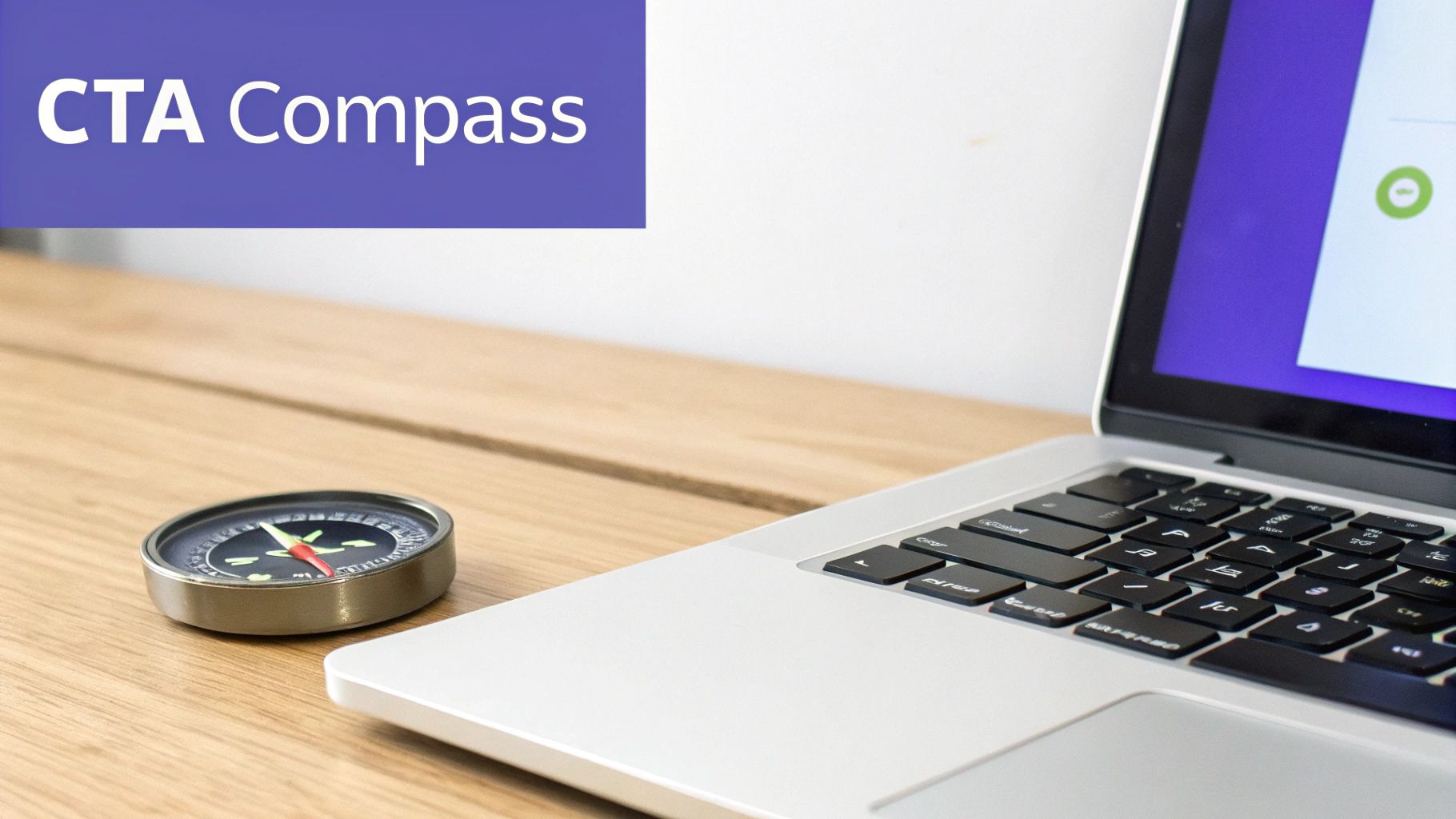
Think of your content as a map leading your audience to an amazing destination—your product, your community, your expertise. A call to action is the signpost, the big, glowing arrow that says, "The treasure is this way!" It's the digital compass that guides them from just consuming your content to truly engaging with your brand.
Without that clear direction, your audience is left at a dead end, wondering, "Okay, that was great... now what?" That moment of hesitation is where you lose them. A well-crafted CTA bridges that gap. It eliminates confusion and makes the user's next step obvious, seamless, and inviting.
For a deeper look at the fundamentals, this quick guide on what is a Call to Action in marketing is a fantastic resource to build your foundational knowledge.
The Anatomy of an Effective CTA
So, what separates a CTA that gets clicked from one that gets ignored? Whether it's a slick button or a simple line of text, every powerful CTA is built from a few core components. Getting these right is the first step toward crafting instructions that don't just ask, but persuade.
A call to action is more than just a button—it’s the logical conclusion to your content's story. It answers the reader’s unspoken question of "What’s next?" with a clear and valuable solution.
These ingredients work together to make your request both easy to understand and hard to resist.
A powerful CTA isn't just a random command; it's a carefully constructed prompt with three key parts. Here’s a quick breakdown of what makes them tick.
The Three Core Elements of a Powerful CTA
| Component | What It Is | Why It Matters |
|---|---|---|
| Action-Oriented Verb | The strong, commanding word that kicks things off. | It tells users exactly what to do (e.g., "Download," "Subscribe," "Shop"). No ambiguity. |
| Clear Value Proposition | The specific benefit the user gets for clicking. | It answers their "What's in it for me?" question (e.g., "Get Your Free Ebook," "Save 20% Today"). |
| Sense of Urgency | Optional language that encourages them to act now. | It leverages scarcity or FOMO (fear of missing out) to prevent hesitation (e.g., "Shop Now, Sale Ends Tonight"). |
By combining a clear command with a compelling reason and a little bit of urgency, you create a CTA that feels less like an ask and more like an opportunity your audience won’t want to miss.
Why Your Marketing Fails Without a Strong CTA
Picture this: you walk into a stunning retail store. The lighting is perfect, the displays are gorgeous, and the products are exactly what you’ve been searching for. But there’s a catch—no checkout counter. No staff, no signs, no way to actually buy anything. You'd probably wander around confused for a minute before leaving empty-handed.
That’s exactly what your content feels like without a strong call to action. You can pour your heart into creating the most engaging, informative, or hilarious post on the internet, but if you don't tell your audience what to do next, you've led them straight to a dead end. You’ve built up all that interest and excitement with no outlet for action, leaving potential customers stranded.
A CTA is so much more than a button; it’s the crucial link that turns passive readers into active participants. It guides your audience along their journey with you, wiping out the confusion that kills conversions and brings your growth to a grinding halt.
Turning Clicks Into Customers
Without that clear next step, you’re not just losing a click—you’re losing a potential relationship. The whole point of your content is to build a connection that leads somewhere, whether that's a sale, a newsletter subscription, or just a new follower. A powerful CTA is the handshake that seals the deal.
It brings clarity and purpose to the table, answering the silent question on every user's mind: "Okay, what now?" Your job is to make their decision a no-brainer by presenting a logical, valuable, and compelling next step. This simple prompt is what turns your content from a monologue into a genuine conversation.
A missing call to action is a missed opportunity. Every single piece of content you publish should have a purpose, and the CTA is what makes that purpose achievable.
The Power of Personalization
Let's be honest, generic instructions get generic results. If you really want to move the needle, your CTA has to feel like it was written just for the person reading it. The data on this is incredibly clear: tailoring your call to action to your audience dramatically boosts its performance.
One analysis, for example, found that personalized CTAs convert 202% better than their one-size-fits-all counterparts. Even tiny tweaks can have a massive impact. Something as simple as changing the button text from "Your" to "My" has been shown to lift conversions by up to 90%.
This proves a critical truth in marketing: the more your CTA speaks directly to a user’s immediate needs and context, the more likely they are to take action. You can dive deeper into these kinds of fascinating call-to-action statistics to see just how much of a difference these details can make.
Choosing the Right CTA for Your Marketing Goal
Not all calls to action are built the same, and picking the right one is like choosing the right tool for a job. You wouldn't use a hammer to turn a screw. In the same way, the CTA you use to get new leads is worlds apart from one designed to drive immediate sales or get your community talking.
Getting this right is simple: align your prompt with your specific marketing goal.
A CTA’s purpose can be a "hard ask," like making a purchase, or a "soft ask," like sharing a post. Understanding this difference helps you meet your audience where they are. A brand-new visitor probably isn't ready to “Buy Now,” but they might be totally fine with “Download Your Free Guide.”
Matching Your CTA to Its Purpose
First things first, you need to be crystal clear on what you want to achieve with a piece of content. Are you trying to grow your email list? Drive traffic to a new product? Or just spark a conversation?
Once you know your goal, the right call to action becomes obvious.
Let's break down the most common types of CTAs and where they shine:
- Lead Generation: These CTAs dangle a valuable carrot—like an ebook, webinar, or free consultation—in exchange for an email address. The whole point is to capture new prospects and welcome them into your world.
- Sales Conversion: Direct and to the point. These CTAs are all about closing the deal. They're perfect for product pages, sales emails, and ads targeting warm audiences who are ready to pull the trigger. For more ideas on this, check out our guide on how to increase online sales.
- Engagement and Nurturing: These are the softer CTAs designed to build community and keep your audience plugged in. They encourage simple actions like commenting, following your page, or sharing your content with their network.
A Practical Comparison of CTA Types
To make this even clearer, let's look at a well-placed "Shop Now" button on an Instagram ad. That can drive immediate revenue. But a simple "Leave a comment" on a blog post builds a loyal, engaged community over the long haul. Both are valuable, but they serve completely different functions.
A great call to action doesn't just ask for a click; it provides a clear, logical next step that aligns perfectly with the user's intent and your business goals. It’s a seamless transition, not an abrupt interruption.
Think of this table as your cheat sheet for matching your goal with the right kind of prompt.
Choosing the Right CTA for Your Marketing Goal
| CTA Type | Primary Goal | Best Used On | Example Copy |
|---|---|---|---|
| Lead Generation | Capture contact info | Blog posts, landing pages | "Download Your Free Ebook" |
| Sales Conversion | Drive immediate purchase | Product pages, social ads | "Add to Cart" or "Shop Now" |
| Event Promotion | Increase attendance | Event pages, emails | "Reserve Your Seat Today" |
| Engagement | Build community | Social media, articles | "Share Your Thoughts Below" |
By mastering which CTA to use and when, you transform your content from a simple broadcast into a strategic conversation. You're no longer just shouting into the void; you're intentionally guiding your audience from initial interest to meaningful action, one clear prompt at a time.
Writing Persuasive CTA Copy That Drives Action
Knowing what call to action to use is only half the battle. The other half is all about the words you choose—the copy that turns a simple instruction into an irresistible invitation. The right phrasing can be the difference between a user scrolling right past or eagerly clicking through.
Great CTA copy isn't just about being clever; it's about tapping into a little bit of psychology to make your offer feel urgent, valuable, and perfectly in sync with what your audience wants.
It all starts with a strong, action-oriented verb. Words like Get, Download, Discover, and Join are your best friends because they're direct and tell people exactly what to do. You want to ditch passive or generic words like "Submit" or "Click Here." They're a total vibe kill.
Instead, always focus on the benefit—what's in it for them? If you really want to get this right, our deep-dive guide on copywriting for social media is packed with tips and frameworks to help you master the craft.
From Bland to Irresistible
Let's look at a simple but powerful transformation. Think about the generic "Submit" button on a form. It's functional, sure, but it’s completely uninspiring. It puts all the focus on the work the user has to do, not the reward they're about to get.
Now, let's inject some real value into that same CTA:
- Before: Submit
- After: Get My Free Ebook Now
See the difference? This tiny change shifts the entire focus from their effort to their reward. The new version is specific, highlights a clear benefit ("Free Ebook"), and even uses personal language ("My") to create a sense of ownership before they've even clicked.
A truly effective call to action doesn't just ask for a click—it presents an opportunity the user won't want to miss. It should feel like the natural and exciting next step in their journey with you.
This flowchart is a great way to visualize how to choose the right type of CTA based on your main marketing goal.
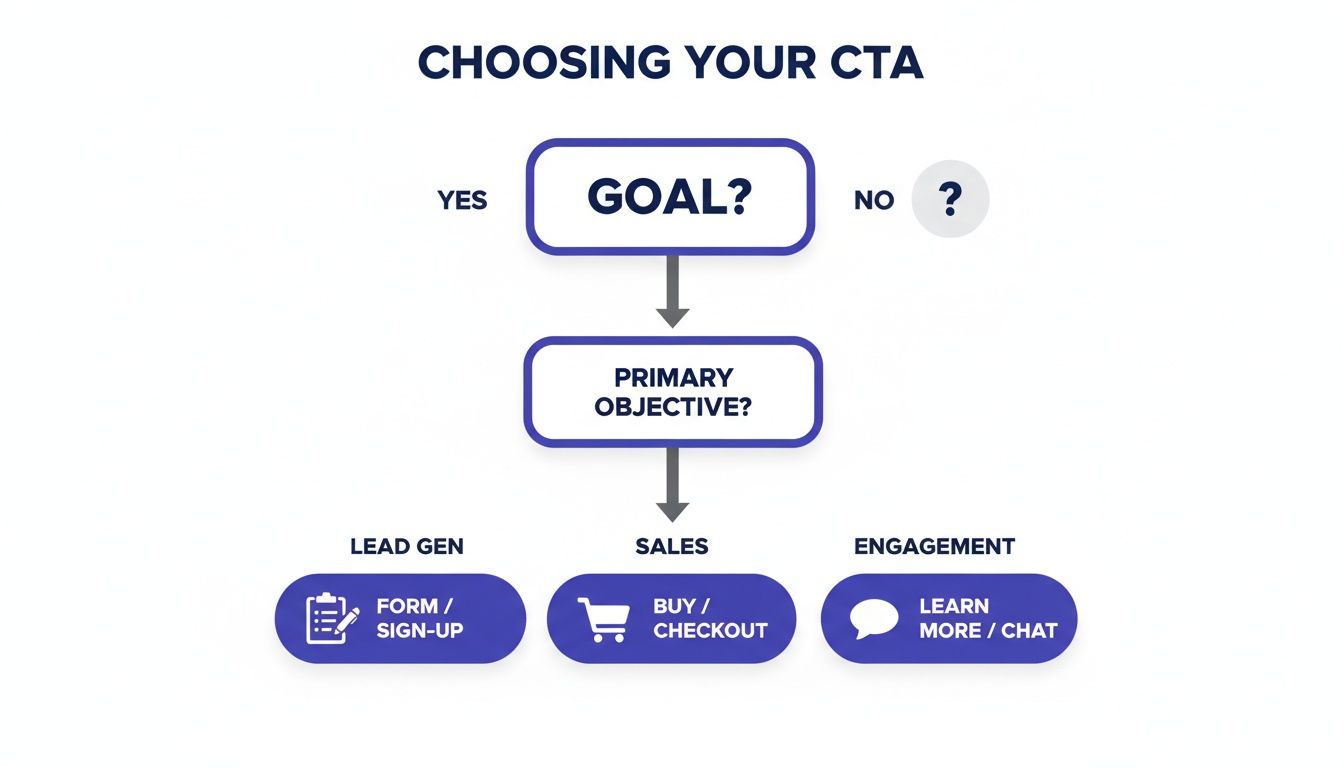
As the decision tree shows, different goals—like lead generation, sales, or community engagement—naturally lead to very different CTA strategies.
Sparking Action with Psychological Triggers
Once you've got your strong verb and clear value proposition, you can amplify your CTA's power by using a few proven psychological triggers. These are little nudges that tap into basic human emotions and motivations, making your call to action feel much more urgent and relevant.
Try incorporating these triggers to make your CTAs nearly impossible to ignore:
- Urgency: Nothing gets people moving like a deadline. Use time-sensitive language to encourage them to act now. Phrases like "Limited Time Offer," "Sale Ends Tonight," or "Only 3 Spots Left!" create a sense that waiting could mean missing out entirely.
- Social Proof: People are wired to follow the crowd. When they see others taking an action, they feel more confident doing the same. Including numbers like "Join 25,000+ Subscribers" or "Trusted by 5,000 Teams" is a powerful way to build trust and squash any hesitation.
- FOMO (Fear of Missing Out): This is urgency’s close cousin. You want to frame your offer as an exclusive opportunity that everyone else is already enjoying. Language like "Don't Get Left Behind" or "See What Everyone's Talking About" can be incredibly effective.
By weaving these elements into your copy, your CTA becomes more than just a button. It becomes a persuasive, emotionally-charged prompt that drives real, measurable results.
High-Converting CTA Examples in the Wild
Theory is one thing, but seeing a powerful call to action in its natural habitat is where the real learning happens. You quickly realize that an effective CTA has to speak the native language of the platform it’s on. A prompt that works wonders on LinkedIn would likely fall flat on TikTok because user expectations and behaviors are completely different.
Let's break down what a high-converting call to action looks like across the social media landscape. We'll explore why certain phrases connect so well on specific platforms and give you some templates you can steal for your own campaigns.
Instagram CTAs That Drive Engagement
Instagram is a visual-first world where actions are often quick, impulsive, and direct. The most valuable real estate you have is that single link in your bio, so it's no surprise that most CTAs are designed to get people there. The best prompts feel conversational and make the next step incredibly easy.
- For E-commerce: "Obsessed with this look? Tap the link in our bio to shop the collection before it’s gone!"
- For Lead Generation: "Want our free guide to [Topic]? The link in our bio has your name on it. Go grab it!"
- For Community Building: "What’s your take? Drop your thoughts in the comments below—we’re reading every single one!"
Why does this work? Instagram users are just conditioned to look to the bio for the next step. Simple, direct instructions like "Tap the link in bio" align perfectly with the platform's layout and ingrained user habits. There's no guesswork involved.
LinkedIn CTAs for Professional Audiences
Switching over to LinkedIn, the entire vibe changes. This is a professional network where users are looking for value—career growth, industry insights, and genuine networking. Your call to action has to reflect that by offering something substantial.
On LinkedIn, a call to action succeeds when it offers tangible professional value. Think reports, webinars, and expert consultations, not flash sales. Your CTA should feel like an extension of your professional expertise.
Generic or overly salesy CTAs get ignored instantly. Instead, lead with the benefit and offer something that helps them do their job better or understand their industry more deeply.
- For B2B Lead Generation: "Ready to see how [Your Service] can drive 30% more efficiency for your team? Download our latest industry report to learn more."
- For Webinars/Events: "Join industry leaders for an exclusive discussion on [Event Topic]. Reserve your seat today to gain actionable insights."
- For Thought Leadership: "This is a complex topic with major implications for our industry. Read the full article to get my complete analysis."
TikTok CTAs That Spark Creativity
TikTok is a totally different beast. It's all about participation, trends, and co-creation. The best CTAs here don't just ask for a click; they invite users to join in on the fun. This means encouraging them to use a sound, try a filter, or jump on a challenge.
The goal is to make your audience an active participant, not just a passive viewer. This is crucial because TikTok's algorithm heavily favors engagement and content creation. CTAs that get people to make their own videos can unlock incredible viral reach.
Here are a few examples built for participation:
- For Challenges: "Think you can do better? Stitch this video with your attempt! #YourChallengeHere"
- For Filters/Effects: "Tap here to try our new [Filter Name] filter and see what you create!"
- For Driving Traffic: "Want the full recipe/tutorial? All the details are waiting for you at the link in my bio!"
Measuring and Optimizing Your CTA Performance
Crafting what you think is the perfect call to action is a great start, but it's only half the battle. The real magic happens when you stop guessing and start measuring. Without data, you’re just flying blind, completely unaware if your brilliant copy is actually driving results or just taking up space on the page.
Tracking your CTA performance is like giving your marketing strategy a regular check-up. It shows you what’s working, what’s falling flat, and where you have a golden opportunity to improve. The two most important metrics you need to keep a close eye on are your Click-Through Rate and your Conversion Rate.
Key Performance Metrics to Track
The first vital sign to check is your Click-Through Rate (CTR). This straightforward metric tells you the percentage of people who saw your CTA and actually clicked on it. It’s a direct measure of how enticing and relevant your prompt is to your audience. A low CTR is an immediate red flag that something's not quite right.
Next up is the Conversion Rate. This metric takes it a step further, measuring the percentage of people who clicked the CTA and then completed the actual goal—like making a purchase, signing up for a newsletter, or filling out a form. A high CTR with a low conversion rate often signals a disconnect; maybe your landing page doesn't deliver on the CTA's promise.
To get a crystal-clear picture of your campaign performance, you’ll want to learn more about how to use UTM variables in Google Analytics. They are essential for tracking where your clicks and conversions are truly coming from.
A call to action is a hypothesis. You believe a certain combination of words, colors, and placement will drive a specific action. Data is how you prove or disprove that hypothesis.
Using A/B Testing to Find What Works
The single most powerful way to optimize your CTAs is through A/B testing. The process is simple: you create two versions of your call to action (Version A and Version B) and show them to different segments of your audience to see which one performs better.
You can test just about any element to find a winner:
- Copy: "Get Your Free Guide" vs. "Download My Free Guide"
- Color: A bright orange button vs. a cool blue one
- Placement: At the top of the page vs. at the bottom
- Shape: A squared button vs. one with rounded corners
The key is to change only one thing at a time. That way, you can definitively identify what resonates with your audience and start making decisions backed by real data, not just a gut feeling. To consistently refine your calls to action, you might even consider bringing in experts who provide Conversion Rate Optimization services to ensure you're always improving.
A Few Common CTA Questions, Answered
Even when you feel like you have a great handle on CTAs, a few practical questions always seem to pop up in the heat of the moment. Let's clear up some of the most common ones so you can move forward with confidence.
How Many CTAs Should I Have on a Page?
It’s tempting to give people lots of options, thinking it increases the chances they’ll click something. In reality, it just creates decision fatigue.
For most pages, especially a landing page built for one specific goal, just stick to one primary call to action. If you absolutely need a secondary option (like a "Learn More" alongside a "Buy Now"), make it visually much less important. The whole point is to create a clear, easy path for your user, not a confusing maze.
What Are the Biggest CTA Mistakes People Make?
Honestly, the most common screw-ups are the easiest to avoid. The biggest one is using lazy, generic copy. Think "Submit" or "Click Here." They’re boring and tell the user nothing about what they’re getting.
Another huge mistake is bad placement. Don't make people hunt for your CTA button. It needs to be front and center, standing out with a contrasting color and written in clear, action-oriented language that screams value.
The best calls to action are simple, direct, and impossible to miss. They feel like the obvious next step, not an awkward, pushy sales pitch.
How Can I Make My CTAs Work on Mobile?
This is non-negotiable. On a phone, your CTA has to be effortlessly tappable. That means designing a button that’s big enough for a thumb, with plenty of empty space around it to keep people from accidentally clicking the wrong thing.
Keep the text short and sweet so it’s easy to read on a small screen. The best test? Pull out your own phone. If you find yourself pinching, zooming, or getting frustrated trying to tap it, your audience will too.
Ready to start creating, scheduling, and actually measuring compelling CTAs across all your social channels? PostSyncer gives you all the tools you need to manage your entire social media workflow from one clean, simple dashboard. Start your free 7-day trial today!