












Here's the simple truth: Earned Media Value (EMV) is the price tag you can put on your brand's organic buzz. It’s a way of estimating what all that unpaid media exposure—social media shares, press mentions, influencer shoutouts—would have cost if you had paid for it as traditional advertising.
What Is Earned Media Value, Really?

Think of it this way. Imagine you run a local coffee shop. The flyers you print and hand out are your paid media. Your shop's Instagram account is your owned media.
But the real magic happens when a happy customer posts a glowing review on their blog or shares a picture of their perfect latte art on Instagram, tagging your shop. That's earned media. It’s gold because it comes with genuine credibility that money can't buy.
EMV takes that authentic, word-of-mouth praise and translates it into a concrete financial figure. It’s a way to measure the impact of conversations you didn't start but definitely benefit from, helping you prove the value of your work beyond direct ad spend.
Why Does Earned Media Feel More Authentic?
People are hardwired to trust recommendations from peers far more than they trust slick advertisements. In fact, a staggering 89% of people trust recommendations from someone they know over paid ads.
This built-in trust is what makes earned media so powerful. It’s not just about getting your name out there; it’s about having other people vouch for you. At its core, earned media is the digital evolution of What is Word of Mouth Marketing, the engine that has always driven organic brand growth.
The Core Components of Earned Media Value
To really get how EMV is calculated, you need to understand the moving parts that come together to create that final dollar value. It's not just pulled out of thin air.
Here’s a quick breakdown of what goes into the EMV recipe:
| The Core Components of Earned Media Value |
| :--- | :--- | :--- |
| Component | What It Measures | Why It Matters for EMV |
| Impressions or Reach | The total number of people who saw the content. | This is the foundational audience size. You can't have value without eyeballs. |
| Cost Per Mille (CPM) | The standard advertising cost for 1,000 views on a platform. | This provides the baseline dollar amount to start the calculation. |
| Engagement Metrics | The likes, comments, shares, and clicks on the content. | Engagement signals quality and resonance, justifying a higher valuation. |
| Adjustment Variables | Multipliers for things like audience relevance or content type. | These fine-tune the final EMV to better reflect real-world value. |
Let's unpack these a bit more.
- Impressions or Reach: This is your starting point—how many people potentially saw the earned content? It’s the raw number of eyeballs. If you want to dive deeper, our guide on what is social media reach explains this metric in detail.
- Cost Per Mille (CPM): This is the industry-standard ad metric for what it costs to get 1,000 impressions on a given platform. It acts as the anchor, connecting your organic exposure to a real-world advertising cost.
- Engagement Metrics: This is where things get interesting. A mention with 10,000 likes is obviously more valuable than one with 10. Factoring in likes, comments, and shares adds a layer of quality to the valuation.
- Adjustment Variables: Not all media is created equal. These are special multipliers that can account for things like the relevance of the influencer's audience or the sentiment of the post.
By combining these components, brands can stop just counting mentions and start understanding their financial impact. This makes EMV a critical tool for proving the value of PR, social media, and influencer campaigns in a language everyone in the business understands: dollars and cents.
How to Calculate Earned Media Value Step by Step
Putting a dollar sign on organic buzz might sound tricky, but calculating earned media value is more straightforward than you think. At its heart, the goal is to figure out what that organic exposure would have cost if you’d paid for it through traditional advertising.
The most common way to do this starts with a simple, foundational formula. Think of it as your baseline—a consistent way to track the value of your earned media and see how it trends over time.
The Foundational EMV Formula
The core idea is to connect the reach of your organic content with standard advertising rates. This gives you a tangible starting point, linking organic performance directly to what the ad industry already uses to measure value.
EMV = Impressions x CPM
Let's quickly unpack that:
- Impressions: This is simply the total number of times your content was seen. It’s the raw count of how many eyeballs it reached.
- CPM (Cost Per Mille): A classic advertising metric, this stands for "cost per thousand impressions." It’s the price you would normally pay for 1,000 views on a given platform.
This first calculation gives you a solid, if rough, estimate. But it’s missing a crucial piece of the puzzle: quality. We all know not every impression is created equal, which is why we need to add a bit more nuance.
Adding Nuance with Adjustment Variables
To get a more realistic EMV, marketers bring in an adjustment variable. This is just a multiplier that helps you account for things like engagement, audience relevance, and the trust that comes with an authentic mention versus a standard ad.
The enhanced formula looks like this:
EMV = Impressions x CPM x Adjustment Variable
This adjustment factor is where the real magic happens. For example, a share is almost always more valuable than a like, and a thoughtful comment is worth more than a fleeting view. Your adjustment variable can reflect this, giving more weight to the interactions that truly matter.
This method really took off in the 2010s when social media exploded, giving marketers a way to prove the value of their work without a direct ad spend. For instance, a viral post with 1,000 impressions, a $5 CPM, and a quality factor of 2 (to show it had amazing engagement) would have an EMV of $10—all from organic word-of-mouth. You can dig deeper into how this has evolved over on trendemon.com.
A Practical Example: Calculating a TikTok Video
Let's walk through a real-world scenario. Imagine a popular creator features your product in a TikTok, and it just takes off.
Here’s how you'd break down the EMV:
- Identify Impressions: The video skyrockets to 500,000 views (impressions).
- Determine CPM: You check industry benchmarks and find the average CPM for a TikTok ad is around $6.21.
- Set an Adjustment Variable: This isn't just any video; the engagement rate is through the roof—far better than a typical ad. To account for that extra impact, you set an adjustment variable of 1.5.
Now, just plug those numbers into the formula:
500,000 Impressions / 1,000 = 500
500 x $6.21 (CPM) x 1.5 (Adjustment) = $4,657.50 EMV
Just like that, a single organic video generated over $4,600 in value you didn’t have to pay for. This isn't just a vague "win" anymore; it's a specific dollar amount you can confidently put in your reports. Nailing this down is a vital first step before you can learn how to calculate marketing ROI for your entire campaign.
By following this simple process, you can start consistently measuring the financial impact of your earned media. This helps you see which channels, influencers, and content are truly driving value, so you can double down on what works and refine your strategy.
The Evolution of EMV: From Newspaper Clippings to Viral Clicks
To really get what Earned Media Value is all about, you have to look at where it came from. This metric didn’t just pop up overnight with Instagram; its story begins back in the old-school days of public relations with a clunky metric called Advertising Value Equivalency (AVE).
AVE was a straightforward, if deeply flawed, concept. PR pros would literally measure the column inches of a newspaper mention or time a TV spot. They’d then calculate what it would have cost to buy that same space as a paid ad. For decades, this was how brands tried to slap a dollar sign on their press coverage.
The problem? It was a terrible assumption. AVE treated a credible news story and a slick advertisement as equals, completely ignoring the trust and authority that comes with a genuine editorial feature.
The Game Changes: Digital and Social Media Arrive
Then came the 2010s, and the explosion of social media and influencer marketing blew that old model to pieces. All of a sudden, the most powerful brand mentions weren't in major newspapers. They were coming from bloggers, YouTubers, and everyday people on platforms like Instagram and Twitter.
Measuring physical space was now totally irrelevant. The new currencies were impressions, likes, shares, and comments. This fast-paced digital world needed a smarter way to measure value—one that understood the sheer scale and engagement of online chatter. Just counting views wasn't going to cut it anymore.
The industry had to move past counting eyeballs and start weighing the quality of the interaction. A share from a trusted creator was obviously worth more than someone passively scrolling past a banner ad. The measurement had to reflect that.
This is where the modern idea of Earned Media Value started to crystallize, moving from the rigid AVE to a more flexible metric built for the internet age.
Building Smarter EMV Models
As the digital world got more complex, analytics pioneers started building much more sophisticated systems. Companies like Tribe Dynamics created platforms specifically to track the EMV of influencer campaigns in beauty and fashion, smartly assigning different values to different kinds of content and engagement.
Another huge leap forward came from the world of employee advocacy. In the mid-2010s, platforms like Dynamic Signal (now part of Firstup) helped companies turn their own employees into brand ambassadors. They defined EMV as the value of all the buzz generated from staff shares versus paid ads. The results were staggering, with many Fortune 500 firms seeing a 5-10x jump in organic reach.
Cisco, for example, reported generating $7.5 million in EMV from its employee posts back in 2018. Those posts pulled in 2.5 million impressions at an incredibly low blended CPM. You can read more about how employee advocacy transformed earned media.
This flowchart breaks down how a simple, modern EMV calculation works.
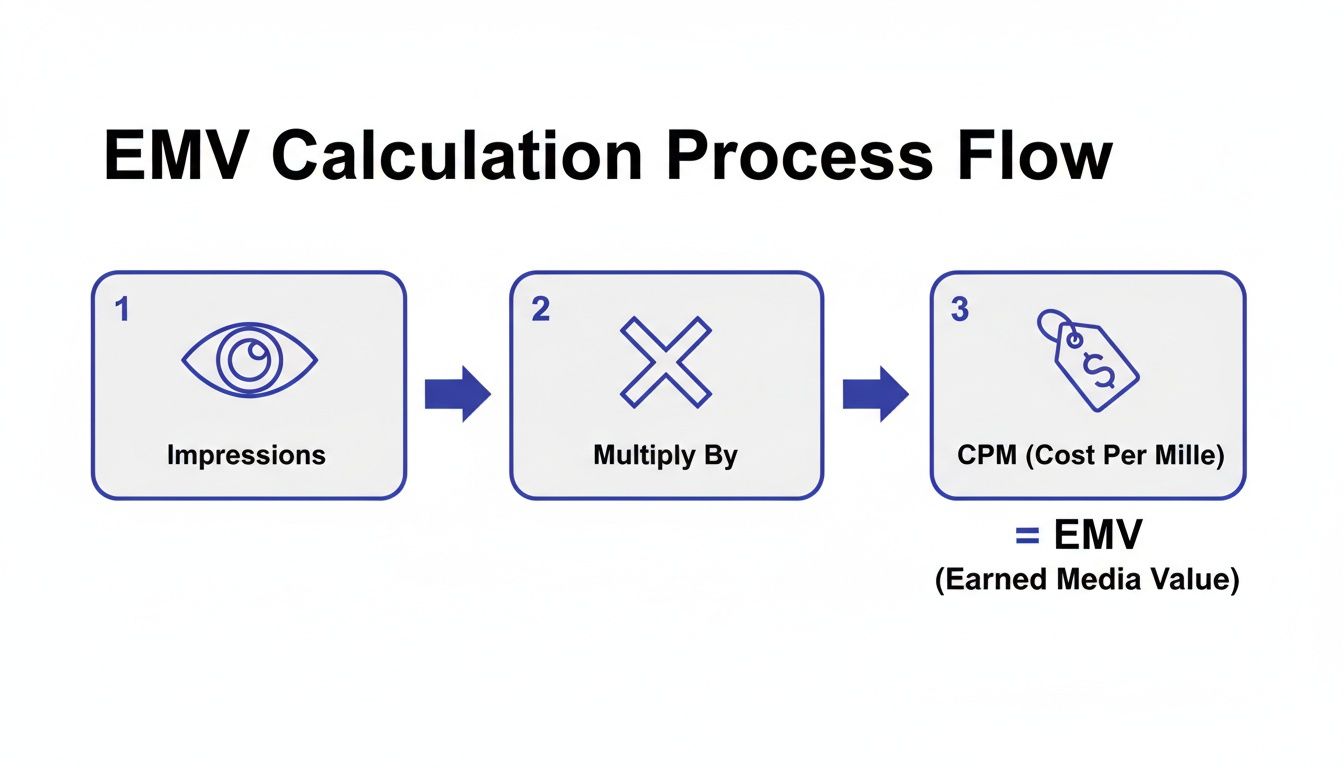
At its core, this process connects the organic reach of a post directly to what it would cost to buy that same reach through advertising. This is the bedrock of modern EMV.
Today, EMV is a go-to metric in marketing analytics, but it’s still evolving. As new platforms rise and fall and user habits shift, the formulas we use to calculate it will keep adapting. Understanding this history makes it clear why today's EMV is far more reliable than its ancestors and gives you the context to use it effectively.
What a Good Earned Media Value Looks Like
So, you’ve calculated your earned media value. That’s a fantastic first step. But it immediately brings up the million-dollar question: Is this number any good?
Let’s get one thing straight—there's no magic number that universally defines a "good" EMV. It's all about context. Think of it like a fitness tracker. Seeing that you walked 10,000 steps is a nice data point, but its real meaning comes from comparing it to your activity yesterday, your goals for the week, and your overall fitness journey.
EMV works the exact same way. Its true power is unlocked through comparison—pitting it against your past performance, your competitors' buzz, and, most importantly, what you're shelling out for paid ads. Instead of chasing an arbitrary dollar figure, the smartest move is to view your EMV as a ratio relative to your paid media spend. This simple shift turns an abstract number into a powerful gauge of your organic marketing efficiency.
The 4:1 Ratio: A Common Benchmark
While industry benchmarks can be all over the place, a widely accepted rule of thumb is to aim for an EMV that dramatically outpaces what you're investing in paid media. This proves your organic efforts aren't just working; they're creating value far beyond what you could ever buy directly.
A common goal for many brands is to hit at least a 4:1 ratio. In plain English, this means for every $1 you put into a paid social or influencer campaign, you should aim to generate $4 in earned media value. Hitting or smashing this ratio is a loud and clear signal that your content is truly connecting with your audience.
When you start digging into benchmarks, it becomes obvious that a strong EMV should dwarf your paid media spend. Success is often pegged at 4x or more—for instance, turning a $1,000 paid campaign into $4,000 in EMV. This standard is becoming more and more common across major markets. For a deeper dive, you can find more on EMV benchmarks and their global adoption on AgencyAnalytics.com.
Why Industry Context Is Everything
It’s absolutely critical to remember that EMV benchmarks aren't a one-size-fits-all deal. A stellar EMV in one industry might be just okay in another. The landscape for what earned media value represents can shift dramatically depending on how audiences behave and what kind of content they expect.
Just look at these different worlds:
- High-Fashion and Beauty: These industries are fueled by visuals and influencer culture. A brand here can see sky-high EMV ratios because a single post from a top-tier creator can rack up millions of impressions and explosive engagement.
- B2B Technology: A B2B software company plays in a much more specialized arena. Here, a huge win might be a detailed product review on a respected trade publication's blog. The impression count will be lower, but the audience is so targeted and influential that even a smaller EMV figure is incredibly valuable.
- Consumer Packaged Goods (CPG): For CPG brands, user-generated content (UGC) is the name of the game. A viral TikTok challenge or a flood of positive Instagram stories from everyday customers can generate massive value, often driven by high volume rather than the impact of a single post.
Your goals have to be calibrated to your specific industry. Don't waste time comparing your B2B tech firm’s EMV to a global cosmetics giant. Instead, focus on tracking your own progress month-over-month and, if you can, benchmark against your direct competitors. This realistic approach helps you set goals you can actually hit and communicate the real impact of your organic marketing wins.
Navigating the Limitations and Criticisms of EMV
While earned media value is a fantastic tool for putting a dollar figure on organic buzz, it’s far from a perfect science. Like any metric, it has some real limitations and blind spots that every marketer needs to understand to use it responsibly.
Being aware of these criticisms doesn’t make EMV useless. Quite the opposite—it gives you the context you need for smarter, more balanced reporting.
The biggest knock against EMV is its lack of standardization. There’s just no single, universally accepted formula. One analytics tool might use a different baseline CPM than another, or it might assign a higher value to a share versus a like.
This means the EMV number you get from a platform like PostSyncer might not match what a competitor’s tool shows you. That isn't a flaw in the platforms; it’s just a reality of how flexible the metric is. The key is to pick one consistent method and stick with it. That way, you can accurately track your own trends over time.
The Problem of Sentiment
Another huge blind spot in basic EMV calculations is sentiment. A simple formula that just looks at impressions and engagement can't tell the difference between glowing praise and a viral backlash.
Imagine a customer posts an angry video review of your product. It goes viral, racking up millions of views and thousands of angry comments. Based on reach and engagement alone, this would generate an incredibly high EMV, even though the content is a PR nightmare for your brand.
This brings us to a critical rule for using earned media value:
- Always pair quantitative data with qualitative analysis. You have to look at the context of the conversation, not just the raw numbers.
- Never rely on EMV as your only measure of success. It should be one key performance indicator (KPI) among many, including sentiment scores, brand mentions, and actual conversion metrics.
A high EMV driven by negative attention isn't a win; it's a crisis masquerading as a vanity metric. True value comes from positive, authentic advocacy that builds brand equity, not erodes it.
Beyond Impressions to True Influence
Critics also correctly point out that a massive impression count doesn't always lead to genuine influence or business results.
A celebrity with millions of followers might generate a huge EMV number, but a micro-influencer with a smaller, hyper-engaged community could actually drive more sales. The real value isn’t just in how many people see the content, but in who sees it and what they do next.
This is why more sophisticated EMV models often bake in adjustment variables for things like audience relevance and content quality.
Ultimately, you should think of earned media value as a directional guide, not a perfect, all-knowing measure of your brand’s health. It gives you a valuable financial benchmark for your organic marketing, but it always needs a human to interpret it alongside other data points. When you understand its limits, you can use EMV not as a final answer, but as a powerful question-starter that leads to deeper insights about your brand’s place in the public conversation.
Integrating EMV Into Your Reporting Strategy

Crunching the numbers to find your earned media value is only half the battle. The real magic happens when you weave that metric into your regular marketing reports and strategic planning, turning a simple number into a powerful tool for growth.
When you present it the right way, EMV stops being a vanity metric. It becomes your best tool for translating the impact of your organic marketing—every PR hit, influencer shoutout, and viral moment—into the one language everyone in business understands: money.
Speaking the C-Suite's Language
Let's be real: stakeholders and executives are laser-focused on the bottom line. While us marketers get pumped about engagement rates and reach, leadership wants to see a direct line to business value. This is where EMV really shines.
Instead of just saying, "our latest campaign got a lot of buzz," you can walk into a meeting and state, "Our campaign generated $50,000 in earned media value, a 5:1 return on our investment." Now that gets attention. It immediately reframes your team's work as a profit driver, not just another expense.
By translating organic marketing success into a dollar figure, you align your team’s efforts directly with the company's financial goals. This approach fosters greater buy-in and helps secure budgets for future initiatives.
Plus, using EMV as a universal metric lets you compare apples to apples across all your channels. You can finally put a press mention, an influencer post, and a viral TikTok on the same playing field to see what’s truly delivering value.
Using EMV to Optimize Your Strategy
Beyond just impressing the board, EMV is an incredible diagnostic tool for fine-tuning your marketing strategy on the fly. By keeping an eye on EMV trends, you can pinpoint exactly which channels, content, and collaborators are giving you the most bang for your buck.
Here’s how you can put EMV to work for you:
- Identify Your Most Valuable Partners: Track the EMV generated by each influencer or media outlet. This data-driven approach helps you double down on relationships that are clearly working and step back from those that aren't.
- Pinpoint Resonant Content: Dig into which types of content consistently rack up the highest EMV. Is it authentic user-generated content? In-depth expert reviews? Quick, shareable videos? Use these insights to guide your next content sprint.
- Allocate Resources Effectively: If your data shows that a specific platform consistently generates a higher EMV for your brand, that’s a massive signal to invest more time, budget, and creative energy there.
This process turns reporting from a backward-glancing chore into a forward-looking roadmap. To really nail this, a solid social media analytics report template can give you the perfect framework for presenting these findings clearly and professionally.
Connecting EMV to Broader Business Goals
At the end of the day, earned media value shouldn't exist in a silo. Its greatest power lies in its ability to connect your organic marketing efforts to bigger business objectives, like brand health and overall financial performance.
When you consistently track and report on EMV, you build a rich historical record of your brand's organic momentum. This allows you to start connecting the dots, correlating spikes in EMV with jumps in website traffic, lead generation, or even sales. Of course, to get the full picture, you also need to measure marketing ROI the right way across all campaigns. By integrating EMV into that broader analysis, you can build an undeniable case for the long-term value of investing in your brand and community.
Got Questions About Earned Media Value? We've Got Answers.
Even after getting the hang of earned media value, a few questions always seem to pop up. It's totally normal. Let's tackle some of the most common ones to clear up any confusion and make sure you're ready to apply this metric in the real world.
Is Earned Media Value the Same as ROI?
Nope, but it's easy to see why they get mixed up. They're related, but they measure two very different things.
Think of EMV as a what-if metric. It estimates what your organic mentions and shares would have cost if you'd paid for them as traditional ads. It’s all about gauging the potential advertising impact you got for free.
Return on Investment (ROI), on the other hand, is the bottom-line, no-nonsense number. It measures the actual profit you made from a marketing investment. A killer EMV can definitely fuel a positive ROI by building the kind of brand buzz that leads to sales, but they aren't the same thing.
Key Takeaway: EMV is about the potential value of your organic exposure. ROI is about the actual cash return on your investment.
Why Do I Get Different EMV Numbers From Different Tools?
This is probably the most common frustration with EMV, and it points directly to its biggest flaw: EMV is not a standardized metric. There's no single, universal formula that every platform agrees on.
Each analytics tool has its own secret sauce—a proprietary algorithm for calculating value. This means they're likely using different inputs, such as:
- CPM Benchmarks: One tool might value 1,000 impressions at $10, while another values them at $15.
- Engagement Weighting: Some platforms might decide a "share" is worth 5x a "like," while others might say it's only 2x.
- Quality Adjustments: They might apply unique multipliers for things like an influencer's authority or the sentiment of a comment.
This is exactly why you need to pick one platform for tracking earned media value and stick with it. Consistency is everything. The goal isn't to compare your Hootsuite number to your Sprout Social number, but to track your own progress over time using one consistent source of truth.
Can I Calculate EMV for Offline Media?
You sure can. In fact, that's where the whole concept started! Long before Instagram stories and TikToks, PR pros needed a way to put a dollar value on a feature in a print magazine or a segment on the evening news.
The original method was often called Advertising Value Equivalency (AVE). It was pretty straightforward: you'd measure the physical size of a newspaper article (in column inches) or the airtime of a TV spot (in seconds), and then calculate what it would have cost to buy an ad of that exact size or length.
While today's EMV conversation is mostly digital, the core idea still works for offline coverage. You just need to find the audience size (a magazine's circulation, a TV show's viewership numbers) and get your hands on its advertising rate card to figure out a comparable value.
Ready to stop guessing and start measuring your social media impact? PostSyncer brings all your analytics together, including the key data you need for EMV, in one clean dashboard. Start your 7-day free trial today and see what data-driven decisions can do for your brand.