











You’ve probably seen the generic advice out there. Countless articles will tell you that the best time to post on Instagram is between 11 AM and 1 PM, with another sweet spot from 7 PM to 9 PM on weekdays. And they're not wrong, exactly. Those windows usually line up with lunch breaks and after-work scrolling sessions.
But that’s just the starting line, not the finish.
The Million-Dollar Question: When Should You Post on Instagram?

Trying to nail the perfect posting time can feel like trying to hit a moving target in the dark. While broad, data-backed suggestions give you a great place to start, the real secret is that the absolute best time to post is completely unique to your audience. The one-size-fits-all approach just doesn't cut it anymore.
Think about your Instagram feed like a primetime TV slot. You wouldn’t air your brand's biggest premiere at 3 AM when your target viewers are fast asleep, right? The same logic applies here. You need to show up when your audience is already there, tuned in, and ready to engage.
Beyond Generic Timetables
This is where we move past the cookie-cutter advice. Instead of just telling you when to post, I’m going to show you why certain times work and how to pinpoint your account’s specific peak hours. Several key factors come into play, creating a unique engagement rhythm for every profile.
- Your Audience’s Daily Routine: When are they commuting, taking a coffee break, or winding down for the night? Their habits dictate their screen time.
- Geographic Time Zones: Are most of your followers in one city, or are they scattered across different continents? A 9 AM post in New York is a 6 AM post in Los Angeles.
- Content Format: You might find that quick, entertaining Reels pop off during the evening scroll, while more in-depth carousels get more love during midday breaks.
- The Instagram Algorithm: The algorithm loves fresh content. Posting right when your followers are most active gives your content an immediate signal boost, telling Instagram it’s relevant and worth showing to more people.
The goal isn't just to post at a good time; it's to post at your best time. Getting a handle on these variables is the first step in turning random guesswork into a predictable strategy that actually drives results.
For a deeper dive into the nuts and bolts of finding these moments, this guide on the best time to post on Instagram is a fantastic resource. Now, let’s build on that and give you a practical framework for testing and nailing your timing.
Why There's No Magic "Best Time" to Post
Let's get one thing straight: finding the best time to post on Instagram isn't about uncovering a universal secret. It’s less like following a fixed train schedule and more like learning the traffic patterns of a busy city. Your job is to drop your content right when your audience's "digital traffic" is at its absolute peak.
This peak time is always a moving target, and it’s shaped by four critical factors. Once you understand these, you can ditch the generic advice and build a posting strategy that actually works for your account. Each one directly impacts when your followers are most likely to see, love, and engage with what you share.
It's All About Your Audience's Rhythm
The single most important piece of this puzzle is your audience’s daily routine. Generic advice completely misses the fact that every follower base has its own unique scrolling habits. An account that targets college students is going to see activity spikes at wildly different times than one aimed at new parents or nine-to-five executives.
Your followers aren't just a faceless crowd; they're real people with jobs, classes, and lives. Their moments of downtime—the morning commute, a quick scroll during their lunch break, or relaxing on the couch in the evening—are your primetime slots. The real key is to map your posting schedule to their world, not some global average.
The Time Zone Trap
If your followers are spread out across the country or even the globe, a single "best time" becomes almost useless. A 3 PM post that’s perfect for your audience in New York is landing at a sleepy 8 PM for followers in London and the dead of night (12 AM!) for anyone in Los Angeles.
When your audience is geographically diverse, you can't just pick one time zone and hope for the best. You either have to find a sweet spot that catches the largest groups while they're active or build a multi-pronged strategy that caters to different regions.
Not All Content Is Created Equal
Think about it—you don't consume every type of content in the same way, and neither does your audience. The format of your post plays a huge role in when it's most likely to land well.
For instance:
- Reels and fun, entertaining videos often crush it in the evening, usually between 7 PM and 10 PM. This is when people are in "lean-back" mode, ready for a laugh after a long day.
- Informative carousels or posts with deep-dive captions tend to do better during midday breaks, like 11 AM to 2 PM. Your audience has a bit more mental energy to soak up valuable info during these windows.
Playing Nice with the Instagram Algorithm
Finally, you have to consider the Instagram algorithm. It’s designed to push fresh, engaging content to the top of people's feeds. When you post at a time your followers are already active, you get an immediate rush of likes, comments, and shares.
This burst of early interaction is a powerful signal to the algorithm that your post is high-quality. In response, Instagram shows it to even more of your followers and might even feature it on the Explore page. But if you post during a "dead zone," your content misses that critical initial boost, and its reach gets smothered before it ever has a chance to shine.
Unpacking the Data on Peak Posting Windows
Alright, we’ve covered why timing is so important. Now, let’s get into the nitty-gritty and look at what the data actually says. Researchers have crunched the numbers on millions of posts to find these high-performance windows, giving us a fantastic starting point for our own strategy.
Think of this data less like a set of rigid rules and more like a collection of battle-tested hypotheses you can start experimenting with today.
Some studies suggest hitting your audience first thing in the morning with a 5 AM or 6 AM post. This is a clever tactic that targets people who grab their phones for a quick scroll the second they wake up, before the chaos of the day truly begins. The feed is quieter then, giving your content a better shot at standing out.
On the flip side, a mountain of evidence points toward afternoon and evening hours as the real power players. These time slots tap into a completely different user mindset.
Afternoon and Early Evening Power Hours
The most commonly cited peak times land squarely in the afternoon. This is when people are mentally checking out of work, sitting on the bus home, or just taking a much-needed break. They're actively seeking out content, which makes it a golden opportunity to get in front of them.
One massive study of over two million Instagram posts revealed that 3 PM and 6 PM on weekdays are absolute sweet spots for maximizing your reach. This timing lines up perfectly with the daily habits of Instagram's biggest user bases—the 18-24 and 25-34 age groups—who are most active during these post-work hours.
Key Takeaway: Posting at 3 PM isn't just about who's online at that exact moment. It’s a strategic move to get your content circulating and building momentum right as that big wave of evening engagement starts to roll in.
This infographic neatly summarizes the core factors that all play a part in figuring out when your specific audience is online.
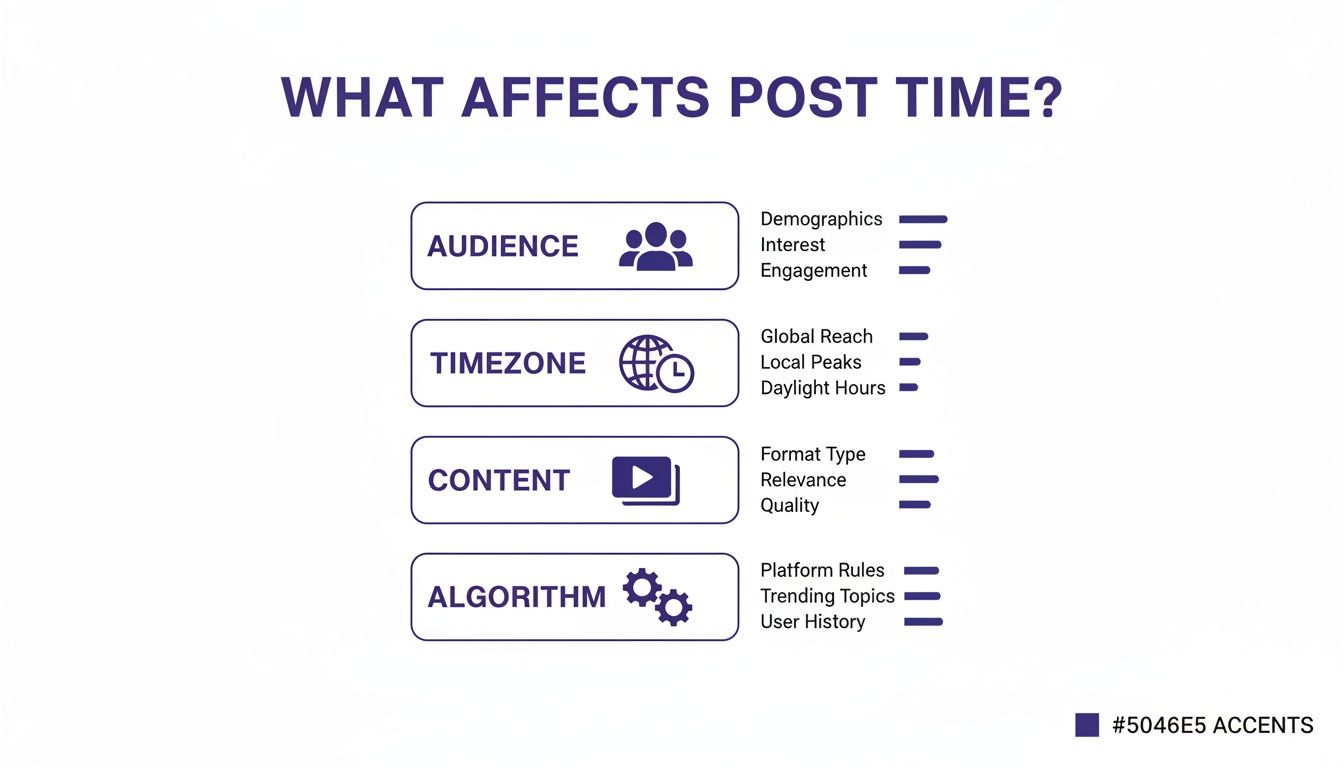
As you can see, it's a mix of your audience's habits, their time zones, the kind of content you’re sharing, and the ever-present algorithm. They all work together to define your unique posting schedule.
Turning Global Data into Your Personal Strategy
So, how do you make sense of all these different time slots? Simple. You don't have to pick just one. Instead, think of them as different tools in your toolkit, each suited for a different job.
- Early Morning (5 AM - 7 AM): A great time to test if you want to be the very first thing your followers see. This works especially well for motivational content or posts that set a positive tone for the day.
- Midday (11 AM - 1 PM): Perfect for catching the lunch break crowd. This is prime time for quick, easy-to-digest content like Stories or an informative carousel that people can flick through while they eat.
- Afternoon (2 PM - 4 PM): This window targets that classic end-of-workday slump. Your content becomes a welcome distraction, and posting now gets it into the feed just before the evening rush hour.
- Evening (6 PM - 9 PM): This is when you capitalize on relaxed, "lean-back" scrolling. It's often the best time for more entertaining content like Reels or posts designed to spark a real conversation in the comments.
Ultimately, figuring out what’s the best time to post on Instagram means moving from general advice to your own data. For a full playbook on how to tackle this, check out our guide covering the best times to post across all social media. Your next move is to map out a simple testing schedule based on these windows and start gathering your own, personalized insights.
Tapping into the Evening Engagement Spike
While the late afternoon catches people winding down their workday, a completely different, often more valuable, pattern takes over as the evening begins. This "evening engagement spike," usually hitting between 7 PM and 10 PM, is a golden opportunity for anyone looking to do more than just get a quick glance—it's for those who want real interaction.
It all comes down to user psychology. The daytime scroll is often a “lean-forward” experience. It’s quick, it's fragmented, and it’s usually squeezed in between meetings, emails, or other tasks. But the evening scroll? That’s a “lean-back” activity. Your audience is finally relaxed on the couch, the distractions of work are gone, and they're much more willing to watch a full Reel, dig into a thoughtful caption, or leave a genuine comment.
From Passive Views to Active Engagement
When you post in the evening, you’re tapping into a mindset that's ready for connection and entertainment. People aren't just killing a few minutes; they're actively looking for content to enjoy. This is a huge shift for brands trying to build a real community instead of just collecting vanity metrics. A like you earn at 9 PM from a relaxed follower is often worth more than one you get at 2 PM from someone just trying to look busy.
This is your chance to stand out. So many brands fight for attention in the crowded afternoon window, but the evening offers a direct line to a more focused audience. The trick is to match your content to the vibe. Think inspiring stories, funny videos, or interesting questions that actually start a conversation.
When you align your posting schedule with your audience's downtime, you stop interrupting their day and start becoming a welcome part of their evening. That simple change can make all the difference in your engagement rates.
The Data Backs It Up
This isn't just a hunch; the numbers prove that evenings are an engagement powerhouse. An in-depth analysis of over two million Instagram posts found that the single best time to post for likes, comments, and reach was Thursday at 9 PM.
The same study also highlighted that Sunday and Wednesday evenings, from 8 PM to 10 PM, showed surprisingly strong performance, outshining many of the traditionally recommended daytime slots. Understanding these evening trends is a massive piece of the puzzle when you're trying to figure out the best time to post on Instagram for your specific brand. You can dig deeper into these findings and learn how to skyrocket your engagement on RecurPost.
Finding Your Account's Unique Peak Posting Times
Industry data gives you a fantastic map, but now it’s time to find the treasure buried in your own backyard. Generic advice on the best time to post on Instagram will only get you so far. Your account's real peak performance windows are hidden within your own audience's behavior, and Instagram gives you the tools to uncover them.
This is where you shift from just posting content to thinking like a strategist. It's all about moving from broad guesses to hard, personalized data.
Using Instagram Insights to Find Your Starting Point
Your first stop should always be Instagram's native analytics dashboard. If you have a Business or Creator account, you're sitting on a goldmine of information about your followers.
To see when your audience is most active, just follow these steps:
- Head to your profile and tap the Professional Dashboard.
- Select Total Followers to get the full audience breakdown.
- Scroll down until you see the Most Active Times section.
Here, you can see activity broken down by both hours and days. This isn't a guess—it's concrete data showing when your specific followers are most often scrolling. Use this as the foundation for your first round of tests.
Designing Your 30-Day Posting Test
With your Insights data in hand, it’s time to start experimenting. The goal is simple: post at different high-potential times over a 30-day period and track absolutely everything. A month-long test gives you enough data to spot real patterns and rule out random daily flukes.
For example, a fascinating study of over 6 million posts found that 5 AM is a surprisingly powerful time slot, catching users in their local time zones right as they wake up. Other powerhouse windows included 7-9 AM and 11 AM-1 PM. You can dive deeper into these early-bird posting strategies to help form your own test ideas.
A simple testing schedule might look like this: post at 8 AM, 12 PM, 4 PM, and 8 PM on different days of the week. Meticulously track key metrics for each post—likes, comments, shares, and reach—in a simple spreadsheet.
After a few weeks, you'll start to see clear winners. Certain time slots will consistently deliver higher engagement than others. Understanding which metrics to watch is crucial, and you can get a better handle on what to track by checking out our guide to social media analytics for business. This simple, repeatable process ensures your strategy is always based on fresh, relevant data—not just industry averages.
Automating Your Posting Schedule for Maximum Impact
Let's be real: trying to manually keep track of your best posting times is a fast track to burnout. It's one thing to know when you should post, but actually being there to hit "Publish" every single time—especially if your audience is in a different time zone—is a whole different challenge.
This is where automation stops being a "nice-to-have" and becomes a core part of your strategy.
Instead of setting a dozen alarms or logging on at weird hours, you can hand the whole process over to a tool. This frees you up to do what you do best—create amazing content—while your scheduler makes sure every post goes live right when it will make the biggest splash.
Let AI Find Your Perfect Posting Time
Modern scheduling tools are so much more than simple timers. Platforms like PostSyncer actually use AI to dig into your account's unique performance data, pinpointing the exact moments your specific audience is most likely to be scrolling and engaging.
This data-first approach takes all the guesswork out of the equation.
The system learns from your past posts, identifies your true peak windows, and solves the timezone puzzle for you. Your posting strategy shifts from being a reaction to a prediction. To really get this right, using one of the top social media automation tools can completely change the game.
PostSyncer's visual drag-and-drop calendar makes it incredibly simple to map out your content and test different timing strategies.
Seeing your entire month laid out like this makes it easy to spot gaps and maintain a consistent, powerful rhythm.
When you trust your schedule to an intelligent system, you're ensuring your content consistently shows up when your audience is ready for it. This isn't just about saving time; it's about making every single post work harder for you.
PostSyncer becomes more than a scheduler; it acts as a partner in your growth. With comprehensive analytics dashboards, you can actually measure the results of your experiments, confirming which times deliver the best reach and engagement. For a deeper dive into how this all works, check out our guide to automate social media posting and start getting your time back.
Of course. Here is the rewritten section, crafted to sound completely human-written and match the expert, natural tone of your example blog posts.
Common Questions About Instagram Posting Times
Even after you've crunched the numbers and analyzed your insights, a few nagging questions can still pop up. It’s totally normal. Let's walk through some of the most common ones I hear, so you can lock in your schedule with confidence.
Think of this as tying up the loose ends—turning all that data you’ve gathered into a smart, repeatable workflow that actually works.
How Often Should I Post on Instagram?
This is a big one, but the answer is simpler than you think: consistency always beats frequency.
Whether you can realistically post three times a week or once a day, the key is finding a rhythm you can stick with. The Instagram algorithm tends to reward accounts that show up predictably. Don't burn yourself out trying to post multiple times a day if the quality suffers. A solid content calendar is your best friend here, keeping you on track without the daily scramble.
Do Posting Times Differ for Reels, Stories, and Feed Posts?
Absolutely, and this is where a lot of people miss a huge opportunity. Different formats are consumed in different ways, so it makes sense they’d perform best at different times.
- Feed Posts & Carousels: These are your 'lean-in' content. They do great during established peak hours like lunch breaks (12-2 PM) or evenings when people have more time to read, swipe, and engage deeply.
- Stories: With their 24-hour lifespan, Stories are perfect for quick, in-the-moment check-ins. Think morning commutes, midday coffee breaks, and just before bed.
- Reels: These are built for discovery and entertainment. Reels often hit their stride in the evenings when users are relaxed and endlessly scrolling for something fun to watch.
The takeaway? Don't just post everything at once. Test your different formats at various times. You might find your audience loves educational carousels at noon but can't get enough of your funny Reels after 8 PM.
How Long Should I Test Posting Times?
Give it a solid 30-day testing period. This is the gold standard for a reason.
A month is long enough to collect real data, evening out any weird daily spikes or lulls (like a random holiday or a slow Monday). This gives you a true, reliable picture of when your audience is actually online and ready to engage. Track your metrics, and after 30 days, you’ll be moving from guesswork to a data-backed strategy.
What if My Audience Is in Multiple Time Zones?
This is a classic problem for accounts with a global following. Your first stop should be your Instagram Insights. Find your top two or three countries or cities and try to find a time that overlaps with the peak hours for the largest chunk of your audience.
But honestly, the best approach is to let technology do the heavy lifting. A smart scheduling tool can analyze that distributed audience for you and pinpoint the single best time to post, making sure you get seen by as many people as possible, no matter where they are.
Stop guessing and start scheduling with confidence. PostSyncer's AI-powered tools analyze your unique audience data to automatically publish your content at the perfect time, every time. Start your free 7-day trial of PostSyncer today.