









Let's get right to it. The simple truth is the best times to post on Facebook are early mornings on weekdays, especially around 5 AM to 7 AM, and then again in the evenings after 5 PM. These windows are pure gold because they catch people during their first phone check of the day and when they're winding down after work, maximizing your post's initial visibility.
Why Your Facebook Posting Time Still Matters
With Facebook's smart algorithm, it's easy to wonder if posting time even matters anymore. The short answer? Yes, absolutely. While the algorithm is designed to push great content to the top, when you post is the critical first domino that gives your content the momentum it needs.
Think of it like opening a pop-up shop in a busy city square. You wouldn't set up your table at 3 AM when the streets are empty. You'd wait for that lunchtime rush when the square is packed with people. Timing your Facebook posts works the same way—you're aligning with your audience's daily habits to create a powerful snowball effect.
The Algorithm and That First Hour
Nailing your timing triggers an immediate flurry of likes, comments, and shares. This initial surge is everything. It's a loud and clear signal to Facebook's algorithm that your content is a winner and deserves to be shown to a much wider audience. Getting that initial velocity is how you break through all the noise on the platform.
The first hour after you hit "Publish" is the most critical window. Strong early engagement tells Facebook that your content is resonating, which earns it more reach and a longer lifespan in the News Feed.
This dynamic is why finding the best times to post on Facebook isn't just some minor tweak—it's a foundational piece of your entire strategy. By lining up your schedule with peak user activity, you give every single post its best shot at success. You're not trying to game the system; you're just working smarter within it.
To really get this right, you need to see how posting times fit into broader effective Facebook marketing strategies. The goal is to create a feedback loop where high initial interaction drives more algorithmic visibility, which in turn drives more interaction. To understand which interactions carry the most weight, it helps to dig into the key social media engagement metrics that platforms like Facebook use to judge content quality.
The Universal Best Times to Post on Facebook
Let's be real: finding the perfect time to post for your specific brand takes a little detective work. But the good news is you don't have to start from scratch. Massive amounts of data show us clear, predictable patterns in how people use Facebook every day.
Think of these universal best times as your strategic head start. They're the "golden hours" that align with common daily routines—the morning scroll, the lunchtime catch-up, and the evening wind-down. Posting during these windows puts your content right in front of the largest possible audience when they're already there and ready to engage.
Capitalizing on Weekday Mornings
The data consistently flags early weekday mornings as a prime-time opportunity. Why? It's a simple formula: low competition + high attention. Before the workday tsunami hits, people are casually scrolling their feeds, catching up on what they missed.
This is where timing makes all the difference. A post that goes live during a peak window can dramatically outperform one dropped into a digital ghost town.
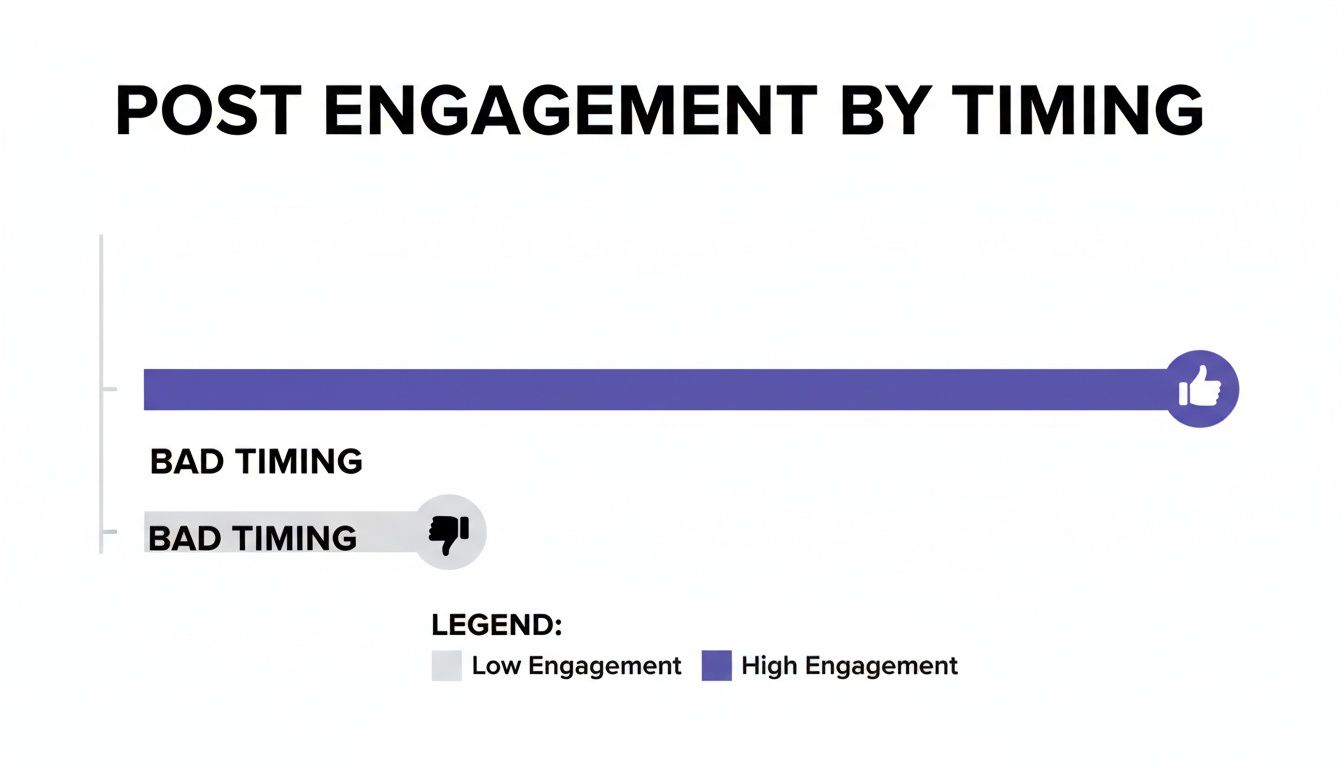
As you can see, good timing isn't just a minor tweak; it’s a core driver of whether your content gets seen or gets lost.
Multiple studies back this up, showing that 8 AM to 10 AM on Tuesdays and Thursdays often produces the best results. We're talking 18-25% more interactions compared to posts at off-peak times. Some analyses even point to the 5 AM to 9 AM block on Tuesdays as a sweet spot, where low competition gives your content a nice algorithmic bump as users start their day.
Your Go-To General Posting Schedule
If you're looking for a simple, data-backed schedule to get started with right now, these aggregated times offer the highest probability of success. They're a fantastic baseline to use while you start digging into your own audience's unique data.
General Best Times to Post on Facebook for High Engagement
This quick-reference guide shows the highest engagement windows for Facebook, based on aggregated global data. Use these as a starting point, adjusting for your local time zone.
| Day of the Week | High-Engagement Time Windows | Common User Behavior |
|---|---|---|
| Monday | 5 AM & 5 PM | Early morning check-ins and post-work scrolling. |
| Tuesday | 5 AM & 6 PM | Pre-work browsing and evening relaxation. |
| Wednesday | 5 AM & 7 AM | Mid-week morning routine before the day gets busy. |
| Thursday | 6 AM & 7 AM | Early birds looking for updates. |
| Friday | 6 AM & 9 AM | Pre-weekend excitement and planning. |
| Saturday & Sunday | 6 AM - 9 AM | Leisurely morning scrolling on days off. |
These times are a powerful launchpad, not a final destination. The goal is to leverage this general knowledge to start testing and eventually build a schedule that’s perfectly synced with your audience’s habits.
While these widely recognized windows give you a strong advantage, the next step is diving deeper to find your brand's specific peak hours. For a complete overview, check out our guide on the overall best times to post across all the major platforms.
Alright, let's move beyond the broad strokes and get into the real tactical advantage: mastering the peak engagement windows on Facebook. While general patterns are a great starting point, the real magic happens when you zero in on specific, high-leverage times.
Two of the most reliable power-plays are the mid-week surge—especially on Wednesdays—and that primetime slot on weekday evenings. To really nail your content strategy, you need to understand the why behind these peaks, getting inside your audience's head.
Wednesday has earned its reputation as a powerhouse day for a reason. It's "hump day," that perfect point in the week where people have settled into their work rhythm but are actively looking for a little mental escape. The Monday rush is over, the weekend is on the horizon, and users are just more open to seeing what you have to share.
The Psychology of Primetime Facebook
This mid-week sweet spot isn't just a hunch; the data backs it up. On Wednesdays, we consistently see engagement spike during two key windows: the morning commute from 5 AM to 10 AM and the evening wind-down from 7 PM to 9 PM.
These surges are tied directly to daily routines. People are checking their phones on the way to work or as they settle onto the couch after dinner. It’s no surprise that interaction rates during these times can be 20-30% higher than on weekends.
Then, as the workday officially ends, user behavior on Facebook makes a big shift. The platform goes from being a quick distraction to a primary source of evening entertainment. This is Facebook's primetime—users are relaxed, scrolling for longer, and far more receptive to deeper content.
Weekday evenings are a golden opportunity for B2C brands and community-focused pages. Users are in a personal, not professional, mindset, making them more likely to interact with polls, watch long-form videos, and participate in discussions.
This relaxed state is exactly what you want when you're sharing content that requires a bit more attention. Think about deploying your best storytelling videos, detailed customer showcases, or even interactive Q&A sessions during this window.
By matching your content's format to your evening audience's mood, you can drive incredible results. To learn more about crafting posts that get people talking, check out our guide on how to improve social media engagement. Nailing these peak times is a massive step toward a smarter, more effective Facebook strategy.
How to Find Your Brand’s Perfect Posting Time
While the industry-wide data gives you a fantastic head start, the real magic happens when you zoom in on your specific audience. Think of it as the difference between a suit off the rack and one that's been custom-tailored. The custom fit just works better, and the same goes for your posting strategy.
This is where we move past the general advice and start digging into your own data. The best source of truth isn't some big, anonymous study—it's right there inside your Facebook Page. Forget the guesswork; let’s look at the hard numbers.
Use Facebook Insights to Pinpoint Peak Activity
Your treasure map is waiting for you in Meta Business Suite. It’s a powerful analytics hub, but for our purposes, we're zeroing in on one thing: when your audience is actually online.
By heading over to the Insights section, you can get a crystal-clear picture of when your followers are scrolling through their feeds, day by day.
Here's the quick and easy way to find it:
- From your Facebook Page, navigate to Meta Business Suite.
- Click on Insights in the menu on the left.
- Choose Audience and make sure you've selected your Facebook Page.
- You'll find a graph labeled Most Active Times. This is what you're looking for.
This graph is your starting point. The darker the color, the more of your followers are online at that specific time. Those dark blocks are your first set of potential "golden hours"—the times you should test first.
Just a heads-up: This graph shows when people are online, which isn't always the same as when they're ready to engage with your brand. Think of this as your hypothesis, not the final answer. Now, we need to test it.
Test and Validate Your Findings
Once you've spotted a few peak activity windows, it's time to put them to the test. Don't just take the data at face value and call it a day. You need to run a few simple experiments to see what really resonates.
A simple A/B test works wonders here. Let's say your Insights show a lot of activity at 8 AM and again at 7 PM on Wednesdays. The next step is to run a controlled test. Post similar content at each of those times on different Wednesdays, then sit back and watch the numbers. After 24 hours, compare the likes, comments, shares, and reach to see which time slot came out on top.
This hands-on process is what separates the pros from the amateurs. It turns you from someone who just publishes content into a data-driven strategist who knows how to get the most out of every single post.
A/B Testing Framework for Your Facebook Posts
Here's a simple framework to help you systematically test and lock in the best posting times for your unique audience.
| Step | Action to Take | Recommended Tool | Key Metric to Measure |
|---|---|---|---|
| 1. Hypothesize | Identify two peak times from Facebook Insights (e.g., 8 AM vs. 7 PM). | Meta Business Suite | N/A |
| 2. Test | Post similar content at each time slot on different days. | PostSyncer Scheduler | Initial Engagement Rate (first 3 hours) |
| 3. Analyze | After 24 hours, compare reach, comments, and shares for both posts. | PostSyncer Analytics | Overall Reach & Total Engagement |
| 4. Implement | Double down on the time slot that consistently performs better. | Your Content Calendar | Improved Post Performance |
By following this loop of hypothesizing, testing, and analyzing, you'll soon have a schedule that’s perfectly dialed in for your followers.
Once you’ve mastered the nuances of Facebook timing, the next logical step is to see how this fits into your larger social media game plan. If you’re looking to go deeper, check out this comprehensive B2B Social Media Marketing Playbook for more advanced strategies.
Automate Your Schedule for Peak Performance
Let's be real: manually tracking your analytics and then trying to post at those hyper-specific "perfect" times is a massive headache. It's a resource drain that pulls you away from what really matters. This is where you graduate from analyzing data to actually acting on it by bringing in automation. A smart scheduling tool isn't just a utility; it's a strategic partner that takes all the manual labor and guesswork out of finding the best times to post on Facebook.
Platforms like PostSyncer use AI to get a real-time read on your audience's unique activity patterns. Instead of you poring over static, week-old reports, this kind of tech adapts on the fly to how your followers are actually behaving right now. It transforms those hard-won, data-driven insights into an automated content calendar that’s always optimized for performance.
Let AI Do the Heavy Lifting
Think of AI scheduling as your always-on social media manager—one that never needs a coffee break. It spots those golden engagement windows you might have otherwise missed and keeps your content queue loaded up, ready to go live at just the right moment.
This frees up your team to do what they do best: create killer content, not stare at a clock waiting for 3:15 PM to roll around.
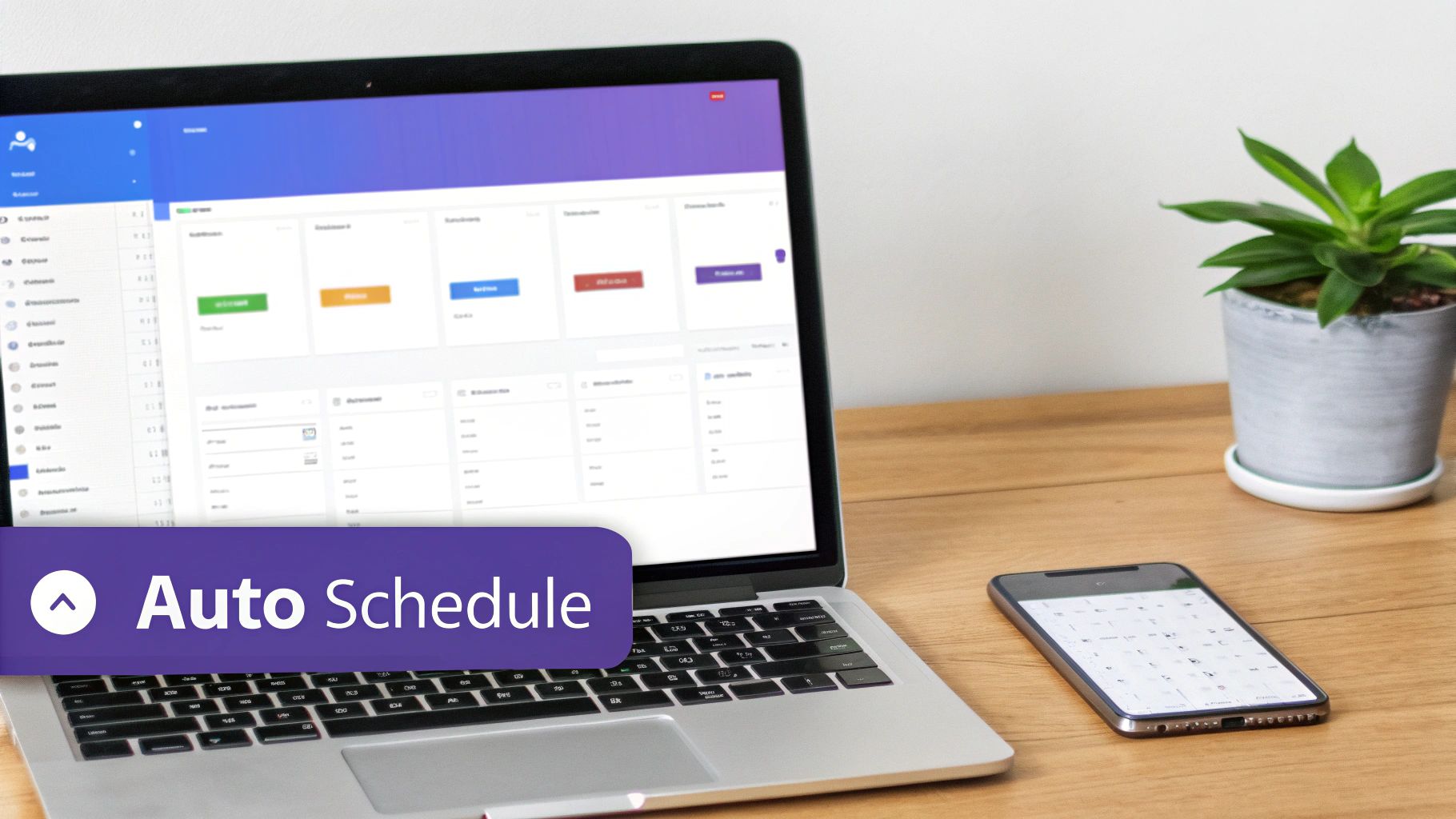
This is what it looks like in practice. The tool highlights the high-engagement periods for you, building an intelligent, automated schedule that you can review and approve with a single click. No more spreadsheets, no more alarms.
This automated approach is especially clutch for capturing those crucial evening audiences. We know that user activity often surges between 5 PM and 10 PM on weekdays as people unwind from their day, which can lead to doubled interaction rates. For businesses, scheduling things like carousels and short-form videos during this primetime slot can deliver performance boosts of up to 30%. You can explore more insights like this in our deep dive into Facebook posting times.
Key Features That Drive Results
Beyond just getting the timing right, the best scheduling platforms give you the tools you need to prove your strategy is actually working. You should be looking for features that give you a real competitive edge and save you hours of work every week.
- Intelligent Queues: Automatically backfill any empty slots in your calendar with your top-performing evergreen content. It's a set-it-and-forget-it way to keep your feed active.
- Performance Analytics: Get reports that are actually easy to understand, showing you exactly which posts and times are driving the most reach and engagement.
- Campaign Labeling: Group your content by campaign so you can easily track the results of specific marketing pushes or product launches.
When you automate your posting schedule, you're doing more than just saving time. You're putting a data-backed system in place that consistently gives your content the best possible chance to connect with your audience, driving real, measurable growth.
This is exactly how modern marketing teams scale their efforts without burning out. By pairing your unique audience insights with powerful automation, you can consistently hit your goals and get better results, minus all the manual grunt work.
Have More Questions? We’ve Got Answers.
As you start to dial in your Facebook strategy, a few common questions always seem to pop up. Let's tackle them head-on so you can post with confidence.
What Is the Worst Time to Post on Facebook?
If there's a "dead zone" on Facebook, it's definitely late at night. Generally, any time after 10 PM and into the wee hours of the morning is a bad bet.
User activity just plummets during this window. Your post ends up in an empty room, missing out on that crucial first wave of likes, comments, and shares that tells the algorithm it's worth showing to more people. Weekends can also be surprisingly quiet compared to the hustle and bustle of the workweek.
Should I Post in My Time Zone or My Audience’s?
This one's easy: Always post for your audience's time zone.
Think about it—your goal is to show up when they're scrolling. If your followers are mostly on the West Coast, your 9 AM post from New York is hitting their feeds at 6 AM. Not exactly prime time. Dive into your Facebook Insights, pinpoint where the majority of your audience lives, and build your schedule around their day, not yours.
The whole point is to meet your audience where they are, when they’re most likely to be there. A perfect post at the wrong time is just a missed opportunity.
Does the Type of Content Change the Best Posting Time?
Absolutely. While the general peak times are a great starting point, the type of content you're sharing definitely matters.
A quick, eye-catching photo or a simple question? That’s perfect for the morning commute scroll when people have just a few minutes. But if you're posting a longer video or a link to a deep-dive blog post, you might get way more traction in the evening. That's when people have settled in and have more time to really engage with something that requires more focus.
Stop playing the guessing game with your content calendar. PostSyncer uses smart, AI-driven analysis of your own audience data to automatically schedule and publish your content right when it will get the most attention. See how it works with a free 7-day trial of PostSyncer today.