











You're probably looking at a dashboard that says the campaign worked.
Reach is up. Impressions are high. Click-through rate looks acceptable. Cost efficiency looks fine. But branded search hasn't moved much, direct traffic feels flat, and the sales team still asks the same question: if so many people saw the campaign, why doesn't it feel like more people know us?
That gap is where many teams get stuck. They measure exposure, then talk as if they measured memory.
Brand awareness measurement matters because awareness isn't “how many times an ad was served.” It's whether a defined audience can remember or recognize your brand later, and whether that changes over time. The useful version of measurement brings together surveys, search behavior, social signals, and lift testing so you can tell the difference between noise and actual brand learning.
When Reach Numbers Stop Telling You Anything Useful
A familiar scene plays out in a lot of marketing teams. A growth marketer opens the weekly report and sees a huge media delivery number. The campaign reached a lot of people. Frequency looks healthy. The creative team likes the engagement. Paid media says distribution wasn't the problem.
Then someone checks the downstream signals.
Branded search is basically unchanged. More people aren't typing the company name into Google. The homepage isn't seeing a meaningful rise in direct visits. Sales hears the brand less often on calls than marketing expected. Suddenly those big top-line media numbers stop answering the question anyone cares about.
That's the moment when reach stops being enough.
Exposure is not the same as remembrance
Reach tells you how many people could have seen a message. Impressions tell you how many times content was delivered. Clicks tell you who took an immediate action. Those are useful operational metrics, but none of them directly answers a more important question: what did buyers remember three days later?
If you've ever had to explain the difference between views and delivered impressions to a stakeholder, this breakdown of views vs impressions helps frame the problem. Visibility metrics describe distribution. They don't tell you whether the brand entered memory.
The hard part of awareness work isn't buying attention. It's proving that attention turned into recognition or recall.
Why this keeps happening
Teams often inherit reporting setups built for performance media. Those setups reward immediate actions because clicks and conversions are easier to count than memory. Brand campaigns then get judged by a system that wasn't designed for them.
That doesn't mean awareness can't be measured. It can. But it has to be measured with the right system, not with a single vanity metric.
What Brand Awareness Measurement Actually Means
Brand awareness measurement is the process of quantifying how many people in a defined audience recognize or recall a brand. The key phrase there is “how many people.” Awareness is usually expressed as a percentage of respondents, not as a raw count of impressions.
That percentage-based definition matters because it gives you a denominator. Without one, teams say things like “awareness is improving” when what they really mean is “we ran more media.”
The two direct measures
Survey-based marketing research traditionally treats unaided recall and aided recognition as the most direct ways to measure how well a brand is known, as summarized in this overview of brand awareness statistics and measurement basics. In practice:
- Unaided recall asks people to name brands from memory.
- Aided recognition asks people to identify a brand from a list.
Those measures are often paired with web analytics signals such as branded search volume, direct traffic, and social listening. That pairing matters because awareness isn't captured by one universal number. It's a set of memory-related signals anchored by direct survey evidence.
Awareness is not the same as preference
Marketers often blur awareness with related ideas:
- Brand equity is broader. It includes the value attached to the brand.
- Perception asks what people think about the brand.
- Preference asks which brand people would choose.
Awareness comes earlier. A buyer has to know you exist before they can prefer you.
Why memory is the real unit
If someone saw your ad but can't retrieve your brand later, exposure happened without durable awareness. That's why the strongest working definition of brand awareness measurement focuses on remembered exposure.
Here's a definition you can paste into a brief:
Brand awareness measurement is the tracking of what percentage of a defined audience can recall or recognize a brand, using survey data and supporting behavioral signals to compare change over time.
The Core Metrics That Define Brand Awareness
A dashboard can show a campaign reached millions of people and still leave you unable to answer the basic question: do more buyers know your brand now than they did last quarter?
That is why brand awareness measurement works better as a system than as a single KPI. Each metric covers a different part of the chain. Distribution metrics show whether people had a chance to see the brand. Memory metrics show whether the brand stuck. Behavioral metrics show whether that memory was strong enough to trigger action. Lift metrics test whether the campaign caused the change instead of arriving alongside it.
What each metric tells you
Reach and impressions measure delivery. They are useful for checking scale, frequency direction, and whether a campaign likely had enough exposure to matter. They cannot confirm awareness on their own, for the same reason a flyer in a mailbox does not confirm anyone read it.
Unaided recall measures memory under pressure. If a person can name your brand without prompts, your brand has earned a place in that buyer's mental shortlist. For quarter-over-quarter tracking, this is often the clearest primary awareness KPI.
Aided recognition measures familiarity. It asks whether people recognize your brand name, logo, packaging, or product once they see it. This metric is often more sensitive than recall, which makes it helpful for newer brands or for campaigns built around visual identity.
Brand lift measures change caused by exposure. The logic is simple. Compare an exposed group with a control group, then look for a gap in recall, recognition, or consideration. If you need help connecting media delivery to outcomes, ad effectiveness research from Adwave offers useful examples of how awareness studies are framed.
Share of voice adds market context. If your mention volume rises while competitors stay flat, awareness may be improving even before your next survey wave confirms it. Branded search adds behavioral evidence. People usually search a brand by name only after some level of memory has formed.
Core Brand Awareness Metrics Compared
| Metric | What It Captures | Typical Source | Best Use |
|---|---|---|---|
| Reach | Potential audience exposure | Ad platforms | Check whether distribution was broad enough to support awareness growth |
| Impressions | Total ad deliveries | Ad platforms | Monitor scale and frequency directionally |
| Unaided recall | Brand remembered from memory | Brand survey | Track top-level awareness quarter over quarter |
| Aided recognition | Brand identified from a list or visual | Brand survey | Measure familiarity with name, logo, packaging, or product |
| Brand lift | Change caused by campaign exposure | Controlled survey design | Test whether a campaign produced awareness gains |
| Share of voice | Relative visibility in category conversation | Social listening and media monitoring | Compare your visibility with competitors |
| Branded search | Active interest tied to brand memory | Search Console, trends tools, web analytics | Spot whether awareness is turning into brand-seeking behavior |
Where teams misread the numbers
The common reporting mistake is stacking delivery metrics at the top of the slide and treating them as proof of brand growth. Delivery is input. Awareness is an outcome.
A second mistake is over-weighting branded search. It is a helpful signal, but it only captures the portion of the audience motivated enough to take action. Plenty of aware buyers never search.
A better setup is to track one metric from each layer of the system:
- Memory metric: unaided recall or aided recognition
- Behavior metric: branded search trend
- Context metric: share of voice
- Causal metric: brand lift after major campaigns
If your team owns social reporting, these social media KPI examples for separating visibility from brand outcomes can help keep engagement and awareness from getting blended into one bucket.
Use that mix the same way each quarter. Surveys tell you whether people know you. Search shows whether memory turns into action. Social shows whether your brand is gaining presence in the category conversation. Lift tests show whether your campaign deserves credit. Taken together, those signals give you a working awareness system instead of a vanity chart.
Surveys, Social Listening, Search, and Lift Tests Compared
The best brand awareness measurement system doesn't ask one tool to do everything. Surveys, social listening, search analytics, and lift tests each capture a different kind of evidence.
Four methods, four kinds of signal
Surveys are the closest thing you have to a direct read on awareness. They ask people what they remember or recognize. That makes them ideal for market-level tracking.
Social listening captures conversation. It tells you whether people are talking about the brand, how often they mention it, and whether your share of category discussion is changing. That's not the same as awareness, but it often provides an early directional read.
Search and web analytics show what people do after awareness forms. Branded queries and direct visits suggest people remembered your brand name well enough to come looking.
Lift tests answer the causality question. They tell you whether the campaign changed awareness relative to a comparable control group.
If you're fielding simple survey waves internally, a practical guide to alternatives to Google Forms can be helpful when you need better routing, cleaner respondent experience, or more controlled data collection than a basic form tool offers.
Brand Awareness Methods Compared
| Method | What It Captures | Data Source | Latency | Best Used For |
|---|---|---|---|---|
| Surveys | Recall and recognition | Research panel or customer research tool | Moderate | Direct awareness tracking |
| Social listening | Mentions and conversation share | Social monitoring tools | Fast | Directional competitive visibility |
| Search and web analytics | Branded intent and direct visitation | Search Console, analytics tools | Fast | Behavioral confirmation |
| Lift tests | Incremental impact of campaign exposure | Exposed versus control survey design | Post-campaign | Causal proof |
Why these methods work better together
Say a campaign triggers a spike in TikTok mentions. On its own, that might just mean the creative was easy to react to. If branded search rises too, people likely remembered the name. If a survey wave also shows stronger recall, the evidence starts to reinforce itself.
That's why single-method tracking often misleads teams. A social spike without search or survey movement might be noise. Search growth without survey movement might reflect short-term curiosity rather than durable awareness.
For teams designing questionnaires around campaigns, these survey questions about social media can help shape cleaner prompts and avoid vague audience feedback.
A workable rule is simple:
- Use surveys to anchor the quarter.
- Use social listening to catch early movement.
- Use search and web analytics to confirm behavioral response.
- Use lift tests after major flights when leadership wants proof.
Running a Brand Lift Study the Right Way
Brand lift is one of the few awareness methods that can tell you whether a campaign caused change instead of merely appearing alongside it.
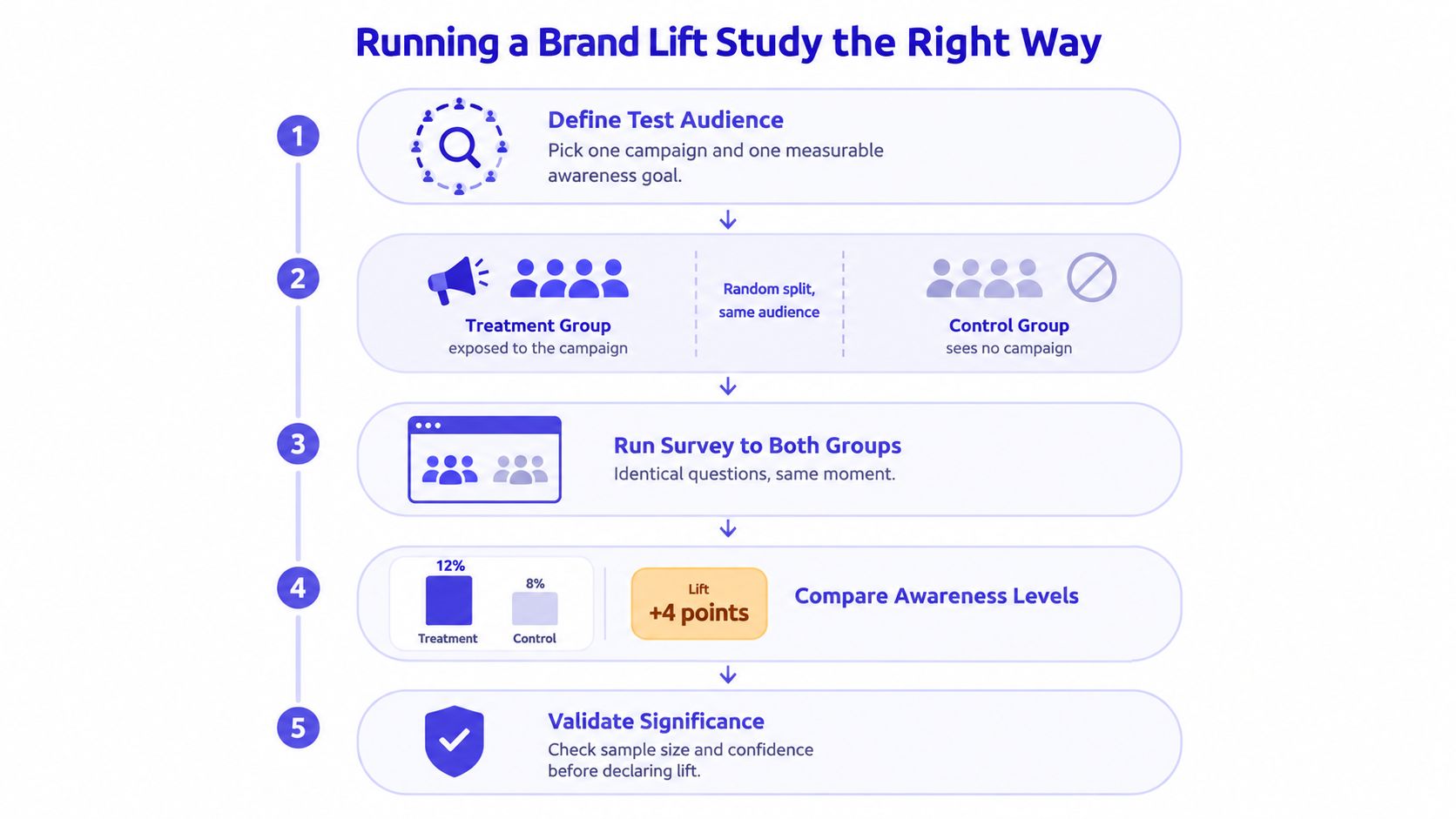
The rigorous setup is a randomized controlled design. You split the target audience into exposed and control groups, ask both groups the same short survey, and calculate absolute lift as the percentage-point difference in awareness, recall, or familiarity. This explanation of a brand lift study design also notes that surveys are often kept to one to three questions, and that some platforms recommend a minimum of 200 total responses across groups to improve the odds of significance.
The five steps that matter
Define one audience and one awareness goal
Don't test everything at once. Pick one campaign, one target audience, and one outcome such as aided recognition or ad recall.Randomly split treatment and control
One group gets campaign exposure. The other doesn't. Randomization matters because it reduces the chance that outside factors explain the difference.Ask identical questions to both groups
Keep the survey short. The more clutter you add, the noisier the data gets.Compare the response rates
If the exposed group reports higher awareness than the control group, the difference is your absolute lift.Check whether the result is stable enough to trust
Don't rush to present a win before the sample is strong enough and the result has settled.
Here's a short explainer if your team needs a visual walk-through:
Common errors in lift studies
The first mistake is reading too much into raw exposed-group awareness without comparing it to a control. The second is writing long surveys that tire respondents and weaken signal quality.
Keep the instrument short, keep the groups comparable, and judge the result by the gap between them, not by exposed-group performance alone.
The point of lift testing isn't to produce a flattering number. It's to isolate incrementality.
Why Attribution Makes Awareness So Hard to Measure
Awareness rarely shows up cleanly in attribution systems because attribution and awareness answer different questions.
Attribution asks, “Which touchpoint gets credit for the conversion?” Awareness asks, “Did our activity make more people remember the brand?” Those aren't the same event, and they often happen on different timelines.
Where attribution breaks down
A person may see a video today, hear a podcast mention next week, then search the brand name later and convert through a direct visit. Last-click attribution gives credit to the final touch. The awareness activity that built recognition disappears from the report.
A few failure modes show up again and again:
- Short lookback windows miss delayed brand effects.
- View-through logic can either undercount or overstate passive exposure.
- Dark social sharing passes brand information around without leaving neat click trails.
- Direct traffic often hides the original awareness source.
That's why strong awareness programs often look weak inside performance-only reporting.
Better ways to judge awareness spend
A more reliable approach is to use incrementality logic for awareness budgets. Instead of asking attribution software to solve a memory problem, compare awareness outcomes against controlled exposure, survey movement, and related behavior like branded search trends.
When possible, some teams also pair awareness work with marketing mix thinking. The exact model varies, but the principle is steady: upper-funnel activity should be evaluated by whether it moves memory and future demand, not only by whether it wins the final click.
The practical reframe is simple. You're not trying to assign every ounce of credit. You're trying to prove that media spend changed what buyers remember.
A Quarterly Framework Your Team Can Run
A lean quarterly rhythm, one survey wave, one lift test, and one branded-search check, gives leadership enough signal to guide spend without dragging the team into a full brand-tracking program.
The goal is consistency. Brand awareness measurement works like a dashboard with four gauges: survey results show memory, social listening shows conversation share, search shows active interest, and lift tests show causal impact after major campaigns. One gauge can move for the wrong reason. Together, they give you a usable read on whether awareness is building or stalling.
One useful principle comes from guidance on aided and unaided recall benchmarking: compare your results against your own baseline and your 2–3 closest competitors, and evaluate movement quarter over quarter rather than against a universal market average, as outlined in this overview of aided and unaided brand recall benchmarking.
What to track across the quarter
Track awareness in three layers so your team does not confuse distribution with memory.
- Leading indicators: reach, impressions, and share of voice
- Memory indicators: unaided recall and aided recognition
- Demand signals: branded search trend
- Proof indicators: brand lift after major campaigns
Each layer answers a different question. Reach shows whether people had a chance to notice you. Recall and recognition show whether they retained anything. Branded search suggests that awareness is turning into active curiosity. Lift testing helps confirm whether a specific campaign changed that outcome.
For social-side monitoring, one option is PostSyncer, which includes cross-network scheduling plus analytics such as reach and impressions that can support awareness reporting when paired with direct memory measures.
Quarterly Brand Awareness Dashboard
| Metric | Cadence | Owner | Review Forum |
|---|---|---|---|
| Reach | Monthly | Paid media or social lead | Monthly channel review |
| Share of voice | Monthly | Social or brand team | Monthly channel review |
| Unaided recall | Quarterly wave | Brand or research owner | Quarterly business review |
| Aided recognition | Quarterly wave | Brand or research owner | Quarterly business review |
| Branded search trend | Monthly | SEO or growth lead | Monthly channel review |
| Brand lift result | Post-campaign | Performance and brand together | Campaign readout and quarterly review |
How to review the numbers without overreacting
Keep the monthly review tight. Check for unusual movement, such as a spike in reach with no change in branded search, or rising share of voice during a product launch. Those patterns do not prove success on their own, but they tell you where to ask better questions.
Use the quarterly review for decisions. Compare survey movement against the prior quarter, check whether branded search moved in the same direction, and line that up with any lift study results from major campaigns. If only one signal changes, pause before shifting budget. If recall, search, and lift all improve together, you have a stronger case to keep or expand the program.
Write down one hypothesis each quarter. For example: “Podcast sponsorship increased aided recognition among category buyers, but did not yet raise unaided recall.” That habit keeps the team from treating the dashboard like a scoreboard. It turns the system into a learning loop.
A good awareness dashboard does not remove uncertainty. It shows where uncertainty sits, and whether the pattern is changing enough to justify action.
Putting It All Together With a Starter Checklist
A common starting point looks like this: the team has reach reports from social platforms, a few search trend screenshots, and maybe one survey from last year. Everyone agrees brand awareness matters, but no one owns a repeatable system for measuring it quarter over quarter.
Start smaller than you think. A useful awareness system works like a control panel, not a warehouse. You need a handful of signals that answer clear questions, a review cadence people will keep, and one owner who can turn readings into decisions.
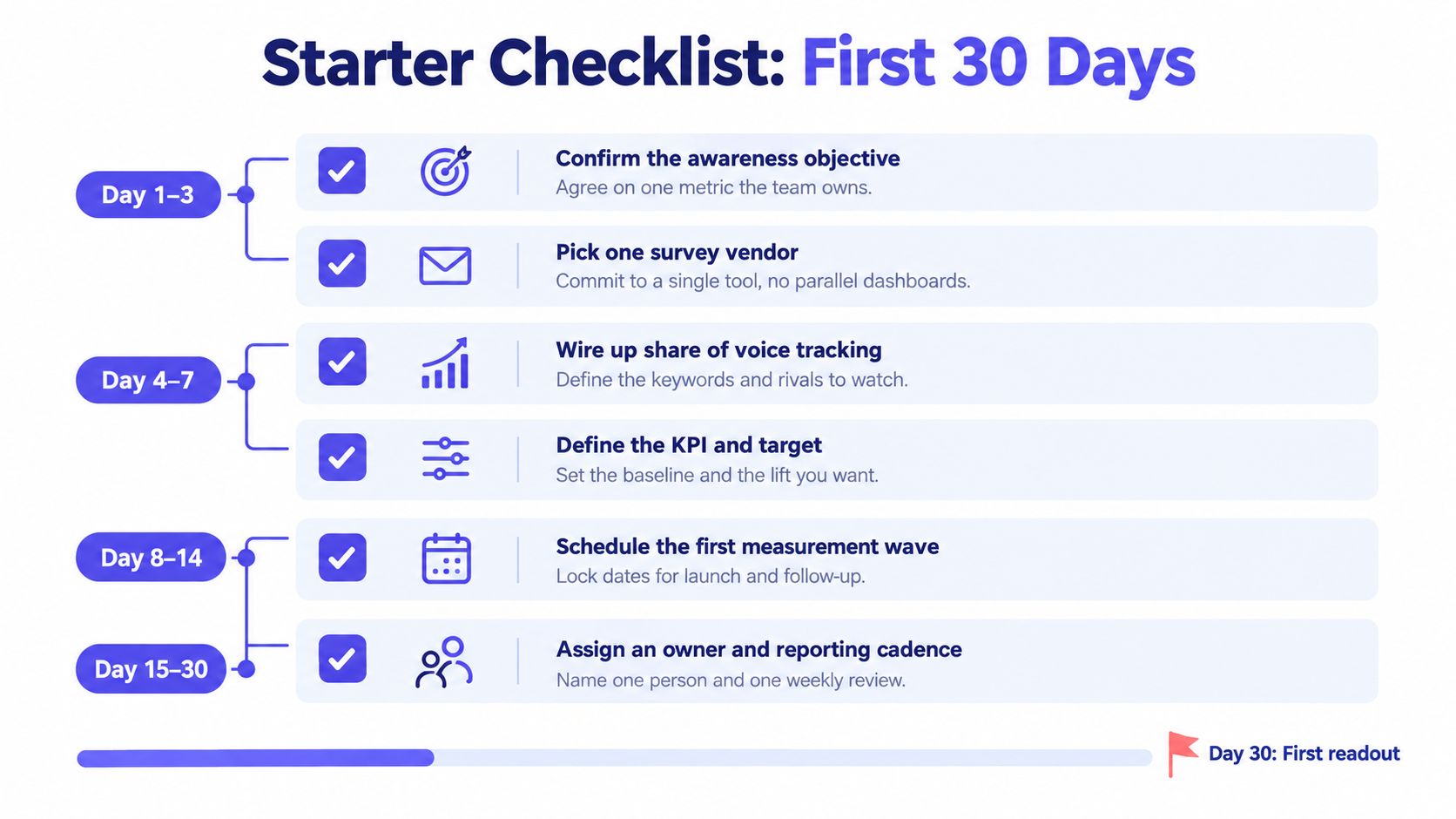
First 30 days
- Set one awareness goal for the quarter. Choose a single outcome, such as higher aided recognition in a target segment or stronger branded search in a priority market.
- Assign one measurement owner. Brand, research, or growth can own it, but one person should keep definitions, timing, and reporting consistent.
- Pick your core signal set. For a starter system, that usually means one survey measure, one search check, one social listening view, and lift testing only for major campaigns.
- Write down your baseline. Save the first quarter's numbers in one place so later changes have context.
- Standardize the inputs. Keep survey wording, brand term lists, competitor sets, and reporting windows stable enough to compare one quarter with the next.
- Put the review meetings on the calendar. Monthly checks catch unusual movement. Quarterly reviews are where budget and channel decisions should happen.
The mistakes that waste the most time
The first mistake is building a dashboard before agreeing on the question. If one team cares about category recall and another cares about share of voice, the report becomes a pile of unrelated charts.
The second mistake is changing too many variables at once. New creative, a new audience, and new survey wording can all shift the numbers. If all three move together, you cannot tell which change mattered.
The third mistake is treating every signal as equal. Survey awareness, branded search, social conversation, and lift results do not play the same role. They work more like instruments in a cockpit. One helps with direction, another with speed, another with altitude. Read them together, and patterns become more useful.
A lean system ages better than an oversized one.
Every quarter, ask three simple questions: What changed, which signals moved together, and what decision follows? Remove a metric that no longer helps answer those questions. Add a new one only when it fills a clear gap.
If you're trying to make this process easier to run each month, PostSyncer gives teams one place to schedule social content, monitor reach and impressions across networks, and review channel-level performance without stitching together scattered reports. Start with one quarterly survey wave and one branded search check, then add social listening and lift testing after your next major campaign.