











The campaign is supposed to launch next week. Creative is still in review. Paid wants final copy. Sales is asking what leads to expect. Someone dropped a new offer into Slack last night, and now half the assets are out of date.
That's what bad campaign planning looks like in practice. It rarely fails because the team is lazy or untalented. It fails because nobody turned the strategy into an operating system with deadlines, owners, approvals, and measurement rules.
Good campaign planning feels different. The brief is clear. The audience is defined. The content calendar matches the goal. Stakeholders know when to review and what they're approving. Launch day is less dramatic because the hard decisions were made earlier, when there was still time to think.
The Difference Between a Plan and a Wish
A wish sounds like this: “Let's push the new feature hard on social next month.”
A plan sounds like this: “We're launching the feature to existing followers and warm prospects. We know the message, the channels, the review path, the publishing schedule, the tracking rules, and the criteria for adjusting spend after launch.”
The gap between those two statements is where most campaigns break.
What reactive teams usually get wrong
Reactive teams move straight into production. They ask for graphics before they've agreed on the offer. They write captions before they've defined the audience. They schedule posts before they've mapped approvals. Everything feels busy, but the campaign has no spine.
The result is predictable:
- Messaging drifts: one post speaks to awareness, another pushes a hard conversion ask, and the landing page says something else entirely.
- Reviews pile up: stakeholders comment late because nobody set review windows or final sign-off rules.
- Budget gets wasted: paid and organic run in parallel without a shared hypothesis about what success should look like.
- The team burns out: last-minute changes create weekend work, duplicate effort, and unnecessary friction.
A rushed launch usually reveals a planning problem, not a content problem.
What an actual campaign plan contains
A real plan is not a vague document and not a spreadsheet with dates. It's a working system that connects strategy to execution.
At minimum, that system includes:
- A defined objective tied to business outcomes.
- A narrow audience focus so creative has direction.
- A content structure that turns one message into multiple assets.
- An approval workflow that keeps feedback from spreading across email, chat, and random docs.
- A launch and measurement setup so the team can react to real performance instead of opinions.
When managers skip those pieces, they don't save time. They delay the hard thinking until the most expensive moment to do it.
Why structure creates better creative
Some marketers still treat planning as the boring part that gets in the way of ideas. In practice, the opposite is true. Structure gives writers, designers, editors, and channel managers room to produce stronger work because they aren't guessing what the campaign is trying to do.
The best campaigns aren't improvised under pressure. They're built with enough clarity that every asset has a job, every reviewer knows their role, and every channel supports the same outcome.
Laying the Strategic Foundation
Most campaign planning problems start before the calendar exists. The team begins with channel ideas instead of business objectives. That's backwards.
If the objective is fuzzy, every decision after that gets slower. You'll debate creative longer, misread performance, and struggle to decide what to cut when resources tighten.

Start with a SMART goal
Strong campaign planning relies on SMART goals. That means the objective is Specific, Measurable, Achievable, Relevant, and Time-bound, and it should be checked against historical campaign data by time period, audience segment, and post-conversion behavior so you don't overreact to a single metric, as outlined in this campaign measurement planning guide.
A weak goal is “increase sign-ups.”
A useful goal is “generate trial sign-ups from owned and paid social during the launch window, with clear tracking by channel and audience segment.”
That second version gives the team something to build against. It shapes the offer, the creative angle, the landing page, and the reporting model.
Here's a practical way to pressure-test a goal before you approve it:
| Question | What to check |
|---|---|
| Specific | Does the team know exactly what action the campaign is driving? |
| Measurable | Can you track the action by channel, audience, and asset? |
| Achievable | Does past performance suggest the target is realistic? |
| Relevant | Does this support a real business priority, not just channel activity? |
| Time-bound | Is there a defined launch period and review window? |
If you're also planning media, it helps to Optimize your advertising budget before creative production gets too far. Budget decisions affect scope, channel mix, and how much testing room you'll have.
Use history without getting trapped by it
Historical data is useful, but only when you read it properly. Don't look at the last campaign as one number on a dashboard and assume you've learned something.
Look at patterns such as:
- Timing: when performance improved or dropped during the campaign
- Audience behavior: which segments engaged, clicked, or converted differently
- Post-click actions: what happened after the user took the first step
- Asset mix: which formats supported the primary goal and which only looked busy
That's why a lightweight planning document works better than a bloated strategy deck. You need enough detail to guide execution, not enough pages to hide unclear thinking.
A useful companion to this process is a documented framework like this social media marketing strategy template, which helps turn campaign intent into channel-specific action.
Build an audience brief people will actually use
Most audience personas fail because they're too long and too generic. Nobody needs a fictional biography with a favorite coffee order.
A working audience brief fits on one page and answers five things:
- Who they are: customer type, buying context, and level of awareness
- What hurts: the problem they want solved now
- What they care about: speed, trust, proof, price, convenience, status, or risk reduction
- Where they pay attention: the platforms and formats they already consume
- What would stop them: objections, confusion, internal approvals, or bad timing
Practical rule: If the audience brief doesn't change the message, the offer, or the format, it's too vague to be useful.
Once those basics are clear, messaging gets easier. You stop making “content for everyone” and start building a campaign for a specific buyer with a specific problem.
Building Your Content Calendar and Workflow
A content calendar is not the campaign. It's the delivery mechanism. But once strategy is set, the calendar becomes the most practical place to expose weak thinking. If the schedule feels random, the campaign probably is.
The teams that stay calm during launch week usually did one thing right early. They turned the strategy into a visible production workflow.

Build around content pillars, not isolated posts
A scattered calendar usually comes from brainstorming post ideas one at a time. That's slow, and it produces mixed messaging.
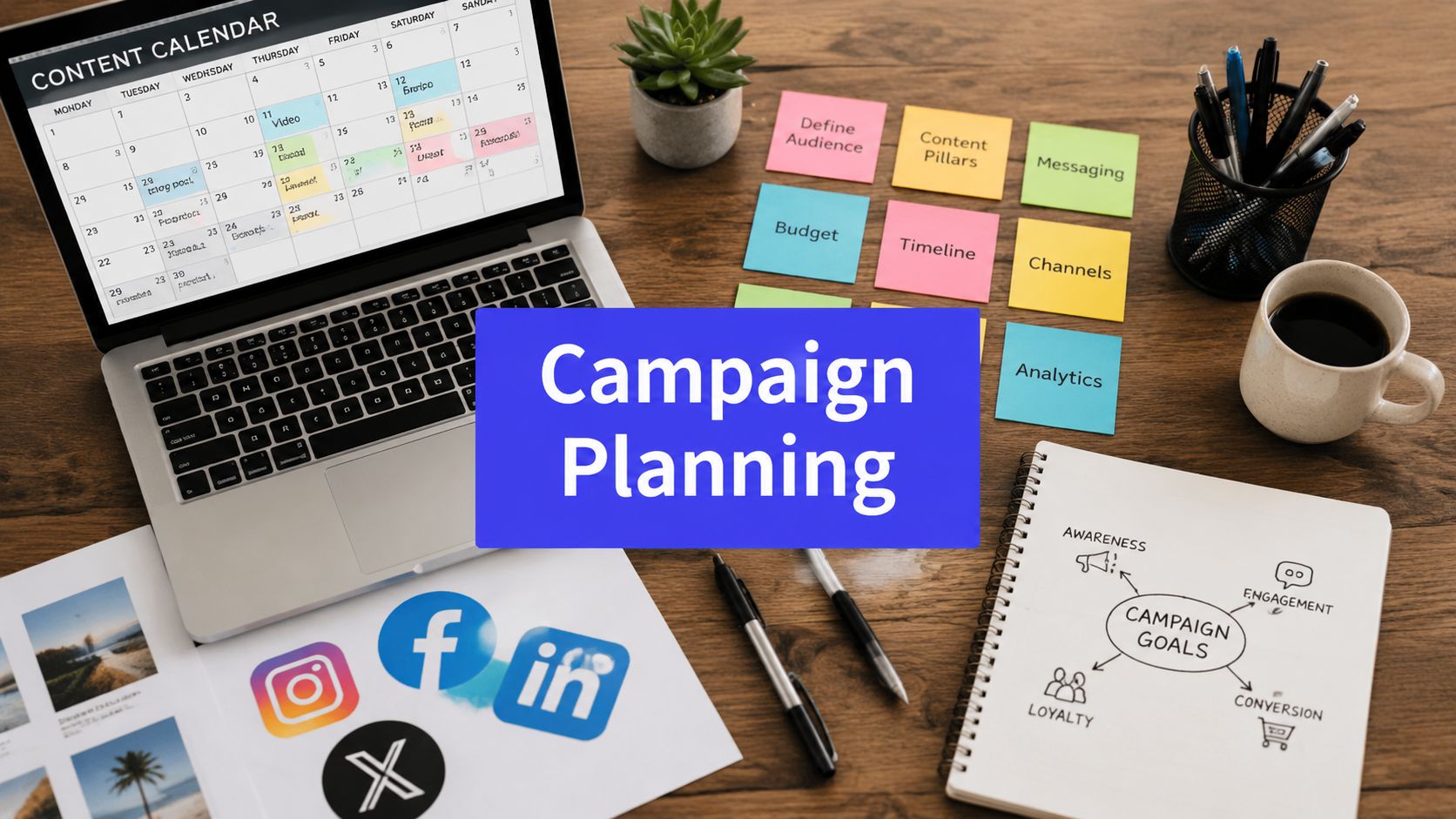
A better system is to define a small set of content pillars that support the core campaign message. For a product launch, those pillars might look like this:
| Pillar | Purpose | Example formats |
|---|---|---|
| Problem awareness | Make the audience feel the pain clearly | short video, founder post, stateless graphic |
| Solution education | Show how the offer works | carousel, demo clip, explainer thread |
| Proof and trust | Reduce risk and skepticism | testimonial creative, FAQ post, objection-handling reel |
| Conversion push | Ask for the action directly | launch post, reminder sequence, offer-led ad |
That structure makes repurposing easier because each idea can be adapted for different networks without rewriting the campaign from scratch.
Plan with real production windows
Large campaigns often need longer lead times than marketers want to admit. For major efforts, the planning phase typically lasts 3 to 6 months, followed by another 2 to 3 months to finalize goals, budgets, committee structure, and timelines before launch, according to Kindsight's capital campaign timeline overview. The same source notes that reviewing historical spending patterns during that window helps teams identify which channels and tactics delivered the best ROI.
That doesn't mean every social campaign needs months of preparation. It means serious campaigns need enough runway to make better decisions before publishing starts.
For leaner teams, I'd break the workflow into these blocks:
- Messaging batch: lock core message, offer framing, and proof points first
- Creative batch: design all related assets in one production cycle
- Copy batch: write captions, hooks, CTAs, and variations together
- Scheduling batch: load, label, and sequence posts with review status visible
At this stage, campaign planning stops feeling theoretical. Once the work is batched, gaps become obvious.
For a practical model, this content calendar creation guide is useful because it treats the calendar as a shared operating document rather than a posting checklist.
Make the calendar visible to everyone who can block it
A calendar hidden in one person's spreadsheet isn't a workflow. It's a private to-do list.
Your team needs one shared view that shows:
- What's publishing
- Who owns each asset
- What stage it's in
- What depends on approval
- Which posts belong to the same campaign
That shared visibility matters even more when multiple channels and stakeholders are involved. Organic, paid, design, and client-facing teams should be able to see the same campaign arc without asking for status updates all day.
A walkthrough like the one below is helpful when you're training a new manager on how scheduling and review logic should work in a live environment.
The point of the calendar isn't to fill every date. It's to make sure every asset has a reason to exist and a path to launch.
Streamlining Approvals for Teams and Agencies
Approvals ruin more campaigns than bad ideas do. Not because feedback is harmful, but because feedback is allowed to happen everywhere at once.
The copy lives in one doc. The design file has separate comments. A client emails edits. Sales drops “one quick thought” in chat. Nobody knows which version is final, and the campaign stalls while people argue over stale drafts.

Define the approval path before content exists
The cleanest approval systems are boring on purpose. Each person has a role, a review window, and a type of feedback they're allowed to give.
A simple structure looks like this:
- Creator drafts the asset and attaches the brief.
- Editor or strategist checks message, clarity, and channel fit.
- Stakeholder or client reviews for business accuracy and final sign-off.
- Publisher schedules only approved assets.
That sequence matters. If executives comment before the editor has cleaned up the draft, you waste senior review time on avoidable issues.
The fastest approval process is not the one with the fewest reviewers. It's the one where each reviewer knows what decision they own.
Use resource-fluid backward planning
This is the part most campaign planning guides miss. Small teams don't operate with stable capacity every week. One designer gets pulled into sales support. Paid media spend changes. A founder suddenly wants a new landing page. The plan has to absorb that without collapsing.
A 2025 industry analysis found that 68% of marketing plans fail because they anchor to outdated annual goals rather than current-year performance data, which is why more agile planning frameworks matter for smaller teams, as noted in this campaign planning analysis.
Resource-fluid backward planning fixes that by planning backward from the launch date while treating team capacity as variable.
Here's how to run it:
- Set the immovable date: product launch, event date, promotion start, or seasonal deadline.
- Map critical dependencies first: landing page, offer, tracking, legal review, and primary creative.
- Rank content by importance: hero assets first, supporting assets second, nice-to-have variations last.
- Create fallback versions: one simpler asset option for anything that could get blocked.
- Review capacity weekly: if resources shrink, reduce asset volume before you compromise the core message.
That model works well for agencies too. Client delays are normal. A backward plan with flexible resource assumptions protects the launch without pretending every week will go as expected.
A documented content approval process helps because it gives the team one reference point for review rules instead of rebuilding the workflow on every campaign.
Keep comments attached to the asset
Approval speed depends on context. If feedback lives away from the draft, the creator has to reconstruct meaning from fragments.
Use a system where comments stay tied to the specific post, image, or video version being reviewed. Then set one rule that saves a huge amount of time: once an asset reaches final approval, new feedback becomes a change request for the next version, not a surprise rewrite.
That single rule prevents the endless almost-final cycle that kills timelines.
Planning for Launch Day and Beyond
Most weak campaigns don't fail on launch day. They fail because launch day exposes everything the team left unresolved. Broken links. Missing tracking. Unapproved captions. No one assigned to monitor replies. Paid and organic publishing different offers at the same time.
The strongest launch plans feel repetitive because they are. They use a checklist, not memory.
Run a pre-flight check before anything goes live
The day before launch, verify the details that are easy to overlook and expensive to miss.
Use a checklist like this:
- Check every destination: landing pages, forms, booking links, app store URLs, and internal handoffs
- Confirm final creative: make sure the scheduled asset matches the approved version
- Verify tracking setup: every link should carry the right campaign attribution logic
- Brief the response team: someone needs to own comments, DMs, and internal escalation
- Align paid and organic timing: the message should feel coordinated, not duplicated by accident
This is also where launch plans separate smart restraint from false ambition. If the landing page isn't ready or the offer is still changing, delay publication. Shipping on time with broken basics is not discipline. It's avoidable damage.
Decide in advance how budget and effort will shift
Good campaign planning includes rules for reacting to early results. Otherwise teams improvise under pressure and start moving money based on mood.
A more rigorous method is to set decision thresholds before launch. One example is increasing budget by 30% only if CPA is 20% lower than target after 10,000 impressions, as described in this measurable campaign planning framework. The same guidance treats budget as a dynamic resource rather than a fixed cost.
That principle matters even if your spend is small. You don't need a complex media model. You need predefined rules so the team knows what to do when one channel outperforms another.
A practical version looks like this:
| Scenario | Planned response |
|---|---|
| Strong early efficiency | Scale the channel or creative variation already showing quality traffic |
| Good engagement, weak conversion | Adjust the landing page, CTA, or offer framing before increasing spend |
| Low response across formats | Rework the message, not just the design |
| Operational bottleneck | Pause expansion until support, sales, or fulfillment can keep up |
Extend the campaign after the first push
Teams often treat launch assets like one-time outputs. That's wasteful. The stronger move is to plan repurposing before the first post goes live.
A single hero asset can become:
- A short-form video cutdown for attention
- A carousel for explanation
- A founder-style text post for authority
- A customer FAQ post for objection handling
- A reminder asset for late decision-makers
Plan the repurposing path before launch, and the campaign keeps working after the initial burst of attention fades.
That's also why workflows matter. If your team can't quickly turn one approved message into multiple formats, you'll keep rebuilding assets from scratch and calling it agility.
Measuring What Matters and Improving Next Time
A campaign isn't complete when the posts go live. It's complete when the team knows what worked, what only looked good, and what should change next time.
That distinction matters because most reporting still overweights visible activity. Reach, likes, and view counts can help diagnose distribution, but they don't tell you whether the campaign achieved its purpose.
Track the KPI that matches the objective
Every campaign needs one primary success metric and a small set of supporting indicators. If the goal is sign-ups, lead quality matters more than applause. If the goal is booked demos, click-through rate matters less than qualified conversions.
A simple measurement stack looks like this:
- Primary KPI: the action that matters most to the business
- Efficiency KPI: cost per acquisition, cost per lead, or another economic measure
- Diagnostic KPIs: engagement, click-throughs, completion rates, landing page behavior
- Quality signal: downstream behavior after the first conversion
That last piece is where many teams get lazy. Completion rate alone isn't enough. The campaign should be judged by what the audience does next.
Make UTM discipline non-negotiable
Attribution gets messy fast when teams share links informally or publish without consistent tracking. That's why UTM parameters on all campaign URLs are mandatory for precise attribution, according to Analytical Alley's campaign success metrics guide. The same source states that campaigns using SMART goals and controlled experiments can improve success rates by up to 5x compared with unstructured efforts.
That doesn't mean every team needs a lab-grade testing environment. It does mean every team needs link discipline.

Use a naming convention your whole team can follow:
| UTM element | What it answers |
|---|---|
| Source | Where the traffic came from |
| Medium | What type of traffic it was |
| Campaign | Which campaign generated the visit |
| Content | Which creative or variation drove the click |
If you don't standardize that naming upfront, your reporting gets polluted by duplicate labels, inconsistent abbreviations, and unattributable traffic.
Hold a short post-mortem while the details are fresh
Debriefs are often skipped or devolve into blame sessions. Neither helps. A useful review is short, evidence-based, and specific about next actions.
Use these questions:
- What was the objective, and did we hit it?
- Which channels or assets drove the best quality outcomes?
- Where did the workflow slow down?
- Which approvals caused preventable delays?
- What audience objections showed up in comments, sales calls, or replies?
- What should become standard in the next campaign?
- What should we stop doing entirely?
Debrief lens: Separate performance problems from process problems. A weak result might come from the offer, the audience, the creative, or the workflow. Don't lump them together.
Turn campaign history into operating knowledge
The biggest advantage in campaign planning isn't one clever idea. It's accumulated pattern recognition.
When teams preserve what they learned, they stop repeating the same mistakes. They know which formats stall in approval, which channels support the goal, which proof points convert better, and which timelines were fantasy from the start.
That's where a lot of marketing maturity comes from. Not bigger decks. Better memory, cleaner workflows, and stricter measurement.
If you want a simpler way to run that whole process, from planning and approvals to scheduling, repurposing, and reporting, take a look at PostSyncer. It gives teams and agencies one workspace to organize campaign planning, manage review flow, publish across channels, and turn winning assets into more content without rebuilding the system every time.