












By Friday afternoon, most marketing teams aren't short of ideas. They're short of usable versions of the ideas they've already paid to research, record, and publish. A blog post sits in the CMS while LinkedIn needs a post, the newsletter needs a takeaway, and the webinar recording waits for someone to find the three minutes worth clipping.
Content repurposing AI can reduce that translation work, but only when you treat it as an editorial pipeline rather than a magic button. The software can extract, rank, and draft. People still decide what the source means, which audience deserves each version, and whether the final copy is accurate enough to publish.
The Weekly Content Grind Most Teams Know Too Well
Monday starts with a content calendar that looks manageable. The team has a long-form article scheduled for Tuesday, a webinar recorded on Thursday, a podcast episode waiting for editing, and a customer interview full of useful details. By Wednesday, the article has gone live, but its follow-up assets haven't been made.
The social manager opens a spreadsheet with columns for LinkedIn, X, Instagram, YouTube Shorts, TikTok, and the newsletter. Each channel needs a different shape. A LinkedIn post needs an argument, X may need a thread, Instagram needs a caption that works beside a visual, and a short video needs a spoken hook. The same source idea gets rewritten repeatedly, often by different people, with no reliable record of which claim came from the original.
By Thursday, posting windows have slipped. The webinar recording is technically available, but nobody has watched it closely enough to mark the strongest moments. The podcast team has notes, the sales team has a customer quote, and the newsletter owner is asking for a summary. Everyone is busy producing derivatives, yet the source material remains underused.
The bottleneck isn't inspiration
This pattern gets misdiagnosed as a creativity problem. It usually isn't. The team already has ideas, evidence, stories, and expert material. The bottleneck is the sequence of work between one finished source asset and several channel-ready outputs.
Manual repurposing asks an editor to remember the source, identify its best points, translate each point into a new format, check every claim, and place the result into a publishing workflow. That isn't one task. It's extraction, selection, writing, quality control, and distribution bundled together.
Practical rule: If your team keeps rewriting the same idea from scratch, fix the handoffs before buying more ideation tools.
A useful repurposing system makes those handoffs visible. It preserves the source behind each output, separates selection from generation, and gives a human a clear review point before anything reaches an audience.
What Content Repurposing AI Actually Means
Content repurposing AI uses language models and supporting tools to take a source asset, identify its reusable ideas, and reshape those ideas into formats suited to other channels. The source might be a blog post, webinar transcript, podcast, customer interview, PDF, or recorded sales conversation. The output might be a LinkedIn post, X thread, Instagram caption, newsletter section, carousel script, or short-video outline.
That differs from reposting. Reposting copies the same paragraph across platforms. Repurposing keeps the underlying argument but rebuilds the delivery. A spoken explanation becomes a concise caption, a detailed framework becomes a carousel, and a customer story becomes a newsletter narrative with a different opening and call to action.
Manual repurposing still has value. An editor reads the source, chooses what matters, and writes each version with full context. AI-assisted repurposing automates the repetitive parts, especially extraction, summarisation, and first-draft generation. The human still chooses which ideas deserve distribution and approves the final wording.
Think in atomic blocks
The most useful mental model is the atomic content block. An atomic block is a self-contained unit that can travel without losing its meaning, such as:
- A claim: One defensible point from the source.
- A quote: A statement connected to its actual speaker.
- A figure: A number with its context and provenance.
- A tip: A practical instruction that survives outside the original paragraph.
- An example: A specific situation that makes the idea concrete.
A system that rewrites an entire article end to end can produce fluent copy while shifting emphasis. A system that first decomposes the source into blocks can attach metadata such as audience, topic, channel, intent, and confidence. Research on reuse in knowledge work supports this structured approach because copied or minimally adapted material benefits from traceable provenance rather than untracked paraphrase, as described in Microsoft Research's work on generative AI and reuse.
That same principle appears outside editorial work. Teams managing large volumes of paid creative often need reusable source variations and consistent metadata, so bulk ad upload features offer a useful adjacent example of treating content as structured, reusable material rather than isolated files.
The Four-Stage Pipeline Behind Every Good Repurposing Workflow
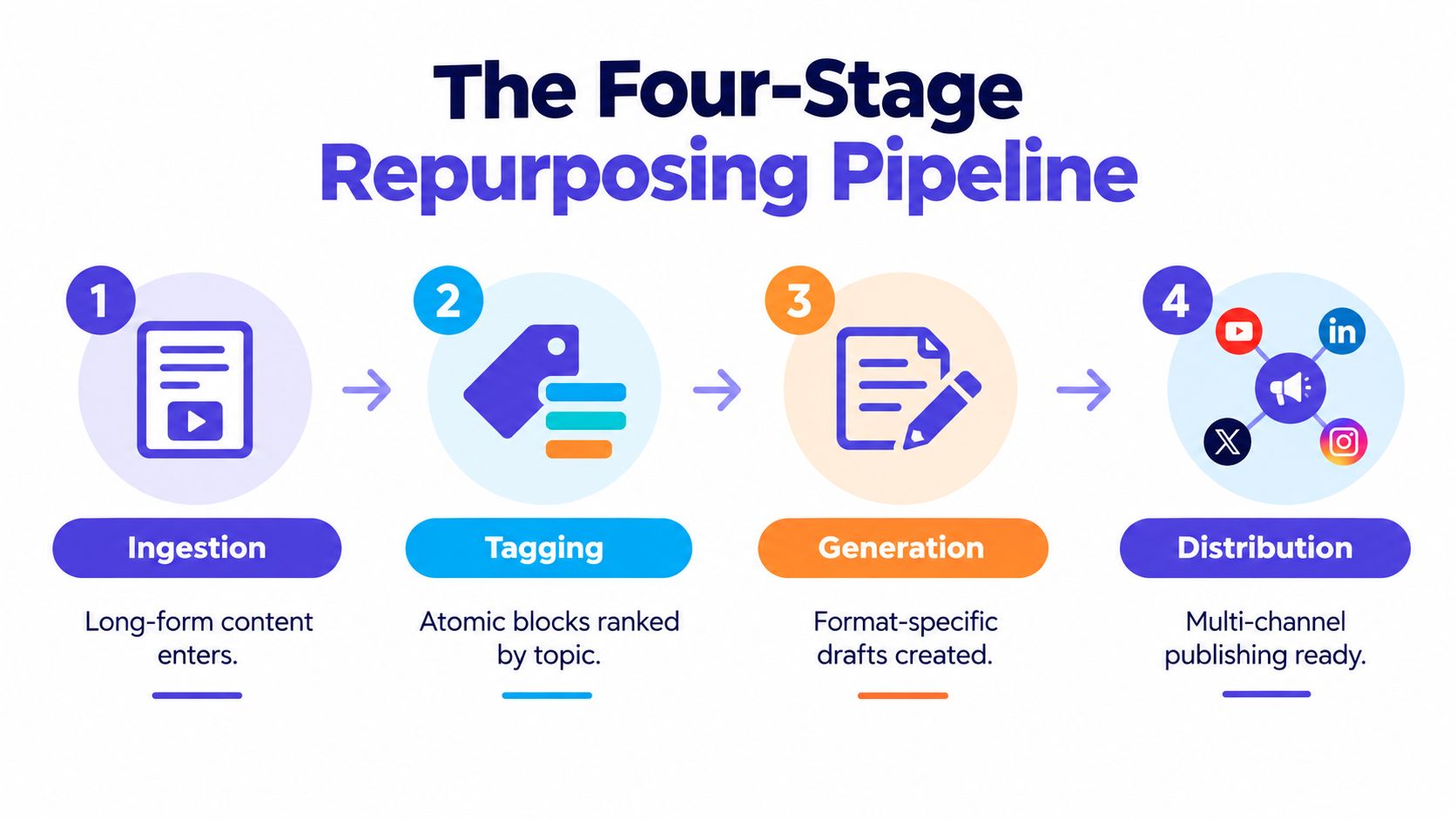
A dependable workflow has four distinct stages: extract, rank, generate, and review. Combining them into one prompt makes errors difficult to locate. Separating them lets a team ask whether the problem came from a weak source, poor selection, a bad format instruction, or an overlooked editorial issue.
Extract the reusable material
The first stage ingests the source and identifies atomic blocks. For a blog post, the system might return the main claim, supporting arguments, examples, objections, and calls to action. For a webinar, it should combine transcription with speaker labels and timestamps. For video, transcript-only extraction can miss visual demonstrations, reactions, and changes in emphasis.
A useful extraction record might say:
- Block type: Customer example
- Topic: Onboarding friction
- Source location: Interview timestamp or article paragraph
- Audience: Operations leaders
- Potential formats: LinkedIn narrative, newsletter section, short-video hook
- Review status: Needs source verification
Rank before you generate
The second stage decides which blocks deserve attention. Ranking can consider recency, novelty, audience fit, evidence strength, and platform potential. The purpose isn't to produce every possible derivative. It's to select the strongest material before the system creates a large batch of mediocre drafts.
Suppose a webinar contains a polished definition, a tired introductory explanation, a specific customer objection, and a practical demonstration. A ranking layer should favour the objection and demonstration for social content, while reserving the definition for an educational newsletter. The team gets a deliberate selection instead of a random summary.
A detailed description of this staged approach appears in the content repurposing workflow guide from PostSyncer, which treats source handling and channel output as connected workflow decisions rather than a single generation event.
Generate for the destination
Generation turns selected blocks into channel-native drafts. One idea might become a LinkedIn carousel script, a short X thread, a YouTube Short outline, an Instagram caption, and a newsletter paragraph. Each needs its own constraints, pacing, opening, and reader expectation.
The source meaning should remain stable, but the surface form shouldn't. A video script needs language that sounds natural aloud. A carousel needs one clear point per slide. A newsletter can carry more context and a personal transition. If every output reads like the original article with shorter sentences, the system has recycled the source instead of repurposing it.
Review the meaning and the risk
Review is the fourth stage, not a final courtesy. An editor checks factual claims, quoted material, speaker attribution, brand voice, legal wording, and platform suitability. The editor also checks whether the generated asset still says what the source said.
Industry guidance on AI repurposing identifies recurring failures such as stripped nuance, outdated errors, brand drift, and compliance problems. Adobe's research, cited in that guidance, reports that 51% of advanced AI adopters cite ethical concerns and brand reputation as barriers, while 48% cite governance, privacy, and compliance in the same source discussion (Dropbox's guidance on AI content repurposing mistakes).
Common Workflows and Use Cases You Can Copy
The best workflow depends on the source format. A written article gives the system clean semantic structure. A webinar adds speech patterns, timestamps, and visual context. A newsletter needs editorial judgement about what to leave out, not just a shorter version of everything.
| Source Format | AI-Generated Outputs | Strongest Pipeline Stage |
|---|---|---|
| Long-form blog | LinkedIn carousel script, X hooks, short-video outline, Instagram captions | Extraction and generation |
| Webinar recording | Highlight clips, caption frames, short-video scripts, quote posts | Ranking |
| Pillar article | Newsletter draft, takeaways, subject-line options, CTA variations | Ranking and review |
| Podcast episode | Show-note blocks, social posts, newsletter ideas, reply snippets | Extraction |
| Customer interview | Story angles, proof-point drafts, sales enablement snippets | Review |
Long-form article to social campaign
Start with a substantial article that has a clear argument, examples, and distinct supporting points. The AI extracts those blocks and maps them to formats. A carousel can explain the framework, several social posts can isolate individual claims, and a Short can turn one practical example into a spoken sequence.
The common failure is over-generation. The system summarises every subsection and produces a collection of posts that all begin with the same generic hook. The editor should select the strongest angles, remove duplicated points, and rewrite the opening for each platform.
Webinar to short-form video
A webinar contains more raw material than a text summary can understand. The ranking stage should identify quotable segments, moments where the speaker answers a real objection, and sections with a clean beginning and end. The generation stage can then create a hook reframe, caption text, and an editing brief for a vertical clip.
High-quality video repurposing needs more than a transcript. Current systems increasingly combine transcription, topic detection, highlight ranking, and template generation, while multimodal analysis considers text, audio, and visual signals. Typeface's overview of AI content repurposing explains why extraction, ranking, and generation should be evaluated separately.
For teams producing these assets, this guide to creating AI-generated videos provides a useful production reference. The human editor still needs to verify that the selected clip begins with enough context and doesn't cut away from a visual detail that makes the statement understandable.
Pillar article to newsletter
A newsletter shouldn't read like a compressed blog post. Use the source to identify one central insight, then build a 600-word issue around a personal introduction, three takeaways, and a CTA that matches the original intent. The AI can assemble the structure, but the editor must decide what the subscriber needs this week.
The most useful adjustment is usually subtraction. AI tends to preserve too many supporting points, add generic transitions, and explain conclusions the reader can already infer. A human pass restores a point of view and gives the issue a reason to exist independently from the source article.
Podcasts, customer interviews, and sales call recordings can also feed the pipeline. They contain candid language and useful objections, but they demand stricter permission, privacy, attribution, and context checks before publication.
Benefits and Limitations You Should Weigh Honestly
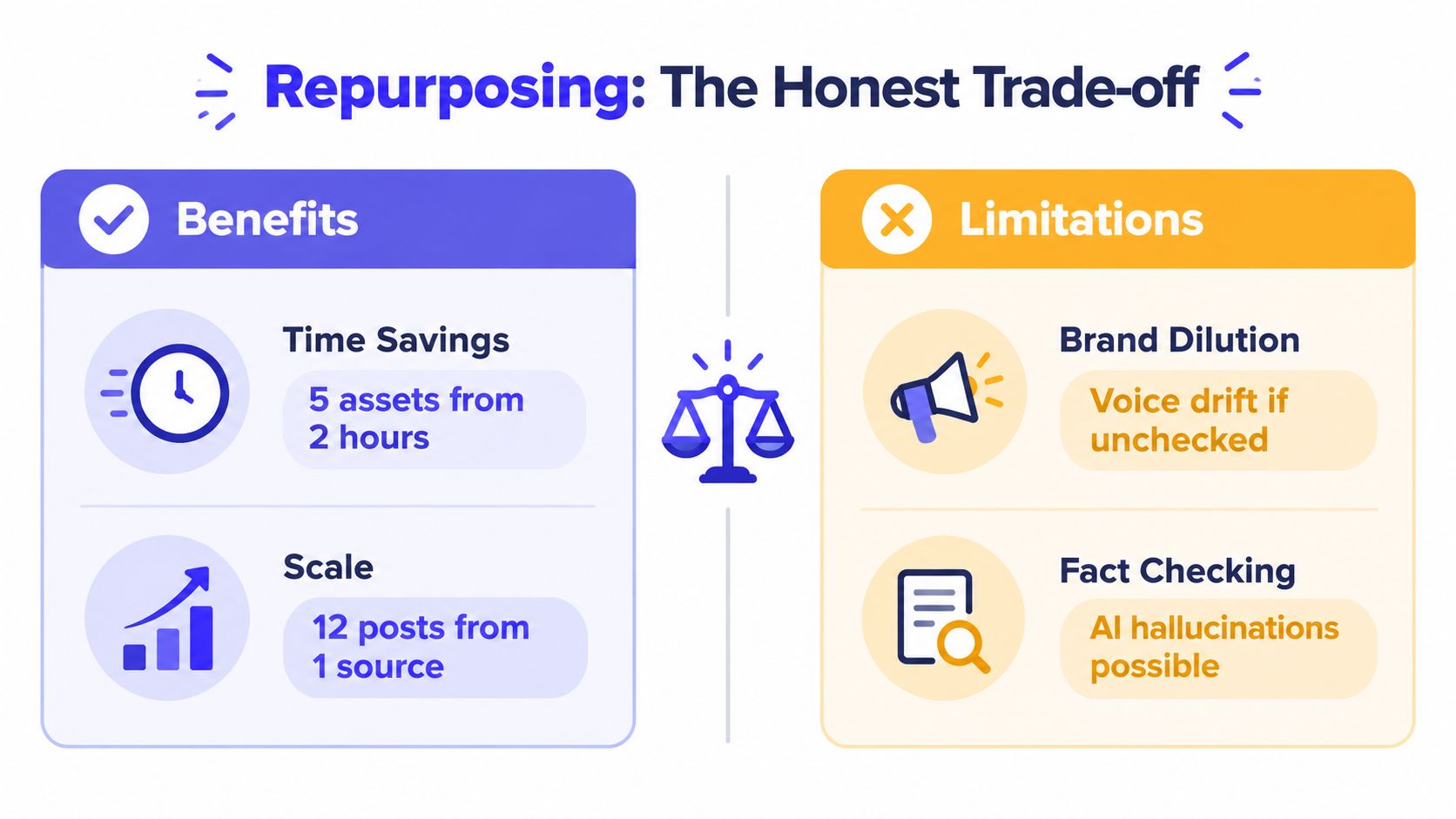
A repurposing pipeline earns its keep when a team has one strong source and several publishing deadlines. AI can extract usable material, rank possible angles, draft channel-specific versions, and expose ideas hidden in old recordings. It reduces repetitive production work, but it does not remove the editorial loop.
Adoption data shows why this workflow now appears in routine marketing operations. A 2025 Ahrefs survey found that 87% of respondents use AI to help create content, and teams using AI publish 42% more content per month than teams not using AI, with median publishing frequencies of 17 articles versus 12 (Ahrefs content marketing statistics). The same survey found that 97% of companies edit and review AI content before publishing, while 80% manually check AI output for accuracy. The numbers support a practical conclusion: higher output still depends on human review.
What AI saves
AI saves time when the task is repetitive and the source structure is clear:
- Source mining: It can locate claims, examples, quotes, and themes faster than someone scanning a transcript.
- Format conversion: It can produce starting drafts for several channels, so an editor is not facing a blank page each time.
- Batch variation: It can suggest alternate hooks, angles, and calls to action for selection and revision.
- Archive recovery: It can make older webinars, interviews, and articles easier to search and reuse.
The time savings are strongest during extraction and first-draft generation. Ranking still needs judgment. A memorable quote may lack context, while a less dramatic passage may contain the point that best supports the campaign.
Independent industry research cited by marketing publications reports that 68% of businesses see an increase in content marketing ROI from AI tools, with content creation identified as a leading use case by 55% of marketers (content repurposing statistics from SHNO). Those figures describe reported adoption and value, not a promise that automated drafts will outperform careful manual work.
What AI doesn't solve
AI can flatten nuance. A sarcastic aside may become a literal claim, a qualification may disappear, and a speaker's uncertainty may turn into confident advice. After several generation rounds, the copy can also drift from the brand voice unless style rules and source boundaries are explicit.
Accuracy risks matter more than awkward phrasing. A generated post can invent a statistic, assign a quote to the wrong speaker, or remove context from a medical, legal, or financial statement. Human reviewers must verify the source, speaker, intent, compliance requirements, and fit for each channel.
AI is a force multiplier for structure and volume, not a substitute for editorial judgment. The reliable workflow uses AI to extract, rank, and draft, then gives a human the final say on meaning, trust, and publication.
A PostSyncer Workflow From One Asset to Twelve Posts
A workable production sequence begins with a source, not a prompt. In a scheduling workspace such as PostSyncer, a team can bring in a URL or transcript, identify the source type, and ask the system to extract reusable blocks before choosing target channels.
Start with selection and rejection
Paste the source into the content input and label it as a blog, webinar, podcast, or another format. That label matters because a transcript needs different extraction logic from a finished article. Review the extracted quotes, claims, steps, and examples, then deselect blocks that feel weak, repetitive, private, or off-brand.
Next, choose the destinations. A single source might produce a LinkedIn post, Instagram caption, X thread, YouTube Short script, newsletter blurb, and additional format variations. Don't ask for identical copy everywhere. Give each output a job, such as explaining one step, challenging a misconception, or inviting readers to explore the full source.
Review inside the same workspace
Run a voice check to flag filler phrases, generic adjectives, and repeated constructions. Treat those flags as prompts for editorial attention, not automatic proof that a sentence is wrong. The editor then adjusts the hook for each network, verifies claims against the source, and checks that the proposed visual or clip supports the text.
The central benefit of a unified workspace is the shorter distance between draft and decision. The finished posts can move into a visual calendar, where the team assigns time slots, applies labels, routes content through approval, and queues publication across connected networks.
The media workflow also needs a feedback loop. After publication, review performance tags by format, platform, and topic. A weak result doesn't automatically mean the source was poor. It may indicate that the hook, length, visual treatment, or audience fit needs changing before the next batch.
This video provides a visual look at the kind of AI-assisted content workflow teams can use to move from source material to social outputs:
Best Practices That Keep Voice and Trust Intact
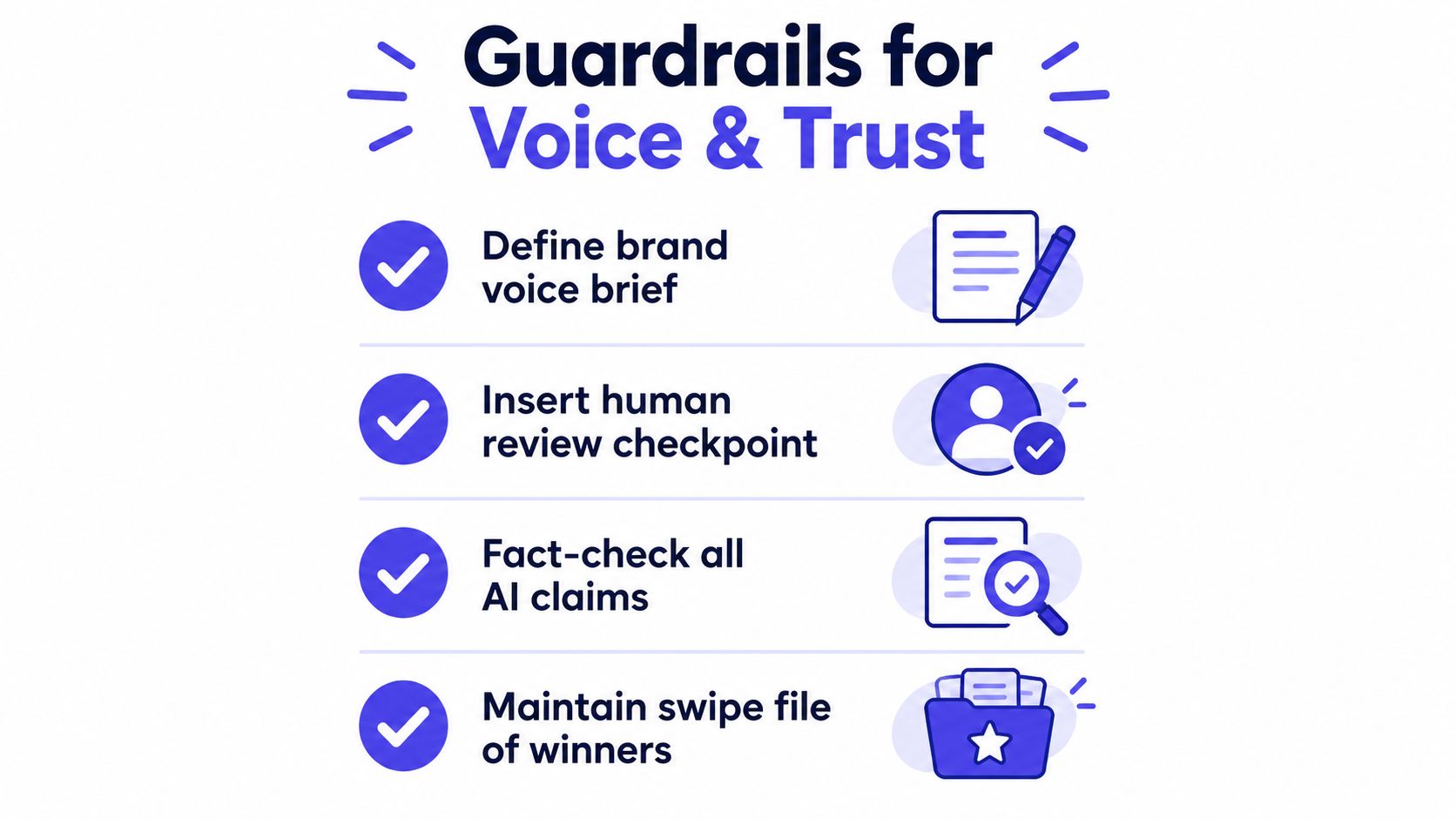
A human review checkpoint keeps repurposing useful. Without it, a system can preserve the topic while losing personality, precision, or responsibility. Review should focus on meaning and risk, rather than recreate the original writing process.
Write the rules before the prompt
Create a brand voice brief covering sentence length, vocabulary, certainty, humour, formatting, and prohibited patterns. Add platform-specific rules. A founder's LinkedIn post may use a personal observation, while a product caption may need a clearer product connection and a shorter route to the action.
Keep a swipe file of approved language. Include strong openings, preferred product descriptions, useful caveats, and phrases the brand avoids. Editors and AI tools can then work from concrete examples instead of an instruction such as “sound authentic.”
Make review traceable
Every output needs a human pass for:
- Factual accuracy: Compare claims, figures, dates, and examples with the source.
- Quoted material: Confirm the speaker and exact wording.
- Compliance: Check regulated claims, permissions, privacy, disclosures, and customer references.
- Voice: Remove generic filler and restore the brand's actual level of confidence.
- Platform fit: Ensure the format works without context the platform will not provide.
A fast draft is useful only when the team can explain where every important claim came from.
Version-control prompts and templates like other production assets. Keep the previous version when a change creates a new failure. Log the source, extracted blocks, selected outputs, editor changes, and approval status. This record helps diagnose recurring errors and shows which instructions improve quality.
Add a voice check at the sentence level. Compare each post with the approved swipe file, flag wording that sounds more certain than the source, and record whether an editor accepted, revised, or rejected the suggestion. A weekly review of those decisions can reveal a recurring problem, such as AI turning cautious product language into a guarantee.
Research on AI-assisted creation consistently shows that only a small minority publish purely AI-generated content without human review. That makes review a normal production layer, not an exception. It protects the value the pipeline is designed to create.
When to Repurpose With AI and When to Do It Yourself
Start with the source, not the deadline. AI fits when the material is substantial, ideas recur, the brand voice is documented, and the team can define extraction and format rules. Evergreen guides, educational webinars, product explainers, and recurring podcast episodes usually meet those conditions.
Keep humans in control when the source includes sensitive claims, confidential details, medical or legal guidance, first-person narrative, or nuance that carries the meaning. A customer interview may contain a strong story, yet an editor must confirm permission, context, and attribution before AI turns it into public copy.
Use this decision rule:
- Low source risk and broad audience: Automate extraction and first drafts, then review the batch.
- High source risk and broad audience: Use AI for organisation only, with substantial human rewriting. For channel-specific trade-offs, see this guide to AI for social media management before automating high-risk sources.
- Low source risk and narrow audience: Automate selectively and improve the workflow from feedback.
- High source risk and narrow audience: Keep the workflow human-led from extraction through approval.
Marketers already use AI for social production. A neutral report states that 78% of marketers use AI for social media content, including caption writing, hashtag generation, and repurposing. It also warns that generic output can struggle as platforms place more weight on creator-specific voice and context (AI versus human social media posts research from Gensumo).
Choose one strong pillar asset this week. Run it through extraction, ranking, generation, and review, then schedule only outputs the team can defend. PostSyncer combines source-based AI drafting, platform scheduling, calendar planning, and performance analysis in one workspace. Visit PostSyncer to turn a controlled batch into a repeatable publishing workflow.