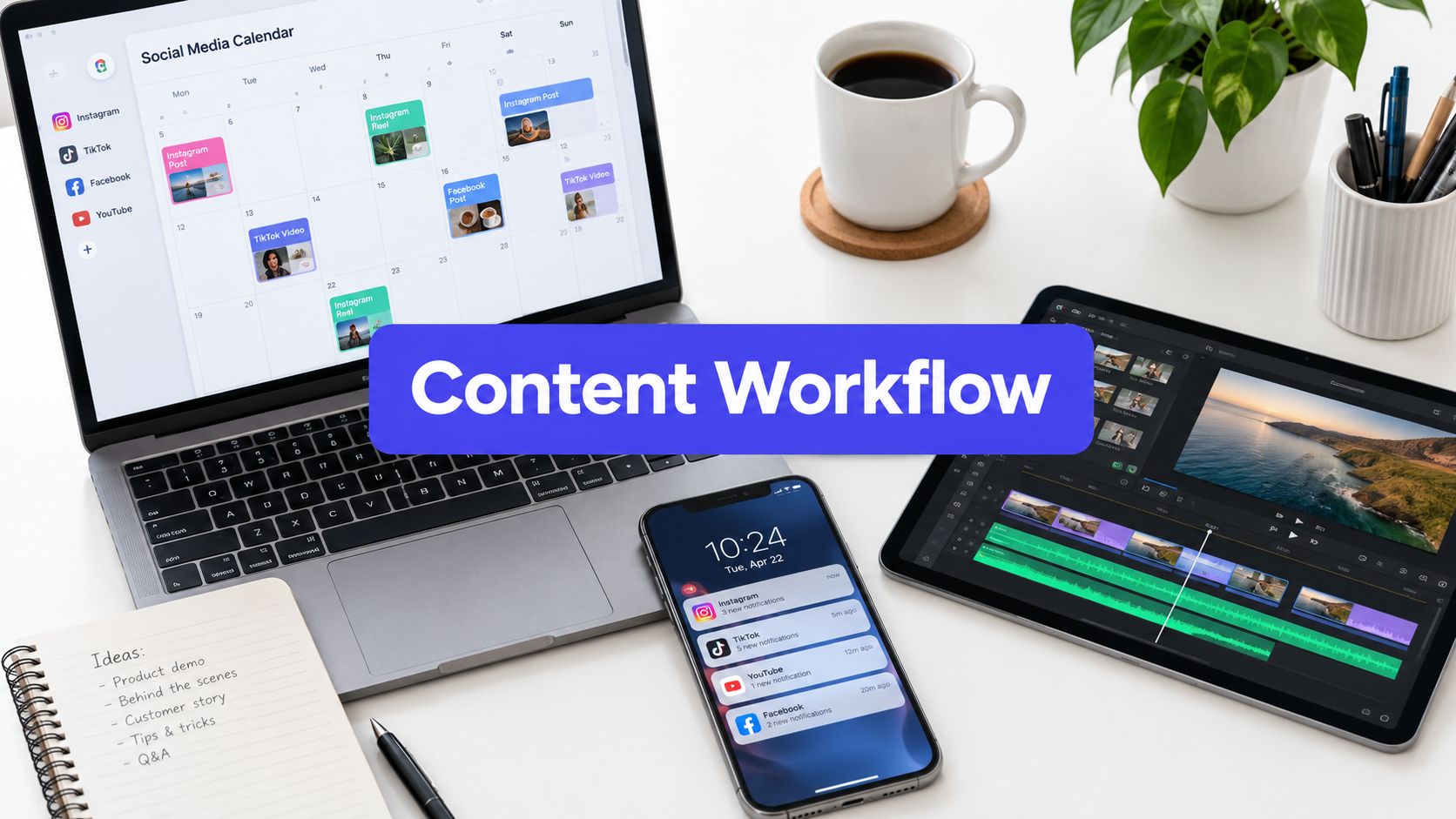












A content repurposing tool is a piece of software, usually supercharged with AI, designed to take one of your core content assets—like a blog post or a long video—and slice it into dozens of new formats. Think social media clips, quote cards, and even summaries for your newsletter. It automates the heavy lifting, letting you get your best work in front of more people on more platforms without burning out.
Why Content Repurposing Is a Modern Marketing Essential
 Let’s be real: the pressure to constantly “feed the algorithm” with fresh, high-quality content is overwhelming. For creators, agencies, and brands, this often leads straight to burnout and astronomical production costs. It’s this never-ending demand that has turned content repurposing from a nice little tactic into an absolute must-have strategy for 2026.
Instead of trying to come up with new ideas every single day, repurposing lets you work smarter, not harder. The entire philosophy is built on a simple but incredibly powerful idea: create once, publish everywhere.
The Strategic Value of a Content Repurposing Tool
This is where a dedicated tool like PostSyncer becomes more than just software—it becomes your strategic partner. Imagine taking a single one-hour webinar and turning it into an entire week's worth of high-impact marketing assets. That one video can instantly become:
- Ten short-form video clips with animated captions, perfect for TikTok and Reels.
- Five eye-catching quote graphics to share on Instagram and Facebook.
- A detailed, SEO-friendly blog post that recaps all the key takeaways.
- A LinkedIn carousel that highlights the most compelling data points and statistics.
This approach hits multiple birds with one stone. It keeps your audience from getting tired of seeing the same old thing by presenting your core message in new, exciting ways. It also helps you stay consistently visible on all the platforms where your audience hangs out, without needing to triple your workload or your budget. Before you start, though, it’s worth brushing up on the fundamentals of creating engaging content that grabs attention from the start.
By maximizing the value of your best work, you extend its lifespan and reach, turning a single successful asset into a perpetual marketing engine.
The Impact of AI on Repurposing
The game has totally changed with the arrival of AI. Tasks that used to take a content team days of manual labor—like watching videos, transcribing them, designing graphics, and writing captions—can now be done in minutes. AI-powered tools handle the most tedious parts of the job, which frees up your team to think about big-picture strategy and creativity.
The market has noticed. The content creation tools sector, which is the engine behind all this, grew from $10.94 billion in 2025 to $12.45 billion in 2026. A huge driver of this growth is AI that automates the clipping and distribution process. This is especially true now that 58% of B2B marketers directly attribute revenue boosts to their content marketing efforts. When done right, repurposed content can generate three times more leads than original pieces. Dive into the complete B2B repurposing statistics to learn more.
Choosing and Preparing Your Pillar Content
Let's be real—your entire repurposing strategy lives or dies by one thing: the source material you choose. This isn’t about just grabbing your most recent blog post and hoping for the best. It’s a strategic decision.
You need to find your true pillar content. These are the big, meaty, high-value assets in your library that can be carved up into dozens of smaller, powerful pieces for social media.
Identifying Your Strongest Assets
Think of your pillar content as the foundation of your campaign. It's usually long-form, packed with information, and has already proven its worth to your audience. The best candidates are the ones that solve a major headache or answer a burning question for your ideal customer.
So, what should you be looking for?
- Comprehensive: Think in-depth guides, ultimate "how-to" articles, or full webinar recordings.
- Data-Rich: Dig up original research, detailed case studies, or reports filled with juicy statistics.
- Insightful: Expert interviews, podcast episodes with industry leaders, or powerful customer success stories work wonders.
- Evergreen: The content should tackle timeless problems and stay relevant for months, if not years.
A quick tip: stay away from repurposing timely news or content that will feel stale in a week. A 2,500-word guide on "Social Media Strategy for E-commerce" is a goldmine. A 500-word blog post about a minor Instagram update? Not so much. The guide has enough substance to be sliced and diced into countless tips, quotes, and video clips.
Ingesting Your Content for AI Analysis
Once you’ve found your golden asset, it's time to feed it to your content repurposing tool. This is where the process gets incredibly simple and, frankly, a bit magical. With a platform like PostSyncer, there's no tedious copy-pasting involved.
All you have to do is provide a source:
- A URL: Just paste the link to your pillar blog post, case study, or landing page.
- A Video File: Upload a webinar recording, customer interview, or YouTube video directly.
- A PDF Document: Have a whitepaper, e-book, or research report? Upload it.
For instance, say we have a 60-minute webinar recording with an industry expert. We can upload that MP4 file straight into the platform. From there, the AI takes over, transcribing the entire video and breaking down its structure, key topics, and most powerful moments.
The goal is to give the AI the richest source material possible. The more depth and value in your pillar content, the more creative and varied the AI-generated outputs will be.
Sparking Ideas with AI-Powered Ideation
Now we move from prep to creation. After analyzing that webinar, a tool like PostSyncer doesn't just hand you a transcript and walk away. It delivers a treasure trove of creative ideas, saving you hours of painful brainstorming. The AI gets the context and generates a ton of different angles to promote your content.
For our 60-minute webinar example, the AI might spit out:
- 30+ Compelling Headlines: You'll get everything from click-worthy hooks ("The #1 Mistake Brands Make on TikTok") to thoughtful questions ("Is Your Content Strategy Ready for 2026?").
- Platform-Specific Hooks: It knows a LinkedIn hook needs to be professional and data-driven, while a TikTok hook has to be punchy and grab attention in seconds.
- Varied Post Captions: It will draft multiple caption options for every potential clip or graphic, tailored for different tones—inspirational, educational, or straight-up promotional.
This ideation step is what really separates a basic editing tool from a true content repurposing platform. It’s like having a creative assistant on call, giving you all the raw materials you need to build a massive campaign from just one asset. You’re no longer staring at a blank screen wondering what to post. Instead, you've got a full menu of validated ideas, ready to be turned into killer assets.
Generating Multimedia Assets on Autopilot
Alright, you've fed your best content into the system. Now for the fun part. This is where a good content repurposing tool really earns its keep, turning that single asset into a whole library of ready-to-go visuals. We're talking short-form videos, eye-catching images, and slick carousels—all created pretty much automatically.
Think about it. You just finished a 45-minute webinar. The old way? You'd be stuck for hours, scrubbing through the timeline, trying to hunt down those few golden nuggets worth sharing. An AI-powered tool finds those moments for you in minutes, pulling out the killer quotes, key stats, and "aha!" moments that are perfect for social media.
From Text to Dynamic Short-Form Video
Let's be real: short-form video is king, but it’s also a massive time sink. This is where automation delivers the biggest win. By scanning a blog post or video transcript, the AI can instantly identify the most compelling sentences and transform them into snappy video clips.
And these aren't just glorified slideshows. A modern content repurposing tool can do some seriously impressive stuff:
- Generate Animated Captions: It creates those bold, on-screen subtitles that are essential for grabbing attention, especially since most people watch videos on mute.
- Apply Your Branding: Your logo, brand colors, and fonts are added to every single clip automatically. No more fiddling with templates; you get brand consistency right out of the box.
- Intelligently Select B-Roll: The best tools will even search for and add relevant stock footage or graphics to make the clip more visually interesting and support the story.
The whole process of turning your words into watchable content has never been easier. If you want to get into the nitty-gritty, we cover the mechanics in our guide on how to turn an article into a video.
Creating Static Images and Carousels Instantly
But it's not all about video. A powerful content repurposing tool is also a wizard at creating static images that make people stop scrolling. All those powerful quotes, stats, and key takeaways buried in your long-form content? The AI finds them and spins them into beautifully designed graphics.
The goal here is pure efficiency. Turn one data point from a case study into a clean infographic. Turn a single powerful quote from a podcast into a shareable card for Instagram.
This all happens at the same time. While the tool is slicing up your webinar into video clips, it’s also creating a batch of quote cards and a LinkedIn carousel that breaks down the top three discussion points. What used to take a graphic designer and hours in Canva now happens with a few clicks.
To show you what's possible, here’s a quick look at how one piece of pillar content can be multiplied into a variety of formats.
Repurposing Output from a Single Asset
| Source Content | Generated Video Asset | Generated Image Asset | Generated Text Asset |
|---|---|---|---|
| Webinar Recording | 5-7 short video clips with animated captions | 10 quote cards for Instagram | 3 LinkedIn text posts with key takeaways |
| In-depth Blog Post | 1 summary video for YouTube Shorts | 3-slide carousel for LinkedIn | 5 engaging tweets with key statistics |
| Customer Case Study (PDF) | 1 animated testimonial video | Infographic with ROI data | Short summary for a Facebook post |
As you can see, the potential to generate a high volume of diverse content from a single source is massive. This approach ensures you're getting the absolute most out of every piece of content you create.
Of course, none of this works if you don't start with the right source material. Choosing your pillar content wisely is the first and most critical part of this process. It all comes down to a simple but effective workflow.

This simple "Identify, Ingest, Ideate" model is what fuels the entire multimedia engine, making sure every asset has the best possible chance to be repurposed effectively. Some tools even go a step further for specific niches. For example, an e-commerce brand can use a specialized ai ghost mannequin generator to quickly prep product shots, which can then be fed into the repurposing workflow to be used across ads, social posts, and carousels.
The numbers don't lie. The digital content market hit $35.22 billion in 2025 and is projected to reach $39.61 billion in 2026, largely because of this "create once, distribute everywhere" model that repurposing makes possible. We've seen from industry data that repurposed content can increase website traffic by 62% and boost lead generation by an incredible 40%. It’s not just a nice-to-have; it's a core part of any smart marketing strategy today.
Deploying Your Campaign and Collaborating with Your Team
 Creating a whole library of fresh, repurposed content feels like a win, and it is. But that’s only half the battle. The real magic happens when you get that content out into the world, and this is where a solid content repurposing tool goes from a simple asset creator to your mission control.
Once you have all your new video clips, carousels, and images ready, you can start mapping out a real multi-channel campaign. The best tools give you a visual content calendar where you can literally drag and drop your assets into place. This gives you a fantastic bird's-eye view of your entire plan for the weeks and months ahead.
From a single dashboard, you can schedule everything—posts, Reels, carousels—across platforms like TikTok, LinkedIn, and Instagram. This unified setup is a massive time-saver and the secret to staying consistent without bouncing between ten different apps.
Refining Posts for Each Platform
While the scheduling itself is automated, there's a crucial human touch required: tweaking your posts for each specific platform. Let’s be real, a caption that kills it on LinkedIn will probably land with a thud on TikTok. AI can get you 90% of the way there, but that last 10% of human refinement is what makes content connect.
- For LinkedIn: Stick to a professional tone. Pull out key data points or takeaways from your original content and pose questions to get industry folks talking.
- For Instagram: It’s all about the story. Use a more personal, engaging voice and make sure your hashtags are on point to catch trending traffic.
- For TikTok: Short and punchy is the name of the game. Your caption should be brief, direct, and ideally, tap into a current trend or sound for maximum reach.
This final polish makes your content feel native to each platform, which drastically improves its chances of getting noticed. If you want to dig deeper into the specifics, check out our guide on the best practices for cross-posting on social media.
Effective deployment isn't just about scheduling; it's about thoughtful adaptation. A small tweak in language or tone can be the difference between a post that gets ignored and one that goes viral.
Streamlining Team Collaboration and Approvals
For marketing teams and agencies, this is where a great content repurposing tool becomes a non-negotiable. It ends the chaos of endless email threads and Slack messages for content approvals.
Picture this: your agency just finished a full week of repurposed content for a client. Instead of exporting and attaching dozens of files, you just send a single, secure link. The client can see the entire week's schedule on the calendar, leave comments directly on individual posts, and approve or request edits with one click.
It’s a completely transparent process that ensures nothing goes live without that final sign-off. I can't tell you how many hours this saves, not to mention how it prevents costly mistakes.
You can also use content labels to keep your strategy straight. An e-commerce brand, for instance, might use labels like "Product Launch," "Customer Story," or "How-To Guide." This helps you visually balance your content mix and make sure you're hitting your goals. For an agency juggling five brands, this kind of organization is what keeps you sane.
This coordinated approach is fast becoming the industry standard. The AI content repurposing market is growing at a 13.6% CAGR and is on track to hit $18.23 billion by 2029. With 45% of marketing budgets now going toward AI tools, it's clear businesses are betting big on tech that turns one piece of content into a dozen social media wins—especially when repurposed assets can deliver 4x the reach of the original.
Measuring and Optimizing Your Repurposing ROI
So you've built a content repurposing machine. Fantastic. But now comes the hard part: proving it actually works and getting the budget to keep it going. To really show the value of a content repurposing tool, you have to look past the likes and shares and connect your work to what the business truly cares about.
This is all about linking your repurposed content to real-world results. A solid tool with built-in analytics means you can stop guessing and start making decisions based on cold, hard data. It’s how you prove the return on investment (ROI) of your entire content strategy.
Tracking Performance Beyond Vanity Metrics
First things first, you need to get into the weeds with your analytics. A unified dashboard is your best friend here, letting you see how everything performs across different platforms, formats, and even which original content pillar it came from.
This is how you start answering the questions that actually matter:
- Did our short-form video clips from TikTok bring in more qualified leads than our LinkedIn carousels?
- Of the ten AI-generated headlines we tested, which one got the highest click-through rate?
- Are we getting more engagement from content repurposed from our last webinar or our newest case study?
Tracking these specific data points shows you exactly what’s landing with your audience and what isn’t. This data-backed feedback loop is what separates the marketers who are just throwing spaghetti at the wall from those who are building a real strategy.
Your goal is to build a clear picture of what resonates with your audience on each platform. This allows you to double down on what works and stop wasting time on formats that fall flat.
Gauging Audience Sentiment and Engagement Quality
A "like" is nice, but a thoughtful comment is gold. True engagement is about the quality of the conversation your content is starting, and modern analytics can help you see it clearly by pulling all your comments and messages into one inbox.
This unified view is a treasure trove for understanding how your audience really feels. Are they asking smart questions? Sharing their own stories? Tagging their colleagues? Those are the signs of high-quality engagement that tell you your message is hitting home.
For instance, if video clips from a customer interview consistently get comments like, "This is exactly the problem we're facing," you've struck a nerve. You now know that content pillar is incredibly effective and worth creating more from. A content repurposing tool with engagement analytics helps you spot these trends without juggling a dozen different tabs.
Creating a Simple Monthly Performance Report
To pull this all together, you need a simple way to show your wins to your boss or clients. Forget the complicated spreadsheets no one reads. Instead, create a clean, visual monthly report that shows how your repurposing work is hitting key business goals.
Here’s a straightforward template you can steal:
- Executive Summary: Kick it off with a one-paragraph summary of the month’s biggest results. For example: "This month, our repurposed video content drove a 25% increase in website traffic from social media and generated 15 new qualified leads."
- Top-Performing Assets: Visually showcase your top 3-5 repurposed posts. Add a screenshot of each post along with key metrics like reach, engagement rate, and clicks.
- Platform-Specific Insights: Briefly explain what you’re seeing on each channel. For example: "On LinkedIn, carousels that broke down data from our whitepaper had the highest engagement by far."
- Key Learnings and Next Steps: What did you learn, and what are you going to do with that information? For example: "Audiences loved the Q&A-style clips. Next month, we’re doubling down and creating more of them."
A simple report like this makes your value crystal clear. You’re not just posting content; you’re driving measurable business growth. For a more detailed breakdown, check out our complete guide on how to measure social media ROI and learn how to build a bulletproof case for your strategy.
Common Questions About Content Repurposing Tools
So, you're sold on the idea of using AI to repurpose your content, but a few nagging questions are holding you back. I get it. It sounds almost too good to be true, and it's smart to have questions about quality, the workflow, and whether it's really worth it.
Let's walk through some of the most common concerns I hear from creators and marketing teams. We'll get you the clear, straightforward answers you need to start repurposing with confidence.
How Do I Choose the Right Pillar Content to Repurpose?
This is easily the most important part of the whole process. Your final results are only ever as good as the source material you start with. The key is to focus on your "greatest hits"—those big, comprehensive assets that are already packed with value.
Think about content like:
- Your top-performing blog posts that consistently pull in traffic.
- In-depth webinar recordings where you shared expert insights or ran a product demo.
- Detailed customer case studies filled with juicy data and real-world results.
- Long-form YouTube videos that have solid viewership and engagement metrics.
You want to pick a piece of content that has enough meat on its bones to be carved up into smaller, standalone nuggets of value. A great rule of thumb is to choose something that solves a core problem for your audience. If it was a hit in its long-form version, the individual ideas within it are almost guaranteed to work as short-form content.
Just be sure to stick with evergreen material. Repurposing a timely news piece will just give you a library of content that feels dated in a few weeks.
Will AI-Generated Repurposed Content Sound Robotic?
This is a huge—and totally valid—concern. Nobody wants their social media feed to sound like a robot wrote it, stripped of all personality. But the great thing about modern AI tools is that they aren't meant to be a one-click-and-publish solution.
Think of a content repurposing tool as your super-fast creative assistant. It does about 80% of the grunt work for you—finding the key moments, pulling out the best quotes, and formatting them for different platforms. This is where you save hours upon hours.
The real magic happens when you add that final human touch. Use the AI-generated hooks and captions as a fantastic first draft, then spend just a few minutes tweaking them to inject your unique brand voice, add a timely comment, or drop in a specific call-to-action.
This hybrid approach gives you the best of both worlds: the incredible speed of automation and the authentic voice that only you can provide.
Is an Integrated Tool Better Than Multiple Separate Tools?
You can absolutely piece together a workflow with a separate video editor, a design app like Canva, and a social media scheduler. A lot of people start out that way. But an all-in-one content repurposing tool offers a massive leap in efficiency and strategic clarity.
When you use an integrated platform, you connect every single step. You feed it a URL or video file once. From there, you can generate video clips, design image assets, and write captions all in the same place you’ll eventually schedule your posts, manage approvals, and track your analytics.
It completely eliminates the friction of downloading and re-uploading files between five different tabs. It also cuts down on subscription costs and gives your whole team one central place to see what's working. For agencies and marketing teams juggling multiple clients or campaigns, a centralized workflow isn't just nice to have—it's a total game-changer.
How Much Time Can a Repurposing Tool Realistically Save?
The time savings are massive. We're not talking about a few minutes here and there; we're talking about reclaiming entire days of work each month. Let's break down the manual process for repurposing just one hour-long webinar.
Manually, you’d have to:
- Sit and watch the full 60-minute recording, taking notes to find the best clips.
- Transcribe those key moments to create captions.
- Animate subtitles for each video clip.
- Hop over to another tool to design quote graphics.
- Write unique social media copy for each clip across five different platforms.
- Log into yet another tool to schedule everything out.
That’s easily 8-10 hours of tedious, focused work. With a capable AI content repurposing tool, you can get that entire job done in under an hour. The AI does the initial watching, clipping, and content generation in minutes.
Your role then shifts from being a content factory worker to a content strategist. You’re reviewing, refining, and scheduling—not doing the heavy lifting. This can easily free up over 70% of the time you used to spend on content creation, giving you more time for strategy and engaging with your community.
Ready to stop the content creation treadmill and start working smarter? PostSyncer gives you an all-in-one AI platform to turn your best content into a full library of social media assets in minutes. Plan, create, schedule, and analyze your campaigns from a single dashboard.
Start your free trial of PostSyncer today and see how easy it is to multiply your content's reach.