










Let's be honest, the content brief is often treated like a chore—just another box to check in a long, complicated workflow. But I've learned from years in the trenches that reframing this one document can be the single most impactful change you make to your content production.
Think of it less as an administrative task and more as the strategic foundation for every single piece of content you create. A well-crafted brief is your team's single source of truth. It's the document that stops miscommunication in its tracks, slashes those painful revision cycles, and gets everyone pulling in the same direction.
We've all been there. An agency trying to nail the distinct voice of five different clients. A marketing team sending work out to a dozen freelancers, praying for some semblance of consistency. Without a solid brief, these situations almost always end in off-brand messaging, blown deadlines, and an inbox full of back-and-forth edits.
Why a Great Brief Is Your Strongest Asset
A great brief is proactive, not reactive. It anticipates the questions a writer or creator will have and provides clear, unambiguous answers before they even type the first word. That clarity is where the magic happens—it translates directly into faster production and better results.
Here’s how it breaks down in the real world:
- Slash Revision Cycles: When expectations are crystal clear from the start, that first draft is so much closer to the final version. This saves countless hours for writers, editors, and project managers. It's a huge win.
- Built-In Quality Control: The brief acts as a quality assurance checklist. It ensures every piece of content hits specific strategic points, from the target keywords we need to rank for to the exact call-to-action that drives conversions.
- Actually Improve Campaign ROI: Content that is precisely targeted and aligned with real business goals just flat-out performs better. A brief is the tool that connects the creative execution directly to measurable outcomes, which is how you improve your return on investment.
To really get it, you have to see the brief as the tactical link in your larger strategy. It’s the tool that brings your big-picture essential content marketing strategy guide to life, one piece of content at a time.
A content brief transforms ambiguity into action. It’s the difference between hoping for good content and planning for it, ensuring every creative effort is focused, efficient, and effective.
Ultimately, investing an extra 30 minutes into a thorough brief is one of the highest-leverage activities a content manager can do. It pays back that time tenfold down the line.
The Core Components of an Effective Brief
A winning content brief is so much more than a simple checklist. It’s a strategic document, a roadmap that explains the "why" behind the "what." Getting these core elements right is the first step in turning your content from a guessing game into a predictable success.
Think of it as building a foundation; without it, even the most creative ideas will eventually crumble.
At its heart, a great brief clarifies three things: the goal, the audience, and the message. Everything else flows from this trinity. If a creator understands what you want to achieve, who you're talking to, and what you need to say, they're already 80% of the way there.
This kind of clarity isn't just a "nice-to-have." It’s essential. A staggering 90% of marketers agree that content creation is the single most critical skill in their arsenal. That makes sense when you see how the industry has blown up—from USD 36.8 billion in 2018 to over USD 413.3 billion by 2022. If you want to dive deeper, you can explore detailed content marketing statistics and trends. With that much money on the line, there’s simply no room for ambiguity.
Defining Your Objective and Audience
Every single piece of content needs a job to do. "Increase engagement" isn't a job; it's a vague wish. A real objective is specific and measurable.
Are you trying to drive 100 webinar sign-ups? Do you need to generate 50 qualified leads for your sales team? This level of specificity is what separates a brief that works from one that doesn't.
Once you know the goal, you have to define who you're speaking to. A detailed audience persona is non-negotiable. Go beyond basic demographics and get into their heads.
- What problem are they trying to solve right now?
- What solutions have they already tried (and failed with)?
- Where do they hang out online? What communities are they in?
Answering these questions helps your creator step directly into the audience's shoes, which makes the content feel personal, resonant, and genuinely helpful.
Crafting the Core Message and Key Takeaways
With your objective and audience locked in, it's time to nail down the core message. What is the one thing you want the audience to remember after they’ve seen your post or read your article? This should be a single, powerful sentence.
Pro Tip: Your core message isn't your headline or your CTA. It’s the central idea that every other element supports. For example: "Our new software saves marketing teams 10 hours a week by automating social media reporting."
From there, you can break it down into key talking points or takeaways. These act as a mini-outline for the creator, ensuring all the critical information gets included without stifling their creativity. It’s a foundational skill for any brief, something we dig into further in our guide on how to write a creative brief.
The simple flow below shows how these components work together to get everyone aligned, push quality up, and save precious time and resources.
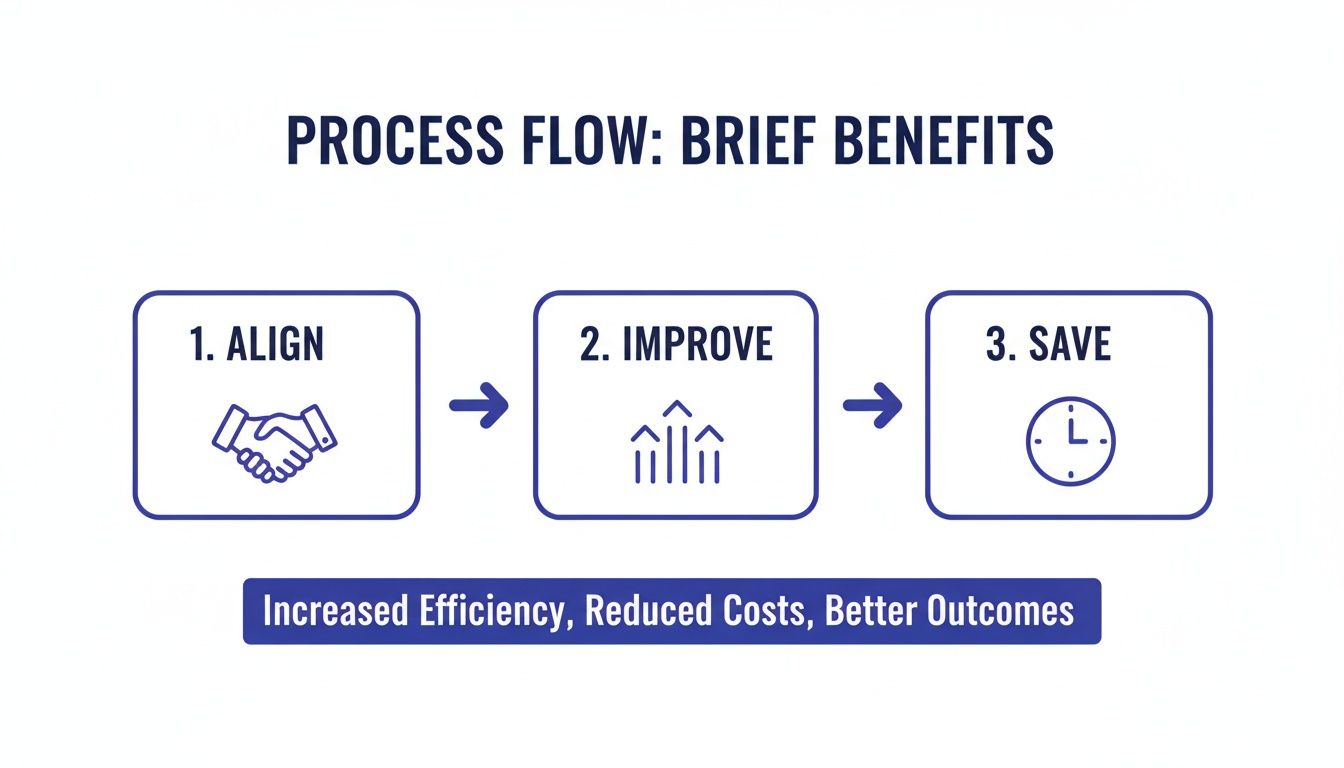
This really is the secret sauce. Align your team, improve the work, and save time—it all starts with a better brief.
From Vague to Actionable Briefing
Turning vague instructions into actionable directives is a learned skill, but the difference it makes is night and day. A brief with clear, specific guidance empowers creators to nail it on the first draft.
Here’s a look at how to transform those common, fuzzy requests into crystal-clear instructions.
| Brief Component | Vague (Ineffective) Example | Actionable (Effective) Example |
|---|---|---|
| Objective | "Create a blog post to get more traffic." | "Drive 500 organic visits by ranking for the keyword 'social media content calendar'." |
| Audience | "Target small business owners." | "Target solo entrepreneurs running e-commerce stores with less than $50k annual revenue." |
| Tone of Voice | "Be professional but friendly." | "Write in an encouraging, expert tone, like a mentor. Avoid corporate jargon; use short sentences." |
| Call to Action | "Get them to sign up." | "End the post with a direct CTA to download our 'Free Content Calendar Template'." |
See the difference? One leaves the creator guessing, while the other gives them a clear target to hit. That clarity is what leads to content that actually performs.
Briefing for a Multi-Platform Social World
Let's be real: the days of writing one generic content brief and blasting it out everywhere are long gone. This is especially true in the wild, fast-paced world of social media.
Just telling a creator to "make a video for social" is a recipe for disaster. You'll get bland, underperforming content every single time. Why? Because each platform is its own little universe with its own rules, user expectations, and weird cultural quirks. If you want content that actually works, you have to learn how to brief for this reality.
A single campaign idea needs to be adapted, not just copy-pasted. The buttoned-up, professional tone you’d use for a LinkedIn carousel will absolutely tank on TikTok, where people want raw authenticity and a good laugh. Your brief has to be the translator, guiding creators on how to remix that core message for each unique audience.

Specifying Technical and Format Details
This is the non-negotiable part. Getting the technical details right is crucial, and they need to be crystal clear in your brief. Any ambiguity here leads to unusable assets, missed deadlines, and a whole lot of wasted time and money. Don't just say "video for Instagram." Get specific.
For every single platform, you need to spell out:
- Dimensions & Aspect Ratio: Are we talking a 9:16 vertical video for Reels or a classic 1:1 square image for the grid?
- File Format & Size: Does the platform have a weird quirk, like needing an MP4 file under 100MB?
- Length Constraints: A Reel can run up to 90 seconds, but a single Instagram Story is capped at 15 seconds. That's a huge difference.
- Text-Safe Zones: You have to show creators where not to put text overlays so they don't get covered by the platform's UI elements like the username or call-to-action buttons.
I've seen so many projects go sideways because the creator wasn't aware of the different video length limits across formats. It's a costly mistake. Pointing them to a resource like these detailed Instagram video length guidelines can save everyone a massive headache.
Adapting Your Message and CTA
Okay, once the tech specs are nailed down, you need to give distinct creative direction for each platform. This is where you tailor the tone, the copy, and the call-to-action to feel native to the environment.
Let's imagine you're launching a campaign for a new project management tool. A single, generic brief is useless. A smart multi-platform brief would break it down like this:
| Platform | Tone of Voice | Core Angle | Call to Action (CTA) |
|---|---|---|---|
| Professional, authoritative, data-focused. | "Boost your team's productivity by 25%." Showcase a case study in a slick carousel format. | "Download our free efficiency report to learn more." | |
| Aspirational, visually polished, benefit-driven. | "Stop drowning in tasks. Find your workflow zen." Create a visually pleasing Reel showing a satisfyingly organized dashboard. | "Tap the link in our bio to start your free trial." | |
| TikTok | Relatable, humorous, trend-aware. | "POV: Your manager assigns another 'urgent' task." Use a popular audio to show the chaos before and the calm after using the tool. | "Comment 'HELP' if this is you! Check out the link in bio." |
A successful multi-platform brief doesn’t just list platforms; it provides a unique strategic playbook for each one. This empowers creators to produce native content that feels authentic and drives platform-specific results.
This approach makes sure your core message stays consistent, but the execution is perfectly tuned for how people actually use each app. When you invest the time upfront to create these platform-specific instructions, your brief stops being a simple request and becomes a powerful tool for blowing up your reach and impact across your entire social footprint.
Connecting Content to Business Goals with KPIs
Let’s be honest. Pushing out content without a plan to measure it is like building a beautiful car with no engine. It might look fantastic, but it's not going anywhere. A truly actionable content brief has to connect the dots between the creative work and the actual business impact.
Your brief is the perfect place to lay out exactly how the content will find its way to your audience. Don't just hope for the best; specify the primary and secondary channels you'll use. This small step ensures the final asset is optimized for those specific platforms right from the start, saving you headaches later.
This kind of strategic thinking is more critical than ever. The demand for skilled content creators is exploding, with the copywriting market alone expected to reach USD 42.83 billion by 2030. To cut through the noise, every single piece of content needs a clear purpose and a way to measure its success. You can read the full research on the growing copywriting market to get a sense of just how competitive this space is becoming.
Defining Your Distribution Channels
Your brief should have a crystal-clear section outlining where this content will live and how you’ll promote it. This isn't just a logistical detail—it forces you to think strategically before a single word is written.
Here’s a simple way to break it down:
- Primary Channels: These are your home base—the owned media platforms where the content gets published first. Think of your company blog, main YouTube channel, or email newsletter.
- Secondary Channels: This is your amplification strategy. How are you going to spread the word? This includes social media promotion (like a LinkedIn post linking to your new blog), paid ads, or even outreach to partners.
For instance, a brief for a new video case study might list "Company Blog" as the primary channel. The secondary channels could be "LinkedIn, Twitter, and targeted sales emails." This immediately tells the video editor they'll need to create some slick, social-friendly clips for the promotion plan.
Tying Metrics to Your Objectives
Once you know where the content is going, you have to define what a "win" looks like. This is where Key Performance Indicators (KPIs) come into play. Forget vague goals like "get more views." That's not a strategy. Instead, link specific metrics directly back to the original objective you set for the content.
A KPI without a connection to a business goal is just a vanity metric. True measurement is about tracking progress against a specific, meaningful objective that moves the needle for the business.
Let’s make this real. Imagine your objective is to generate qualified leads for your new software.
| Content Objective | Key Performance Indicator (KPI) | How to Measure It |
|---|---|---|
| Generate 50 MQLs | Conversion Rate | Track the percentage of landing page visitors who fill out the demo request form. |
| Increase Brand Awareness | Social Media Reach | Monitor the total unique impressions on promotional posts across all platforms. |
| Drive Organic Traffic | Keyword Rankings | Use an SEO tool to track the article's position for its primary and secondary keywords. |
When you embed these KPIs directly into your brief, you create a powerful feedback loop. Everyone on the team—from the writer to the marketing manager—knows exactly what the target is. This kind of alignment is a fundamental part of building a successful content machine, which we dive into in our guide on how to create a content strategy. It transforms your brief from a simple to-do list into a strategic tool that drives real, measurable results.
Templates and Tools to Streamline Your Workflow
Knowing how to write a solid content brief is one thing. Actually cranking them out consistently, especially when deadlines are piling up, is a completely different beast. This is where a smart system of templates and tools can turn a tedious chore into a smooth, scalable part of your operation.
A good template isn't just a glorified checklist. It's a standardized framework that acts as your safety net, ensuring no critical detail gets overlooked, no matter how chaotic the day gets. It bakes consistency right into your workflow, which makes bringing on new writers or freelancers a breeze and keeps quality high across every single project.
Building Your Go-To Content Brief Template
First things first, create a master template that covers every component we've talked about. This document becomes your single source of truth, something your whole team can easily find and use.
Here’s a practical structure you can copy and paste to get rolling immediately:
- Project Overview: A quick summary of what this content is for.
- Primary Objective: What’s the single most important thing this piece needs to achieve? (e.g., Generate 25 demo sign-ups).
- Target Audience: Who are we talking to? Get specific with persona details.
- Core Message: The one big idea the audience absolutely must walk away with.
- Key Talking Points: 3-5 essential bullet points that have to be included.
- Tone of Voice: Be descriptive (e.g., "Mentor-like and encouraging, but absolutely no corporate jargon").
- SEO & Keywords: List the primary and secondary keywords, with any notes on placement.
- Distribution Channels: Where will this content live and be promoted?
- KPIs: How will we know if we succeeded? (e.g., Click-through rate on the main CTA).
- Deadlines: Hard dates for the first draft and the final, approved version.
A template isn't there to box in creativity; it's there to eliminate the administrative guesswork. It frees up your creators to do what they do best—make amazing content—by giving them a clear and reliable roadmap every single time.
This foundation is more important than ever. With the global content writing services market projected to rocket to USD 35.63 billion by 2032, efficient briefing is no longer just a nice-to-have. You can discover more insights about the content services market to see why this is so critical.
From Static Documents to Dynamic Workflows
A template is a fantastic start, but let's be real—in a busy, collaborative team, a static Word doc or Google Sheet quickly becomes a bottleneck. You end up emailing versions back and forth, trying to track feedback in messy comment threads, and hunting for assets buried in different folders. It's organized chaos. This is where specialized tools really shine.
Platforms like PostSyncer were built to solve these exact headaches. They take your static brief and turn it into a living, breathing part of your content machine. By integrating the brief directly into a shared workspace, every stage of the process is connected.
Here’s a glimpse of how a collaborative workspace can pull all your content planning and briefing into one central hub.
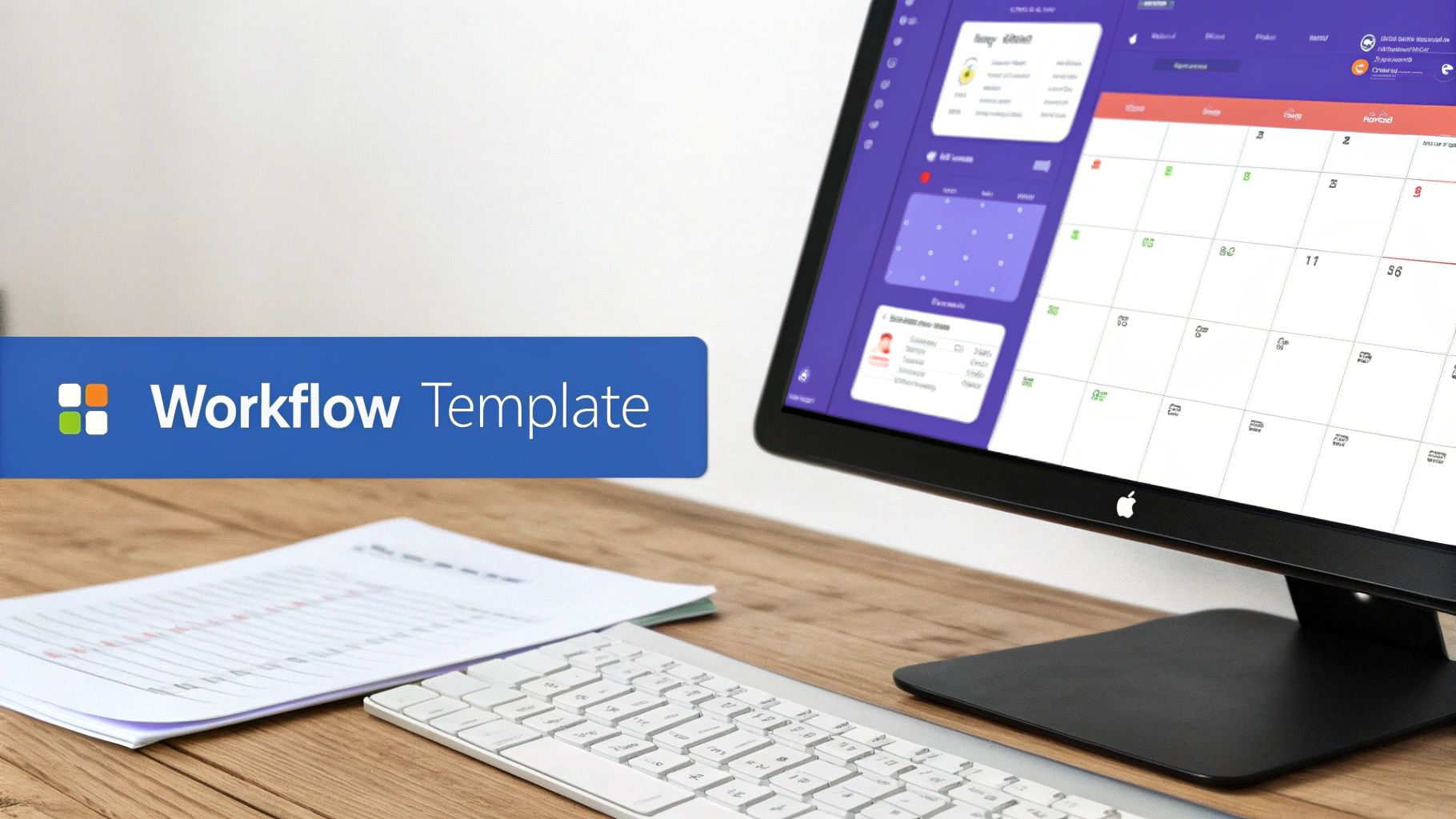
This kind of integrated view brings everything together: the brief, the content calendar, the assets, and the approval process.
Instead of a disjointed process spread across multiple apps, you get a single, unified workflow. Team members can see their assignments on a shared calendar, click into a task to find the brief and all necessary assets, and manage approvals without ever leaving the platform. This is especially powerful for mapping out complex campaigns, a topic we dive into in our social media calendar template guide.
When you combine a smart template with the right tool, you create an efficient system that can actually keep up with your team's ambition.
Common Questions About Writing Content Briefs
Even with a killer template in hand, practical questions always pop up when a team finally gets serious about the briefing process. Let's dig into some of the most common hurdles I've seen, so your briefs become a tool your team loves, not just another box to check.
One of the first things people ask is about getting the detail right. It's a real balancing act.
How Detailed Should a Content Brief Be?
The goal is to provide clarity, not a cage. A truly great content brief gives a writer or creator all the strategic context they need—the objective, the audience, the core message—but it leaves plenty of room for their creative magic to happen.
Think of it like this: the brief needs to nail down the "what" and the "why," but the creator should always own the "how."
A brief goes off the rails when it starts dictating sentence structure or trying to micromanage creative choices. Your job is to define the target and the boundaries; their job is to hit that target in their own style.
Here’s the acid test. If a writer constantly has to ask for clarification on the goal, audience, or key takeaways, your brief is too thin. On the flip side, if they feel like they’re just connecting the dots in a paint-by-numbers exercise, it’s way too restrictive.
Who Should Write the Content Brief?
This really depends on how your team is set up, but what matters most is that ownership is crystal clear. Whoever writes the brief needs to have a solid grasp of both the high-level content strategy and the specific goals for that piece of content.
- In-House Teams: This responsibility usually lands with the Content Manager or Marketing Manager—the person who lives and breathes the content calendar and strategy.
- Agencies: Typically, an Account Manager or a Content Strategist owns the brief. They're the ones who act as the bridge between what the client wants and what the creative team needs to deliver.
At the end of the day, the right person is the one closest to the strategy. That’s how you ensure every brief is perfectly aligned with the bigger business objectives.
How Do I Get My Team to Actually Use Briefs?
Getting buy-in is everything. If your team sees briefs as just more administrative work, they’ll get ignored or filled out half-heartedly. The trick is to frame them as a tool that makes everyone's job easier.
Show your writers how a solid brief helps them nail the first draft faster, cutting down on those soul-crushing revision cycles. For stakeholders, you can demonstrate how briefs ensure consistency and tie content directly back to measurable results.
When the whole team starts to see the brief as a time-saver and a quality-driver, adoption just naturally follows.
Ready to turn your briefs into a dynamic, collaborative workflow? PostSyncer centralizes your content planning, briefing, and approvals in one place, saving your team hours and ensuring every piece of content hits the mark. Start your free 7-day trial of PostSyncer today.