











A great creative brief does one thing exceptionally well: it translates messy business goals into a clear, inspiring roadmap for your creative team.
It’s where you pin down your objective, get laser-focused on your target audience, and articulate a single, compelling message that will guide every piece of work that follows. This isn't just a document; it's the strategic foundation for any successful campaign.
Why Your Brief Is the Bedrock of Great Creative
Before we get into the nitty-gritty of what goes into a brief, let's talk about why it’s so much more than just administrative paperwork.
I’ve seen it time and time again: a well-crafted creative brief is the single source of truth that stops endless, costly revisions in their tracks. It gets everyone on the same page and, most importantly, gives your team the confidence and clarity they need to do their best work. Honestly, writing the brief is the first—and most critical—creative act of any project.
Without this strategic anchor, projects just drift. Teams are left guessing at objectives, which inevitably leads to misaligned expectations, wasted budgets, and creative that just doesn't land. The brief is your compass, making sure every decision—from the copy to the visuals—points toward the same North Star.
The Strategic Blueprint for Success
Think of the brief as the blueprint for a house. You’d never dream of starting construction without one, right? The same goes for any creative project.
The process forces you to answer the tough strategic questions upfront, demanding clarity before a single dollar is spent on execution. It’s the bridge between the business side of the house and the creative side, translating metrics and KPIs into an exciting challenge. This isn't about boxing creatives in; it's about focusing their incredible talent on the right problem.
A great brief inspires. It gives just enough information to define the problem and the sandbox, then trusts the creative team to build the castle. It’s the difference between saying "make a blue button" and "create a design that makes users feel confident about their purchase."
Aligning Teams and Preventing Chaos
This isn't just my opinion; the data backs it up. In a landmark study by the Association of National Advertisers (ANA), over 900 executives were asked what enables effective creative work. The number one answer? 'A tight brief with clearly defined objectives.' It beat out every other factor, making it clear that a bad brief is the biggest roadblock to success.
When the brief is solid, everyone—the designer, the copywriter, the marketing manager—is working from the same playbook. It creates a shared understanding of what "done" and "successful" actually look like.
This alignment is also crucial for brand consistency. The brief should always tie back to your core brand identity. If you're still solidifying that foundation, our guide on how to create brand guidelines is a great place to start. A strong brief ensures every campaign reinforces who you are, creating a seamless experience for your audience.
The difference between a project that starts with a strong brief and one that doesn't is night and day. It's the ultimate "work smarter, not harder" tool.
The Impact of a Strong vs Weak Creative Brief
Investing an hour upfront to write a killer brief can save you days of headaches and revisions later. The contrast in outcomes is stark.
| Attribute | Strong Brief (Clarity & Strategy) | Weak Brief (Vague & Unfocused) |
|---|---|---|
| Creative Output | Inspired, on-target, and effective work that solves the business problem. | Generic, misaligned creative that misses the mark and requires heavy revisions. |
| Team Morale | Empowered, confident, and motivated. The team understands the "why." | Frustrated, confused, and demotivated. Constant guesswork leads to burnout. |
| Revisions | Minimal and focused on refinement. Edits are strategic, not reactionary. | Endless cycles of feedback and major redos. "I'll know it when I see it." |
| Timeline & Budget | Projects stay on track and within budget. Resources are used efficiently. | Delays, scope creep, and budget overruns are almost guaranteed. |
| Stakeholder Alignment | Everyone is on the same page from day one, leading to smoother approvals. | Conflicting feedback from different stakeholders creates chaos and rework. |
| Final Results | The campaign achieves or exceeds its goals, delivering measurable business impact. | Underwhelming results that fail to move the needle. A wasted opportunity. |
Ultimately, a strong brief respects your team's time and talent, setting them up for a win. A weak one does the exact opposite, creating friction and leading to subpar work that helps no one.
The Core Components of an Effective Creative Brief
Think of a creative brief as the blueprint for your entire campaign. Just like a builder wouldn't dream of starting a house without precise plans, your creative team needs a crystal-clear, strategic document to build work that actually hits the mark.
Skimping on this step is like telling a construction crew to "just build something cool" and hoping for the best. It rarely ends well.
Each piece of the brief has a job to do, turning fuzzy business goals into a concrete, actionable roadmap. When all these components work in harmony, they create the clarity needed to sidestep miscommunication and spark genuinely great ideas. If you neglect even one, you're setting yourself up for confusion, endless revisions, and a final product that just falls flat.
This flowchart says it all: a weak brief is a direct path to chaos, while a strong one is the foundation for a smooth, successful project.
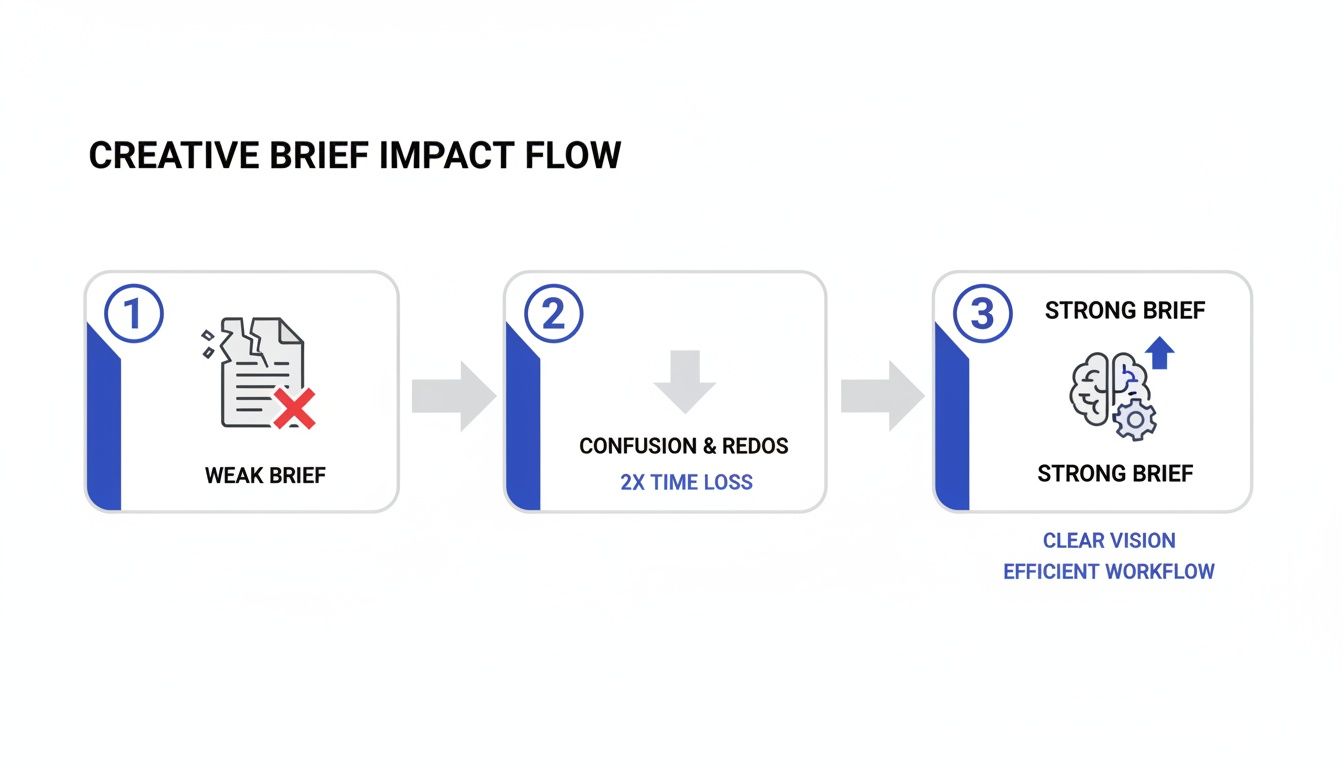
It's a simple equation: the time you invest upfront in a solid brief pays off tenfold in workflow efficiency and killer creative.
Project Background and Business Objective
Every single creative project exists to solve a business problem. Period. This first section needs to set the stage by answering two critical questions: "Why are we even doing this?" and "What does a win actually look like?"
Kick things off with a tight project background. Give just enough context for a total newcomer to get up to speed. Are you launching a new product? Fighting back against a competitor's latest campaign? Trying to pull out of a sales slump?
Next, lock in the business objective. This is the measurable, tangible outcome you're chasing. Steer clear of vague fluff like "increase brand awareness." Instead, get specific using the SMART goal framework—make it Specific, Measurable, Achievable, Relevant, and Time-bound.
- Weak Objective: "Get more people to know about our new app."
- Strong Objective: "Achieve 10,000 new app downloads and a 15% lift in user sign-ups by the end of Q3."
Your objective is the North Star for the entire project. Every single creative decision, from the font choice to the headline, must be weighed against it. If an idea doesn't serve the objective, it's the wrong idea—no matter how clever it seems.
The Target Audience Deep Dive
This is where so many briefs fall apart. Just writing down demographics like "Females, 25-40" is lazy and gets you nowhere. To create work that connects, you have to dig deeper and understand the actual human beings you're trying to reach. A truly powerful audience profile brings a person to life, moving way beyond what they are to who they are.
This means getting into psychographics—their values, attitudes, interests, and lifestyles. What keeps them up at night? What are their secret ambitions? What podcasts are they listening to, and which influencers do they actually trust? Answering these questions gives your creative team empathy, which is the secret ingredient for crafting a message that feels authentic and lands with real impact.
Example Audience Profile
| Category | Description |
|---|---|
| Demographics | Urban millennial parents (28-38) with young kids (ages 2-6) and a household income of $80k+. |
| Psychographics | They're constantly short on time but deeply value family experiences. They carry a lot of guilt about screen time and are always searching for educational, guilt-free activities for their kids. They trust recommendations from parent bloggers and feel paralyzed by too many choices. |
| Pain Point | Finding engaging, non-digital activities for their children that are both fun and developmental is a constant, exhausting struggle. |
This level of detail gives your team a real person to talk to, not just a faceless demographic. It's the difference between shouting into the void and having a meaningful conversation.
The Single Most Important Message
If your audience could only remember one thing from your entire campaign, what would you want it to be? That's your Single Most Important Message (SMIM). It's the one focused, powerful idea that all your creative work must communicate.
A classic mistake is trying to say too many things at once, which just dilutes your impact. A brief with a laundry list of messages—we're affordable, high-quality, eco-friendly, and innovative!—is a surefire recipe for bland, forgettable creative. You have to be ruthless and choose the one thing that will be most persuasive to your audience.
Your SMIM should be:
- Simple: Can be understood in a single, clear sentence.
- Relevant: Directly speaks to the audience's pain point or desire.
- Unique: Sets you apart from the competition.
For that organic snack brand targeting the parents we just profiled, a strong SMIM might be: "The only healthy snack that makes learning fun, so you can finally feel good about what your kids are eating."
Tone of Voice and Mandatories
The tone of voice is all about the personality of your brand's communication. It’s not what you say, but how you say it. Are you witty and playful, or are you authoritative and serious? Should you be inspirational, or more down-to-earth and relatable? Giving a few keywords (e.g., "Confident, encouraging, simple") and showing examples of what the tone is and is not can be a massive help.
Mandatories, on the other hand, are the non-negotiables. This is where you list any specific rules the creative absolutely must follow. This could include things like:
- Legal disclaimers that have to be on every ad.
- The brand logo, tagline, or a specific call-to-action.
- Any restrictions, like avoiding certain words or types of imagery.
But be careful. This section is meant to provide guardrails, not a creative straitjacket. The goal is to define the constraints without killing creativity. To get a handle on all the key elements, you can explore another perspective on what is in a design brief. A well-defined brief is a core part of any solid marketing plan. For a look at the bigger picture, see our guide on how to create a content strategy and see where briefs fit in.
Deliverables and Key Milestones
Finally, you have to be painstakingly clear about what you actually expect the creative team to make. This is the deliverables section. Don't just write "social media assets." Get specific.
List out every single asset needed, down to the formats, technical specs, and intended channels. A detailed list kills scope creep before it starts and ensures everyone is on the same page about what's being created.
Example Deliverables List
- Three (3) 15-second video ads for Instagram Stories & Reels (9:16 aspect ratio).
- Five (5) static image ads for Facebook & Instagram Feeds (1:1 aspect ratio).
- Ad copy for all assets, including 3 headline variations for each.
Right alongside the deliverables, lay out a realistic timeline with key milestones. This should include firm dates for the creative kickoff, concept presentation, feedback rounds, and final asset delivery. This kind of transparency helps everyone manage their workload and keeps the whole project running smoothly.
Finding the Insight That Fuels Amazing Ideas
A creative brief filled with basic information is really just a glorified to-do list. But a brief built on a powerful, unexpected insight? That’s a launchpad for incredible ideas.
Information tells you what your audience is, but insight tells you why they behave the way they do. This is where you have to move beyond assumptions and dig for the data that will genuinely supercharge your creative direction.
Your goal is to translate raw numbers into a compelling story about your audience. Your analytics dashboards are absolute goldmines, but the real value isn't in the numbers themselves—it's in the human behavior they represent.

From Data Points to a Human Story
Start by looking for patterns and—even better—anomalies in your existing data. Don't just glance at top-level metrics. It’s time to really dig into your Google Analytics, social media reports, and CRM data to uncover the hidden narrative.
- Google Analytics: Where is your most engaged traffic coming from? What search terms are they actually using? Which pieces of content keep them on-site the longest? A high bounce rate on a key page might reveal a major mismatch between your messaging and what users expect.
- Social Media Insights: When are your followers most active? What kind of content earns the most shares versus just likes? The comments section is a treasure trove of your audience's unfiltered thoughts, questions, and pain points. A comprehensive social media audit can reveal these patterns; our guide on what is a social media audit can walk you through the process.
- CRM & Sales Data: Who are your most loyal customers? What was their journey from prospect to buyer? Identifying common traits among your best customers helps you build a "pen portrait" of who you should be talking to.
This data-driven approach has a massive impact. Data from GWI shows that brands using robust audience profiling can achieve up to 40% higher engagement rates. In one case, their analysis revealed a brand’s audience massively over-indexed on Pinterest—a platform the brand had completely ignored. This single insight led to a unique creative idea that skyrocketed relevance and ROI.
An insight is a new understanding of human behavior that can unlock a new way of thinking about a problem. It’s the "aha!" moment that makes you see the audience, and the opportunity, differently.
Creating a Data-Backed Pen Portrait
Once you've gathered your data, it's time to synthesize it into a "pen portrait"—a detailed, narrative-driven profile of your ideal consumer. This goes far beyond dry demographics to capture their real behaviors, motivations, and media habits.
Instead of saying, "Our audience is women 30-45," your portrait might say:
"Meet Sarah, a 34-year-old project manager juggling a demanding career with two young kids. She feels a constant low-level anxiety about not having enough time. Her screen time report shows she spends two hours a day on Instagram after 9 PM, but our data shows her most active shopping time is 6 AM on weekdays, right before the chaos begins. She follows minimalist home organizers for inspiration, but her own life feels cluttered. Her core desire isn't just a product; it’s a feeling of control and a moment of peace."
See the difference? This portrait gives your creative team a real person to connect with. They aren’t creating for a statistic; they're creating for Sarah.
The Power of an Unexpected Angle
Let's put this into a real-world scenario. A brand selling pre-made, healthy lunches was struggling to stand out. Their initial brief focused on "convenience for busy professionals." Logical, but incredibly boring.
During their data dive, they noticed an unusual spike in website traffic and orders between 10 PM and midnight on Sundays. What was going on? They discovered their audience wasn't just buying lunch; they were trying to conquer the "Sunday Scaries"—that wave of anxiety about the upcoming workweek.
This insight changed everything.
- Old Message: "Healthy, convenient lunches."
- New Insight: "Our customers are buying back their Sunday nights from work-week anxiety."
- New Creative Angle: "Win Your Weekend Back."
The campaign shifted from sterile food photography to relatable scenes of people enjoying their Sunday evenings, free from the chore of meal prep. This single, data-backed insight unlocked a powerful emotional angle the competition had completely missed, making the brief—and the work—far more effective.
To truly find the insights that fuel amazing ideas for your creative brief, leveraging powerful audience research tools can help you dig even deeper.
A Real-World Creative Brief Template You Can Steal
Theory is great, but let's get our hands dirty. The best way to understand a creative brief is to see one in action. We're going to move past the abstract and into a practical, annotated template you can actually use.
This isn't just another fill-in-the-blanks doc. We're going to reverse-engineer how a legendary brand might have approached this very process. Imagine how Nike could have used a brief like this to kick off a campaign that didn't just sell shoes, but changed culture. That's how you see the real power of this simple document—it's the strategic launchpad for something massive.

The Anatomy of a World-Class Brief
Here’s a breakdown of the key fields you'll find in our template. I've added some expert commentary on what to aim for in each section, using a hypothetical scenario inspired by one of the greatest campaigns of all time to make it crystal clear.
1. Project Background
This is where you set the stage. It’s the short, sharp answer to the question, "Why are we doing this, right now?" It provides the market context, the competitive chatter, and the business reality that makes this project a necessity.
- How to Write It: Give a bird's-eye view of the current business situation. What’s happening in the market? Who are the key competitors making noise? What internal goals are driving this? Keep it tight.
- Nike 'Just Do It' Example: It's the late 1980s, and our brand is seen as being for elite marathon runners only. But the fitness boom has opened the floodgates to everyday people, and we're losing ground to competitors speaking their language. We have to close this gap and make Nike mean something to anyone who moves.
See? That context immediately frames the business problem: we're losing relevance with a massive new audience.
2. Business Objective
Now we get specific. This is the measurable, bottom-line goal the business needs to hit. Forget vague aspirations—this needs to be a concrete target.
- How to Write It: Think SMART goals. Define what victory looks like in hard numbers.
- Nike 'Just Do It' Example: Increase our US market share from 18% to 25% within two years. We need to reclaim our spot as the number one athletic brand for all athletes, period.
A great creative brief doesn’t just ask for an ad; it asks for a business solution. The objective is the finish line everyone on the project is running toward.
That original 1988 'Just Do It' brief was pure magic. It fueled a strategy that blew its goals out of the water, catapulting Nike's US market share from 18% to over 40% by 1998. The brand's revenue skyrocketed from $877 million to $9.2 billion in that same decade. If you want to dive deeper, Grassroots Creative Agency has a great write-up on how this insight redefined a global icon.
3. The Target Audience
Time to go deeper than demographics. This is where you paint a vivid picture of the human being you're trying to connect with. What keeps them up at night? What are their real-world struggles?
- How to Write It: Zero in on the psychographics—their mindset, values, and emotional state.
- Nike 'Just Do It' Example:
- Primary Audience: The "Everyday Athlete." These aren't pros. They're regular people battling self-doubt, procrastination, and that nagging voice that says, "I can't." Their fitness journey is a mental war just as much as a physical one.
- Secondary Audience: The "Elite Athlete." We still need them for credibility, but the creative must tap into the universal mindset that connects them to the everyday person.
This single insight—that the internal battle is universal—was the key that unlocked the entire campaign.
4. The Single Most Important Message
If your audience only remembers one thing from your campaign, what is it? This is the core idea, the strategic heart of the brief that all creative work must serve.
- How to Write It: Be ruthless here. Cut everything that isn't essential. It should be a simple, powerful, and emotionally resonant sentence.
- Nike 'Just Do It' Example: Nike gives you permission to push through your own barriers and just begin.
Notice it’s not about shoe tech or performance stats. It's an emotional message of pure empowerment, which is why it has resonated for decades.
Key Sections of a Creative Brief Template
To help you get started on your own brief, here's a quick-reference table summarizing the other essential components you'll need. Think of it as your pre-flight checklist.
| Section | Key Question to Answer | Pro-Tip |
|---|---|---|
| Tone of Voice | What is the personality of our message? | Use 3-5 descriptive adjectives (e.g., "Empathetic, direct, motivational, unapologetic"). |
| Mandatories | What absolutely must be included? | List non-negotiables like the logo, tagline, or specific legal disclaimers. Keep this list short. |
| Deliverables | What exactly do we need to create? | Be specific: "One 30-second TV spot, three full-page print ads, and two radio ads." |
| KPIs | How will we measure success? | Connect back to the objective: "Track brand sentiment lift and quarterly sales figures." |
This structure ensures you cover all your bases, from the high-level strategy down to the practical execution details.
By following this template, you aren't just filling out a form. You’re building a strategic weapon that inspires brilliant creative and drives tangible business results.
Common Briefing Mistakes and How to Fix Them
Even with the best of intentions, a creative brief can go sideways. Instead of creating clarity, it creates confusion. The good news? The most common pitfalls are surprisingly easy to spot and fix once you know what you're looking for.
Getting these right from the start is the difference between a project that sings and one that just… stalls. Let's walk through a few of the classic blunders I see all the time and, more importantly, how to sidestep them completely.
The Shopping List Objective
This is probably the most frequent mistake I run into. The objective section reads like a frantic shopping list: "This campaign needs to increase brand awareness, drive website traffic, generate leads, boost social engagement, and improve customer loyalty."
You can almost feel the creative team's eyes glaze over.
When you ask for everything, you end up with nothing specific. It’s like trying to hit five different targets with a single arrow—you're almost guaranteed to miss them all. A creative team needs one clear thing to aim for.
How to Fix It: Get ruthless with your priorities. Ask the tough question: "If this campaign could only achieve one single thing for the business, what would it be?" This forces you to nail down the most critical problem you're trying to solve. Any other positive outcomes are just happy bonuses, not the main event.
A brief that tries to be everything to everyone ends up being nothing to anyone. Your job is to provide a laser focus, not a laundry list of wishes. The tighter the objective, the sharper the creative.
Using Vague, Subjective Language
Here's another classic. The brief is littered with empty phrases that sound important but mean absolutely nothing. We’ve all seen them: "make it pop," "give it a wow factor," or the dreaded "we need something more innovative."
These words are creative kryptonite. They're frustrating because they're impossible to act on.
This kind of fuzzy language is usually a symptom of a bigger issue: the strategic thinking hasn't been done yet. If you can't articulate what you want in clear, objective terms, you haven't truly defined the problem.
How to Fix It: Swap out those subjective words for solid, strategic direction. Instead of asking for a design to "pop," define the outcome you're after.
- Vague: "The design needs to be more modern and clean."
- Actionable: "The design should use more white space and a sans-serif font to appeal to our minimalist-loving Gen Z audience, as defined in our audience profile."
See the difference? One is a guess. The other provides clear guardrails the creative team can actually work with.
Failing to Secure Stakeholder Buy-In
This one is a project-killer. You’ve written the perfect brief, pouring your heart and soul into it… but you did it in a silo. You fire it over to the team, work begins, and then, at the very first review, a senior stakeholder who has never seen the brief swoops in with feedback that completely contradicts it.
The project grinds to a halt. All that momentum, gone.
This happens when the brief isn't used as a collaborative alignment tool from the get-go. A brief that isn't signed off on by all key decision-makers isn't a source of truth—it’s a landmine waiting to go off.
How to Fix It: Build collaboration into the process from day one.
- Involve stakeholders early: Don't wait until the brief is "done." Get input from every key decision-maker before you finalize it.
- Hold a formal kickoff: Get the stakeholders and the creative team in the same room (or video call) and walk through the final brief together. This is the time for questions and clarifications.
- Get a formal sign-off: Before a single pixel is designed, require every stakeholder to formally approve the brief. This document now becomes the project's constitution, protecting everyone from subjective feedback and scope creep down the road.
Your Creative Brief Questions, Answered
Even with a solid template in hand, a few practical questions always seem to pop up when it's time to actually write a creative brief. Getting the answers straight from the start can save everyone a ton of headaches down the line.
Let's tackle the most common ones I hear all the time.
How Long Should a Creative Brief Be?
The golden rule is clarity, not length. Ideally, a brief should fit on a single page, maybe two at the absolute most. It needs enough meat to give your team real strategic direction, but it has to be lean enough for a busy creative to scan and digest in minutes.
If you find yourself writing a multi-page novel, you’ve gone too far. You're burying the essential insight. Your job is to be ruthlessly concise. Every single word has to earn its spot by either guiding or inspiring the team. Think of it as a strategic cheat sheet, not a comprehensive report.
Who Is Responsible for Writing the Creative Brief?
This is a team sport, but someone has to own it. Usually, an account manager, strategist, or brand manager takes the lead because they're closest to the client's business goals. They're responsible for corralling all the necessary input from marketing teams, client contacts, and anyone else with a stake in the project.
But here’s a pro tip: the secret to a brief that actually gets creatives excited is to bring them into the process. Involve an art director or copywriter in the final stages. Their perspective is absolutely crucial to make sure the brief is not just strategically sound but also genuinely inspiring and actionable for the people doing the work. Shared ownership is everything.
A brief isn't a command handed down from above. It’s a pact—a shared agreement between the business side and the creative side on what winning looks like and how you're going to get there together.
What Is the Difference Between a Creative Brief and a Project Brief?
This is a big one, and the confusion can cause real problems. While the two documents are related, they do very different jobs.
Here’s the simplest way to think about it:
- A project brief is all about the how and when. It's the logistical blueprint covering timelines, budgets, resources, and all the project management details. It’s operational.
- A creative brief is all about the why. It digs into the strategy and inspiration—the audience, the core message, the emotional takeaway, and the business problem you’re trying to solve.
One inspires the idea, the other ensures it gets executed efficiently. You need both.
How Do You Ensure the Creative Team Actually Uses the Brief?
A brilliant brief that nobody reads is just a waste of time. To make sure it becomes an indispensable tool, you have to treat it like one.
First, hold a proper kickoff meeting. Don't just fire off an email with the brief attached and cross your fingers. Walk the team through it. Talk about the strategy. Answer their questions. This is where you build shared understanding and get everyone on the same page from day one.
Second, make it a living, breathing part of the project. Refer back to it constantly during creative reviews. When you’re giving feedback, anchor your comments to the brief. Instead of saying "I don't like this color," try, "Does this visual approach align with our goal of reaching a younger demographic as we defined it in the brief?" This simple habit cements the brief’s role as the project's single source of truth.
Ready to turn your killer creative briefs into high-performing social media campaigns? PostSyncer gives you the tools to manage your entire workflow, from creating and scheduling content to tracking analytics. Streamline your process and see what your team can really do. Start your free 7-day trial today.