








A solid brand awareness strategy is your roadmap to becoming memorable on social media. It’s not about throwing content at the wall and seeing what sticks; it’s a deliberate plan to build recognition and trust with the right people, so your brand is the first one they think of. This is how you turn casual scrollers into a loyal community.
Defining Your Brand's Foundation for Social Media

Before you even think about posting, the most important work happens behind the scenes. Skipping this foundational step is like building a house on sand—it might look fine for a minute, but it's guaranteed to collapse. A successful brand awareness strategy starts with having total clarity on who you are, who you're talking to, and what you're trying to accomplish.
This goes way beyond picking a logo or a few brand colors. It’s about nailing down the core identity that will inform every single piece of content you create. Without it, your social media efforts will feel random and fail to leave any real impression.
Establish Clear and Meaningful Objectives
Your goals are the North Star for your entire strategy. It’s crucial to move past vanity metrics like "getting more likes" and focus on objectives that actually tie back to real business outcomes. What does success truly look like for your brand?
The best goals are always SMART: Specific, Measurable, Achievable, Relevant, and Time-bound. This simple framework turns fuzzy wishes into concrete targets.
For example, instead of "get more engagement," try something like:
- Increase brand mentions on Instagram by 20% within the next quarter by launching a user-generated content campaign.
- Grow branded search queries by 15% in six months by creating educational YouTube videos that answer common industry questions.
- Boost website referral traffic from social channels by 25% over the next year by consistently sharing valuable blog content.
When you tie your social media goals to bigger business KPIs, you can actually prove the value of your work to stakeholders and make a solid case for future investment.
Develop Detailed Audience Personas
You can't build awareness if you don't know who you're building it for. Creating detailed audience personas turns abstract data into a real person you can talk to, making it so much easier to craft content that genuinely connects. Go beyond the basic demographics and get into the psychographics—the why behind their actions.
A great persona should feel like someone you know. Instead of "millennial female, age 30," let's create "Eco-Conscious Elena."
- Who is she? A 32-year-old graphic designer in a major city who is passionate about sustainability and ethical brands.
- What are her pain points? She struggles to find stylish, eco-friendly products that fit her budget and feels overwhelmed by all the corporate greenwashing.
- Where does she hang out online? She’s all over Instagram following sustainability influencers, subscribes to curated newsletters, and is active in niche Facebook groups for ethical living.
See how much easier it is to create content now? You know exactly what kind of message will grab Elena’s attention and solve a problem for her. To get a better sense of the bigger picture, you can explore some other powerful brand awareness strategies.
Define Your Unique Brand Voice and Style
Last but not least, how are you going to show up? Your brand voice is your personality, and your visual identity is how you dress. Consistency here is non-negotiable if you want to be recognizable. Are you witty and a little sarcastic like Wendy's, or are you inspiring and authoritative like Nike?
Get this down on paper in a simple style guide:
- Voice & Tone: Pick 3-5 adjectives that describe your brand's personality (e.g., "Playful, helpful, direct"). Add a few "we say this, not that" examples.
- Visuals: Lock in your color palette (with hex codes), primary and secondary fonts, and logo usage rules. Outline the kind of photography or illustration style you’ll use. For a deeper dive, check out our complete social media branding guide.
Doing this prep work ensures that every single tweet, story, and comment feels authentic to your brand. It’s how you become instantly recognizable in a sea of endless content.
Choosing Where to Tell Your Brand Story
Your audience isn't everywhere, so your brand shouldn't be either. I've seen so many businesses fall into the trap of thinking they need a presence on every single social media platform. It's a tempting thought, but a scattergun approach is one of the fastest ways to burn through your budget and water down your message.
An effective brand awareness strategy isn't about shouting from every rooftop; it's about having meaningful conversations in the right rooms. Forget the pressure to master every new app. The real goal is to deliberately invest your time and energy where your ideal customers are already hanging out. This means going deeper than just demographics and truly understanding the unique culture of each platform.
Matching Your Brand to Platform Culture
Every social channel has its own vibe—its own unwritten rules, content styles, and user expectations. A post that gets amazing engagement on Instagram could be a total dud on LinkedIn. The trick is to find that sweet spot where your brand’s personality clicks with the platform’s native environment.
Think of them as distinct social ecosystems:
- Instagram: It's a visual-first world, perfect for brands with a strong aesthetic. Think high-quality photos, behind-the-scenes Stories, and punchy Reels.
- TikTok: This is the home of raw, trend-driven, and entertaining short-form video. Brands that win here are less polished, more human, and aren't afraid to jump on cultural moments with a bit of humor.
- LinkedIn: The professional network where authority and value are the main currencies. It’s a goldmine for B2B brands, thought leadership, and in-depth content that educates an industry-specific audience.
The way people discover new brands has completely shifted. Today, a staggering 58% of consumers find new businesses through social media, which now outpaces traditional search engines. On Instagram, it's even more powerful—83% of users say they discover new products and services right on the platform. This data, highlighted in Sprinklr's latest research, makes choosing your channels more critical than ever.
How to Select Your Core Platforms
Making the right call comes down to looking at three things: your audience data, your team's capacity, and your brand's natural strengths. A great place to start is with your audience personas. If you created "Eco-Conscious Elena," and you know she’s all over Instagram and niche Facebook Groups, those two platforms should be at the top of your list.
From there, get real with yourself and ask these questions:
- Where are our competitors getting traction? Use this for insight, not as a copy-paste plan. If a competitor is bombing on TikTok but killing it on LinkedIn, that tells you a lot about where your shared audience is most receptive.
- What content can we realistically create, consistently? If you have a knack for gorgeous visuals but lack the gear for high-production video, Instagram and Pinterest are much smarter bets than YouTube. Be honest about your resources.
- Which platform best aligns with our business goals? If you’re hunting for B2B leads, LinkedIn is a no-brainer. If you're building a D2C lifestyle brand, Instagram and TikTok are your playgrounds.
A classic mistake is jumping on a platform just because it's popular. Your strategy should be driven by where your specific audience is most engaged, not by chasing the biggest user base. It's far better to dominate one or two relevant channels than to be just okay on five.
Developing Your Foundational Content Pillars
Once you’ve picked your platforms, it's time to define your content pillars. These are the 3-5 core themes your brand will own and talk about consistently. Think of them like the main sections in your brand's own magazine—they provide structure and ensure you're never scrambling for ideas.
Content pillars are what stop you from just posting randomly. They keep your messaging focused and constantly reinforce what your brand is all about. For a sustainable fashion brand, for instance, the pillars might look like this:
- Ethical Production: Taking people behind the scenes to meet the artisans and see the materials.
- Styling Inspiration: How-to guides and user-generated content showing the clothes on real people.
- Sustainability Education: Quick tips on conscious consumerism and textile recycling.
- Brand Values: Posts that highlight company culture, the team, and community involvement.
These pillars become the backbone of your editorial calendar, guaranteeing every single post ladders up to your larger brand awareness goals. To dig deeper into how different platforms can work for you, check out our guide on the best social media platforms for business. By strategically choosing your channels and defining your pillars first, you build a focused plan that creates a brand people actually remember.
Building a Sustainable Content Workflow
Consistency is the secret weapon for brand awareness, but let’s be real—it’s also a fast track to burnout if you don’t have a solid system. A sustainable content workflow is all about creating a process that works for you, not against you. It’s the difference between frantically asking "what should we post today?" and confidently executing a plan that builds real momentum.
This is more than just scheduling a few posts. It’s about building the operational backbone for your entire content engine. When you map out key themes, campaign dates, and audience touchpoints weeks or even months ahead, you free up so much mental energy. Instead of just feeding the algorithm, you can focus on creating high-quality, resonant content. The goal is to make consistency feel almost effortless.
Think of it as a simple, three-phase flow: analyze, select, and then create.
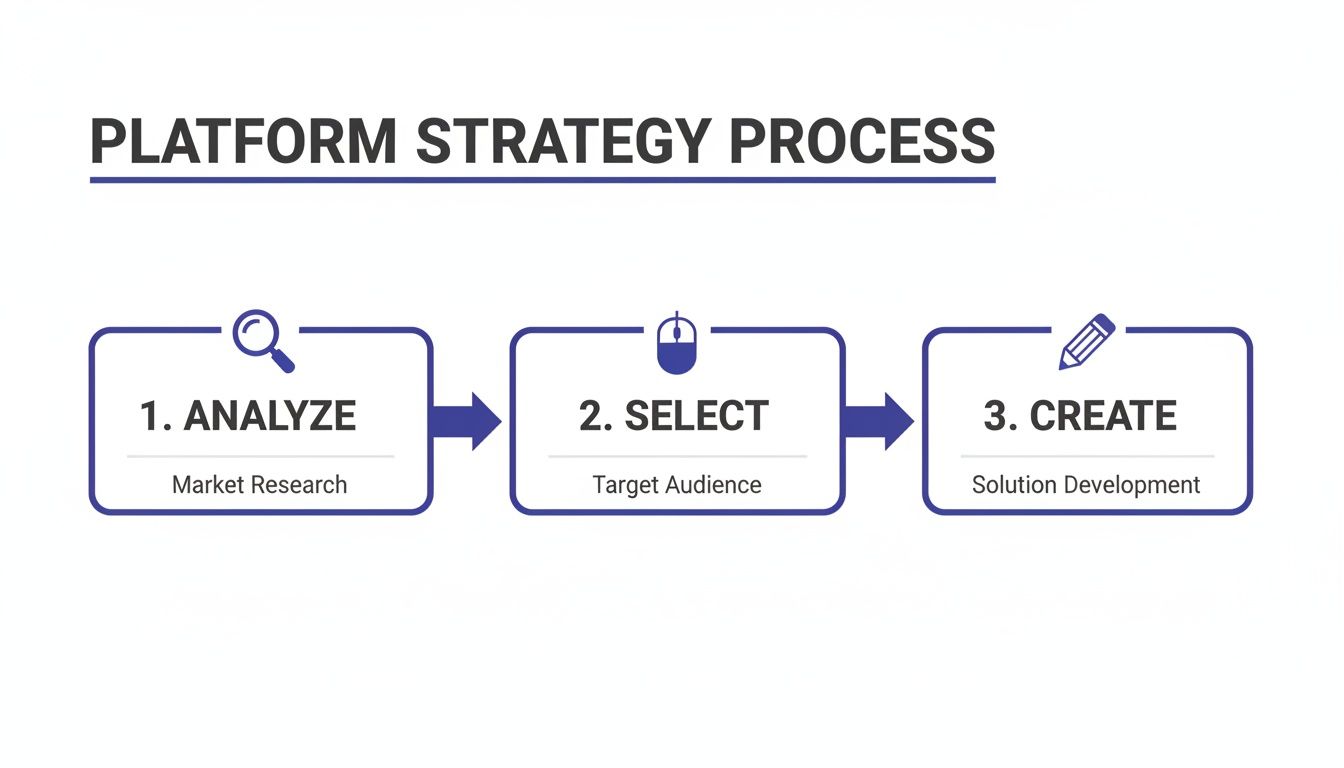
This keeps every piece of content purposeful and grounded in what you know about your audience and your goals.
Designing a Strategic Editorial Calendar
An editorial calendar is your brand's narrative blueprint, not just a list of dates. This is where you connect your content pillars to real-world events, product launches, and cultural moments your audience actually cares about. A well-designed calendar ensures a healthy mix of content—some posts will educate, others will entertain, and some will drive direct engagement.
I always recommend starting with the big rocks first:
- Quarterly Campaigns: Block out any major marketing initiatives or product launches.
- Seasonal & Holiday Hooks: Pinpoint relevant holidays or seasonal events where your brand can join the conversation authentically.
- Industry Events: Note key conferences, trade shows, or awareness days that matter to your audience.
Once you have these anchors in place, you can fill the gaps with your evergreen content pillars. This approach makes your content both timely and consistently on-brand. Trust me, a solid calendar prevents those last-minute scrambles that kill quality and consistency.
Determining Your Ideal Posting Cadence
"How often should I post?" I get this question all the time. The honest answer? It depends. There's no magic number that works for every brand on every platform. Post too little, and you're invisible. Post too much, and you risk fatiguing your audience and watering down your impact.
Finding your rhythm is a mix of knowing the platform and listening to your audience.
- Instagram & TikTok: These platforms are hungry for content. The algorithms tend to reward creators who post multiple times a week, or even daily, with a mix of Reels and Stories.
- LinkedIn & Facebook: A more measured approach often works best. Aiming for 3-5 high-quality posts per week usually outperforms a constant, noisy stream.
- YouTube: Here, consistency trumps frequency. One polished, well-produced video a week is far more effective than three rushed ones.
Your ideal posting frequency is the one you can realistically maintain without sacrificing quality. Start conservatively, watch your engagement and reach, and let the data guide your adjustments. Burnout helps no one.
Using Tools to Centralize Your Workflow
Juggling an ambitious content calendar across multiple platforms can get chaotic, fast. This is where a centralized platform like PostSyncer becomes your command center, turning a tangled process into a smooth, manageable workflow. It gives your entire team a single source of truth.
A centralized tool makes several critical jobs much easier:
- Visual Planning: A drag-and-drop calendar lets you see your whole month at a glance. It’s so easy to spot gaps, reschedule content, and ensure you have a balanced mix across channels.
- Collaborative Creation: Your team can draft posts, upload media to a shared library, and leave feedback right in the platform. No more messy email chains or lost files. Our guide on building an efficient content creation workflow has more tips on this.
- Streamlined Approvals: You can set up simple approval workflows to ensure every post is on-brand and error-free before it goes live. This is a lifesaver for quality control, especially in larger teams.
- AI-Powered Scheduling: Instead of guessing the best time to post, tools like PostSyncer can analyze your audience’s activity and automatically schedule your content for when it will get the most eyeballs.
By building a system that organizes your planning, creation, and scheduling, you create a sustainable foundation for your brand awareness strategy. This structure frees you up to focus on what really matters: telling compelling stories that build a brand people remember.
Finding the Right Mix of Organic and Paid Social Media
Figuring out your social media strategy shouldn’t be a battle between organic and paid. The magic happens when you get them working together.
Think of it like this: your organic content is the slow-burning campfire you build to create a warm, inviting space. It's where you build community and trust over time. Paid ads? That’s the fuel you strategically throw on the fire to make it visible from miles away. One is for connection, the other is for reach. When you blend them, you create something far more powerful than either could be on its own.
Fueling Community Growth with Organic Content
Organic social is your handshake, not your sales pitch. This is where you build genuine relationships and let your brand’s personality shine, one post at a time. The real goal here is to create content so genuinely helpful or entertaining that your audience wants to see it and engage.
Here are a few ways to build that real community vibe:
- Go behind the curtain: Show your team, your messy creative process, or even a mistake you learned from. Humanizing your brand is the fastest way to become relatable.
- Share your knowledge: Create quick video tutorials or simple carousel posts that solve a genuine problem for your audience. This positions you as a helpful expert, not just a seller.
- Start a conversation: Use polls, Q&As, and open-ended questions to get your audience talking. Involving them shows you’re listening and that their opinion actually matters.
Ultimately, organic content is your long-game investment in brand loyalty. It builds the foundation that makes your paid ads feel less like an interruption and more like a helpful suggestion from a brand people already know and like.
Amplifying Your Message with Strategic Paid Ads
Paid social is your megaphone. It’s how you break free from the whims of the algorithm and introduce your brand to new, laser-targeted audiences who are prime to be interested in what you do. It’s less about shouting at everyone and more about whispering to the right people.
Social media advertising has become a powerhouse for reaching younger audiences. In fact, for internet users aged 16 to 34, social ads are now the number one way they discover new brands. With projections showing that by 2030, a staggering 83% of all social media ad spending will happen on mobile, a mobile-first paid strategy isn't just a good idea—it's essential. You can find more social media statistics and how they impact brand strategies that highlight this trend.
The smartest way to use paid social is to amplify what’s already working. Don’t just throw money at random posts; identify your top-performing organic content and put a budget behind it to reach thousands of new people.
You'd be surprised how far even a modest budget can go when you're smart about it:
- Boost Your Winners: Got an organic post with fantastic engagement? Use the "boost" or "promote" function to show it to a wider audience that looks just like your current followers.
- Target Lookalike Audiences: Take your customer email list and upload it to a platform like Facebook or Instagram. The platform can then create a "lookalike" audience—a brand-new group of users with similar demographics and interests to your best customers.
- Run Awareness Campaigns: Create ads specifically for brand awareness. These campaigns are optimized for reach and impressions (getting in front of eyeballs), not clicks, making them a super cost-effective way to get your name out there.
To help you visualize how this works, here's a table comparing the goals and activities of organic versus paid social.
Organic vs Paid Social Media Activities
| Aspect | Organic Social Media | Paid Social Media |
|---|---|---|
| Primary Goal | Build community, foster loyalty, establish brand personality, and provide value. | Generate broad awareness, reach new targeted audiences, and drive specific actions (e.g., website visits). |
| Content Focus | Behind-the-scenes, educational tutorials, user-generated content, Q&As, and interactive polls. | High-impact visuals, clear calls-to-action, promotions, and amplified top-performing organic content. |
| Expected Outcome | Gradual increase in followers, higher engagement rates, stronger brand trust, and long-term customer relationships. | Rapid increase in reach and impressions, predictable traffic to landing pages, and lead generation from new audiences. |
As you can see, they aren't competing; they're complementing each other perfectly.
How to Allocate Your Budget: A Real-World Scenario
Let's get practical. Imagine you're a new e-commerce brand with a starting social media budget of $1,000 a month. A balanced brand awareness strategy might break down something like this:
| Activity | Budget Allocation | Goal | Why It Works |
|---|---|---|---|
| Boosting Top Organic Posts | $300 (30%) | Extend Reach | You're amplifying content that's already proven to work, maximizing your creative investment with a warm audience. |
| Lookalike Audience Ads | $400 (40%) | New Customer Discovery | This targets users who are statistically most likely to love your brand, making your ad spend incredibly efficient. |
| Top-of-Funnel Awareness Ads | $300 (30%) | Broad Introduction | This introduces your brand name and what you stand for to a cold but relevant audience, keeping your funnel full. |
This blend ensures you’re not just talking to the same people over and over. You’re nurturing your current community while systematically expanding your brand’s footprint. The organic content tells the story, and the paid ads make sure a bigger audience is there to hear it. This integrated approach is at the heart of any modern and successful brand awareness strategy.
How to Measure Brand Awareness That Matters
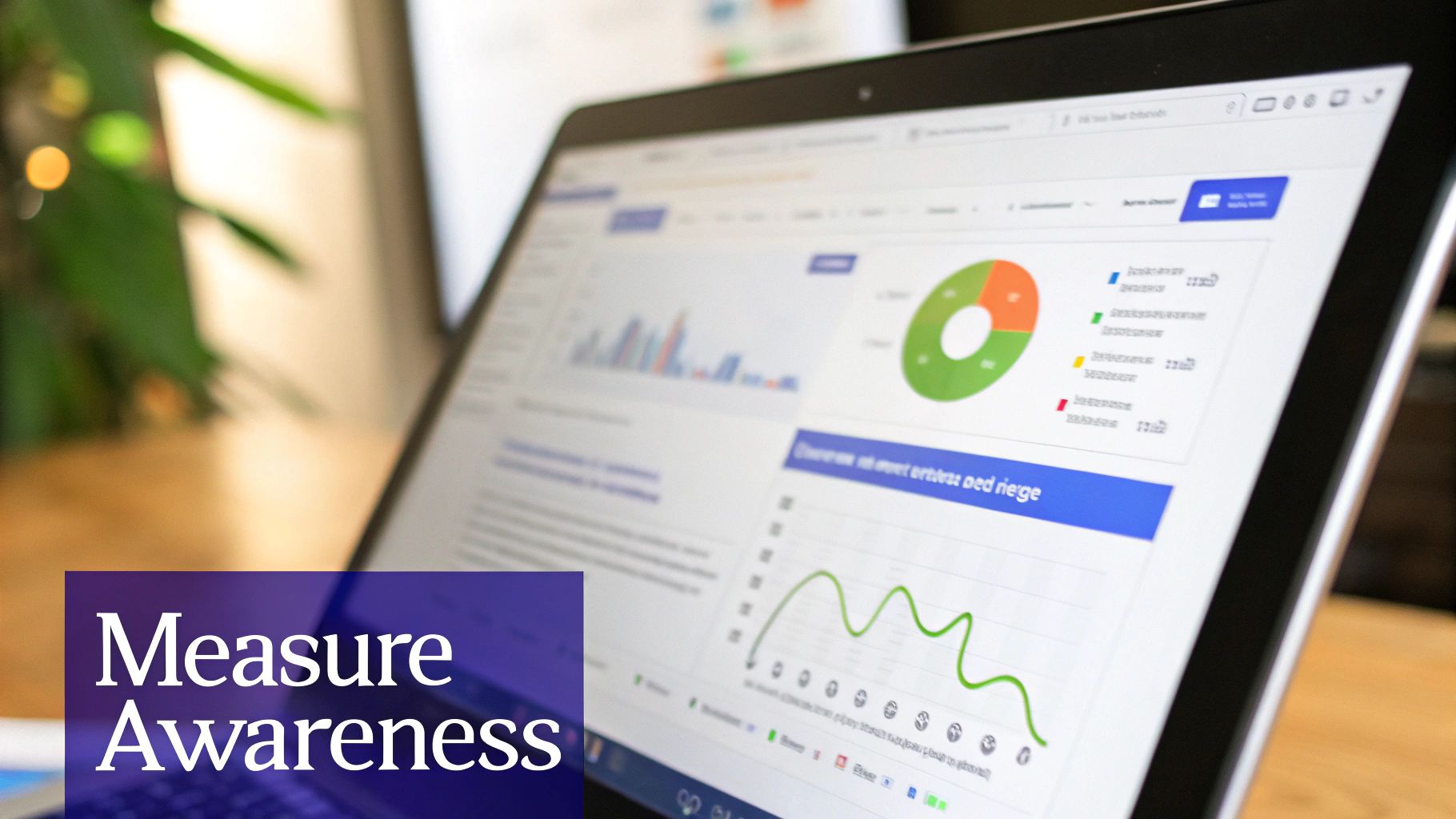
If you can’t measure your efforts, you’re just guessing. A successful brand awareness strategy isn’t built on hope; it’s proven with data. This is where we stop creating and start analyzing, focusing on the numbers that truly signal a growing presence in the minds of your audience.
We need to cut through the noise. While a spike in likes feels good, it doesn't tell you if your brand is actually becoming more recognizable. The real goal here is to track indicators that prove your brand is entering the conversation and becoming top-of-mind for the right people.
Moving Beyond Vanity Metrics
First things first: let's redefine what "success" looks like. It’s way too easy to get caught up in metrics that feel good in the moment but have zero correlation with actual business impact. True brand awareness is less about momentary engagement and more about sustained, long-term recognition.
Instead of chasing those fleeting numbers, we'll focus on a handful of core KPI categories that paint a much clearer picture of your brand's growing influence. These are the metrics that show not just that people saw your content, but that it’s starting to stick with them.
Key Performance Indicators for Brand Awareness
Your measurement framework should be a smart mix of quantitative and qualitative data. Each metric tells a different part of the story, from how many eyeballs you’re reaching to how those people actually feel about your brand.
Here are the essential KPIs to build your dashboard around.
Key Brand Awareness Metrics to Track
This table breaks down the most critical KPIs for any social media brand awareness campaign, explaining what they measure and why they are so important for tracking your progress.
| KPI (Key Performance Indicator) | What It Measures | Why It Matters for Brand Awareness |
|---|---|---|
| Reach & Impressions | The number of unique users who saw your content (Reach) and the total times it was displayed (Impressions). | These are your foundational visibility metrics. They tell you the sheer scale of your brand’s exposure and the top-of-funnel potential of your content. |
| Share of Voice (SOV) | Your brand’s percentage of the total online conversation in your industry compared to competitors. | A rising SOV is a direct sign that you are capturing more market attention and becoming a more significant player in your space. It's a competitive benchmark. |
| Branded Search Volume | The number of people searching for your brand name directly on search engines like Google. | This is a powerful signal. It means your social efforts are driving recall—people are actively seeking you out by name, not just stumbling upon you. |
| Website Referral Traffic | The volume of visitors who land on your website by clicking a link from your social media profiles or posts. | This metric directly connects your social content to audience curiosity, proving your presence is compelling enough to inspire action and further exploration. |
These KPIs are your compass, guiding your strategy and showing you what's truly working.
To really dig into the mechanics, this guide on How to Measure Brand Awareness is an indispensable resource. It offers a deeper look into tracking how familiar your target audience is becoming with your brand.
A huge mistake I see is people tracking these metrics in isolation. The real insights come from seeing how they influence each other. For example, a spike in impressions followed by a lift in branded search volume a week later shows your campaign is working exactly as intended.
Centralizing Your Analytics with a Dashboard
Juggling analytics from Instagram, LinkedIn, TikTok, and Google Analytics separately is a recipe for confusion and missed opportunities. To make smart, data-driven decisions, you need a single source of truth.
This is where an integrated analytics dashboard, like the one built right into PostSyncer, becomes a game-changer. It pulls all your critical metrics into one clean, easy-to-read view.
This centralized approach allows you to:
- Monitor Cross-Platform Performance: See at a glance which channels are driving the most reach or generating the highest-quality traffic.
- Identify Top-Performing Content: Instantly pinpoint the posts, videos, or campaigns that resonate most deeply with your audience across all networks.
- Track Audience Trends: Discover demographic or engagement patterns that can inform your future content strategy.
- Benchmark Against Competitors: Use tools to monitor competitor SOV and other public metrics to understand where you stand in the market.
It’s about turning raw data into actionable insights, making it obvious what's working and where you need to make a change.
Generating Reports That Tell a Story
Data is only useful if it informs your next move. The final piece of this puzzle is generating reports that tell a clear story about your progress. Your reports should connect your day-to-day social media activities to tangible business outcomes.
A strong report doesn't just list numbers; it answers key strategic questions:
- Which of our content pillars are driving the most impressions this month?
- Did our latest campaign actually lead to an increase in branded searches?
- How has our share of voice changed this quarter compared to our top three competitors?
By regularly analyzing these reports, you create a powerful feedback loop. The insights from your data directly inform your next editorial calendar, your paid media budget, and your overall content direction. This iterative process of measuring, learning, and optimizing is what transforms a good brand awareness strategy into a great one.
Got Questions? We've Got Answers
Even the most buttoned-up brand awareness plan runs into real-world questions. It's one thing to have a strategy on paper, but it's another to navigate the tricky bits of audience attention, content formats, and proving it all works.
Let's tackle some of the most common questions that pop up when you're in the trenches, trying to get your brand seen and remembered.
How Much Should I Actually Spend on This?
This is always one of the first questions, and there's no magic number that fits everyone. A great framework to start with, though, is the 70-20-10 rule. It’s a simple but effective way to allocate your budget without getting paralyzed by indecision.
Here’s how it breaks down:
- 70% of your budget goes to your core, proven strategies. These are the channels and content types you already know work for you.
- 20% is for experimenting. Try out that new platform everyone's talking about or test a different video format. This is where you find your next big win.
- 10% is for your wild ideas. These are the high-risk, high-reward creative swings that could either flop or go viral.
Okay, But How Long Until I See Results?
This is the million-dollar question, and the honest answer is almost always: longer than you'd like. Brand awareness isn't like a PPC campaign where you can see results in a day. It's a long game.
You're not going to see a seismic shift overnight. But you will see progress if you know where to look. Meaningful results, the kind that moves the needle on business goals, typically start showing up within 6 to 12 months of consistent, focused effort.
Here's a more realistic timeline of what to expect:
- Months 1-3: You should start seeing a steady climb in your foundational metrics, like post reach and total impressions. This is the "getting the word out" phase.
- Months 3-6: Now, you're looking for a noticeable uptick in engagement. Are your follower counts growing? Are people clicking through to your website from social?
- Months 6-12+: This is when the magic starts to happen. You should see real growth in your brand's share of voice, more people searching for your brand name directly, and a rise in direct traffic. These are the clearest signs that your brand is becoming top-of-mind.
The name of the game is patience and consistency. Brand awareness is like a snowball rolling downhill—it starts small but builds powerful momentum over time. The most common mistake is giving up too soon.
Which Content Format Is the Best?
While everyone is screaming about short-form video right now, the best format is always the one that connects with your audience on a specific platform. Don't put all your eggs in one basket. A diversified content mix is always your safest—and most effective—bet.
Video is fantastic for snagging attention and telling a quick story, no doubt. It's a powerhouse for that initial "hello!" moment.
But don't sleep on other formats. Carousels are brilliant on Instagram and LinkedIn for breaking down complex topics and positioning you as an expert. High-quality images and well-designed graphics are still absolutely essential for building a memorable visual identity.
Ultimately, the smartest strategies use a variety of formats to keep things fresh and communicate their message in different ways. The real secret? Pay close attention to your analytics. See what your audience actually responds to, and then give them more of that.
Ready to put these strategies into play? With PostSyncer, you can manage your entire workflow in one place—plan your content calendar, get team approvals, schedule every post, and actually see what’s working. Stop juggling spreadsheets and start building a brand people remember.