












Ever feel like your social media efforts are just spinning their wheels? You're posting, engaging, and following all the "best practices," but the needle just isn't moving. This is exactly where a social media audit comes in.
Think of it as a strategic deep dive to uncover what's actually working, what's falling flat, and—most importantly—where your biggest growth opportunities are hiding. It’s the tool that helps you move beyond just counting followers and start building a data-backed strategy that delivers real results.
Why A Social Media Audit Is A Game-Changer For Growth
It’s a common story: a brand hits a plateau and can't figure out why their content isn’t connecting anymore. Maybe you're posting consistently but seeing minimal engagement, or even worse, a drop in reach. A social media audit shifts your approach from guesswork to a calculated, effective strategy.
It’s basically a comprehensive health check-up for your online presence. Instead of just treating symptoms like low engagement, an audit gets to the root causes, giving you a clear, objective look at your performance and the real impact of your hard work.
Uncovering Hidden Opportunities
A good audit does more than just point out problems; it shines a light on opportunities you never knew you had. By systematically reviewing your profiles, content, and audience data, you can pinpoint exactly what makes your audience tick.
For instance, you might discover:
- A specific content format, like behind-the-scenes videos, drives 3x more shares than your standard posts.
- Your audience is most active on LinkedIn during morning hours—a time you've been completely ignoring.
- A competitor is successfully tapping into an audience segment you hadn't even considered.
These insights are pure gold. They let you stop wasting time and money on tactics that don’t work and double down on what truly drives growth. This is how you start connecting social media activity to tangible business goals, like generating leads or driving website traffic. If you're curious about making that connection, our guide on how to measure social media ROI is a great place to start.
A social media audit isn’t about judging past performance. It’s about gathering intelligence to build a smarter, more effective future for your brand online.
Staying Relevant in a Crowded Space
Let's be real—the digital world is noisy. Grabbing your audience's attention is harder than ever. By 2025, an estimated 5.24 billion people will be active on social media, spending an average of 2 hours and 21 minutes on these platforms every single day.
With that kind of volume, just showing up isn't enough. You have to be strategic to stand out. An audit ensures your strategy stays relevant and competitive, which is non-negotiable for agencies and brands using PostSyncer to manage their profiles and demand data-driven clarity.
To get a handle on what you'll be looking at, here's a quick overview of the essential areas your audit will cover. This gives you an immediate framework for what's ahead.
Core Components of a Social Media Audit
| Audit Area | Key Question to Answer | Example Metric |
|---|---|---|
| Profile & Branding | Is our branding consistent and our profile fully optimized? | Profile completion rate |
| Audience Demographics | Who are we actually reaching vs. who do we want to reach? | Follower age & location data |
| Content Performance | Which content formats and topics get the most engagement? | Engagement rate per post type |
| Publishing Cadence | Are we posting at the optimal times and frequency? | Reach/impressions by time of day |
| Competitor Analysis | What are our competitors doing well, and where are their gaps? | Competitor share of voice |
| ROI & Goal Tracking | Are our social media efforts contributing to business goals? | Conversion rate from social |
Looking at these pieces together gives you a complete picture, moving your strategy from reactive to proactive.
Setting Clear Goals for Your Audit
Jumping into a social media audit without a clear destination is like setting off on a road trip with no map. Sure, you’ll see a lot of things and gather plenty of data, but you'll have no idea if you’ve actually arrived anywhere meaningful.
Before you even think about pulling a single analytic, your first and most critical job is to define what a "win" looks like for your audit. Vague goals like "get more engagement" are a recipe for unfocused analysis and, frankly, lackluster results.
Your objectives have to be tied directly to tangible business outcomes. This is the only way to ensure the insights you uncover lead to real action, not just another report that gathers digital dust. A well-defined goal transforms your audit from a simple check-up into a strategic tool for growth.
An e-commerce brand, for example, might set a goal to increase website traffic from social media by 15% in the next quarter. With that north star, their audit immediately has focus. They'll zero in on which platforms, content formats, and posting times are driving referral traffic and, just as importantly, which ones are falling flat. This clarity directs the entire process.
Aligning Audit Objectives with Business Goals
Your social media audit can't operate in a silo. Its whole purpose is to support the bigger picture—the main goals of your company. Whether the business is chasing leads, building brand awareness, or trying to keep customers coming back, your audit objectives need to be a bridge between your social activity and those bottom-line KPIs.
To get started, just ask yourself: "What is the most important thing our business needs to achieve right now?" Once you have that answer, you can work backward to create specific, measurable social media goals that help get you there.
Business Goal: Increase qualified leads for the sales team.
Audit Objective: Pinpoint which social channels and content types are generating the most form fills or demo requests.
Business Goal: Boost customer loyalty and repeat purchases.
Audit Objective: Analyze audience sentiment and our team's response times to customer service DMs and comments to find spots where we can improve.
Business Goal: Establish our brand as a thought leader in a new market.
Audit Objective: Measure our share of voice and engagement on long-form content (think LinkedIn articles or video interviews) against our top competitors.
This approach makes sure your audit delivers insights the entire organization can get behind. It frames your findings in a language that executives and other departments actually understand: the language of business results.
An audit without clear objectives is just data collection. An audit with business-aligned goals is a strategic weapon that drives measurable growth and proves the value of your social media efforts.
From Vague Ideas to SMART Objectives
The best way to nail down your goals is by using the SMART framework. It’s a simple but incredibly powerful method that forces you to move beyond fuzzy intentions and create objectives that are truly actionable. Let's see how it works for a social audit.
Imagine a B2B agency that uses PostSyncer to manage client accounts. Their vague goal is to "improve our LinkedIn presence." Let's sharpen that into a powerful SMART objective for their audit.
- Specific: We want to identify the top-performing content pillars that generate leads from C-suite executives on LinkedIn.
- Measurable: Our success metric will be the number of clicks to our "Book a Demo" landing page from LinkedIn. We're aiming to find content that drives a click-through rate of at least 2%.
- Achievable: Looking at past performance, a 2% CTR is a stretch, but it's a realistic target for our best-performing content.
- Relevant: This directly supports our main business goal of increasing sales-qualified leads this quarter.
- Time-bound: We will complete this analysis as part of our quarterly social media audit, and the findings will be implemented in next month's content strategy.
By setting such a precise goal, the agency knows exactly what to look for when they dive into their LinkedIn analytics. They won’t get distracted by vanity metrics like follower count. Instead, they’ll have a laser focus on what actually moves the needle for their business. This kind of clarity is the foundation of any successful social media audit.
Gathering the Right Data and Metrics
Okay, you’ve got your goals locked in. Now comes the fun part: digging into the data. This is where the magic happens in a social media audit, transforming educated guesses into cold, hard facts about what's working and what's not.
First up, you need to create a complete inventory of every single social media profile tied to your brand. You’d be surprised what you might find—that forgotten Twitter account from 2012, an experimental TikTok someone on the team started, or even imposter accounts that could be hurting your reputation. It’s a bit of digital detective work.
This whole process boils down to defining your goals, measuring what matters, and then aligning your strategy based on what you find.
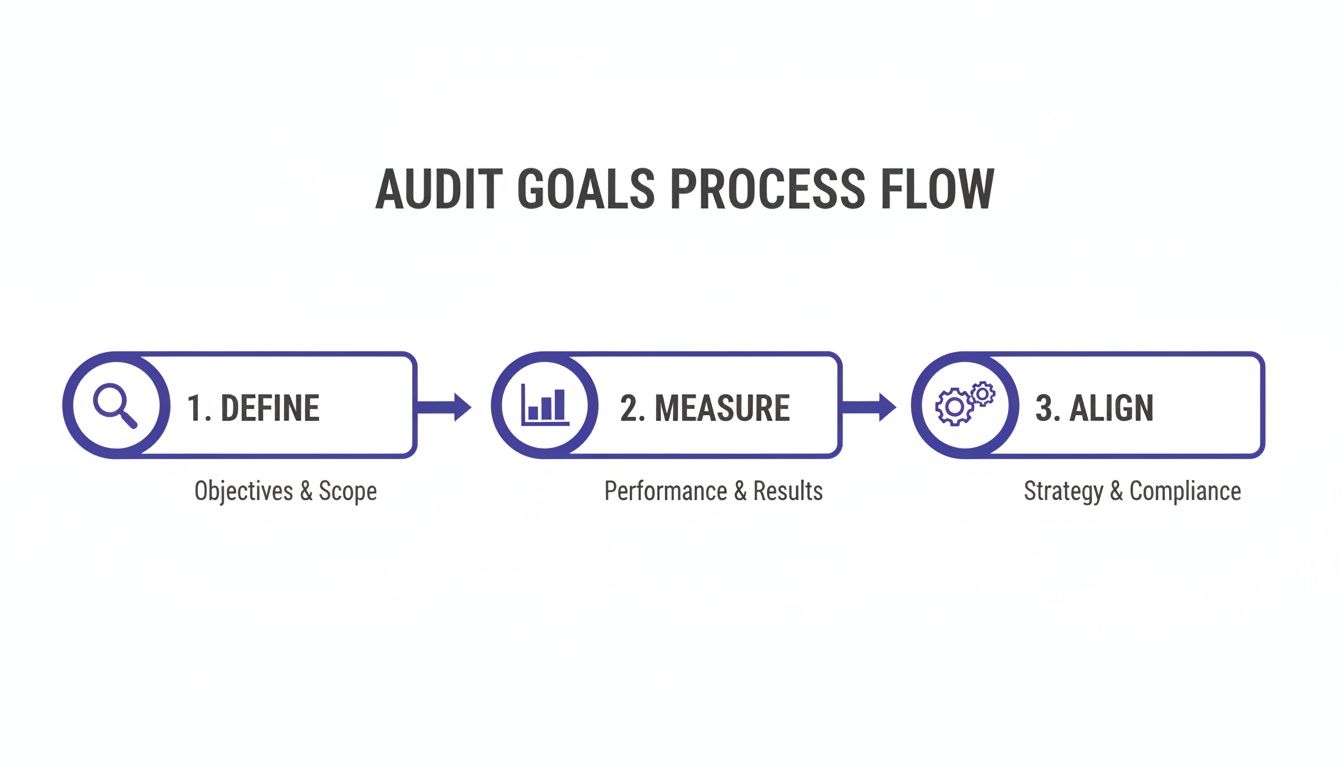
As you can see, clear goals (Define) dictate what you track (Measure), which then empowers you to make smart changes (Align) that pull your social media efforts directly in line with your business objectives.
Locating All Your Social Profiles
I recommend starting with a simple spreadsheet. List the platform, username, URL, current follower count, and the date of the last post for every account you uncover. This initial sweep gets you organized and immediately flags any rogue profiles that need to be shut down or brought into the fold.
If you’re juggling a lot of accounts, a tool like PostSyncer can be a lifesaver. It connects all your profiles into one central dashboard. Instead of hunting down each account one by one, you have a single source of truth, which is a massive time-saver and helps keep your branding consistent across the board.
Identifying Your Core Metrics
Once your accounts are all cataloged, it's time to zero in on the metrics that actually matter. It's incredibly easy to get lost in a sea of vanity numbers. To avoid that, focus only on the key performance indicators (KPIs) that connect back to the goals you set earlier.
Here are the essential categories to keep an eye on:
- Engagement Metrics: This shows how people are interacting with your content. Go beyond likes and look at the good stuff: shares, comments, saves, and click-through rates.
- Audience Metrics: This is all about who you’re talking to. Key data points here include follower growth rate, demographics (age, location, gender), and even audience sentiment.
- Reach and Impression Metrics: These numbers tell you how many eyeballs are on your content. Track impressions (total times your content was seen) and reach (unique people who saw it) to gauge visibility.
- Conversion Metrics: This is where social media proves its value to the business. Track things like referral traffic to your site, lead generation from social links, and any direct sales you can attribute to your channels.
A huge part of this is knowing what good engagement even looks like. For instance, understanding how to measure social media engagement on Facebook provides a solid foundation for interpreting the data you collect.
The point isn't to track every metric under the sun. It's about tracking the right metrics that tell a clear, actionable story about your performance and how it impacts the bottom line.
Platform-Specific KPIs to Watch
Every social network is its own little world. What signals success on one platform might be irrelevant on another. A good audit treats each channel individually.
For example, on Instagram, saves and shares are gold—they show your content is so valuable that people want to come back to it. Over on LinkedIn, you’re probably more interested in the click-through rate on your articles or the number of profile views your posts generate. If you want to go deeper, our guide on the best social media analytics tools is a great next read.
To make this easier, here’s a quick-glance table to help you focus on the right numbers for each major platform.
Essential Metrics to Track Per Platform
| Platform | Top Engagement Metric | Key Reach Metric | Business-Critical Metric |
|---|---|---|---|
| Saves & Shares | Story Views | Website Taps from Bio | |
| Comments & Reactions | Post Reach | Clicks to Landing Page | |
| Comments on Posts | Unique Impressions | Lead Gen Form Submissions | |
| TikTok | Video Completion Rate | For You Page Views | Clicks on Profile Link |
Recognizing these differences is crucial. It lets you evaluate each profile on its own terms instead of using a one-size-fits-all approach. Context is everything. An audit helps you see exactly where you stand and what's realistically achievable.
Analyzing Your Performance Against Competitors
You’ve got the data. It’s all collected, neatly organized, and ready to go. While it’s tempting to jump to conclusions, those numbers are pretty meaningless on their own. An audit truly comes to life when you benchmark your performance—not just against last quarter, but against your direct competitors.
This is the part where you turn a spreadsheet of metrics into a real strategic advantage. It's less about just copying what others are doing and more about finding the gaps they’ve left open for you to own.
First, Look at Your Own Top-Performing Content
Before you start peeking over the fence, look at your own backyard. The first layer of context always comes from your own historical performance. Dive into your analytics and pinpoint the posts that genuinely resonated with your audience over the last quarter or year.
And don't just stop at the posts with the most likes. Dig deeper to find the outliers that actually drove meaningful action.
- What themes consistently get people talking? Maybe posts about your company culture get way more comments than your polished product announcements.
- Which formats earn the most shares? You might find that your short, educational video clips outperform static images by a long shot.
- Are there specific times or days that boost your reach? Perhaps your weekend posts are hitting a completely different, and more engaged, slice of your audience.
Make sure to document these high-flyers in your audit spreadsheet. Note the topic, format, call-to-action, and when you posted it. This process starts to build a blueprint of what your audience actually cares about, helping you shift from a "what should we post?" mindset to an "what does our audience want?" strategy.
Then, Find Out What’s Falling Flat
Just as important is figuring out what isn't working. Every post that gets crickets in the comments or fails to drive any traffic is a lesson in what to avoid. It represents time, effort, and budget that could be funneled back into your proven winners.
You have to be a little ruthless here. If that weekly industry news round-up you spend hours on consistently underperforms, it’s time to ask if it deserves a place in your strategy. This isn't about admitting failure; it's about optimizing your resources for the biggest impact. That’s a core function of any good social media audit.
An effective audit isn’t just about celebrating your wins. It’s about having the courage to prune the content that holds you back, freeing up resources to double down on what truly drives results.
Now, Benchmark Against Your Niche
Okay, now it’s time to look outward. Pick three to five direct competitors to analyze. The key here is to choose brands that are chasing a similar audience, not just massive industry leaders with bottomless budgets.
Your goal is to understand their strategy and spot opportunities. Look at their profiles with the same critical eye you just used on your own.
- How often are they posting, and when? Are they more active on certain days of the week?
- Which of their content formats gets the best engagement? Are they succeeding with something you haven't even tried yet, like Reels or user-generated content campaigns?
- How are they engaging with their community? Note their response time to comments and the overall tone of their interactions.
- What's their overall share of voice? How often are they being mentioned in conversations compared to your brand?
This comparative analysis provides the crucial context your own data is missing. A 5% engagement rate might feel low when you look at it in a vacuum, but if your top competitor is only averaging 2%, you’re actually leading the pack.
This kind of competitive intel is even more critical when you factor in paid advertising. With 93% of marketers advertising on social media, the space is incredibly crowded. Audits often show that most brands are underperforming because their strategies are spread too thinly across an average of 6.83 platforms per user. This is where tools like PostSyncer become essential for auditing ad reach on major platforms like YouTube and Facebook, helping you pinpoint where your budget will actually make a difference.
A Real-World Scenario in Action
Let’s imagine a digital agency working with an e-commerce client that sells sustainable home goods. Their initial audit revealed high engagement on beautiful, styled product photos, but very few clicks through to the website. The content was pretty, but it wasn't selling anything.
During their competitor analysis, they noticed a smaller rival was getting huge traction with "behind-the-scenes" videos showing how their products were made. The videos weren't nearly as polished, but they were authentic and told a compelling story.
So, the agency pivoted their client's strategy. They cut back on the sterile product shots and introduced a weekly video series featuring the artisans who crafted the goods. The results were immediate: engagement rates on the video posts were 4x higher, and referral traffic to product pages jumped by 65% in the first month.
They didn't just copy their competitor; they identified a successful concept—storytelling—and adapted it to their client's unique brand. That's the power of putting your data in context. If you want to dive deeper into this process, check out our guide on social media competitor analysis tools.
Turning Your Audit Into an Actionable Strategy

So, you've finished your social media audit. You’re staring at a spreadsheet packed with data, charts, and notes. That's a huge accomplishment, but the real work starts now. An audit is just a collection of facts; its true power is unlocked when you use those insights to build a smarter, more deliberate plan.
Think of it this way: the data you've gathered is your roadmap. Now it’s time to get in the driver's seat. Let’s translate those numbers and observations into real-world changes that will shape a far more effective social media presence.
Build a Data-Informed Content Calendar
Your first move is to take a hard look at your content strategy, guided by what the audit revealed. It's time to stop guessing what your audience wants and start giving them more of what they’ve already told you they love through their clicks, shares, and comments.
Pinpoint your top-performing themes and formats—these are the new pillars of your content calendar. For example, if your audit showed that "how-to" carousel posts on Instagram drive a ton of saves and shares, those should become a regular feature. If long-form articles on LinkedIn discussing industry trends are your secret weapon for website clicks, make sure they happen every month, without fail.
Your new calendar should be a strategic mix of your proven winners:
- High-Engagement Formats: Double down on the formats—like video, carousels, or user-generated content—that consistently hit the mark.
- Topical Pillars: Zero in on the 2-3 core themes that clearly resonated most with your audience.
- Gap-Filling Content: Look at your competitor analysis. Where are they dropping the ball? Weave in new content ideas that serve an unmet need you identified.
This isn’t about just filling slots on a schedule. It’s about being intentional with every single post you create.
Optimize Your Posting Schedule
One of the quickest and easiest wins from any audit is figuring out when to post. Forget generic advice like "post on Tuesdays at 10 AM." That’s useless. The only source of truth that matters is your own data, for your specific audience.
Dig into the analytics for each platform and find the days and times your engagement and reach consistently spiked. Those are your new prime-time slots. Once you have them, use a tool like PostSyncer to automatically schedule your most important content for those peak windows. You get maximum visibility without having to be glued to your phone.
An audit turns your posting schedule from a guessing game into a precise, data-backed tactic. Remember, posting at the right time is just as important as posting the right content.
Refine and Unify Your Brand Voice
Inconsistency is a brand killer. Your audit probably flagged a few instances where your tone of voice felt a little... off. Maybe your Twitter was witty and casual, while your LinkedIn presence was buttoned-up and overly corporate. Now's the time to fix it.
Decide on a single, unified voice that truly reflects your brand’s personality and make sure it’s applied everywhere. This doesn't mean every post has to sound identical, but the underlying character and tone should feel consistent. It’s how you build a recognizable and trustworthy brand people want to follow.
Reallocate Your Ad Budget Smarter
For anyone running paid social, your audit findings are pure gold. If you discovered that your Facebook ad spend generated a mountain of impressions but almost no actual conversions, while a tiny Instagram ad budget drove a surprising number of sales, the path forward is crystal clear.
Use this data to shift your budget away from the platforms that aren't performing and double down on the channels that deliver a measurable return. The audit gives you the hard evidence you need to make these tough (but smart) financial decisions and ensure every ad dollar is working as hard as it possibly can.
Establish a Recurring Audit Cadence
This is probably the most important takeaway of all: your social media audit can't be a one-and-done project. The digital world simply moves too fast for a "set it and forget it" mindset. A strategy that crushes it today might be totally obsolete in six months.
To stay sharp and effective, make auditing a regular part of your marketing workflow. A quarterly review is a great place to start. It’s frequent enough to let you adapt to trends and platform changes but not so often that it feels like a burden.
By making your audit a recurring process, you create a powerful feedback loop:
- Audit: Analyze what’s working and what isn’t.
- Strategize: Build an action plan from what you learned.
- Execute: Put the new strategy to work with tools like PostSyncer.
- Measure: Track the results of your new approach.
- Repeat: Kick off the next audit with fresh data to refine and improve all over again.
This cycle is how you turn a simple audit into a sustainable engine for growth, ensuring your social media strategy is always evolving and always aligned with your business goals.
Still Have Questions About Social Media Audits?
Even with a step-by-step guide, it's natural for a few questions to pop up when you're deep in the data. A social media audit has a lot of moving parts, and getting some clarity can be the difference between a good audit and a great one. I've put together answers to some of the most common questions I hear from marketers.
Think of this as your personal cheat sheet for clearing up any last-minute uncertainties. Let's make sure you have everything you need to turn your audit into a real strategic advantage.
How Often Should I Actually Be Doing This?
This is easily the most common—and most critical—question. The honest answer? It really depends on your industry and how fast things move. But for most businesses, a thorough social media audit every quarter is the sweet spot.
Why quarterly? It hits that perfect balance. It’s frequent enough to let you:
- React to sudden shifts in platform algorithms or what your audience is responding to.
- Keep a close eye on what your competitors are up to.
- Fix small issues with your strategy before they snowball into major problems.
Doing a big audit just once a year simply isn’t enough in today's world. A strategy that was crushing it in January could be totally stale by July. Regular check-ins build a rhythm of constant improvement.
Stop thinking of your audit as a once-a-year headache. It’s a quarterly strategic review that keeps your social media sharp, relevant, and tied directly to your business goals.
What’s the Difference Between an Audit and a Report?
This is a really important distinction. A social media report is backward-looking. It usually covers a set period, like the last month, and spits out performance metrics—engagement, reach, follower growth, that kind of thing. It answers the question, "What happened?"
A social media audit, however, is strategic and forward-looking. It takes all that same data from your reports but layers on competitor analysis, brand consistency checks, and a deep dive into your goals. It answers the question, "Okay, why did that happen, and what are we going to do about it?"
| Aspect | Social Media Report | Social Media Audit |
|---|---|---|
| Focus | Performance measurement | Strategic analysis |
| Timeline | Retrospective (e.g., monthly) | Comprehensive (e.g., quarterly) |
| Key Question | "What happened?" | "Why, and what's next?" |
| Outcome | Data summary | Actionable improvement plan |
Put simply, a report gives you the box score. An audit gives you the game plan to win the next quarter.
Can I Really Do a Social Media Audit Myself?
You absolutely can! With the frameworks and checklists in this guide, you’ve got a solid foundation to run a successful audit on your own. Every social platform has its own native analytics that give you a ton of data to work with right out of the box.
Just be realistic about the time it takes. A proper audit isn't a 30-minute task you can squeeze between meetings. It demands some dedicated, focused time to pull the data, really think about what it means, and then map out a smart, actionable plan based on what you find. For a busy solo entrepreneur or a small team, that can be a heavy lift.
If you're managing a roster of clients or several brands, specialized tools are pretty much non-negotiable. They pull all your data into one place, saving you from the mind-numbing task of bouncing between a dozen different analytics dashboards. More importantly, they often surface insights that native tools just can't.
Ready to make your next audit less of a chore and more of a strategic weapon? PostSyncer brings all your analytics, scheduling, and reporting into one clean platform. Ditch the tab-switching chaos and start building a smarter, data-backed strategy today. Explore PostSyncer and start your free 7-day trial.