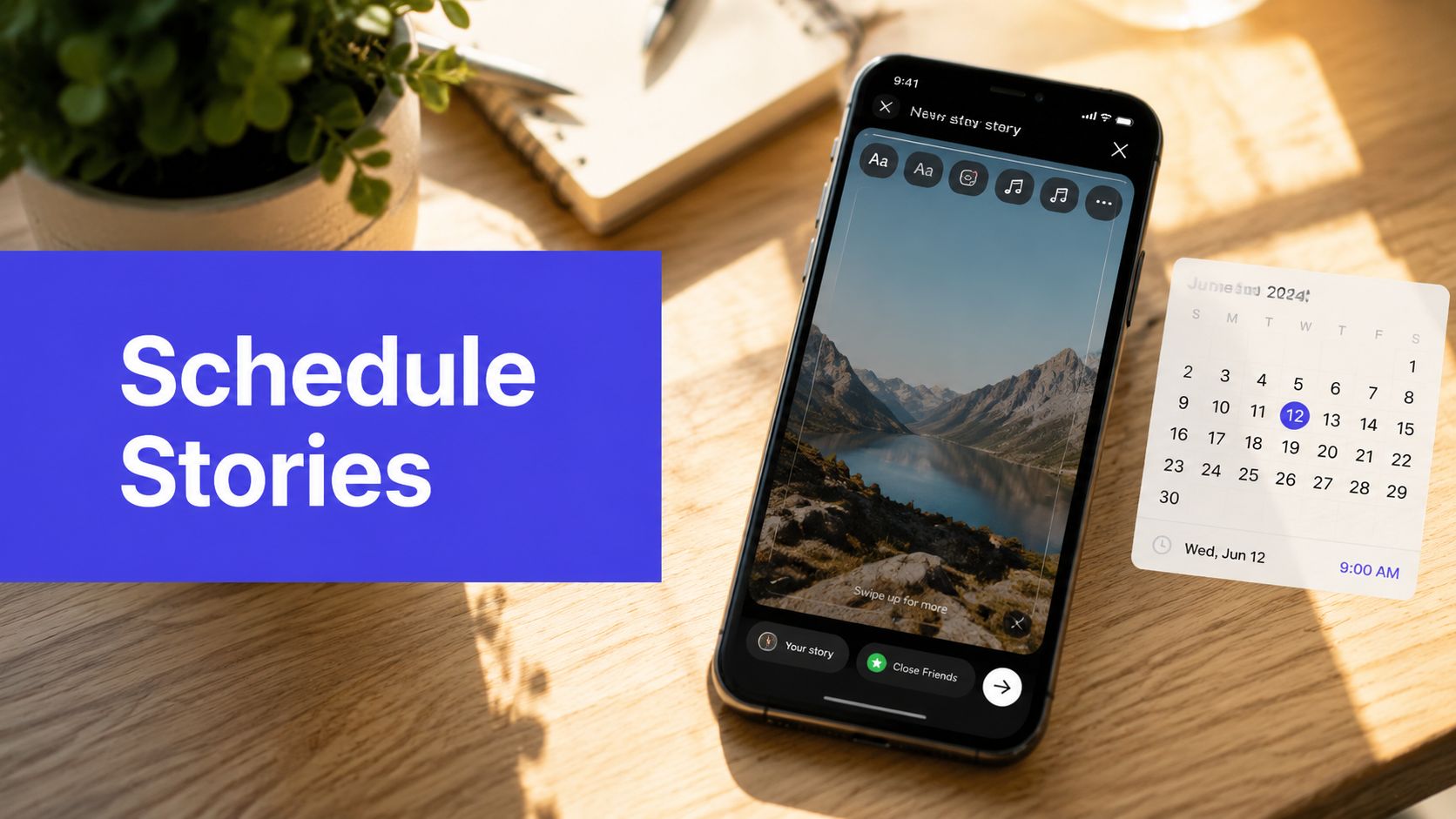












You're staring at tomorrow's Story draft at 11:47 p.m., trying to decide whether to finish it on your phone now or trust the scheduler in the morning. The hook is fine, the assets are ready, and the question isn't whether you can schedule it, it's whether the Story will still work once stickers, links, approvals, and timing get involved.
That's why schedule Instagram Stories is really a workflow problem, not a button problem. Stories live inside a fragile mix of 24-hour visibility, mobile-first features, and creative sequencing, so a clean calendar is only useful if the content survives the handoff intact. Meta's own scale for Stories, 500 million daily active users as of January 2019, is part of why teams treat this format as a core publishing channel and plan around consistent timing instead of improvising every post (EmbedSocial's summary of the Stories audience scale).

Why Scheduling Instagram Stories Is Harder Than It Looks
A team can get through feed scheduling and assume Stories will behave the same way. The first scheduled Story usually clears that up fast. A sticker is missing, a link no longer shows up where it should, or the frames publish with the wrong feel, and the workflow stops looking simple.
A Story is a short-lived sequence built for mobile behavior. It depends on timing, frame order, and interactive pieces that do not always survive a desktop-first handoff. That is the part people miss when they treat it like another queue item.
The part people underestimate
A Story is not just media plus a publish time. It can rely on mentions, polls, music, URLs, or a CTA that only makes sense inside the frame sequence. Once that passes through a scheduler, the fragile pieces are usually the first ones to break, which is why many teams end up with one process for standard posts and another for Stories that need more control.
Scheduling works best when the Story is mostly structural and the team wants consistency across markets or time zones. It helps less when the post depends on last-minute native edits, interactive stickers, or a final approval that has to happen on mobile. That trade-off matters more than the convenience of setting a time slot.
Practical rule: if the Story only works when a human adds the final native touches, schedule the slot, not the whole experience.
The setup also depends on your asset prep. A clean scheduler does not fix the wrong frame order, a weak opening frame, or text that sits in the wrong place. Before you publish, it helps to use a dimension and safe-zone guide for Instagram Stories like this Instagram Stories dimensions and safe zones guide, because cropping problems and UI overlap are easier to prevent than to clean up after upload.
For caption support, keep the workflow aligned with a guide to Story captions for creators if the Story needs spoken context or accessibility support. That step is often what separates a polished scheduled Story from one that feels like it was rushed through a tool.

Preparing Your Story Assets Before You Schedule Anything
Every scheduling failure I've had to clean up started before the scheduler opened. The asset was wrong, the frame order was sloppy, or the hook and CTA were treated like afterthoughts. Scheduling doesn't rescue weak structure, it makes weak structure more visible.
Build the frame set before the upload
Start with the 9:16 canvas, then design with the safe zones in mind so usernames, captions, and calls to action don't get buried by the interface. If you need a reference while designing, keep a dimension and safe-zone guide handy, like this Instagram Stories dimensions and safe zones guide. That alone prevents a lot of ugly cropping and misplaced text.
From there, lock the sequence before you open any scheduler. If your Story arc depends on order, treat the frame stack like a mini narrative, not a folder of loose images. Some publishing workflows handle batching cleanly, but once you start uploading in a rush, the first and last frame tend to get less attention than they deserve.
A strong first frame does the same job every time, it gives the viewer a reason to keep going. A weak last frame makes the whole sequence feel unfinished.
Use captions and structure on purpose
If the Story needs spoken context or accessibility support, prep the captioning early instead of trying to fix it after upload. A useful companion resource is BlitzReels' guide to Story captions for creators, because once the caption plan is decided, the rest of the workflow gets easier.
Write the hook in the first frame and the CTA in the last frame before you touch the scheduler. That sounds basic, but it's the difference between a batch that reads like a sequence and a batch that feels like disconnected tiles. Keep the export clean, keep the visual hierarchy obvious, and treat every frame as if it needs to make sense both on its own and inside the set.
Choosing Your Scheduling Method
There are three realistic paths in 2026. The right one depends on whether you care more about cost, native interactivity, or team workflow.
| Method | Direct Publish | Stickers/Links | Best For |
|---|---|---|---|
| Meta Business Suite | Limited, depending on the Story format | Often constrained on desktop-scheduled Stories | Teams that want a free native starting point |
| Third-party scheduler | Often yes, depending on the tool and account setup | Better for hybrid workflows, but still not perfect for every native feature | Agencies, multi-brand teams, and heavier publishing calendars |
| Reminder tool | No, it sends a notification to post manually | Preserves native features because you finish in the app | Solo creators who care about stickers and links more than automation |
How the trade-offs actually feel
Meta Business Suite is the obvious first stop because it's native and free, but that doesn't mean it solves the hard parts. Desktop scheduling is fine for simple Stories, yet it becomes clunky the moment the post depends on native interactivity or exact visual control. A third-party platform can help when the problem is more about planning, approvals, and cross-network management than about one isolated Story.
That's where a tool like PostSyncer's social media scheduling platform fits naturally for teams that need a calendar, approvals, and multi-network planning in one place. It's not the only option, and it's not the right answer for every workflow, but it does show why many teams move beyond a single-platform native composer once volume starts to rise.
Pick based on friction, not hype
If you're a small business owner posting a few Stories a week, a reminder workflow can be enough. If you're running multiple clients, the approval and calendar layer matters more than the reminder itself. If you're a solo creator who relies on stickers, polls, or link-native behavior, a reminder may be more reliable than a “direct publish” promise that strips the parts your audience interacts with.
The cleanest choice is the one that matches your real output. If the Story has to look native, the workflow has to respect native behavior.
Scheduling a Story With Meta Business Suite
Meta's native route is the lowest-friction starting point because it keeps you inside the platform. You connect a professional Instagram account, open the desktop composer, add the media, and choose a publish time. Buffer's Instagram scheduling guidance shows the basic path, but the friction appears once the Story depends on native interactivity or tight visual control (Buffer's Instagram scheduling guidance).
Where the desktop path works
For straightforward Story content, the native route is usable. It works best when the frame is mostly visual, the CTA is simple, and you are not relying on a sticker-heavy layout to carry the message. Meta also supports future planning in a broader scheduling sense, and the ecosystem around it is mature enough that teams can get a Story lined up without much setup.
The trade-off shows up fast. Stories that depend on URLs, music, polls, Story stickers, and some other interactive elements may need a mobile-publisher flow rather than a desktop-only schedule. In plain terms, if the Story needs native interactivity to feel complete, desktop scheduling alone may strip out the parts that drive taps and replies.
When to switch to the mobile handoff
If the Story depends on interaction, I switch the workflow instead of forcing the tool. That means scheduling the slot, then finishing the native elements in the Instagram app on mobile. It takes more time, but it preserves the parts of the format that matter for response quality and tap behavior.
If the Story needs stickers, polls, music, or a link treatment that affects performance, schedule the reminder, then publish natively.
For teams that also produce quick ad assets from the same workflow, a product like ShortGenius Meta ad creator can sit alongside Story planning when the need is rapid creative generation rather than pure scheduling. Used well, it belongs in the asset pipeline, not as a substitute for the scheduling decision.
When Scheduling Helps and When It Hurts
Scheduling helps most when the Story is evergreen, repeatable, or dependent on a consistent cadence. It hurts when the content needs immediate context, fast audience replies, or a live moment to feel relevant. That's the split I use in practice, and it keeps a team from automating the wrong things.
Use analytics instead of generic best times
The lever isn't a universal posting chart, it's your own account data. Look at reach, tap-forward behavior, and exits on scheduled Stories versus live-posted Stories, then compare what happens to different content types. The goal isn't to prove scheduling is always better, it's to see which formats survive automation and which ones need a human to post in real time.
The most common underperformers are obvious once you name them. Event coverage gets stale if it waits in a queue. Trend-jacking loses value if the moment passes. Stories built around replies or fast follow-up feel colder when the audience can tell they weren't published in the moment.
Run the test like a working team
Take two weeks and split similar Stories between scheduled and live posting. Keep the topics as close as possible, then compare which version gets the audience to keep tapping, responding, or staying through the sequence. That gives you a real decision rule instead of a theory.
- Schedule evergreen sequences: product education, FAQs, recurring promos, and repeatable behind-the-scenes content.
- Post live for time-sensitive moments: launches, event updates, breaking context, and anything audience reaction-dependent.
- Test interactive Stories separately: anything that relies on replies, stickers, or trend participation should be judged on native behavior, not just convenience.
The clearest mistake is assuming automation is the goal. It isn't. Consistency is the goal, and sometimes consistency means scheduling. Sometimes it means staying close to the app and posting live because the moment itself is the hook.
Team Workflows, Approvals, and the Mobile Publisher Path
Once more than one person touches the calendar, scheduling stops being a convenience feature and becomes a handoff system. Someone drafts, someone reviews, someone approves, and someone still has to deal with the Story in the app if native features are part of the plan.
Build the handoff deliberately
Meta Business Suite can work as the default publishing layer, but teams usually need more structure when multiple people are involved. A platform with approval workflow support, like PostSyncer's content approval process guidance, makes the review step easier to separate from the publishing step. That matters because the schedule date is not the same thing as the final publish action when the Story needs mobile-only elements.
The cleanest setup I've seen is simple. The strategist tags the Story as scheduled, the reviewer checks the copy and visual order, and the publisher handles the mobile-publisher step only when the Story includes stickers, links, or other native pieces that don't survive desktop automation. Label the difference in the calendar so nobody confuses a fully automated slot with a manual finish.
One workflow, two endings. If the Story needs native interactivity, the schedule marks the timing, not the final action.
That separation keeps teams from assuming a Story is done before it's done.
Troubleshooting the Five Scheduling Failures That Waste Hours
The same failures show up again and again. A Story publishes without the sticker because the desktop path stripped it. The aspect ratio crops strangely because the asset wasn't exported for Stories. The wrong account gets used because permissions weren't checked. The Story goes live out of order because the upload sequence wasn't verified. Or the publish fails and nobody notices until the slot has passed.
The fastest fixes
- Sticker missing: switch that Story to the mobile-publisher path, because the interactive element didn't survive desktop scheduling.
- Crooked crop: re-export in the right Story format and verify the safe zones before uploading.
- Silent failure: confirm account permissions and check whether the scheduler supports the feature set you used.
- Wrong account: revalidate connected profiles before batch scheduling, especially in multi-brand setups.
- Wrong order: rebuild the stack and preview it on mobile before finalizing.
The queue problem is the other one teams underestimate. If a breaking-news moment needs to cut the line, the calendar has to allow that without forcing you to rebuild the entire schedule. A good workflow leaves space for a live Story to jump ahead while the rest of the batch stays intact.
If you want a cleaner way to plan, approve, and publish Stories without guessing which ones need a mobile handoff, PostSyncer gives you a single workspace for scheduling, approvals, and cross-network planning. It's useful when your Story workflow has outgrown a simple reminder and you need the calendar, review layer, and publishing process to stay in sync.