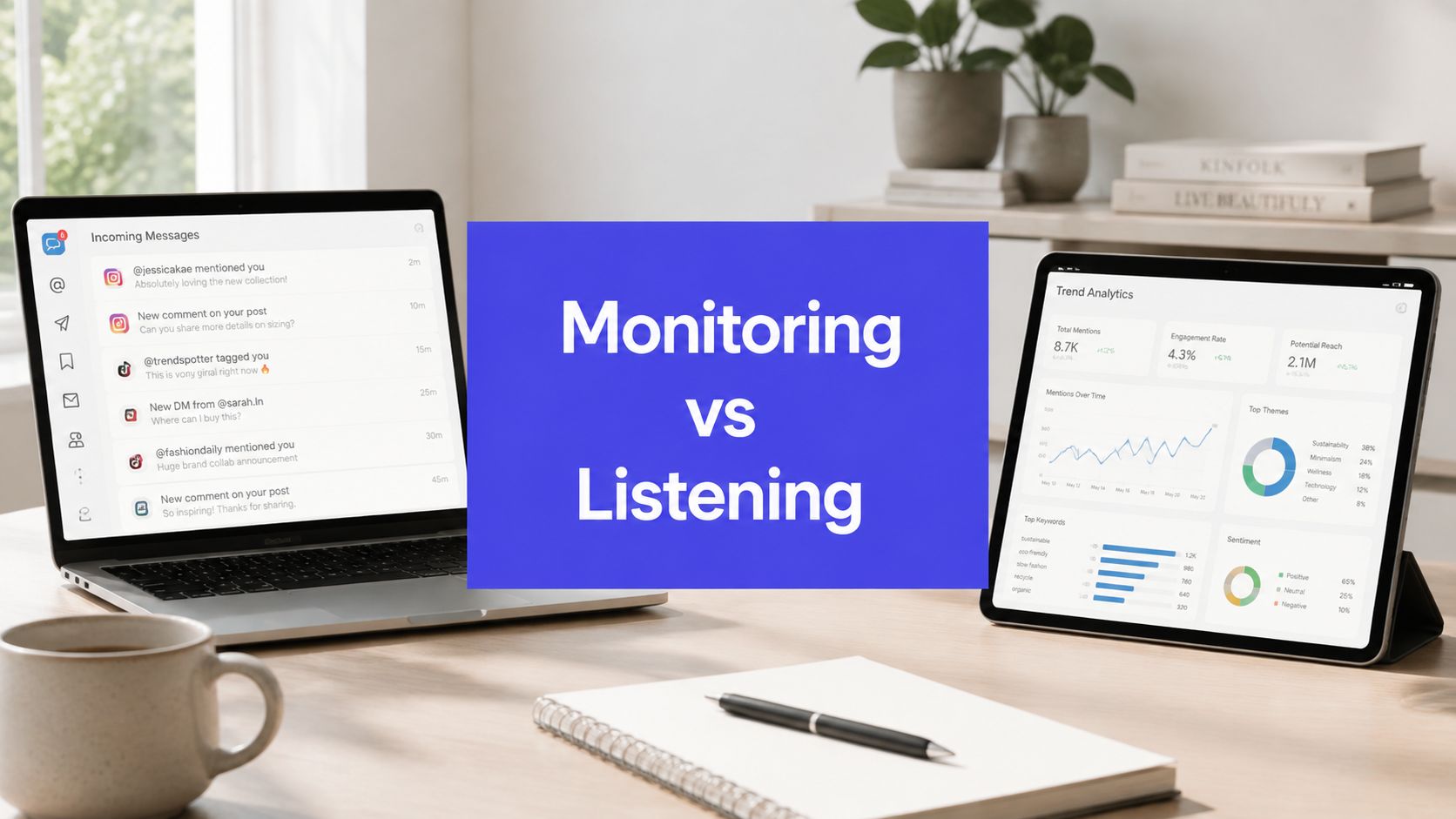












Your inbox is full, the comments are piling up, and a customer complaint just landed at the same time your team is trying to make sense of a new pattern in the feed. One tab needs an answer in minutes. Another needs interpretation across weeks of conversation. That tension is exactly where social media monitoring vs listening gets misunderstood, because the common need is not a debate between two separate practices. Instead, a working system is required that handles the urgent stuff without starving the strategic side.
| Dimension | Monitoring | Listening |
|---|---|---|
| Primary job | Catch and route mentions fast | Interpret conversation patterns |
| Time horizon | Minutes to hours | Weeks to quarters |
| Core output | Alerts, queues, responses | Themes, trends, insights |
| Best for | Service, reputation, escalation | Strategy, positioning, product input |
| Common failure | Seeing issues but not the meaning | Seeing themes but missing the live problem |
The cleanest way to think about it is as two layers of social feedback. Monitoring is the operational layer, the one that keeps a brand from missing live issues. Listening is the strategic layer, the one that turns scattered chatter into direction. Teams get into trouble when they force both jobs into one workflow, because a queue built for replies won't surface market meaning, and a monthly insight deck won't save an angry customer waiting for a response.
The Two Layers of Social Feedback
The fastest way to spot the difference is to watch a social manager during a busy day. A complaint comes in through comments, a second one hits the inbox, and at the same time a vague pattern starts forming around a product feature that keeps popping up in replies. One problem needs a direct response. The other needs interpretation before anyone should act on it.
That's why I treat social media monitoring and social listening as layers, not rivals. Monitoring is the real-time operational layer, built to catch mentions, tags, comments, and direct messages so teams can route them into alerts and queues. Listening is the strategic insight layer, built to aggregate those conversations over time and reveal themes, sentiment patterns, and market movement signals.
Why the binary framing breaks down
Most explanations stop at “monitoring is reactive, listening is strategic,” which is technically true and still not enough for a working team. The core issue is resourcing. If you only run monitoring, you'll stay busy but blind to the patterns behind the noise. If you only run listening, you'll produce thoughtful analysis while the live inbox keeps collecting unresolved problems.
This is why the practical question isn't which one is better. It's which layer the team needs first, and how to make sure the second layer doesn't become shelfware. The answer depends on whether the team is fighting fires, trying to shape messaging, or doing both.
A useful outside reference for marketers building the broader social program is social media marketing tips for South Africans, especially if the team needs to connect conversation management back to campaign work and local channel realities.
Practical rule: if the team is judging success by response speed, it's running monitoring. If it's judging success by better decisions, it's running listening.
Defining Social Media Monitoring and Listening
A brand can have both layers running at once and still get them mixed up. Monitoring handles the live queue. It watches what's happening right now, tracks brand mentions, tags, comments, and direct messages, then pushes them into alerts or assignments so someone can respond without delay. That is where response discipline lives, and it is also where a lot of teams first feel the pressure of volume. Adobe's example says brands can wait an average of 11 hours for issue resolution if they miss direct social feedback, while other industry guidance targets first response in under 30 minutes and tracks response rate, complaint resolution time, and weekend or after-hours coverage (Adobe).
Listening starts after the dust settles, or while it is settling. It looks at aggregated conversation data over weeks, months, or quarters and asks what those mentions mean together. The metrics change too, from response time and mention volume to share of voice, sentiment trends, topic clustering, and market movement signals (Brand24). That is why listening belongs in planning meetings, not just in the inbox, and why a team that only watches the queue still misses the larger pattern.
A useful outside reference for marketers building the broader social program is social media marketing tips for South Africans, especially if the team needs to connect conversation management back to campaign work and local channel realities.
A simple way to label your current setup
If your team is doing any of the following, you are probably in the monitoring layer:
- Alerting on mentions: The system pings someone when the brand name appears, and the goal is speed.
- Routing to owners: Messages get assigned to support, community, or PR.
- Tracking closure: The team wants to know whether the issue got solved, not just whether it was noticed.
If your team is doing any of these, you are in the listening layer:
- Comparing sentiment over time: You are looking for shifts, not isolated reactions.
- Grouping themes: Repeated objections, wishes, or praise get collected into topic clusters.
- Reading market signals: You are asking what the category is saying about itself and where the conversation is headed.
That distinction matters because many teams call everything “monitoring” when what they really want is insight, or they call everything “listening” when what they need is response discipline. The terminology matters less than the job each layer is meant to do.

For teams that already use a workflow system and want a closer look at the mechanics, the internal walkthrough on message filtering is a useful companion because filtering is often the first place monitoring breaks down.
Goals Metrics and Workflows Side by Side
Comparing the two layers is clearest when you look at what each one produces. Monitoring shortens the gap between a mention and a response. Listening turns accumulated conversation into a decision.
| Dimension | Monitoring | Listening |
|---|---|---|
| Goal | Protect response speed and reputation | Find meaning, themes, and direction |
| Time horizon | Immediate | Longer-term |
| Core metrics | Response time, mention volume, resolution rate | Share of voice, sentiment trend, topic clustering, anomaly signals |
| Workflow | Alerts, assignment, escalation, closure | Collection, pattern analysis, synthesis, review |
| Team owner | Community, support, PR, social care | Marketing, insights, product, comms leadership |
| Decision output | Reply, route, escalate, resolve | Adjust messaging, refine product, change plan |
Monitoring answers what is happening now. Listening answers what it means and what to do next.
That difference shows up in how the work runs. A monitoring desk needs clear ownership, a fast escalation path, and a queue that does not bury urgent items under low-priority chatter. A listening program needs a steady review cadence, a way to group similar comments, and someone senior enough to turn the findings into a real decision instead of another slide deck.
Filtering is part of that operating setup, especially once volume starts to climb. A workflow built around message filtering keeps the monitoring side from drowning in noise while still surfacing the items that need a human response.
What goes wrong when only one layer is running
A monitoring-only program tends to become operationally competent but strategically thin. The team knows complaint volume, angry comments, and resolved tickets, but they cannot tell whether the issue is temporary, cyclical, or part of a broader shift in perception.
A listening-only program has the opposite problem. It can identify themes and sentiment changes, but it often misses the live customer who needs a fast answer. That is not a small gap. In social, unresolved service issues can become the very data that later distorts the listening readout.
Running both layers, each with its own job, metric, and owner, is recommended.
Real Use Cases From the Trenches
The clearest way to see the split is through situations where both layers are useful, but for different reasons. The patterns are consistent across brands, even if the subject matter changes.
Crisis response
Monitoring catches the first spike. A few comments become a visible cluster, then direct messages start coming in faster than usual. The desk flags the issue, routes it to the right person, and logs the response path. That's the operational side doing what it should.
Listening then tells leadership whether the problem is isolated or becoming a broader story. If the same complaint keeps showing up across the category, the issue isn't just customer care anymore. It's narrative pressure. In that moment, the brand needs both a fast reply and a clearer internal read on what the market is saying.
Product launch
Listening does the heavier lifting before launch day. It surfaces recurring objections, unmet needs, and the language people use when they talk about the category. That lets marketing and product tighten the message before the first post goes live.
Monitoring takes over when the launch lands. Comments, tags, and DMs start flowing in, and the team needs a live queue to separate support questions from praise, confusion, and bugs. If launch day only has listening, the brand gets insight without response capacity. If it only has monitoring, the brand can react without learning much.
Competitor intelligence
Listening is the better tool for category position. It can track how people talk about rivals, how sentiment shifts across the field, and where your brand is being compared against others. That's where strategic comparison lives.
Monitoring still matters, because competitor channels often expose useful live signals. A pricing announcement, a backlash, or a campaign misstep can create immediate openings. The team that watches only its own account misses those moments. The team that watches only competitor feeds misses the larger pattern behind them.
The strongest teams don't ask whether the signal is “monitoring” or “listening.” They ask who needs it, how fast, and what decision it should support.
Implementing Both in One Operating System
A small team needs one operating system with two routines, one for immediate response and one for analysis.
Week one setup
Start with a unified comments inbox so every responseable item lands in one place. Add core alert rules for brand terms, key products, and major competitor names, then define an escalation path so nobody wonders who owns a sensitive thread. Track basic response time from day one, because the point of monitoring is speed and closure, not just awareness.
You also need a simple tagging habit. Even basic positive, negative, and neutral labels make the queue easier to scan and give the future listening work something cleaner to review. Without that, the live desk and the analysis layer end up speaking different languages.
A shared setup also makes it easier to connect response work to deeper analysis later. A practical community management tool can keep the inbox, routing, and tagging habits in one place so the team is not piecing the process together by hand.
Month two and beyond
Once the desk is stable, add a weekly digest for sentiment movement, topic clusters, and share of voice. Then schedule a monthly review with marketing, product, and customer care so the findings do not sit in a folder nobody opens. The best listening output is the one that gets discussed in the room where decisions happen.
Staffing matters just as much as tooling. One person or pod should own the real-time queue. Another person, sometimes the same strategist with protected time, should own the weekly analysis and summary. If nobody is accountable for turning the output into actions, the listening program becomes a reporting habit instead of a business tool.
For teams comparing systems, analytics discipline is what keeps listening from turning into vague commentary.

Tooling and Where PostSyncer Fits
The most common mistake when buying tooling is shopping by feature list instead of by layer. A scheduling suite, a dedicated listening platform, and a point solution each solve a different part of the job, and treating them as interchangeable usually creates avoidable friction.
Where each category fits
Scheduling and engagement suites are strongest at the monitoring layer when they include a unified inbox, routing, saved replies, basic analytics, and team workflows. Dedicated listening platforms are stronger when the work is historical analysis, share-of-voice comparison, sentiment movement, and theme detection over time. Point solutions can help when you only need a narrow alert or analytics function, but they rarely become the central operating system.
PostSyncer sits in the operating layer where monitoring lives. Its unified comments inbox, AI auto-replies, contact CRM, spam filtering, and live analytics across major networks fit the day-to-day monitoring workflow without forcing constant context switching. It can collect contacts from comments and track interactions, which makes it useful for monitoring audience and engagement patterns, but it does not try to replace a dedicated listening platform for deep historical analysis or category benchmarking.
Use the inbox for response control. Use the listening platform for category interpretation.
That pairing is usually the most practical setup for a mid-sized brand. The inbox handles the urgent queue. The listening tool handles the slower synthesis. A team that tries to force one platform to do both usually ends up with either weak service or weak insight.
PostSyncer is one option for the operational side, especially if the team already wants scheduling, engagement, and analytics in the same workspace. For broader community workflows, the related guide on community management tool helps frame how engagement, moderation, and response management fit together.

Measuring Success and Choosing What to Run Next
A useful program can look productive with the wrong metric. A weak program can look busy for the same reason. Monitoring should be judged by first response time, resolution rate, escalation count, and the sentiment of resolved tickets. Listening should be judged by share-of-voice shift, sentiment trend, insight-to-action rate, and how often the findings shape product or campaign decisions.

The decision rule is straightforward. If the team is missing real-time issues, invest in monitoring first. If the team is publishing without category insight, invest in listening first. Once both are stable, fold them into a single weekly review so the response queue and the strategy conversation inform each other.
One practical check keeps that review honest. Ask what got fixed fast, and what got learned that should change the next plan. If the first answer is strong and the second is thin, the listening layer needs work. If the second answer is rich and the first is weak, the monitoring layer needs attention.
For teams that want tighter reporting discipline, the internal guide on how to track social media analytics is a useful measurement companion, because the metrics only matter when someone reviews them regularly.
If you want one workspace for the live queue, contact tracking, AI auto-replies, spam filtering, and platform analytics, PostSyncer covers the monitoring side without making the workflow noisy. Use it to keep response work moving, then pair it with a listening process when you need deeper category insight and planning support.