










You post a video you were proud of. Maybe it was the cleanest edit you've made, the clearest tutorial you've ever explained, or the best product demo your team has shipped this month. Then the view count crawls, while a scrappy clip you almost didn't publish starts moving. That gap feels random until you understand what TikTok is optimizing for, because the platform is not rewarding effort in a general sense, it's testing relevance in real time.
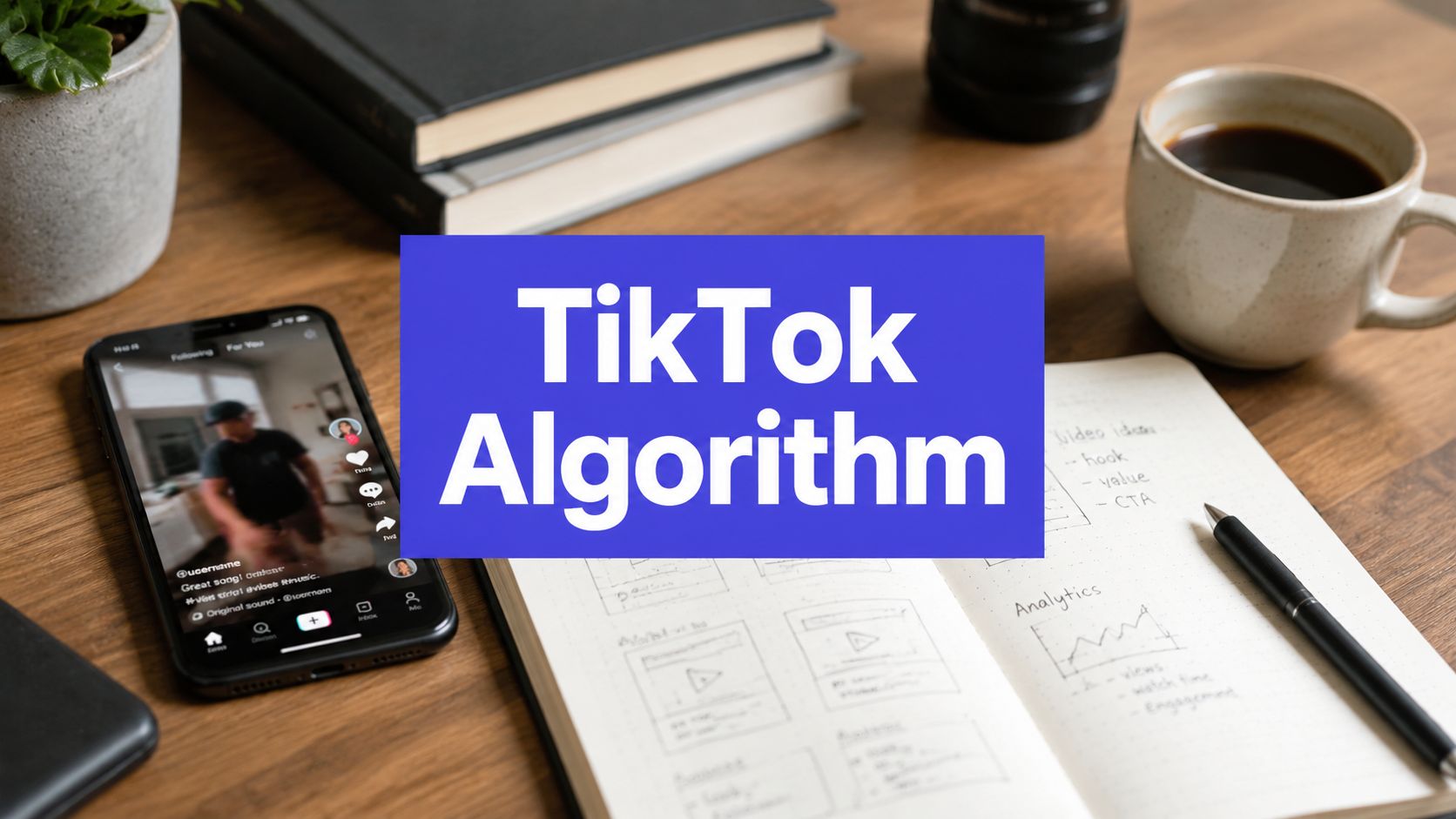
The useful way to think about TikTok algorithm explained is as a layered system, not a magic switch. First, it decides whether your account can reach people outside your followers. Then it measures whether the first viewers stay, rewatch, share, save, or keep searching for more. After that, it expands or contracts distribution based on the response, while newer search-style signals make captions, on-screen text, and intent matter more than older guides admit.
If you're a creator, a social team, or an agency, that distinction matters. The goal isn't to “beat” the algorithm. The goal is to make content the system can recognize, test, and confidently keep showing.
The Algorithm Question Every Creator Asks First
A creator usually notices the pattern before they can explain it. One post they were excited about stalls, while a less polished clip keeps climbing because the opening lands faster, the topic is clearer, or viewers keep watching to the end. That's the core question behind every search for TikTok algorithm explained, what is the system optimizing for, and how do you work with it without chasing folklore?
Start with the right mental model
TikTok's recommendation system is built around an interest graph rather than a follower graph, which is why even new accounts can reach large audiences when early performance is strong. In plain language, the platform cares more about predicted interest than about who already follows you. That's a different game from a chronological feed, because the system can test a post with people who seem likely to care, then widen the audience if the reaction is strong. TikTok algorithm explained 2026
That's also why a small account can beat a larger one on a single video. The account size matters less than whether the video immediately fits a viewer's behavior pattern. If you want a practical starting point for that audience thinking, find your target audience before you start chasing trends, because TikTok's testing is only useful when the topic is specific enough to read cleanly.
Practical rule: Think of TikTok less like a billboard and more like a talent scout. It keeps sampling your work, then sends it farther only when the early signals say, “this fits.”
That mindset prepares you for the rest of the system. Once you stop assuming follower count is the main lever, the next question becomes how TikTok gathers candidates, scores them, and decides what deserves another round of distribution.
Why TikTok Is an Interest Graph, Not a Follower Graph
TikTok behaves more like a personalized radio station than a TV channel. A TV channel schedules one program for everyone, while a radio station learns what the listener keeps returning to and keeps adjusting the mix. That's the core difference between a follower graph and an interest graph, TikTok is trying to predict what each person wants next, not just reward the biggest audience.
Why size doesn't control the outcome
That's easier to understand when you look at scale. One 2026 guide cites about 1.9 billion monthly active users and roughly 1.12 billion daily active users, with users spending about 95 minutes per day on average worldwide and opening the app approximately 19 times per day. Those habits create a huge amount of repeated behavior data, which gives the recommendation system more chances to learn what keeps people watching. TikTok guide 2026
The practical consequence is simple. On TikTok, a video doesn't need a big account behind it to get tested widely, it needs early evidence that the audience wants more. That's why creators who know how to package one clear idea can outperform accounts with a larger following but weaker retention. If you're used to follower-first platforms, that can feel counterintuitive at first.
What that means for creators
The system is constantly searching for fit, not prestige. A niche cooking creator, a local service business, or a product demo from a brand can all surface if the content lines up with a viewer's interests fast enough. In other words, virality is less about broadcasting and more about matching.

The same logic is why posting time alone rarely explains performance. The platform has enough behavioral variety to keep learning after the post goes live, which is why the next layer, the ranking pipeline, matters so much.
Inside the Recommendation Pipeline
TikTok does not sort videos by popularity and hand them out in order. It runs a sequence, first it gathers possible videos, then it ranks them for a specific viewer, then it removes content that doesn't fit constraints, and finally it updates future decisions from the result. That's why a strong post can start small and still keep growing, because the system keeps retesting it against new audiences. TikTok recommendation stack
A simple cooking example
Take a 30-second baking clip. The platform may first place it in front of people who already watch dessert content, or people whose recent behavior suggests they enjoy quick recipes. If those viewers stay to the end, replay the clip, or save it, the video looks more relevant to similar users and gets another round of testing. That's a feedback loop, not a one-time launch.
The four stages matter because each one connects to something a creator can influence. Metadata like captions and on-screen text helps the video enter the right candidate pool. Retention and engagement affect ranking. Constraints decide whether the content is eligible for wider delivery. Outcomes feed the next update cycle.
Creator takeaway: You're not uploading into a void. You're giving the system clues about who should see the video first, then proving whether that guess was right.
This also explains why “good content” is too vague to be useful. The platform needs signs it can measure, not just a general sense that the clip is polished. If your opening is weak, the ranking stage has less reason to expand you. If your metadata is unclear, the candidate stage may misread your topic entirely.
The pipeline is the skeleton. The signals are the muscles, and the next section shows which ones move distribution.
The Ranking Signals That Matter Most
The strongest signal is retention, especially watch time and completion. TikTok's public guidance says completed views, likes, shares, comments, and re-watches all feed ranking decisions, while third-party analyses describe a small seed audience first and broader rollout only if the early response clears internal thresholds. TikTok recommends content
What the system reads first
A viewer staying with the clip tells TikTok the content earned the slot. A viewer dropping off early sends the opposite message. That is why the opening seconds carry so much weight, they decide whether the rest of the video gets a fair test. A short video that holds attention to the end can outrank a longer one that loses people halfway through.
A useful way to read the signals is to sort them by how strongly they reflect viewer behavior:
| TikTok Ranking Signals Ranked by Influence | Why It Matters | Optimization Cue |
|---|---|---|
| Watch time and completion | Shows whether viewers stayed with the video | Open with the point fast, trim filler, keep the promise clear |
| Rewatches | Signals the content felt worth revisiting | Add details, surprises, or useful reference value |
| Shares | Tells TikTok the clip has value beyond one viewer | Make the idea useful, funny, or easy to send |
| Comments | Shows the video sparked reaction or discussion | Ask a real question, not a generic prompt |
| Saves | Suggests the content will be used again later | Make tutorials, checklists, and references easy to keep |
| Likes | A lighter signal, still useful but less revealing than watch behavior | Use it as a baseline, not the main goal |
| Skips and “not interested” | Negative feedback suppresses further expansion | Remove confusion, slow intros, and misleading hooks |
A second piece people miss is constraint. TikTok-facing explainers note that “not interested,” skips, language, country, and device type can affect distribution, and that a video's posted location and a user's location can matter too. TikTok ranking guide 2026
That is why the same post can behave differently by region even if the creative itself is strong. The system is checking fit and friction, not just raw appeal. If your content is hard to understand in a market, or the context feels off for the viewer's device or location, the ranking stage can slow down.
The signal hierarchy keeps you from optimizing for vanity. Comments matter, but they do not rescue weak retention. Likes help, but they rarely make up for a video that loses people in the opening seconds.
A creator also has to respect the frame the video lives in. Tight hooks, readable on-screen text, and the right aspect ratio all help the platform and the viewer process the clip quickly, which is why a reference like PostSyncer's TikTok video size and specs guide belongs in the planning stage before you publish.
The Search and Semantic Shift Most Guides Miss
Older TikTok advice treats the app like a pure engagement machine. That's incomplete now. Several 2026 explainers say TikTok behaves more like a search engine, prioritizing keyword relevance, search intent, captions, on-screen text, and session depth rather than just likes or watch time. TikTok semantic search 2026
Why this changes how content gets found
That shift matters most for informational, product, and tutorial content. If someone searches for a problem, TikTok can use the words in your caption, the text on the screen, and the topic you clearly state in the opening to decide whether your video belongs in that search path. The platform is still watching engagement, but it's also reading intent.
A useful way to think about it is this. Engagement tells TikTok whether people enjoyed the clip once they found it. Search relevance tells TikTok whether the clip should have been found in the first place. Those are different jobs, and creators who only design for one of them leave reach on the table.
For practical keyword work, the caption and on-screen text need to match the viewer's likely query. If you post a skincare tutorial, the video should sound and look like the exact problem someone would search for. The same applies to product demos, software walkthroughs, and how-to content.
If you want to turn this into a repeatable process, how to find trending hashtags is useful as a starting point, but the bigger win is choosing terms that reflect real search intent rather than stuffing in broad tags.
Useful test: If a stranger saw only the caption and the first frame, would they know what problem the video solves?
That question is more important now than it used to be. TikTok still rewards strong viewing behavior, but it increasingly rewards content that can be indexed by meaning, not just by momentum. In plain English, the algorithm is learning not only what people watch, but what they're actively trying to find.
How the Algorithm Plays Out for Different Creators
A niche cooking creator and a small e-commerce brand can earn distribution for very different reasons. One wins by keeping people watching until the payoff arrives. The other wins by matching a specific search phrase and making the product clear almost immediately. Same platform, different route through the system.
A niche creator and a small brand
The cooking creator posts short recipe videos with tight editing, a clean opening, and one visible result. Viewers stay for the end, TikTok keeps testing the clip with more people who already like food content, and the account builds on that pattern over time. Each video helps reinforce the same behavior the system has already seen.
The e-commerce brand usually follows a different path. Its team writes captions and on-screen text around the exact question customers already ask, then shows the product in a way that makes sense in the first frame. That helps the video surface for viewers with direct intent, not just people browsing casually. The clip may never look flashy in the usual “viral” sense, but it can still perform well because it answers a search need clearly.
That difference becomes easier to see if you compare it to timing and discovery on other channels. A post can be strong but still miss the moment if it is pushed when the audience is asleep or offline, which is why a guide like the best time to post on TikTok matters more as a planning tool than as a magic switch. The same idea applies here, the system does not treat every creator the same way, because audience behavior is different from one account to the next.
Why the same video behaves differently by market
Distribution also changes by context. Analyses of TikTok's ranking behavior note that language, country, device type, and location can affect how a video travels, so a post that lands well in one market can slow down in another if the fit is weaker. That is part of how relevance works, not a flaw in the system. TikTok distribution factors
Creators often read the numbers too quickly and blame the creative itself. Sometimes the topic is clear, but the language, references, or framing do not fit a region, so the system has less reason to keep expanding it there. It works a bit like a store with the right product but the wrong shelf label. People may want it, but they have to recognize it fast enough to pick it up.
A music creator can run into the same pattern. A track breakdown or production tip may travel well with one audience because the terminology is familiar, while a different audience needs a simpler frame before it will keep watching. Drumloop AI's music production guide shows the same kind of context problem in a different niche, where the clearer the framing, the easier it is for the right viewers to understand why they should keep going.
The takeaway is simple. You do not need one universal formula. You need to know which signal the account is winning on, retention for one creator, search relevance for another, or localization fit for a third.
A Practical Optimization Playbook You Can Run This Week
Start with the opening. The first line, first frame, and first visual need to tell people exactly why they should keep watching. If the hook is vague, the completion rate suffers, and the rest of the ranking chain weakens. Then tighten the pacing so every second earns its place.

A usable weekly checklist
- Write one clear promise: Say exactly what the viewer gets, then deliver that outcome quickly.
- Design for completion: Remove pauses, long intros, and unnecessary context that delay the payoff.
- Use searchable wording: Put the topic in the caption, on-screen text, and spoken audio where it fits naturally.
- Repurpose smartly: Pull short clips from long-form content when one moment has a strong, self-contained idea.
- Track what wins by format: Compare tutorials, demos, and story clips separately so you don't average away the signal.
If you're planning across multiple channels, a tool like PostSyncer can help you organize the workflow. It supports scheduling, content calendars, AI-assisted captions and hooks, and analytics across platforms, which makes it easier to batch ideas, test variants, and see which format performs best in TikTok-style short video.
For timing, best time to post on TikTok is worth reviewing, but timing should support the content, not substitute for it. Posting at the right hour won't rescue a weak hook, while a strong hook can still earn distribution after a slower start.
If your team works with audio-heavy content, Drumloop AI's music production guide can also help when you're building short-form clips that rely on original sound design or cleaner production choices.
The measurement loop should stay simple. Publish, review the first 48 hours, compare completion and share behavior, then revise the hook and metadata before the next post. That's how you stop guessing and start learning what your audience rewards.
The Mental Models Worth Keeping
A new creator often expects TikTok to behave like a broadcast channel. A video goes out, followers see it, and growth follows. The system works more like a test lab, where each upload is a small experiment and each viewer reaction decides whether the next group gets to see it.
TikTok is an interest graph, not a follower graph. The account with the biggest audience does not automatically win distribution, because the system is trying to match each video to the people most likely to care about it. That is why a small account can reach far when the topic, hook, and viewer response line up.
Distribution moves through a pipeline. A video is retrieved, ranked, limited by available inventory, then rechecked as people watch, skip, share, or rewatch. If that sounds abstract, the simple version is this, every new signal either keeps the video moving or slows it down.
Watch time and search relevance sit at the top of the signal stack. Completion, rewatches, shares, and intent-rich captions do different jobs, so creators should not treat them as interchangeable. A clip that holds attention can travel well on the For You feed, while a clip with clear topic language can also surface when someone searches for that subject.
One common mistake is chasing a single winning post and assuming the job is done. That creates a false reading of what worked, because the key question is whether the pattern repeats when the format, hook, or topic shifts slightly. Another mistake is reading engagement as proof of broad appeal when it may only reflect a narrow pocket of viewers who happened to respond quickly.
A useful self-audit is simple. Ask whether the video makes its topic obvious in the opening seconds, whether the caption uses the same language a viewer would type into search, whether the first viewers are staying long enough to signal relevance, and whether you are comparing similar formats instead of mixing everything together. If one of those answers is weak, the post may still earn views, but the lesson you take from it will be fuzzy.
Growth comes from measurement, not one lucky hit. The creators who last keep testing hooks, metadata, and audience fit until the pattern becomes repeatable. PostSyncer can help with that loop by keeping scheduling, content calendars, AI-assisted hooks and captions, and analytics in one place, so the work stays organized while you compare what TikTok is rewarding over time.