











Let's get one thing straight: AI social media management isn't some futuristic idea pulled from science fiction. It's here, it's practical, and it's what separates brands that are just surviving on social media from those that are truly thriving.
Think of it like this: a social media manager is a talented chef. They know the recipes, the ingredients, and what their diners love. Now, give that chef a state-of-the-art kitchen with assistants who prep ingredients, manage the oven timers, and clean up. The chef is still in charge of the creativity and the final dish, but they can produce more amazing meals, faster.
That's exactly what AI does for social media.
What Is AI Social Media Management and Why It Matters Now
At its core, AI social media management is the use of intelligent software to help with the heavy lifting of running social media accounts. This isn't about letting a robot take over your brand's voice. It's about giving your team a super-powered assistant that never sleeps.
This assistant can brainstorm post ideas, figure out the absolute best time to post for maximum reach, pull performance reports in seconds, and even handle a lot of the basic, repetitive customer questions that clog up your inbox. It’s about augmenting your team, not replacing it.
The sheer amount of content you need to create and manage for platforms like TikTok, Instagram, and LinkedIn has made a purely manual approach unsustainable. The numbers don't lie—this is no longer a niche trend.

Recent data shows that nearly 90% of marketers are already using AI tools in their weekly, if not daily, routines. If you're not on board, you're already falling behind.
The Shift From Manual To Augmented Workflows
So, why the big shift? It all comes down to one word: efficiency.
Your social media manager is a creative strategist, not a copy-paste machine. But so much of their day can get eaten up by tedious, repetitive tasks. AI steps in to handle that operational drag, freeing up your team to do what humans do best—build relationships, get creative, and think about the big picture.
For instance, a tool like PostSyncer can take a single piece of content—like a blog post—and instantly spin it into a dozen different social media posts, each perfectly formatted for a different platform with its own unique caption and hashtags. A task that would take a human hours is done in minutes.
The goal of AI social media management is not to automate creativity but to augment it. It handles the repetitive, data-driven tasks, allowing humans to focus on high-impact strategy and authentic brand storytelling.
To better understand how this works, let's break down the core functions AI handles. The table below outlines the main jobs AI takes on and the direct benefit you'll see.
| Core Functions of AI in Social Media Management | | --- | --- | --- | | AI Function | What It Does | Key Benefit | | Content Generation | Drafts captions, brainstorms ideas, creates image variations. | Smashes through writer's block and fills your content calendar faster. | | Scheduling Optimization | Analyzes engagement data to find the best times to post. | Maximizes the reach and impact of every single post. | | Engagement Automation | Manages comments, answers common questions, routes complex queries. | Improves response times and keeps your community feeling heard. | | Performance Analytics | Processes vast amounts of data to identify trends and top performers. | Delivers clear, actionable insights instead of data overload. |
As you can see, each function is designed to take a time-consuming manual task and make it smarter and faster, directly empowering your team.
Key Benefits Driving Adoption
The move to AI-powered tools isn't just about chasing the next shiny object. It’s driven by real, tangible results that impact brand growth and the bottom line.
- Massive Time Savings: This is the big one. Automating content creation, scheduling, and reporting gives you back hours in your day. It’s no surprise this is the top benefit reported by 71.1% of marketers.
- Enhanced Content Quality: AI isn't just about speed. It can analyze what’s already working online and give you suggestions for hooks, formats, and topics that are proven to get a reaction from your audience.
- Data-Driven Decisions: Stop guessing and start knowing. AI analytics cut through the noise to show you exactly what’s working, so you can double down on your wins and fix what isn't.
- Improved Scalability: For agencies managing dozens of clients or creators expanding onto new platforms, AI is the only way to scale your output without burning out or hiring a massive team.
Ultimately, getting a handle on the fundamentals of AI for social media marketing is your first step toward a more effective and efficient online presence. It's about working smarter, not harder, and that’s what defines social media success in 2026.
The Four Pillars of an AI-Powered Social Strategy
To really get how AI social media management works, it helps to look past the buzzwords and see what it actually does. Think of your social strategy like a building—it needs a solid foundation, and that foundation is held up by four key pillars. Each one solves a very real, everyday headache for social media managers.
Individually, each pillar is a powerful tool. But when they all work together in one platform, you get a system that saves a ton of time, drives up performance, and lets you get back to what you do best: connecting with your community.
Let's break them down.
Pillar 1: Content Generation
This is your creative partner. Imagine having a brainstorming assistant who's available 24/7, has basically read the entire internet, and can spitball ideas on demand. That’s AI content generation. It’s the ultimate cure for the dreaded blank page, able to spin a single idea into a dozen different posts.
For instance, you could drop a link to a new blog post into an AI tool like PostSyncer’s AI Content Agent. In seconds, it can:
- Draft several different hooks to grab attention on each platform.
- Write engaging captions in different tones—maybe professional for LinkedIn and more casual for Instagram.
- Suggest relevant hashtags based on the post's actual content.
- Create on-brand images or even short video clips from the text.
This isn't about replacing you. It's about giving you a running start. The AI handles the first draft, and you come in to add your unique brand voice and polish. For teams that need to create a lot of content, this alone can free up dozens of hours every single week.
Pillar 2: Smart Scheduling
Think of this pillar as your master strategist. It's not enough to have great content; you need to post it when people are actually online to see it. Smart scheduling goes way beyond a simple calendar—it uses your own data to pinpoint the absolute best times to post.
AI tools dig into your account's historical data, figuring out when your followers are most active and likely to engage on each platform. That means a Facebook post might go live at a totally different time than an Instagram Reel, all optimized automatically for the biggest impact.
An AI-powered scheduler is like having a data scientist working full-time on your content calendar. It’s always learning from your performance, making sure every post goes out with the best possible chance for success—no guesswork needed.
This gets rid of the need to follow generic "best times to post" guides. Instead, you get recommendations based on your unique audience's behavior.
Pillar 3: Automated Engagement
This pillar is your tireless community assistant. On social media, a quick response makes a huge difference. A lot of interactions are pretty routine—common questions, thank-yous, or spam comments that need to be dealt with.
AI-powered engagement tools can take care of these repetitive tasks, so your community always feels heard. For example, an AI can:
- Auto-reply to frequently asked questions in your DMs or comments.
- Filter and hide spam or inappropriate comments before they cause problems.
- Flag complex questions and route them to the right person on your team.
By automating the basics, you and your team are freed up to have more meaningful conversations, build real relationships, and jump in where a human touch really matters.
Pillar 4: Advanced Analytics
The final pillar is your personal data guru. It turns all those charts and spreadsheets into a clear story about what your audience actually wants. Old-school analytics show you what happened; AI-powered analytics can tell you why it happened and what you should do next.
Instead of just counting likes and shares, advanced analytics spot the deeper patterns. A platform like PostSyncer can show you exactly which content formats, topics, or even caption lengths are driving the most engagement or website clicks. This information feeds right back into the first pillar—Content Generation—creating a cycle where your strategy gets smarter with every post.
How to Generate High-Performing Content With AI
When we talk about AI social media management, a lot of people think it's just about asking an AI to "write a post." That’s selling it short. The real power is in taking one great idea and letting AI multiply it into a whole campaign of platform-specific content. This isn't about replacing your creativity; it's about giving it superpowers.
Think about the last time you published a big piece of content—a new blog post, a podcast episode, or a detailed product tutorial. That single asset is a goldmine. Instead of spending hours manually slicing and dicing it for social media, a smart AI workflow does the heavy lifting for you.
From a Single Asset to a Full Campaign
Picture your latest blog post or video not as a finished product, but as a block of raw material. An AI content tool, like PostSyncer's AI Content Agent, is like a workshop full of precision tools, ready to carve that material into dozens of unique assets.
Here’s what that looks like in practice:
- Feed the AI: You start by giving the AI your source content. It could be a link to a blog post, a PDF of a whitepaper, or even a video file. The AI gets to work, analyzing the content and pulling out the most important concepts, stats, and quotable one-liners.
- Generate Hooks for Each Platform: From those key ideas, the AI creates a bunch of different hooks. It knows a professional, data-backed hook will perform well on LinkedIn, while a provocative question or a bold statement is what you need to stop the scroll on X (formerly Twitter).
- Draft Custom Captions: Next, it writes multiple captions for each hook, perfectly matching the tone of voice for each platform. You’ll get a formal, insightful caption for LinkedIn and a casual, emoji-sprinkled one for Instagram, all derived from the same core idea.
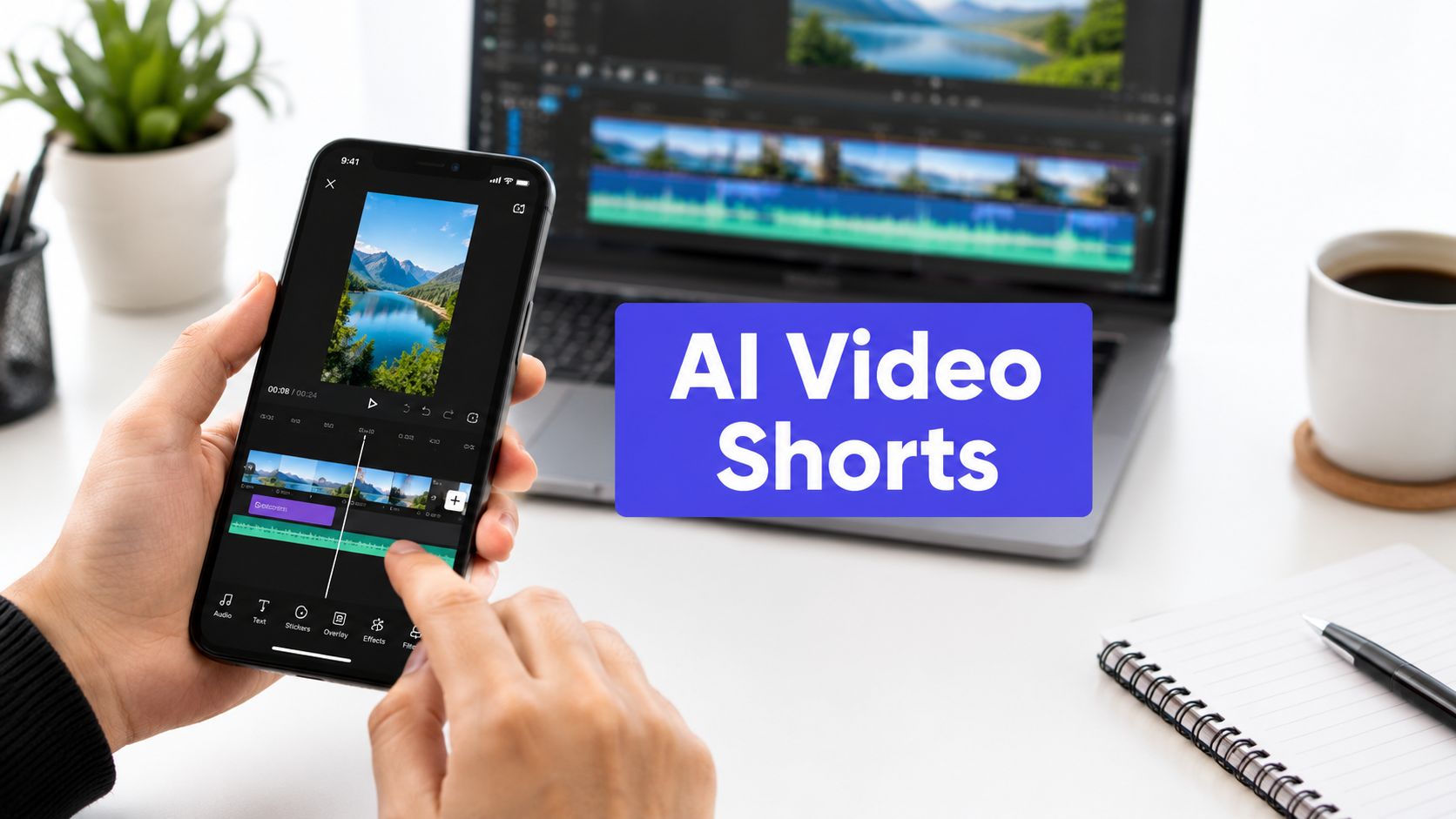
- Create Visuals: The best AI tools don't just stop at text. The AI Video Creator can take snippets from your article and spin them into an engaging short-form video, complete with animated text and stock footage. It's perfect for TikTok, Reels, or YouTube Shorts.
This whole process can turn one piece of long-form content into a full week's worth of coordinated social media posts. The best part? It takes minutes, not hours.
This diagram shows how AI-driven content creation kicks off a cycle of scheduling, engagement, and analysis that continuously sharpens your strategy.

As you can see, content generation is just the first step in a loop that helps you get smarter and more effective with every post.
The Human Touch Is Your Superpower
All this automation is incredible, but it brings us to the most important point: AI is your collaborator, not a replacement for your expertise. The single biggest mistake I see brands make is just hitting "generate" and then "publish" without a second thought. That's how you end up with a social feed full of generic, soulless content that doesn’t connect with anyone.
Your brand's unique voice, its specific point of view, and its sense of humor are your most valuable assets. AI can’t fake that. What it can do is give you a fantastic first draft to build on. The magic really happens when you step in to add your own personality.
This isn't just a hunch; it's what the most successful marketers are already doing. A 2026 study found that while a massive 89.7% of social media marketers use AI every week, a critical 78.4% of them always edit the AI's output to keep their brand's voice authentic. The report also highlights that 71.1% named massive time savings as the number one benefit, which is what gives them the breathing room for that strategic editing. You can dive into more insights in the full 2026 AI in Social Media Marketing Report.
Think of the AI as your junior copywriter. It's incredibly fast and never runs out of ideas, but it needs your guidance and editorial eye to create work that truly represents your brand and resonates with your audience.
This human-in-the-loop approach is the secret to scaling your content without watering down the authenticity that builds a real community. It’s how you use AI social media management tools the right way—getting the speed of a machine but keeping the heart of a human creator.
Streamlining Workflows for Agencies and Teams
If you've ever worked in an agency or on an in-house marketing team, you know the reality of social media management. It's less a creative process and more a frantic juggling act. You're bouncing between client accounts, chasing approvals, and drowning in a sea of comments. It's organized chaos at best.
This is where AI social media management steps in, not just to help, but to give you a genuine command center. Think of it as the mission control for your entire social media operation. It’s about creating a single, unified space where your team can actually work together instead of tripping over each other.

This single source of truth isn’t just a nice-to-have; it’s how you prevent the costly mistakes and mix-ups that happen when your workflow is scattered across emails, spreadsheets, and DMs.
Unifying Multi-Brand Management
Let's be honest: managing social accounts for multiple clients is a disaster waiting to happen. Constantly logging in and out of different accounts is inefficient and, frankly, risky. We've all heard horror stories of a post for Brand A accidentally going live on Brand B's feed. It's a client's—and an agency's—worst nightmare.
AI-powered tools like PostSyncer solve this with multi-brand workspaces. Imagine giving every client their own secure, tidy folder. Inside, you have all their social accounts, content plans, and performance data, completely separate from everyone else. This structure makes onboarding new clients a breeze and turns a chaotic portfolio into a model of efficiency.
Implementing Seamless Approval Workflows
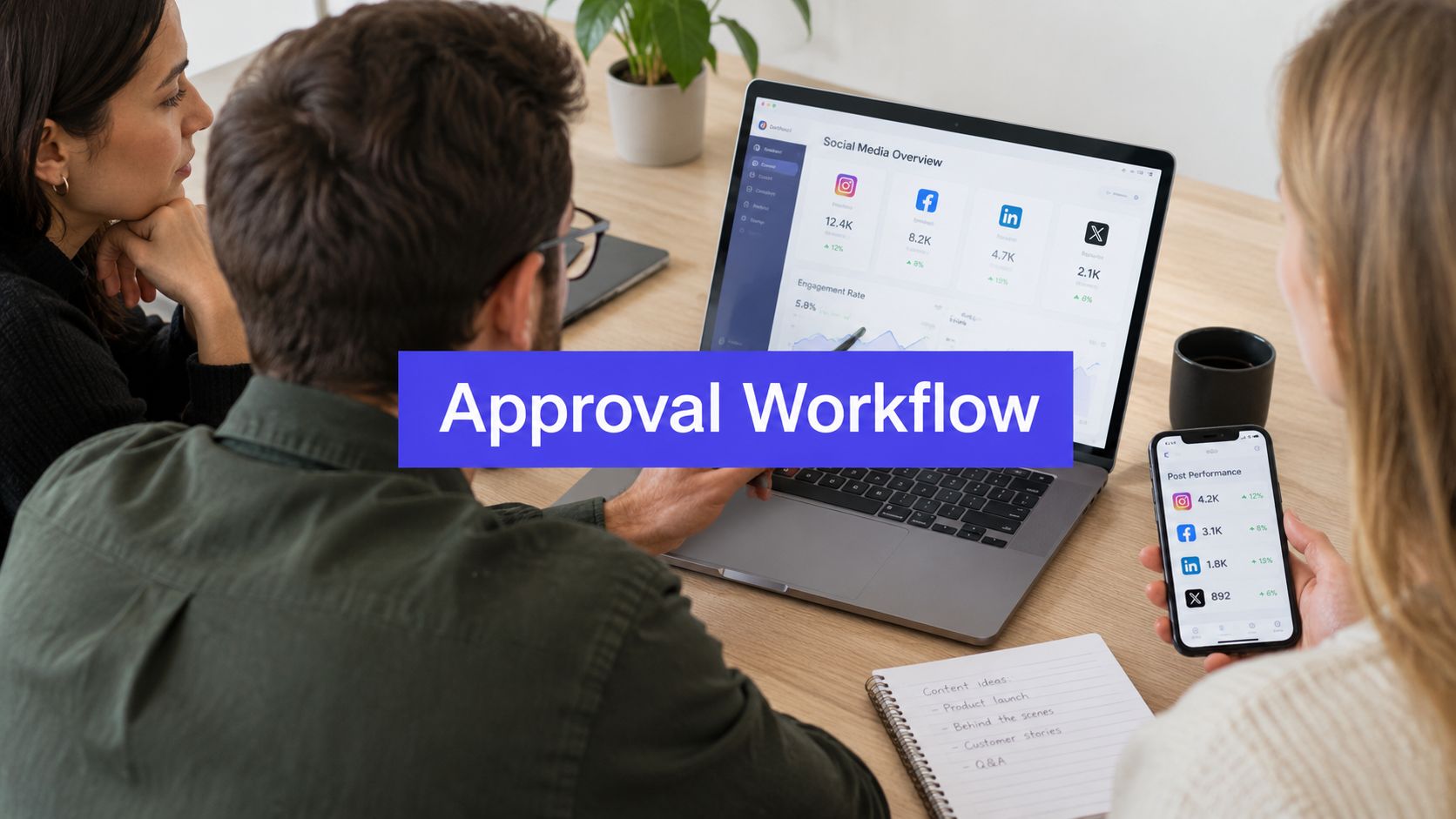
In an agency world, nothing goes live without an okay. But chasing approvals through endless email chains or chaotic Slack threads is a massive time sink. It creates bottlenecks and confusion—is this the final version, or was there another one?
Modern AI platforms build the approval process right into the workflow, where it belongs.
- Draft & Submit: A social media manager creates a post and, with one click, sends it up the chain for review.
- Review & Comment: The client or a senior manager gets an instant notification. They can view the post, leave specific feedback directly on it, or approve it.
- Automatic Scheduling: Once approved, the post automatically joins the content queue. No more manual steps.
This creates a clear audit trail, guarantees every post is on-brand, and frees up countless hours previously lost to administrative back-and-forth. We break down how to perfect this process in our guide to building a content creation workflow.
Consolidating Engagement in One Place
Your community lives in the comments and DMs, but trying to keep up across a dozen different accounts is a full-time job in itself. A unified inbox changes the game, pulling every single comment, mention, and message from all your accounts into one feed.
A unified inbox equipped with AI is your team's ultimate front-desk receptionist. It never misses a message, intelligently sorts incoming queries, and ensures every customer interaction is handled promptly and professionally.
But it gets better. AI supercharges this by handling the simple stuff for you. It can auto-reply to common questions ("What are your hours?") and filter out spam. The more complex questions? It intelligently flags and routes them to the right person, so nothing ever gets lost in the shuffle.
This system does more than just save time. It enables you to deliver faster, more consistent responses, which is the secret to building strong brand loyalty at scale.
How to Choose the Right AI Social Media Management Tool
Trying to pick the right AI social media management tool can feel like wading through a sea of endless options. Every platform seems to promise the world, armed with a feature list longer than your arm. But here's a secret I've learned from years in the trenches: the best tool isn't the one with the most bells and whistles. It's the one with the right bells and whistles for you.
The reality is, your needs as a solo creator are worlds apart from those of a digital agency juggling 20 clients. Cutting through the marketing noise means matching a platform’s strengths directly to your day-to-day workflow and what you’re trying to achieve.
First, Know Thyself: Define Your User Profile
Before you even glance at a pricing page, take a moment to figure out who you're shopping for. Are you a one-person army, part of a growing marketing team, or running a full-blown agency? The answer completely changes what you should be looking for.
Solo Creators & Influencers: If you're flying solo, your world revolves around speed, simplicity, and keeping costs down. You need a tool that helps you churn out great content fast, get it scheduled everywhere (especially visual-heavy platforms like TikTok and Instagram), and doesn't demand a huge budget.
In-House Marketing Teams: You’ve got more moving parts. You need structure—things like a shared visual calendar, simple approval steps for your manager, and analytics that clearly show the ROI of your efforts. Collaboration is everything, so the tool must let your team work together without stepping on each other's toes.
Digital Agencies: You need the command center. We're talking multi-brand workspaces to keep client accounts completely separate—that's non-negotiable. You also need ironclad approval workflows, easy content labeling, and one unified inbox to handle all client engagement. This is how you scale without losing your mind.
Once you know which bucket you fall into, you can create a checklist of features that actually matter.
Core Features to Look For
With your profile in mind, you can start evaluating tools based on how they solve your specific problems. For instance, a platform like PostSyncer was built to be flexible for these different roles. A solo creator gets a huge boost from its affordable AI credits, while an agency can leverage its multi-workspace setup and unlimited team seats to grow their client base.
To help you focus on what's important and cut through the marketing fluff, I’ve put together a quick checklist. This breaks down which features are "nice-to-have" versus "must-have" depending on your role.
AI Tool Feature Checklist for Different Users
| Feature | Solo Creator | Marketing Team | Digital Agency |
|---|---|---|---|
| Affordable Pricing | Critical | Important | Important, but ROI is key |
| Ease of Use | Critical | Critical | Important |
| Multi-Brand Workspaces | Not Needed | Nice to Have | Critical |
| Approval Workflows | Not Needed | Important | Critical |
| Unified Inbox | Important | Important | Critical |
| Advanced Analytics | Nice to Have | Important | Critical |
| Unlimited Team Members | Not Needed | Important | Critical |
This kind of thinking helps you move past the shiny objects and zero in on the functions that will genuinely make your job easier.
Look Beyond the Obvious Differentiators
Let’s be honest—a lot of tools offer the same basic scheduling and analytics. To find a true gem, you have to dig a little deeper into the details that really impact your efficiency and ability to grow.
Think about things like support for new and emerging social networks, or how flexible the AI truly is. For example, a huge plus for a tool like PostSyncer is its support for over 12 networks, including up-and-comers like Bluesky and Mastodon. That kind of foresight keeps your strategy from getting stale. Its AI Video Creator, which can spin a simple PDF or even just an image into a slick short-form video, is a massive time-saver for anyone drowning in content demands.
The chart below shows just how vital these visual and video AI tools have become.
As visual content continues to rule social feeds, having the right AI assistant is no longer a luxury. The latest data shows that by 2026, a whopping 59% of social media teams will rely on visual and video AI tools. They're especially critical for high-volume creators on TikTok and Instagram, where 40.5% of marketers already use them to generate content variations and sidestep creative burnout. You can dive deeper into these trends in the 2026 AI in social media findings.
The best AI social media management tool is an extension of your team. It should feel intuitive, solve your biggest operational headaches, and provide clear, actionable data that helps you get better results.
Ultimately, your choice should empower you, not add another layer of complexity to your work. Always, always take advantage of a free trial to get a feel for the platform in a real-world setting. To see more options, you can also check out our detailed comparison of the top AI tools for social media marketing. Your goal is to find a partner in your growth—one that helps you achieve more with less grunt work.
Answering Your Questions About AI Social Media Management
Jumping into AI social media management brings up a lot of questions. We get it. It’s a big shift from the way things have always been done, and it’s smart to have concerns about everything from your brand voice to the tech itself.
We’re here to tackle those common hesitations head-on. Let's clear the air so you can feel confident about what these tools can actually do for you.
Will AI Make My Brand Sound Robotic and Inauthentic?
This is probably the number one fear we hear, but the reality is completely different. The secret is to think of AI as a creative assistant, not an automaton you just set and forget. It’s a partnership, and that’s what keeps your brand’s personality front and center.
The best approach, one that nearly 80% of marketers already use, is to have AI generate first drafts, brainstorm fresh angles, or just help you get past a creative block. After the AI does the initial heavy lifting, the human expert—you—comes in. Your job is to refine, edit, and sprinkle in that unique voice, humor, and nuance that only a person can bring.
The point of AI isn’t to replace creativity, but to supercharge it. It handles the repetitive grunt work, freeing you up to focus on the high-level strategy and final polish that truly makes your brand shine.
Modern tools like PostSyncer are built for exactly this kind of teamwork. They speed up the tedious parts so you have more time to be strategic.
Is It Difficult to Get Started With an AI Social Media Tool?
Not at all. The idea of adding a new "AI" system might sound complicated, but today's platforms are built to be incredibly user-friendly. The days of needing a tech degree to operate new software are long gone.
Getting started with a tool like PostSyncer is designed to be painless. You just securely connect your social media accounts through official, safe integrations, and you’re ready to go. With intuitive visual calendars, drag-and-drop scheduling, and simple AI prompts (like "write three tweets about our new feature"), the whole experience feels natural from day one.
Most platforms also offer free trials, which are a great, no-risk way to see how the tool fits into your workflow.
How Do I Measure the ROI of AI for Social Media?
Measuring the return on an AI tool really boils down to two things: the time saved and the performance gained. Both have a direct impact on your bottom line.
First, look at the hard numbers. Calculate how many hours your team saves each week on tasks like writing posts, scheduling content, and pulling reports. Multiply those hours by your team's hourly rate, and you’ve got a clear dollar amount saved.
Then, check your performance gains using the platform’s built-in analytics.
- Are your AI-assisted posts getting higher engagement?
- Is your overall reach or number of impressions going up?
- Are you seeing more clicks to your website or more conversions from your social channels?
When you combine the value of reallocated time with clear performance improvements, you get a powerful, undeniable picture of your ROI.
What Are the Biggest Mistakes to Avoid When Using AI?
While AI is an incredible ally, a few common slip-ups can sabotage your efforts. Steer clear of these, and you'll be set up for success.
- Over-Automation Without Review: Never just "set it and forget it." Always review, edit, and approve anything AI generates. This is non-negotiable for protecting your brand voice, ensuring accuracy, and avoiding embarrassing mistakes.
- Ignoring the Analytics: AI tools give you a goldmine of data. Not using these insights is like flying blind—you’re missing a huge opportunity to learn what your audience wants and fine-tune your strategy.
- Choosing the Wrong Tool: A solo creator’s needs are completely different from a large agency’s. Before you commit, map out your main workflow, your biggest headaches, and your goals. Then, find a tool that’s actually built to solve them.
Ready to see how a smart, intuitive AI platform can reshape your social media workflow? PostSyncer gives you all the tools you need—from AI content generation and video creation to seamless scheduling and approval workflows—to help you grow consistently with less effort. Discover your new workflow at https://postsyncer.com.