

The most repeated advice about SaaS content strategy is to publish consistently, pick a niche, and let topical authority compound until signups arrive. It's not wrong. It's incomplete in a way that costs teams a year of budget.
A calendar tells you what to make. It doesn't tell you what a piece is supposed to change, who needs to see it, or which number proves it worked. I'd rather have twelve assets with a named outcome and a tracking event than forty with a publishing streak.
So treat the strategy as two systems bolted together. A measurement system that gives every asset one outcome and one test, and a distribution system that puts that asset in front of people in the format each channel rewards. Everything else, the style guide, the keyword sheet, the editorial calendar, is plumbing.
And then there's the part most guides skip entirely. Some of your content now shapes a shortlist inside a chat window and never registers as a session, so the report says the page did nothing while the buyer moves forward with your name on their list. Measuring that is a design problem, not a dashboard problem.
Research Your Audience and Build Topic Clusters That Convert
Keyword tools tell you what people type into a search box. They don't tell you what buyers say to each other when a launch goes sideways, and that gap is where most topic lists go wrong before a single draft exists.
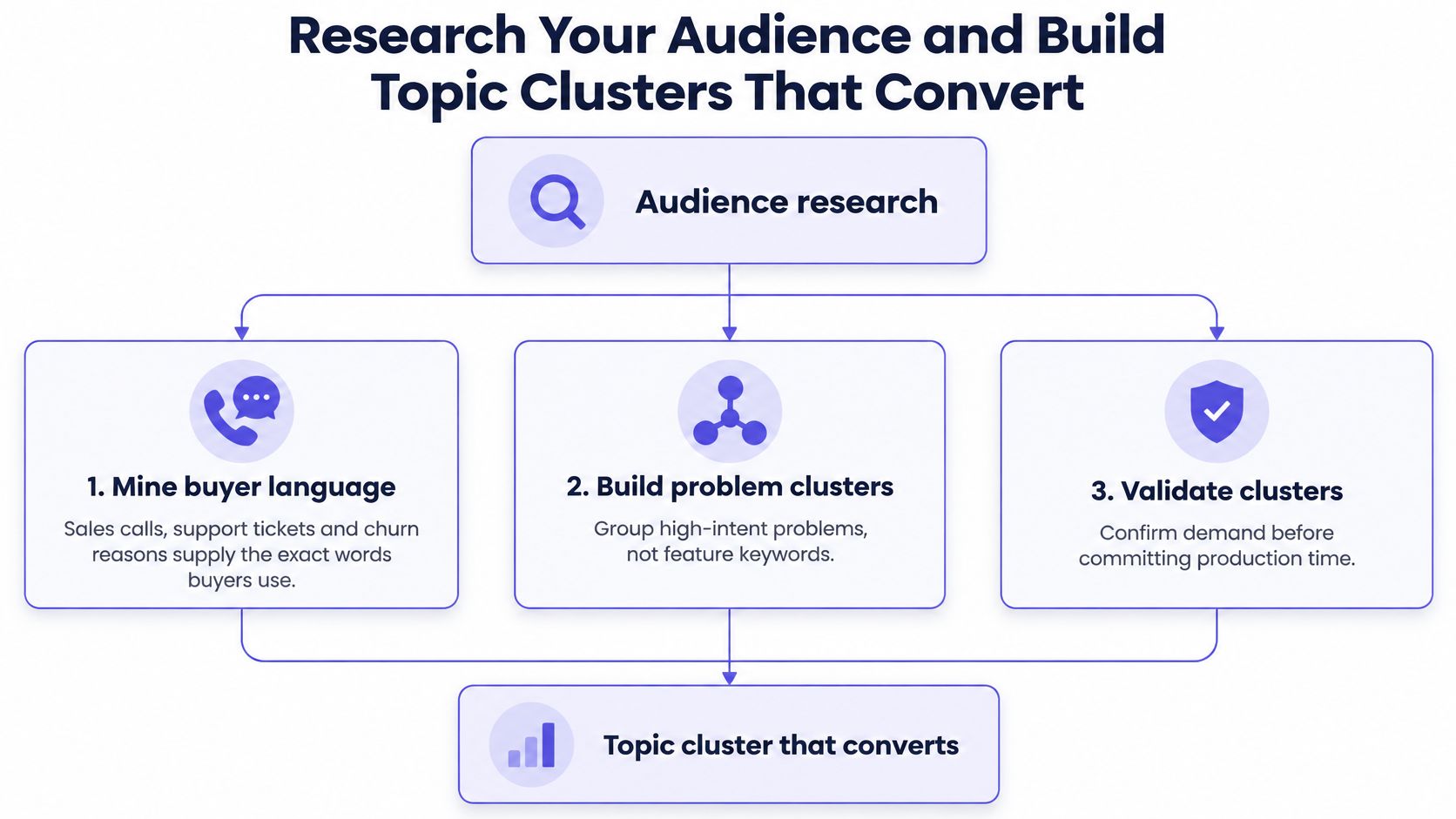
Step 1. Mine the language buyers already use. Pull the last twenty recorded sales calls, the support tickets tagged "how do I," and the closed-lost reasons sitting in your CRM. Write the phrases down verbatim instead of translating them into product terms. A buyer who says "we keep missing Tuesday approvals" has handed you a cluster. A buyer who says "we need a social media tool" has handed you a category you have to fight three competitors for.
Step 2. Build problem clusters, not feature keywords. Each cluster is one recurring problem plus every question that hangs off it. Feature words such as bulk scheduling belong inside a cluster, not at the top of it, because nobody wakes up wanting bulk scheduling. They want to stop pasting the same caption into four dashboards.
Step 3. Validate before you commit a quarter. Run three checks. Does the problem recur across calls or tickets? Is there a search result you can beat on evidence rather than word count? And does the cluster sit close enough to a purchase decision that a reader could plausibly sign up within two months? If a cluster fails the third check, park it. Traffic with no path to activation is a hobby.
Step 4. Design each cluster as a pillar plus derivatives. One pillar page answers the problem end to end. Around it sit a comparison guide, an implementation walkthrough, a template, and two or three platform-specific posts. That shape gives you internal links, repurposing material, and the same problem told in the formats different buyers prefer.
The research and the cluster map fit on one page.
What a cluster looks like in practice
Four clusters carry most of the commercial weight for a social publishing product. Multi-platform scheduling starts from the question "why did the same post break on two networks?" Agency approval workflows starts from "how do we get client sign-off without six email threads?" Short-form repurposing starts from "how do we get twelve clips out of one webinar?" And analytics-driven publishing starts from "which posts produce signups?" Each one is a buyer question. None of them is a feature name, which is exactly why they out-convert pages called "features."
The demand case for doing this properly is directional, not magic. Independent benchmark summaries compiled by Shno report that SaaS sites publishing at least nine blog posts a month saw 35.8% year-over-year traffic growth, and that sites offering original research averaged 29.7% organic traffic growth against 9.3% for sites without it. Read those as correlations. The teams hitting nine posts a month probably also have more than one writer and a distribution habit. Nine posts of rephrased competitor content is thin content with a schedule attached, and no cadence fixes that.
Run the loop quarterly: identify clusters, publish, distribute the derivatives, measure qualified organic sessions and conversion, then update or consolidate whatever underperforms. A content gap analysis at the start of each quarter tells you which cluster has a hole and which one you've already overfilled.
You should finish this step holding three validated clusters, each with a pillar brief and four derivative briefs. Not thirty ideas. Three.
Map Every Asset to a Funnel Stage and a Business Outcome
The deliverable I want from a SaaS content strategy isn't a calendar. It's a table, five columns wide, one row per asset, with a number in the last column that a CFO would recognize.
Having a strategy and having one that works are different problems. In the Content Marketing Institute and MarketingProfs 2025 benchmarks study of 1,186 global marketers, 95% of respondents had a content strategy but only 29% rated it extremely or very effective (Content Marketing Institute statistics). The publishing happened. The system didn't.
One asset, one outcome
Assign every asset a single primary outcome from a short list: qualified traffic, trial or demo conversion, activation, retention, or pipeline influence. Then give it a funnel label and a UTM taxonomy so the page connects to product events you already log, such as account created, workspace set up, first post scheduled, and paid conversion. An asset that can't be tied to one of those events is brand content, and brand content should be funded from a different line with different expectations.
The map itself is small.
| Funnel stage | Share of output | Content types | Primary outcome | Proving KPI |
|---|---|---|---|---|
| Top-of-funnel | 31% | Problem articles, original research, short-form video | Qualified traffic | Qualified organic sessions, assisted signup rate |
| Consideration | 25% | Comparison pages, implementation guides, webinars | Trial or demo conversion | Content-influenced pipeline, demo requests |
| Decision | 24% | Migration checklists, limitations pages, ROI calculators | Pipeline influence | Trial-to-paid conversion, influenced pipeline |
| Post-purchase | 20% | Onboarding playbooks, changelog explainers, templates | Activation and retention | Activation rate, expansion, CAC payback |
The Contentful content marketing benchmarker report puts median quarterly output at 11 to 20 blog posts, 51 to 100 social posts and 3 to 5 webinars, split fairly evenly across the funnel, which is where the share column above comes from. The interesting split is in measurement. In that survey 59% of teams measured direct conversions and 54% measured content-influenced pipeline, while 75% still tracked engagement. Engagement is a useful diagnostic for whether distribution worked. It can't carry a budget conversation on its own, and it won't tell you whether the decision-stage page is doing the job the sales team needs.
Working rule: if you can't name the event that proves an asset worked, you're running a publication rather than a growth program. Fund it from the right line and stop arguing about its ROI.
Draft the four rows for your own product before you write anything. If the consideration and decision rows look identical, you have a distribution problem disguised as a strategy problem.
Run an Editorial Workflow With Approvals and Repurposing Built In
Strategy dies in the handoff between the finished draft and the publish button. Five steps, in this order.
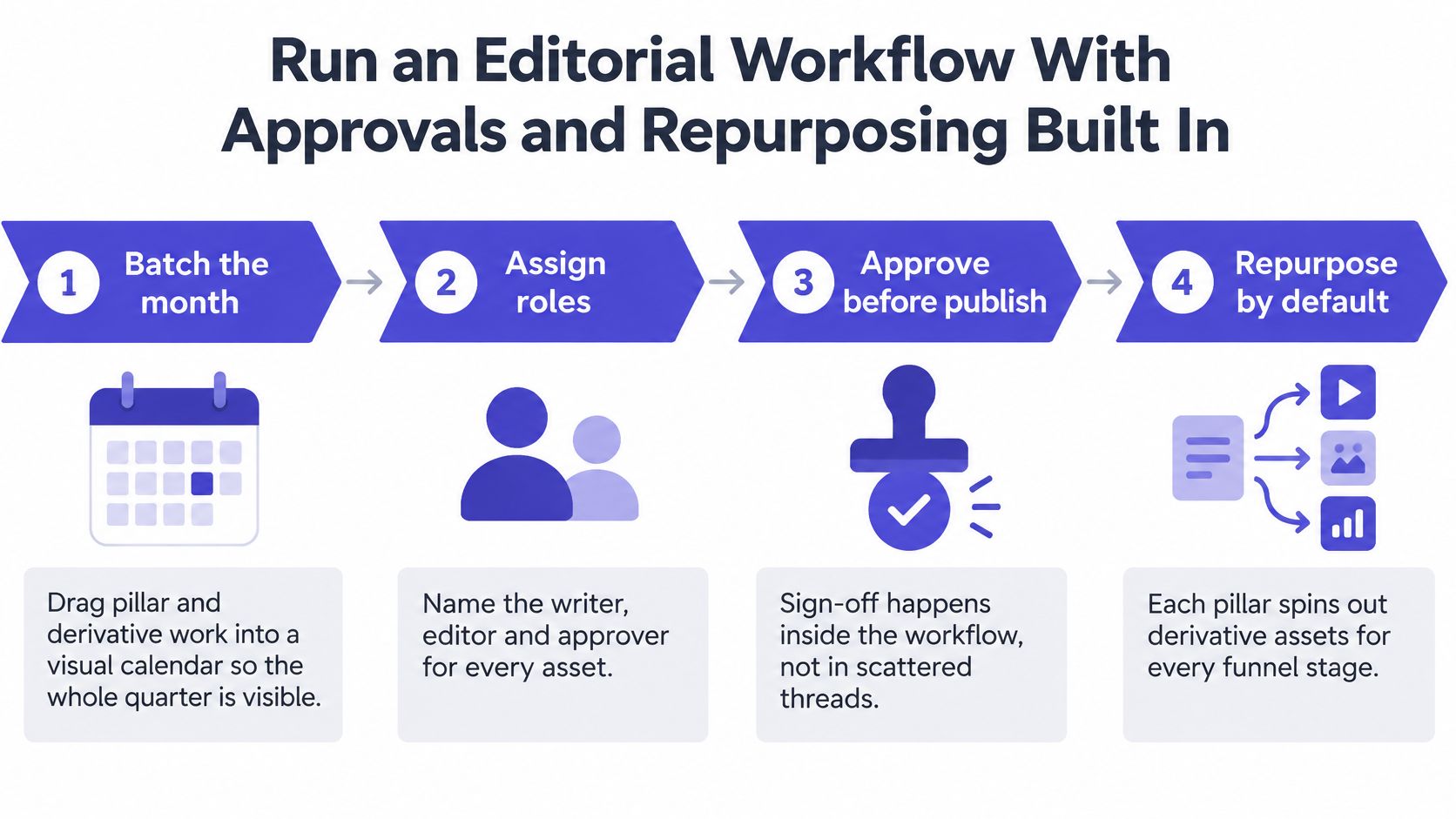
- Batch the month, not the day. Put pillar work and derivative work into one visual calendar so the whole quarter sits in a single view. Batching protects the pillar from the daily scramble and makes repurposing a planned step instead of a heroic one.
- Name three roles per asset. Writer, editor, approver. One approver, not a committee, because a five-person sign-off is how a two-day draft becomes a three-week draft.
- Approve inside the workflow. Scattered email threads lose version control and hide the comment that mattered. Review, comments, and sign-off belong on the asset itself, where the person publishing can see them.
- Repurpose by default. Every pillar spins out platform-native derivatives: a LinkedIn carousel of the framework, an X thread of the sharpest five points, a forty-second clip, a Pinterest pin of the template. Native means rewritten. Cross-posting identical copy is distribution theater.
- Rewrite for the platform, then schedule the batch. Tone, length, and hook change per network. Queue the whole batch at once and add a first comment carrying the link so captions stay clean.
A calendar you can see is the difference between planning and reacting.
| Week | Asset | Format | Owner | Channel | Status |
|---|---|---|---|---|---|
| Week 1 | Pillar guide | Long-form article | Writer, then editor | Blog | In review |
| Week 1 | LinkedIn carousel | Platform derivative | Approver | Scheduled | |
| Week 1 | Short-form clip | Video from the pillar | Approver | Reels, Shorts, TikTok | Scheduled |
| Week 2 | X thread | Rewritten derivative | Writer | X | Draft |
| Week 2 | Recycled winner | Repost of a proven asset | Approver | Top-performing channel | Queued |
Tooling earns its place only when it removes a handoff. A drag-and-drop visual calendar that lets you plan weeks in minutes kills the spreadsheet. Unlimited team members with roles and in-place approval kills the email thread. A creator that turns a blog post or an idea into a short-form video kills the "we'll shoot something later" excuse. That's where PostSyncer sits in a stack, as one option that covers those three handoffs rather than a fourth tool to log into.
The edge case worth planning for is an agency running six client brands. Separate workspaces per client, each with its own accounts, calendar, and approvals, prevent the mistake that ends relationships: publishing a client's launch post to the wrong account because everything lived in one queue.
A repeatable week looks like this. One pillar, four derivatives, one approval pass, one analytics review on Friday. That cadence beats a heroic month followed by two quiet ones, and it fits inside the production benchmarks without inventing hours.
Distribute Content With Channel Fit and Short-Form Video
Most SaaS content doesn't fail at writing. It fails at publication, when one blog post gets one LinkedIn link and the team moves to the next draft. Run a promotion sequence after every approval instead.
- Publish the pillar with its internal links live on day one. The comparison page and the implementation guide should be reachable from the new page, not "coming next sprint."
- Seed native derivatives the same week. LinkedIn and X carry the argument and the thread version for a B2B audience. YouTube Shorts, TikTok, and Instagram Reels carry short-form reach. Pinterest and Telegram give a post durability that feeds don't, since pins and channel posts keep surfacing months after the timeline moves on.
- Recycle winners on a rolling schedule. Once analytics shows which posts earn qualified visits rather than impressions, put the top two back into rotation six to eight weeks later with a different hook.
- Treat timing as a hypothesis. Tuesday to Wednesday, 9 a.m. to noon local, is a reasonable starting guess for professional audiences. Confirm it in your own data, by platform, before you bake it into the calendar as policy.
Short-form is where distribution gets won or lost, and the production rules are unglamorous. Cut clips from the pillar you already published. Put the hook in the first two seconds, because the third second is where the scroll resumes. One idea per clip. Captions on, vertical framing, twenty to forty-five seconds. If a clip needs a spoken setup to make sense, it isn't a clip yet.
Speed is now table stakes. In 2025, 87% of 879 marketers surveyed by Ahrefs said they used AI to help create content (Ahrefs AI marketing statistics), which means volume stopped being a moat. If everyone can produce competent derivatives in an afternoon, the differentiator is a claim only your team can make: a benchmark from your own customer base, a workflow nobody else has documented, a limitation competitors won't admit to.
Channel fit beats channel count. Five networks you post to natively will out-earn eleven networks you cross-post to identically, and the analytics will tell you which five within a month.
Give each derivative a receipt before it ships: channel, native format, publish window, recycle date, and the KPI inherited from the parent asset's funnel label. That last column is what stops a distribution sprint from turning into a busywork audit at quarter end.
Measure Content When Buyers Research Inside AI Chatbots
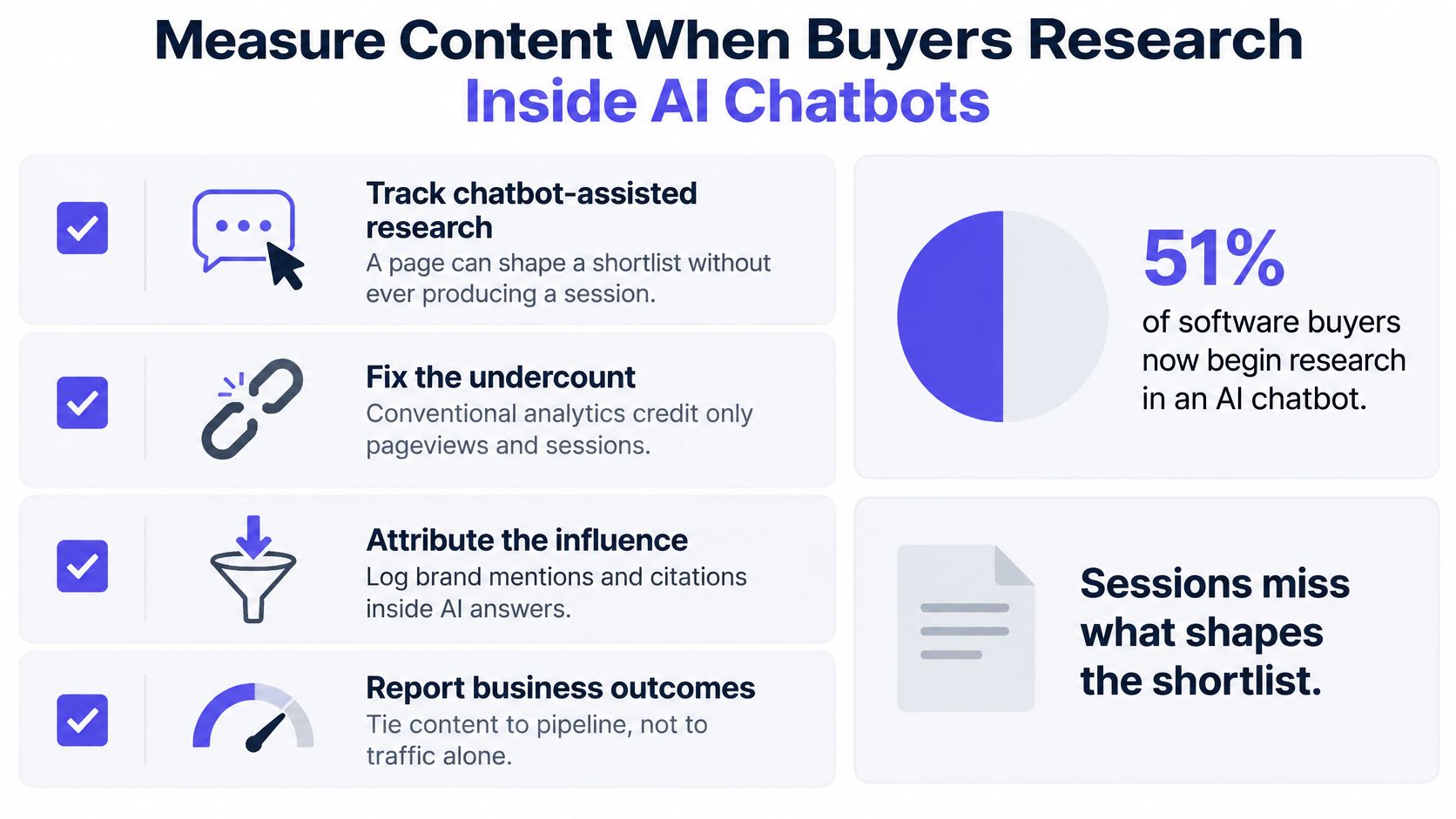
Here's the assumption worth challenging: that a content program's job is to produce sessions. For a growing share of software buyers, the shortlist gets built before anyone opens your site.
Research cited in the Content Marketing Institute's B2B content marketing trends work reports that 51% of software buyers now begin research in an AI chatbot more often than Google, up from 29% the previous year, and that 54% say AI influences their shortlist (Content Marketing Institute B2B trends research). Meanwhile 56% of marketers struggle to attribute ROI and track customer journeys, which is the honest reason so many teams still report clicks: clicks are the thing they can see.
Your analytics credit a pageview or a session. Neither exists when an assistant summarizes your comparison page into a three-line answer and the buyer never clicks. That's the undercount.
Build a prompt panel this week
- Fix a set of commercial prompts for your category and keep them stable. For a scheduling and publishing product, that looks like "best tool to schedule posts across TikTok and LinkedIn," "how do agencies handle client approval on social posts," and "how do we turn one blog post into a week of social content."
- Record what comes back. Whether your product is mentioned or cited, which competitors appear in the same answer, and how good the citation is. A passing mention in a list of nine is worth less than a paragraph that describes your workflow accurately.
- Separate zero-click discovery from website demand. Falling clicks on an informational page isn't automatically a failure if branded search and demo requests hold steady. Treat the two as different signals and stop letting one dashboard explain both.
- Add a self-reported field to the CRM. One question on the demo form, "how did you hear about us," catches the assistant-assisted buyer that no attribution model will ever tag.
- Review quarterly with a human reading the answers. Correlation between prompt visibility and pipeline movement needs a person checking whether the model described your product correctly, not just whether your name appeared.
Pair the panel with the downstream reporting you already trust. If you want the finance-friendly version of the arithmetic, the case for content marketing ROI rests on influenced pipeline and CAC payback, and the prompt panel is one more input into it.
Ten prompts, one spreadsheet, one CRM field. That's the entire new measurement layer, and it's live before your next content review.
Publish Decision-Risk Content Buyers Actually Search
Buyers don't stop at features. They interrogate risk, and the questions they type are risk questions wearing a shopping costume.
Research on 609 SaaS-buyer prompts found that 79% were questions and 48% of commercial prompts requested "best" or similar recommendations, which tells you buyers arrive at evaluation mode early and stay there (Position Digital's analysis of SaaS buyer prompts). That same analysis notes that aligning content with the buyer journey remains a challenge for 45% of B2B organizations. The gap isn't knowledge of the funnel. It's that most content libraries answer "what does it do" and almost none answer "what breaks if we switch."
A decision-risk asset set answers the second question on purpose.
| Asset | Buyer question | Include |
|---|---|---|
| Migration checklist | What breaks if we switch tools? | Brands, channels, permissions, cutover steps |
| Limitations page | When should we not buy this? | Unsupported workflows and honest constraints |
| Security and retention note | Where does data live and who can see it? | Support boundaries, retention, permissions |
| Failure recovery guide | What do we do when an integration fails? | API assumptions, regional limits, rollback |
| Migration calculator | How much operating effort does switching take? | Brand count, channel count, stated assumptions |
For teams publishing across several networks, the risk content has to go further than a generic security page. Platform APIs change without warning. Regional availability differs by network. Permission models and formatting rules shift, and a scheduling setup that worked in March can misfire in June. Say so in public. A page that documents which networks support which formats, and what the fallback is when a connection drops, buys more trust than three feature tours.
Honest constraint: a limitations page that tells a buyer they're a poor fit is the cheapest churn prevention you will ever write, and it makes the sales conversation shorter for everyone who is a fit.
Neutral frameworks also sell. A guide for choosing a publishing stack that compares total operating effort across brand count, channel count, and approval complexity works because it helps a buyer decide rather than telling them what to decide. State your assumptions, the workflows you support, the edge cases you handle badly, and the success criteria a buyer should measure against in ninety days.
Audit every cluster against this list before it ships. If none of the five assets exists, the cluster will attract readers and produce objections, which is a worse outcome than ranking lower.
Start With One Cluster and the Right Publishing Stack
The failure mode at this point isn't ignorance. It's attempting all of it in one quarter.
Pick one validated cluster and ship the pillar plus four derivatives in the next thirty days. Tag every URL with its funnel label and UTM parameters. Stand up the ten-prompt panel from earlier in this piece, add the CRM question, and leave the rest alone for sixty days. One cluster measured properly teaches you more than four clusters published and forgotten.
Then size the stack to the team you have. For a lean SaaS team that needs planning, creation, approval, and analytics in one workspace, PostSyncer's Starter plan covers 10 social accounts, 1 workspace, unlimited scheduled posts and drafts, unlimited team members, basic analytics and 1,000 AI credits a month. Pro Plus scales to 30 accounts and 3 workspaces with advanced analytics when an agency runs several brands. AI-generated media on the platform is licensed for commercial use, so repurposed assets can move into ads and client work without extra clearance.
Analytics closes the loop. Read performance by platform, by content type, and by publish timing, then move budget toward the two combinations that produce qualified visits rather than the one that produced the biggest impression count.
Build the measurement system first and publish second. Downstream outcomes, not traffic, decide where the next dollar goes.
PostSyncer puts the operational half of this framework in one workspace: a drag-and-drop calendar for batching a quarter of pillar and derivative work, an AI Content Agent that turns a URL, PDF, or rough idea into platform-ready drafts, an AI Video Creator for short-form clips, and per-platform analytics that show which posts earn qualified visits instead of empty reach. If you're ready to stop treating your content plan as a publishing schedule, visit PostSyncer and run your first cluster through it this month.