











You've probably seen this audit before: a spreadsheet with hundreds of URLs, competitor exports in separate tabs, Search Console queries nobody has reviewed, and a growing list of “opportunities” that all look equally urgent. The team spends days collecting evidence, then publishes whatever topic has the largest apparent demand. A quarter later, the site has more pages but no clearer path to better visibility or qualified conversions.
A useful content gap analysis produces something more practical. It turns your existing library, competitor coverage, first-party search data, audience questions, and emerging AI visibility signals into a ranked production queue. You should finish with a defensible shortlist, a usable brief for each priority, and clear reasons to update, consolidate, repurpose, or skip the rest.
What Content Gap Analysis Actually Looks Like in Practice
A content gap analysis isn't a report you hand to a stakeholder and forget. It's a triage workflow. The work compares your current visibility and coverage with competing pages, audience needs, and the business outcomes your content must support. Modern guidance describes the gap as the difference between what your site currently covers and what competing domains or audiences expect, including missing topics, thin explanations, outdated information, weak links, and unserved intent. Search Engine Land's gap analysis guide places the method within a broader audit of content, keywords, links, technical health, and visibility.
Consider a B2B software team with a large library of educational articles but no pages addressing implementation risk, vendor comparisons, or troubleshooting. A keyword export might flag hundreds of terms. A proper review narrows them into three different problems:
- Visibility gaps: Queries relevant to the business where the site has little or no presence.
- Coverage gaps: Topics competitors answer repeatedly while the brand offers no useful resource.
- Format gaps: Questions your written guides can't answer efficiently, such as a product comparison, demonstration video, checklist, or support asset.
The output isn't “write more blog posts.” It might recommend improving an existing guide, adding internal links between related pages, creating a comparison page, recording a short walkthrough, or leaving a low-fit topic alone. That distinction prevents teams from turning every competitor keyword into another URL.
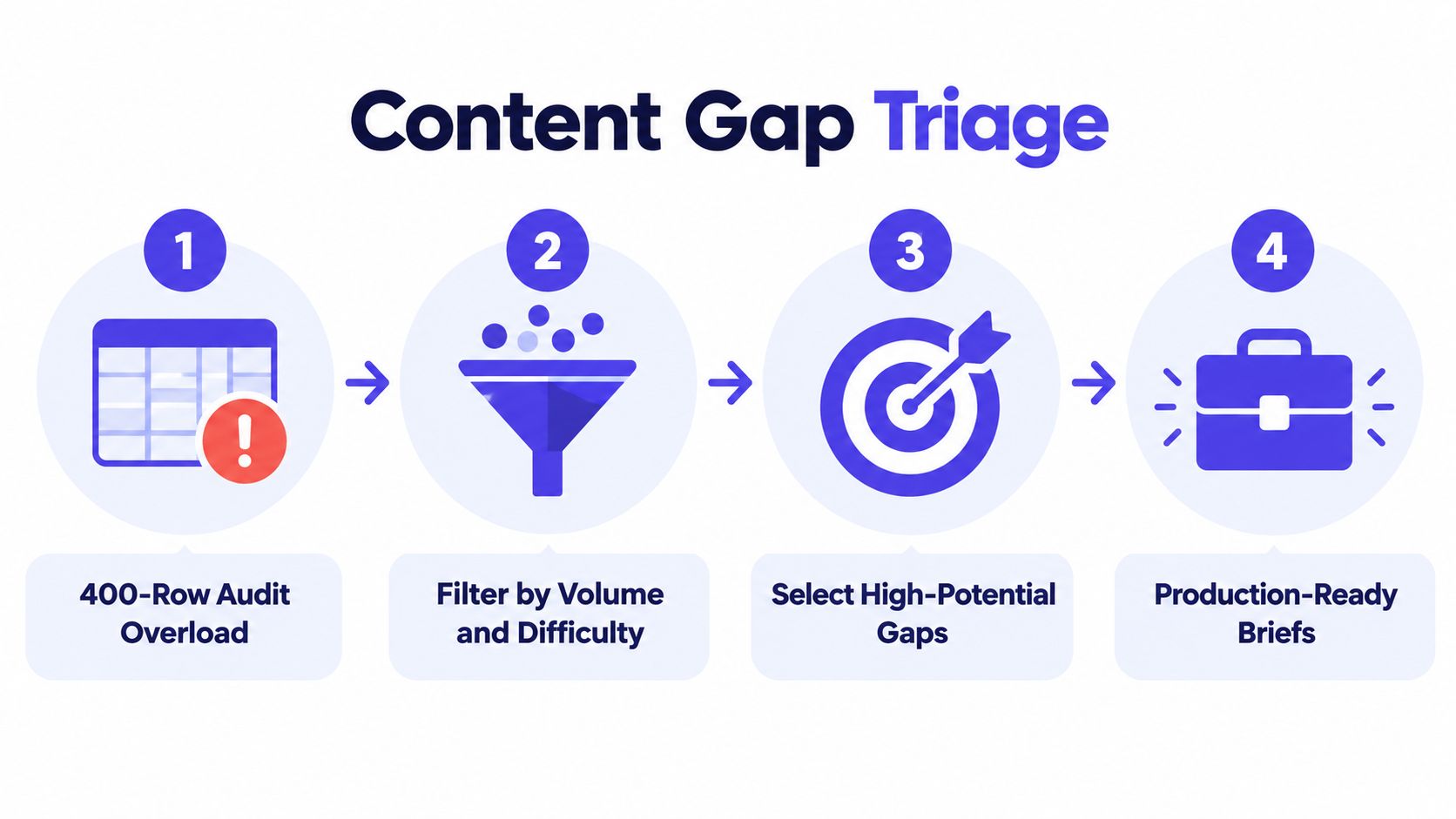
The seven-step workflow
A dependable audit moves through a repeatable sequence:
- Define the business question.
- Select genuine SERP competitors.
- Inventory and tag owned content.
- Merge competitor, first-party, and audience inputs.
- Map each gap to intent, journey stage, and format.
- Score opportunities by fit, winnability, and emerging demand.
- Convert the shortlist into briefs, owners, and measurement plans.
The failure I see most often is stopping after step four. A keyword list may reveal opportunities, but it doesn't tell a writer what to produce, an editor what quality means, or a marketing lead which work should happen first. For broader planning ideas, Storyloft's content strategy resources offer useful context on connecting content decisions with a wider publishing system.
Setting Up Your Audit With Goals Competitors and a Real Inventory
Start with the business question, not the tool. Write one sentence that the audit must answer, such as, “Which content actions can support qualified demo demand in the next planning cycle?” That wording forces the team to distinguish commercial opportunities from attractive but irrelevant traffic.
Choose competitors from the SERP
Your competitors for this exercise aren't necessarily the companies your sales team names. Select three to five true SERP competitors, meaning domains that rank for the informational and transactional searches your buyers actually use. A large industry publication may dominate broad educational terms but compete with you only indirectly. A smaller specialist may be the more useful benchmark because it consistently ranks for evaluation queries.
Use a competitor keyword platform to collect candidate terms, then inspect the actual results. A local SEO competitor keywords guide can help teams think through competitor selection and keyword comparison when location-specific search intent matters. Don't accept a competitor list generated solely from brand similarity.
Build the inventory before drawing conclusions
Export your URL list from a crawler or content audit platform. Combine it with Search Console and analytics data before you score anything. Every row should identify what the asset is supposed to do, who it serves, and how it currently performs.
| URL | Primary Keyword | Search Intent | Buyer-Journey Stage | Content Format | Last Updated | Monthly Clicks |
|---|---|---|---|---|---|---|
/guides/email-deliverability |
email deliverability | Informational | Problem-aware | Guide | Date | Export value |
/compare/tool-a-vs-tool-b |
tool A vs tool B | Commercial | Decision-ready | Comparison | Date | Export value |
/templates/audit-checklist |
deliverability audit checklist | Transactional | Solution-aware | Template | Date | Export value |
Use consistent stage labels, such as problem-aware, solution-aware, decision-ready, and retention. Record the primary keyword, but don't pretend one phrase represents the entire page. Add the dominant intent, content format, update history, indexability status, and business objective where your workflow supports them.
Before the audit begins, spend a short preparation session checking that the exports are complete, URLs are canonicalized, duplicate pages are grouped, and every owner understands the stage labels. This small investment saves much more time than cleaning contradictory tags after the scoring is underway.
Finding the Gaps Most Audits Miss
A competitor keyword export answers one question: what do other domains rank for that your domain doesn't? It doesn't reveal which questions your existing visitors already ask, which topics are gaining attention in your communities, or where your current pages are close to useful visibility.
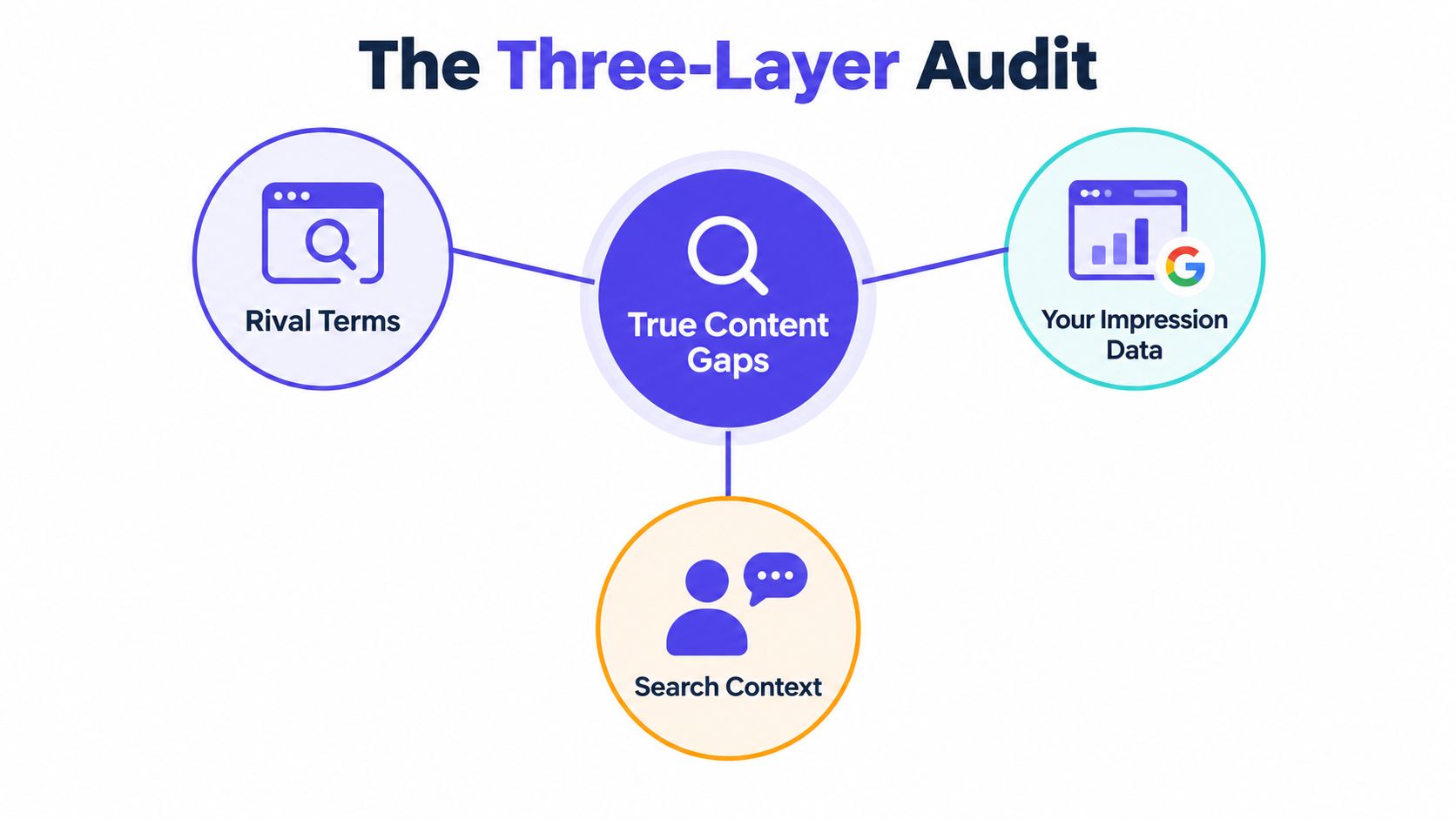
Use three layers and keep their roles distinct.
Competitor keyword data exposes external coverage. Tools such as Semrush, Ahrefs, and similar platforms can show missing and shared terms, competitor landing pages, and thematic clusters. The limitation is important: the dataset is based on observed search rankings, so it favors established demand and can miss questions that are new, conversational, or discussed outside traditional search.
Search Console data exposes first-party opportunity. Review queries generating impressions and clicks for your own domain, especially queries where a relevant page appears but doesn't satisfy the searcher completely. Near-miss positions deserve attention because they indicate that Google already associates your site with the topic. Search Console also surfaces language your audience uses, which is often more valuable than a planner's suggested phrasing.
Audience-question mining captures context that neither source owns. Review sales calls, support tickets, Reddit threads, Quora discussions, community posts, customer interviews, and People Also Ask results. These sources reveal objections, implementation details, comparisons, and practical questions that may not yet have stable keyword demand.
Merge by intent, not wording
De-duplicate queries that express the same need. “How to audit email deliverability,” “email deliverability checklist,” and “deliverability audit steps” may represent one guide, several supporting assets, or different stages depending on the SERP and audience context.
Tag a topic appearing in two of the three sources as high-confidence, then flag queries ranking in positions 8 to 20 as potential fast wins. The position range is a workflow filter, not a guaranteed result. A page still needs the right intent, useful depth, internal support, and a realistic chance of improvement.
A merged gap list might look like this:
| Topic cluster | Competitor evidence | First-party evidence | Audience evidence | Initial action |
|---|---|---|---|---|
| Deliverability diagnostics | Rival comparison pages rank | Existing guide receives related impressions | Support asks for a checklist | Improve guide and add checklist |
| Tool evaluation | Competitors own comparison intent | Product pages receive evaluation queries | Sales hears repeated vendor questions | Create comparison resource |
| Emerging workflow question | Little established coverage | New query language appears | Community discussion repeats the problem | Validate and test a focused asset |
This layered approach prevents a common mistake: treating the absence of a keyword in a database as proof that no opportunity exists. Independent guidance on content gap analysis also emphasizes first-party analytics, Search Console, emerging demand, AI citation gaps, and multi-channel coverage as inputs beyond competitor pages.
For a visual explanation of how these sources fit together, this content gap analysis video provides another way to review the workflow.
Mapping Gaps to the Buyer Journey and Choosing the Right Format
A keyword becomes actionable only after you assign it a stage, a job, and a format. “Email deliverability tools” could represent someone diagnosing a problem, comparing vendors, or looking for a downloadable audit resource. One page rarely serves all three needs well.
Use a mapping sheet with three essential fields:
| Gap topic | Buyer-journey stage | Primary format |
|---|---|---|
| Email deliverability symptoms | Problem-aware | Diagnostic guide or checklist |
| Email deliverability tools | Solution-aware | Comparison page |
| Deliverability audit process | Decision-ready | Template, product workflow, or lead magnet |
| Ongoing sender operations | Retention | Help content or customer training |
Match the format to the question
A long-form guide works when the reader needs explanation and context. A comparison page works when the query contains evaluation language and the SERP presents structured alternatives. A checklist reduces friction for a process with clear steps. A video can work better for troubleshooting, demonstrations, and tasks where seeing the sequence matters.
For AI-facing visibility, structure matters as much as format. Use descriptive headings, direct answers, clear tables, and self-contained explanations so readers and answer systems can identify the relevant passage without reconstructing the entire page. A troubleshooting video can support the written answer, but it shouldn't replace the concise steps a visitor needs immediately.
A single topic can therefore justify a small asset system:
- Awareness: Explain common deliverability symptoms and offer a diagnostic checklist.
- Evaluation: Compare relevant tools by workflow, use case, limitations, and fit.
- Decision: Provide an audit template connected to a clear next action.
- Retention: Maintain practical help content for customers implementing the process.
Format check: If the brief says “write a blog post” before it states the audience question and buyer stage, the mapping is incomplete.
Run a quality check before assigning the work. Ask whether the format matches the dominant intent, whether an existing page should be updated instead of duplicated, whether internal links connect the journey stages, and whether another channel already serves the question better. A repurposing workflow can extend a strong core asset into social and email formats, as shown in this content repurposing strategy guide.
A Prioritization Matrix That Beats Chasing Volume
Volume-first planning rewards the biggest audience estimate, not the most useful opportunity. A new site may spend weeks pursuing a broad software term when a narrower workflow query has clearer commercial intent, stronger first-party evidence, and a more credible path to visibility.
Use a five-input score, with each gap rated from 1 to 5:
- Search volume, weighted at 15%: Is there established demand?
- Current position, weighted through opportunity fit: Does your site already have a relevant page or near-miss visibility?
- Win probability, weighted at 25%: Can your domain compete with the current depth, authority, and format?
- Commercial intent, weighted at 20%: Does the topic support a meaningful business action?
- Emerging demand, weighted at 25%: Are rising queries, AI answer appearances, social discussions, or first-party questions pointing to momentum?
To keep the calculation transparent, assign each input a 1-to-5 rating and calculate:
Score = (Volume × 15) + (Position fit × 15) + (Win probability × 25) + (Commercial intent × 20) + (Emerging demand × 25)
The result ranges from 100 to 500 under this weighting system. Use local thresholds that fit your team's capacity. A practical starting point is to treat scores above 320 as sprint targets, scores from 200 to 320 as quarterly candidates, and lower scores as consolidation, monitoring, or archive decisions. These are operating thresholds, not market facts.
| Keyword Gap | Volume-Only Rank | Weighted Score | Win Probability | Recommended Action |
|---|---|---|---|---|
| Project management software | High | 235 | Low | Defer or narrow the angle |
| Async standup templates | Moderate | 365 | High | Produce a focused template |
| Project status reporting workflow | Moderate | 330 | Medium-high | Create a guide and comparison support |
The exact ratings require judgment, but the judgment is visible. In a spreadsheet, if the five ratings sit in cells B2:F2, use =B2*15+C2*15+D2*25+E2*20+F2*25. Add columns for evidence, owner, proposed format, and next review date so the score doesn't become a detached number.
Practical rule: A gap with modest demand and strong intent can outrank a broad term when your team has a realistic route to publish, earn links, and satisfy the query better.
Review the score with a strategist, subject expert, and commercial owner. The model should support decisions, not hide them behind a formula.
Turning Ranked Gaps Into Briefs and Multi-Channel Content
A ranked list is still a wishlist until someone can produce from it. Each priority needs a brief that translates evidence into editorial decisions, while AI handles repetitive drafting work without deciding the strategy.
A production-ready brief should include:
- Target and supporting entities: The main topic, related concepts, products, audiences, and terminology.
- Intent summary: What the reader is trying to accomplish and what competing pages fail to answer.
- SERP and answer review: The dominant formats, recurring sections, cited sources, and missing practical detail.
- Structure: Proposed H2s, H3s, tables, examples, internal links, and conversion points.
- Distinctive value: First-party evidence, tested experience, a useful framework, or a clearer workflow.
- Distribution plan: Adaptations for social posts, short video, email, and relevant support content.
ChatGPT, Claude, and Surfer can accelerate outline variations, entity lists, title options, and meta descriptions. Keep the strategic inputs manual. An AI draft won't know which customer objection matters to sales, whether a claim is defensible, or which internal page deserves the strongest link without your direction.
For a reusable structure, adapt the fields in this content brief writing guide. A simple execution cadence could look like this:
| Day | Work | Owner | Output |
|---|---|---|---|
| Monday | Confirm the top-ranked gap and evidence | Strategist | Approved topic |
| Tuesday | Draft and review the brief | Strategist and subject expert | Production brief |
| Wednesday | Write the core asset | Writer | First draft |
| Thursday | Edit for accuracy, usefulness, and voice | Editor and expert | Publish-ready asset |
| Friday | Publish and schedule adaptations | Content and social teams | Page plus campaign |
The repurposing grid should preserve the core insight while changing the job of each channel:
| Core asset element | X thread | Short video | ||
|---|---|---|---|---|
| Diagnostic steps | Practical post | Sequenced tips | Walkthrough | Checklist excerpt |
| Comparison criteria | Decision post | Short evaluation thread | Feature explanation | Buying prompt |
| Original framework | Carousel concept | Framework summary | Screen-led explanation | Method recap |

Use a platform such as PostSyncer when the team needs one workspace to schedule and analyze adaptations across social networks. The tool supports content calendars, approval workflows, multi-workspace management, AI-assisted captions and short-form assets, and performance reporting, which can keep distribution attached to the original gap rather than treated as a separate campaign.
Measurement Habits and a 30-Day Plan to Keep It Running
A gap program needs a small measurement set that connects visibility to business value. Track share of voice for target query groups, indexed URLs within each gap cluster, click-through rate changes on refreshed pages, and assisted conversions from new or updated assets. Add AI citation and mention observations where those answer surfaces matter to your audience.
Review the signals monthly, but run the deeper analysis on a 90-day rhythm. Search results, competitors, audience language, and answer engines change often enough that a one-time audit becomes stale. At the same time, a monthly review shouldn't trigger a full rebuild. Check the shortlist, update evidence, inspect published pages, and move stalled items back into the queue.
| Week | Focus | Key Tasks | Owner | Output |
|---|---|---|---|---|
| Week 1 | Inventory and competitors | Crawl assets, export performance, confirm SERP competitors | SEO lead | Tagged inventory |
| Week 2 | Data collection | Merge competitor terms, Search Console queries, and audience questions | SEO and research | Deduplicated gap list |
| Week 3 | Mapping and scoring | Assign intent, journey stage, format, evidence, and priority score | Strategist | Ranked backlog |
| Week 4 | Briefs and launch | Approve briefs, publish one asset, schedule distribution, record baseline metrics | Content and channel owners | Live asset and review dashboard |
Hold one short working session each week, assign one accountable owner per output, and keep the dashboard tied to the gap cluster rather than individual vanity metrics. The content marketing ROI resource can help teams frame distribution and performance discussions around outcomes instead of activity alone.
Start tomorrow by exporting your URLs and Search Console queries, naming your true SERP competitors, and selecting one gap with clear intent and credible win probability. Build its brief, publish the first useful asset, then use the monthly review to improve the system rather than waiting for another enormous spreadsheet.
PostSyncer can help you turn a completed gap analysis into a coordinated distribution workflow by scheduling adapted posts, managing approvals, and analyzing results across social channels. Visit PostSyncer to connect your content briefs with a repeatable publishing and measurement process.