

The average brand published 9.5 social media posts a day across its networks in 2024, according to Sprout Social's analysis of more than 3 billion messages from over 1 million public profiles. Put that beside the team doing the work, usually one marketer with three other jobs, and the number stops being a benchmark and starts being a warning.
The question of how often to post on social media is really two questions that most guides merge into one. How often does your team invent a new idea, and how often does that idea get adapted and published somewhere? Those are separate budgets, they fail at different times, and splitting them is the cleanest way to find a cadence you can defend in a planning meeting.
I'd add a stopping rule on top: keep adding posts only while each extra publish still earns enough reach, saves, leads or revenue to cover the production time and the attention it takes from your audience. When per-post results fall faster than weekly totals rise, the schedule is buying noise.
Posting Ranges for Every Major Network
Start with numbers you can put on a calendar this week. The table below mixes three kinds of evidence, and treating them as one is how teams end up chasing volume they can't staff.
| Platform | Starting range | Median-style benchmark | Businesses published weekly, Q1 2025 |
|---|---|---|---|
| 3–5 feed posts a week | About 17 posts a month | 9.3 | |
| TikTok | 3–5 videos a week | 8–9 posts a month | 3.7 |
| 2–5 posts a week | 2–5 posts a week | 5.5 | |
| 4–8 posts a week | About 35 posts a month | 14.2 | |
| X | 3–7 posts a week unless it's a news feed | About 9 posts a month | 18.1 |
| YouTube | 1 long video a week plus 2–4 Shorts | No comparable benchmark found | No published figure |
| 3–5 pins a week from assets you already have | No comparable benchmark found | No published figure | |
| Threads | 3–5 posts a week | No comparable benchmark found | No published figure |
The starting range is my editorial guidance for a small team, not a research finding. It's what I'd hand a two-person marketing department on day one, sized so there's still an hour left for replies and reporting.
The median-style benchmark comes from broader industry datasets covering accounts of every size. A Buffer analysis of about 2 million posts across more than 94,000 LinkedIn accounts puts an effective LinkedIn cadence at two to five posts a week, and reports medians of roughly 17 Instagram posts a month, 8 to 9 TikTok posts a month, 35 Facebook posts a month and 9 X posts a month.
The last column is behavior, not a target. During Q1 2025, businesses published an average of 18.1 posts a week on X, 14.2 on Facebook, 9.3 on Instagram, 5.5 on LinkedIn and 3.7 on TikTok, according to Hootsuite's analysis of business posting behavior. Eighteen posts a week on X is nearly three a day. That's a newsroom operation, not a two-person team that still has a newsletter to write.
What stays out of the count
- Stories are not feed posts. Twelve Story frames in a day is a presence habit, not a publishing cadence. Count them separately or leave them out.
- Replies are not original posts. Answering five comments keeps you visible and eats real time, but it doesn't belong in the weekly total.
- Drafts don't count. Neither does a queue you built and never published.
- A carousel counts once. Ten slides is one publish and one idea.
- The same asset on three networks is one idea and three publishes. Count both, because the production cost and the distribution cost are different numbers.
For YouTube, Pinterest and Threads, no comparable benchmark average surfaced, so treat the starting range as the whole answer until your own account says otherwise. Choose the starting-range column, hold it for four weeks, and only then look at the higher observed column and ask whether the extra posts bought anything.
Why a Weekly Habit Beats a Daily Quota
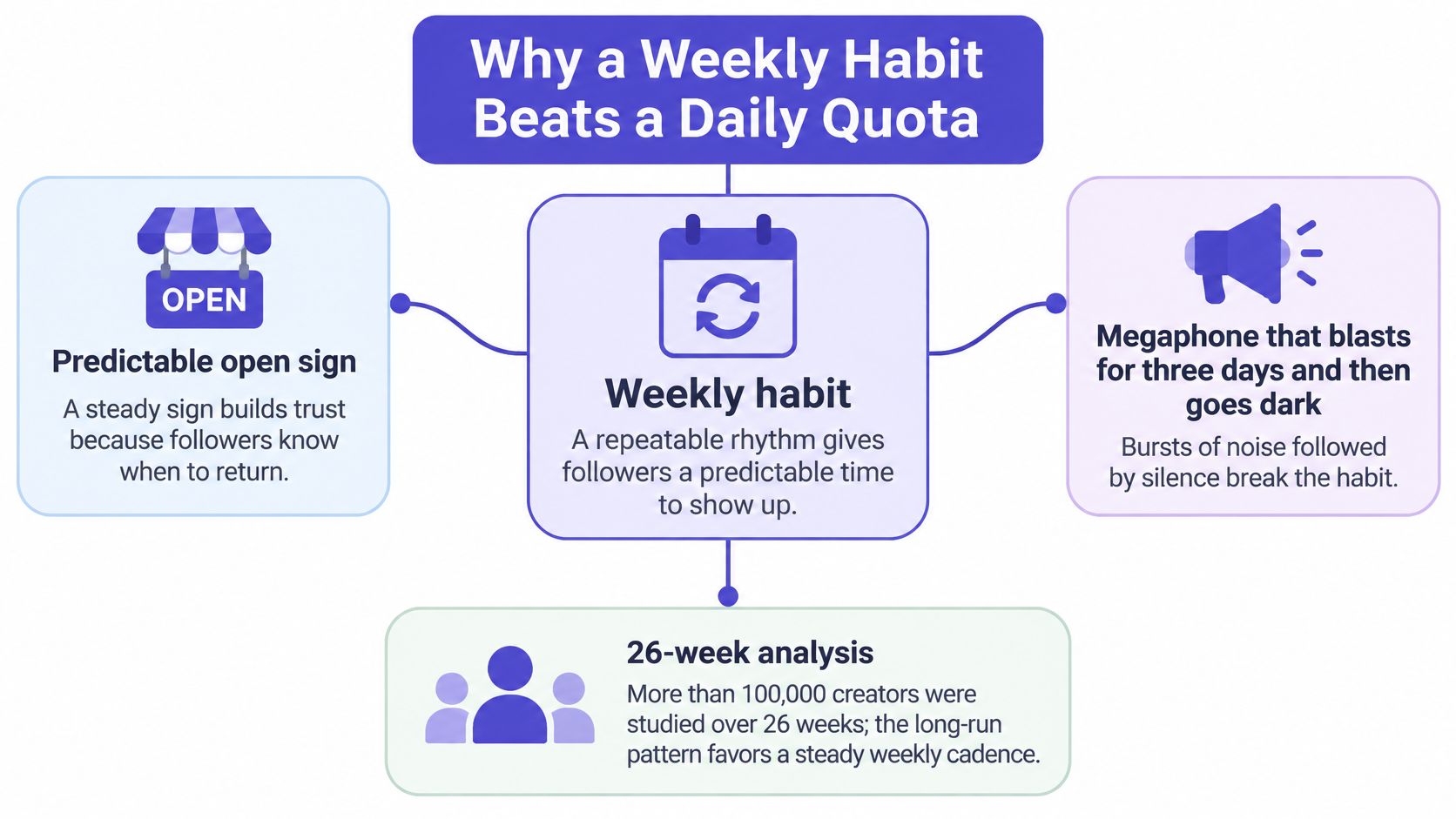
A shop that opens at nine every morning builds a habit. The one that throws open its doors for three days with a megaphone, then stays dark for a fortnight, doesn't. Social accounts behave the same way, and the evidence here is unusually blunt.
An analysis of more than 100,000 creators over 26 weeks found that accounts posting at least once a week in 20 or more of those weeks earned roughly 450% more engagement per post than accounts that posted fewer than five times in the period. Engagement peaked around week 21, at a median of 4.47 interactions per post. Nothing in that finding rewards a burst. It rewards showing up.
The audience side reinforces it. Ofcom's UK Adults' Media Use and Attitudes research found that in 2023, 59% of social media users said they shared, posted or commented, with 25% doing so often and 33% sometimes. Many in your feed are participants, not passive scrollers, which is exactly why a crowded feed has little patience for a brand that appears twice in one afternoon and then vanishes for a month.
Two scores, not one
Every week produces two numbers, and they can move in opposite directions: total interactions across all posts, and engagement per post. A team that doubles output can watch the first climb while the second slides, then conclude the strategy works because the graph goes up. Track both, weekly, per network, and you'll spot the crossover before it costs a quarter.
Continuity compounds for two reasons. Regular publishing feeds recommendation systems repeated signals about content quality, and it gives people repeated chances to form a viewing habit. A burst followed by silence resets both clocks, which is why the week after a quiet spell always feels like starting over.
For a small team, one strong post per active network each week is the floor I'd defend. It isn't a ceiling, and it isn't a target you should feel guilty about missing in a bad week.
Log four numbers every week: engagement per post, reach, follower growth, and saves or shares. They tell you whether the cadence is building an audience or just filling a calendar.
The rule I use: raise volume only when production quality and reply capacity have both held steady for a month. If either slipped, the extra posts are borrowing from next month.
When Posting More Stops Helping
The clearest case against "post more" comes from a single study, and it's worth sitting with. A 2018 study of 476 fashion brands on Instagram, summarized by MarketSplash's posting frequency research, associated a move from 0.5 to 1.5 posts a day with a 19% decline in engagement per post. Going to 2.5 posts a day lined up with a further 9% drop, and 3.5 posts a day with another 6%.
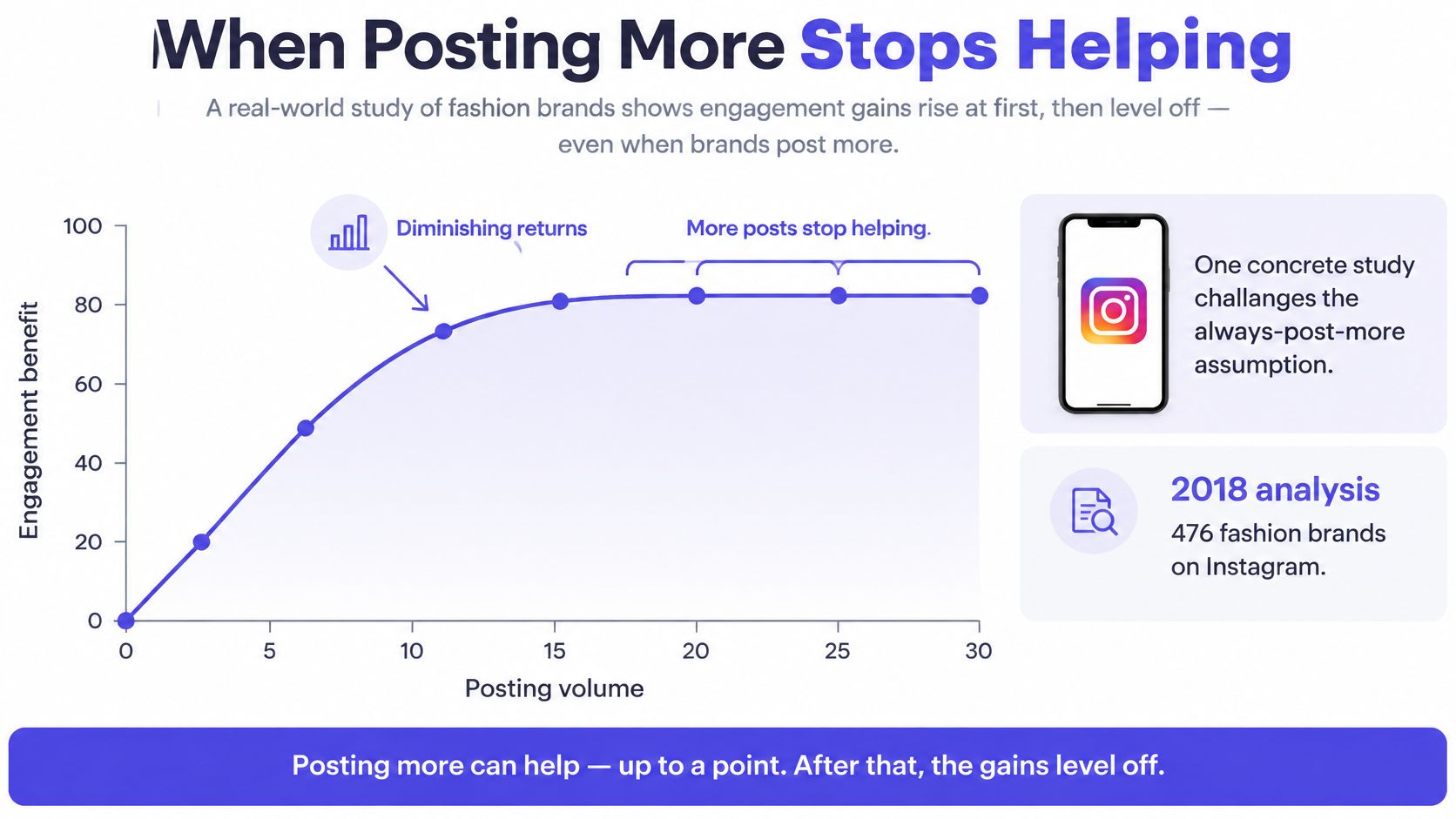
Doubling the daily rate still produced 1.61 times as much total daily engagement. That's the whole trade in one line: the account got busier and each individual post got quieter.
Keep the limits in view. That evidence is observational, comes from fashion on Instagram, and dates from 2018. It describes a shape, not a law for your niche in 2026. What transfers is the mechanism: attention is finite, and every additional post competes with the ones around it for the same eyeballs.
The stopping rule
Increase frequency only while the extra posts produce enough additional reach, saves, leads or revenue to justify the production time and the attention they take from your audience.
Judge each four-week window on medians, never on the single best post. A lucky reel can make a badly diluted schedule look healthy. And count original posts, Stories, short video and replies as separate units, because they cost different amounts of time and they don't substitute for each other in a weekly report.
Posting more does raise your chances. It doesn't guarantee that any single post performs better, and past a certain point it guarantees the opposite.
It's worth knowing what the crowd does, if only so you can decide not to join it. HubSpot's survey data on posting frequency found 30.9% of marketers posting multiple times per week in 2025 and 19.7% posting multiple times per day. Those numbers describe the marketing industry's habits, not results. A team of three shouldn't restructure its week to match a median set by publishers with full-time social staff.
If the argument is easier to follow in motion, this works through how volume and engagement interact:
The brands in that Instagram study didn't get worse at making content. They got faster, and the speed showed in every post that followed.
New Ideas Versus Adapted Posts
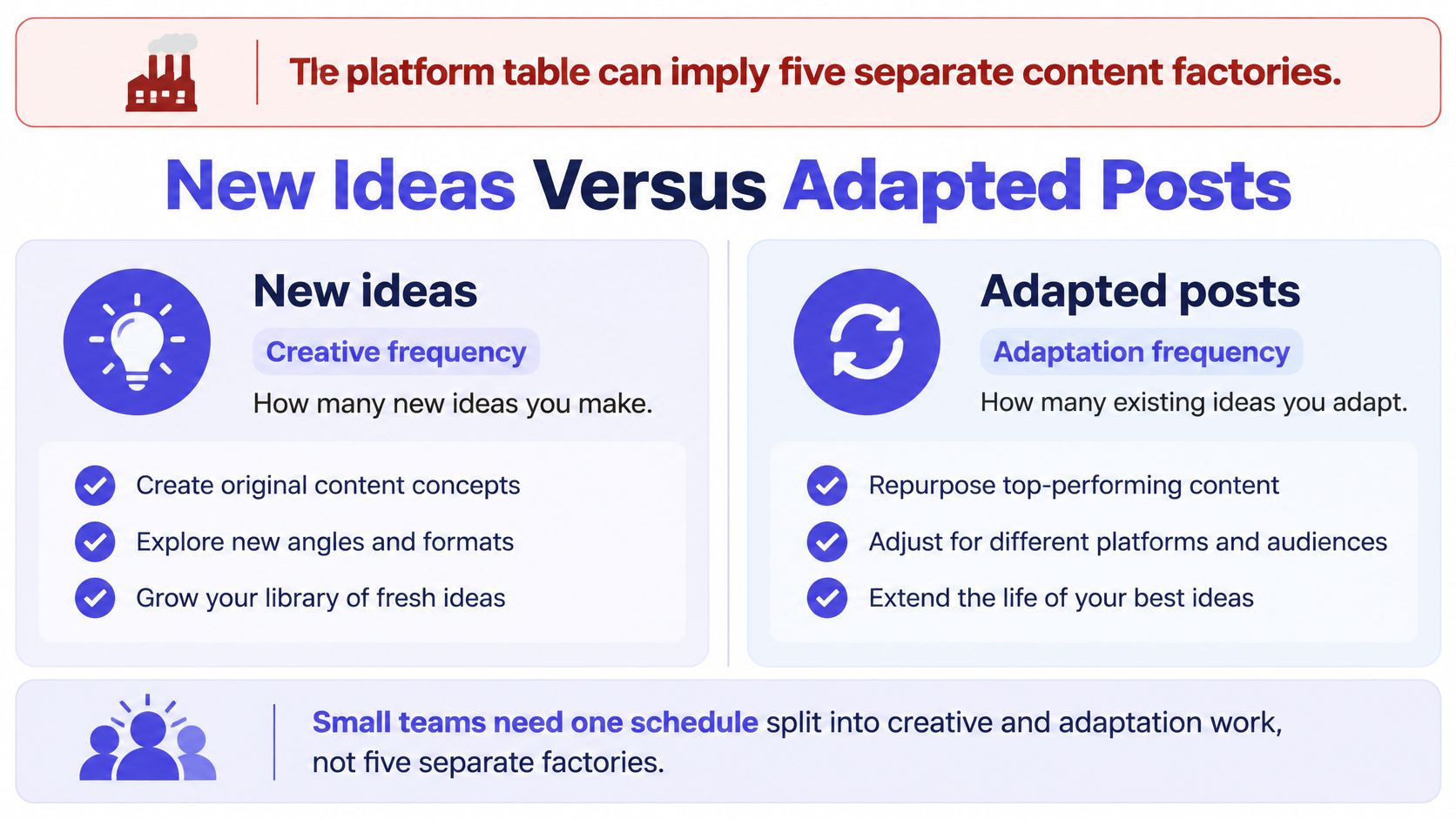
A platform table like the one above can read like a demand for five content factories. That's the fastest route to burnout I know, and it's why I'd split the schedule into two numbers instead: creative frequency, how many new ideas you make, and distribution frequency, how often each idea gets adapted and published.
Observed behavior doesn't answer the question for you. Hootsuite's benchmark research found technology companies averaging 12.1 Instagram posts a week, education organizations averaging 10.1 posts a week on X, and entertainment and media organizations averaging 10.8 Facebook posts a week. Every one of those figures counts posts, not ideas. None of them tells you whether posting identical creative everywhere helps or hurts.
One idea, five native cuts
Say a bakery works out that its sourdough starter is the reason regulars keep coming back. That's one idea, and it can become five publishes without a second idea being invented.
- LinkedIn: a short point of view on why a twelve-year-old starter beats a new one, written for other food businesses rather than for customers.
- Reel or TikTok: twenty seconds of the starter being fed, one line of on-screen text, no voiceover, front-loaded to the first second.
- Instagram carousel: five slides on feeding schedules, with a save-worthy final slide and a soft call to action.
- Threads: the single most surprising line from the carousel, no link, no hashtag.
- Pinterest: a vertical graphic on starter ratios pointing at the bakery's site.
Each cut changes the hook, length, caption or call to action. That's what makes it native rather than duplicated. The mechanics of that cutting work are worth learning properly, and our guide to repurposing content for social media walks through the full sequence from one source asset to platform-specific versions.
What doesn't count as an adaptation: the same video file with the same caption and the same call to action pushed to four networks. That's one publish repeated four times, and the versions compete with each other for the same audience on the days they land.
For agencies and startups, this reframes staffing. A sustainable week might be three new ideas and eight to twelve adapted publishes, not twelve unrelated concepts. Compare the original against each recycled variant on reach and your goal metric, and retire the cut that never earns its slot.
Sample Schedules for Common Goals
Posting advice usually dies at the point where a real week meets a real calendar. Here are five weeks that fit different goals. Pick the closest one and run it for a month.
A weekly baseline is normal, not a failure. In 2025, 44% of surveyed business owners said they shared content once per week, while 18% posted daily, according to Adobe Express's survey of 433 business owners.
- Local service business chasing enquiries. Two original ideas a week. Three Instagram feed posts, three Facebook posts, one Reel. Judge the week on enquiries and profile visits, not likes. If enquiries hold and replies stay under half an hour a day, add a fourth Facebook post next month.
- B2B founder building authority. Two ideas, published as three LinkedIn posts and three short takes on X. Watch profile visits and demo clicks. Prospect comments are the point here, so if you can't answer them within a day, cut X before you cut LinkedIn.
- Creator chasing reach. About four originals, published as four or five TikToks or Reels plus one YouTube video. Track saves, shares and follower growth. If two videos carry the whole week's numbers, your cadence is running ahead of your production quality.
- Agency running several brands. Three campaign ideas per client, one native cut per priority network, nothing published that hasn't been adapted. Judge leads against hours spent, and log the hours. When hours per lead rise for a client, drop a network rather than drop the standard.
- Ecommerce brand. Three ideas, published as roughly four product pieces and three short videos. Watch saves and site clicks. If replies are mostly stock questions, route those to support so the social week isn't swallowed by logistics.
The test for every schedule: name the one metric that would justify adding posts next month, and the reply load that would make the week unsustainable. If you can't name either, the schedule is a guess dressed up as a plan.
If you'd rather start from a template than a blank week, these content calendar ideas map onto the schedules above and save you the first hour of planning.
How to Run a Four-Week Cadence Test
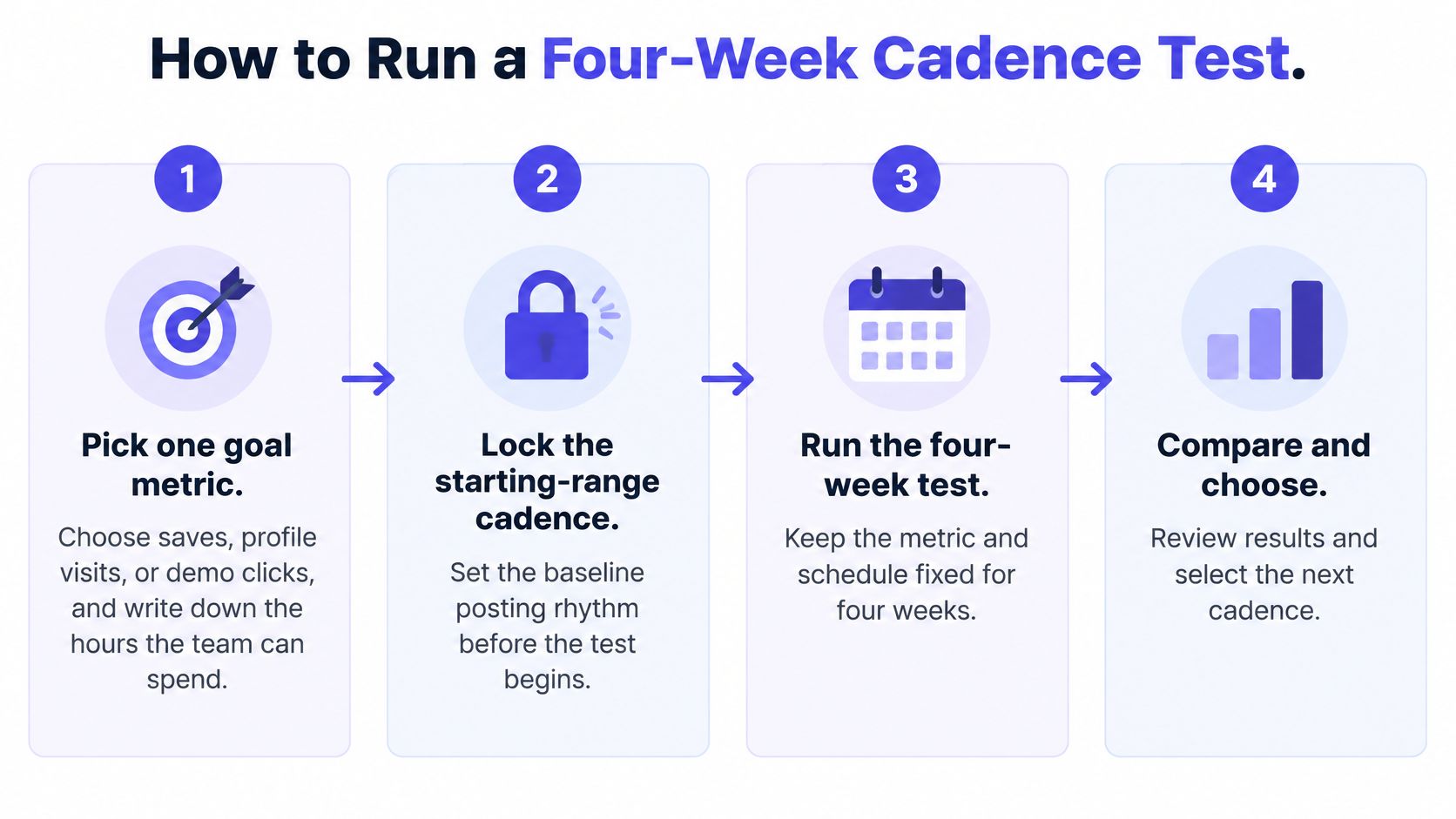
Guessing at a posting frequency costs a year. A controlled test costs four weeks. Run it in this order and don't improvise halfway through.
- Pick one goal metric and one time budget. Saves, profile visits or demo clicks, whichever matches the business. Then write down the hours the team can realistically spend each week, because a cadence that ignores the hours isn't a plan.
- Lock the starting range for four weeks. Take the column for your networks from the ranges table and don't add a channel mid-test. One new platform halfway through makes every comparison unreadable.
- Batch the originals in one sitting. Produce the week's new ideas in a single block, then adapt each one per platform instead of inventing a concept per publish. The mistake this prevents is turning every slot into a fresh creative brief.
- Hold format and topic mix steady. Change frequency and content type at the same time and you learn nothing about either.
- Label the test window. Use post labels or a saved view so the four weeks can be compared as a group rather than reconstructed post by post at the end.
- Compare medians at day 28. Median reach, engagement rate, follower conversion and total weekly interactions. Judging a cadence by its best single post is the most common way teams talk themselves into the wrong schedule.
- Change one variable. Add or cut about two posts a week on a single platform, then run another four weeks. Two variables at once means another month of guesswork.
- Stop when the extra output doesn't pay. The threshold: weekly totals should rise faster than per-post results fall. If engagement per post drops and the added reach, leads, saves or revenue doesn't cover the extra production and reply time, cut back.
Cadence fixes how often you publish, not when. Once the range is set, work through scheduling optimization for each platform so those posts land where your audience already is.
Two edge cases that break the test
Launch weeks are allowed to run hotter. Seven days of extra posts around a product or event is fine, as long as the team returns to baseline afterward and doesn't read the launch spike as the new normal.
A dormant account isn't ready for this test at all. It needs four weeks of any consistent posting before a comparison means anything, because the first month is mostly rebuilding the habit, and its numbers describe the restart rather than the cadence.
At day 28 the numbers force one of three decisions: keep the cadence, raise it, or cut it. Write the decision down with the metric that justified it, so the next test starts from a recorded position instead of an argument.
Set the Cadence You Will Actually Keep
Close on a decision rather than another framework. Write the minimum week you won't miss: which networks, how many original ideas, how many adapted publishes. If that minimum already feels uncomfortable, cut a network before you cut quality. A thin post on six platforms reads worse than a good one on three.
The hard part isn't knowing the range. It's publishing that range in a week full of meetings.
Put the schedule on a visual calendar with a fixed time for each platform and room for anything recurring, whether that's a weekly offer, a tip series or a Friday roundup. Then book the first working session: pick the matching sample week from above, block two hours to batch the originals, schedule the adaptations across the week, and leave reply time unbooked so community management doesn't get squeezed out by the first meeting that overruns.
A scheduler such as PostSyncer can hold that week. You can set specific posting times for each platform, create recurring posts for the things you publish on a rhythm, and drag posts around a visual content calendar spanning 11+ networks, including X, Facebook, Instagram, TikTok, YouTube, Pinterest, Threads, Telegram, LinkedIn, Bluesky and Mastodon. Planning weeks in minutes is the difference between a cadence you chose and one that collapses the first busy Tuesday.
The win is four quiet weeks at the same cadence, then one honest look at engagement per post and total weekly interactions. Not a perfect daily streak.
PostSyncer keeps that minimum week in one place: a visual calendar where you set per-platform times, schedule recurring and adapted posts across 11+ networks, and compare results by cadence, format and platform. Plan your four-week test there once, and the following months become scheduling rather than rebuilding. Start with PostSyncer and give your cadence four quiet weeks to prove itself.