






Let's be real, everyone wants that one magic answer—the single best day to post on social media to get a flood of likes, comments, and shares. While plenty of studies point to the midweek (Tuesday, Wednesday, and Thursday) as a strong contender, the truth is a lot more personal.
The secret isn’t a universal day of the week; it’s finding the specific day your audience is ready and waiting to hear from you.
The Myth of One Perfect Posting Day
We've all seen the headlines promising the ultimate secret formula for social media success. But here's the thing: a one-size-fits-all answer just doesn't exist. Your ideal posting schedule is a tailored strategy, not a generic template.
Think of it like setting up a shop on a busy street. You wouldn't throw open your doors at 3 AM when the sidewalks are empty, right? You’d open when the most potential customers are milling about. Social media is the exact same. The goal is to show up when your audience is already there, scrolling through their feeds.
Finding Your Own Prime Time
Your brand's sweet spot for posting comes down to three key things:
- Your Audience: Who are you talking to? A B2B crowd of nine-to-fivers will have completely different online habits than a community of late-night gamers.
- The Platform: People use different platforms for different reasons. LinkedIn, the ultimate professional network, naturally hums during business hours. Meanwhile, an entertainment hub like TikTok often lights up in the evenings.
- Your Industry: A local restaurant might get a massive response by posting about their Friday night specials, while a software company could see its best performance on a Tuesday morning.
The question isn't "What's the best day to post?" It's "What's the best day to reach my people?" Getting this mindset shift right is the first real step toward a strategy that actually works.
Now, while every account is unique, we aren't starting from scratch. Massive amounts of data give us a solid foundation, showing general trends in user activity across the major networks. Think of these as a data-backed starting line for your own experiments.
Quick Guide to Peak Posting Days by Platform
To give you a head start, here’s a quick-glance table summarizing the generally accepted best days to post on the big platforms. This is your baseline—a place to start before you dive into your own analytics to see what holds true for your brand.
| Platform | Primary Best Days | Peak Engagement Window |
|---|---|---|
| Monday - Friday | 8 AM - 6 PM | |
| Tuesday - Thursday | 11 AM - 6 PM | |
| Tuesday - Thursday | 8 AM - 2 PM | |
| X (Twitter) | Tuesday - Thursday | 10 AM - 5 PM |
| TikTok | Monday - Thursday | 5 PM - 9 PM |
Remember, treat this guide as your launchpad, not the final destination. The real magic happens when you test, measure, and refine based on what your data tells you.
Why Midweek Is the Sweet Spot for Engagement
It's not just a coincidence that Tuesdays, Wednesdays, and Thursdays pop up again and again as the "best" days to post on social media. There’s a very human reason behind this midweek magic, and it all comes down to the rhythm of our weekly routines. Once you get a feel for this pattern, you can start building a content strategy that catches people when they’re actually listening.
Think about a typical work week. Mondays are a whirlwind of catching up on emails, diving into meetings, and just trying to get a handle on the week ahead. Social media usually gets pushed to the back burner. Fast forward to Friday, and everyone's focus is drifting toward the weekend. People are mentally checking out, not checking in.
But the middle of the week? That’s the sweet spot. The Monday chaos has settled, and people have found their groove. They're productive, sure, but they’re also looking for quick mental breaks. That’s when they open their social feeds.
The Psychology of the Midweek Scroll
The shift from a relaxed weekend vibe to a structured work week creates a really predictable pattern in our online behavior. By the time Tuesday hits, most people are fully locked into their schedules and are on the lookout for little distractions during the lulls in their day.
This plays out in a few common ways:
- Commute Scrolling: People kill time on their morning and evening commutes by catching up on news and social updates.
- Lunch Break Engagement: That midday break is prime time for users to scroll, like, and comment on content.
- The Afternoon Dip: When energy levels start to tank in the afternoon, a quick peek at social media feels like the perfect way to recharge.
These little windows of activity might seem small on their own, but they add up, creating a wave of engagement that really crests in the middle of the week. This is especially true on platforms that cater to professional or more general audiences.
Understanding why people are online is just as important as knowing when. Midweek content hits the mark because it lines up perfectly with someone's need for a quick, engaging escape from their daily grind. Your content becomes the micro-break they’re actively looking for.
When you schedule your most important stuff during these peak times, you’re not just tossing content into the internet abyss. You're meeting your audience right where they are, at the exact moment they’re most open to what you have to say.
The Data Doesn't Lie
This isn't just a gut feeling; tons of data confirms that social media is buzzing midweek. Take LinkedIn, for example. It sees a massive spike in engagement from professionals during business hours on Tuesdays and Wednesdays. These folks are actively networking, reading up on industry news, and looking for career-related content.
It’s a similar story on general interest platforms like Facebook and Instagram. Families, local communities, and consumer brands all find that their audiences are way more responsive on these days, creating a reliable window to connect. The data consistently points to Tuesday as one of the best days for social media posts across the board, especially during mid-morning and afternoon. In fact, a deep dive into posting patterns shows that Tuesdays through Thursdays between 10 a.m. and 5 p.m. are the absolute peak for social media activity, with Tuesday often leading the pack. You can see more data on these social media posting trends on sproutsocial.com.
Cutting Through the Weekend Noise
One of the biggest wins of a midweek focus is getting your audience’s full attention before the end-of-week chaos takes over. As Thursday afternoon and Friday roll around, people's attention splinters. They're making weekend plans, scrambling to finish projects, and are just generally less focused on what brands have to say.
By front-loading your most important messages on Tuesday and Wednesday, you make sure your voice is heard when your audience is actually paying attention. This helps you build momentum and stay top-of-mind, so even if they see your content later, that initial connection is already there. It’s a simple strategy to keep your posts from getting lost in the Friday afternoon shuffle and gives your message the best possible chance to make a real impact.
Breaking Down the Best Days for Each Platform
A social media strategy that works wonders on one platform can completely tank on another. Why? It's simple: every network has its own unique audience, culture, and rhythm. Getting a feel for these individual nuances is the secret to moving beyond generic advice and figuring out the real best day to post on each channel you use.
Think of it this way: your LinkedIn audience is at a professional networking event, hungry for business insights during the workweek. Your TikTok followers, on the other hand, are at a casual weekend hangout, looking for pure entertainment. You wouldn't use the same approach for both events, right? Your posting schedule needs that same level of distinction.
This platform-by-platform breakdown will give you a solid starting point for getting your content in front of the right people at the right time.
The Best Posting Day Recommendations by Social Network
To make it even easier, here's a quick look at the optimal days for each major platform. This table gives you a clear comparison to help tailor your schedule for maximum impact.
| Platform | Best Days | Key Considerations |
|---|---|---|
| Tuesday, Wednesday, Thursday | Broad user base means consistent activity all week, but midweek is the sweet spot. | |
| Tuesday, Wednesday, Thursday | Visually driven users are most active during midday breaks on workdays. | |
| Tuesday, Wednesday, Thursday | Strictly business. Engagement drops off a cliff outside of the 9-to-5 workweek. | |
| X (Twitter) | Tuesday, Wednesday, Thursday | The fast-paced, real-time nature of X means users are plugged in during the workday. |
| TikTok & YouTube Shorts | Weekends, Late Afternoons/Evenings | Entertainment-focused. Audiences tune in after work/school and on their days off. |
While this table offers a great starting point, let's dig into the "why" behind these recommendations.
Facebook: The All-Week Connector
As the world's biggest social network, Facebook's user activity is incredibly consistent. People are checking in all day long—during their morning coffee, on their lunch break, and while winding down in the evening. This creates a pretty reliable window for engagement almost any day.
That said, the midweek days of Tuesday, Wednesday, and Thursday are when you'll see the highest levels of activity. By then, users have settled into their weekly routines and are actively scrolling for updates. Engagement is still strong on Mondays and Fridays, but the midweek is where the magic happens. Our guide on the https://postsyncer.com/blog/best-times-to-post-on-facebook digs even deeper into these daily patterns.
Instagram: The Visual Midweek Hub
Instagram is all about eye-catching content, and its users are most active when they have a spare moment to browse. Just like with Facebook, the platform really hits its stride midweek, with Tuesdays, Wednesdays, and Thursdays standing out as the strongest days to post.
Engagement usually climbs in the late morning and stays steady through the afternoon, which lines up perfectly with lunch breaks and that classic 3 PM slump. This is your chance to share those high-quality images, Reels, and Stories that can grab attention when people are looking for a quick visual escape.
This chart really drives home how powerful that midweek engagement window is.
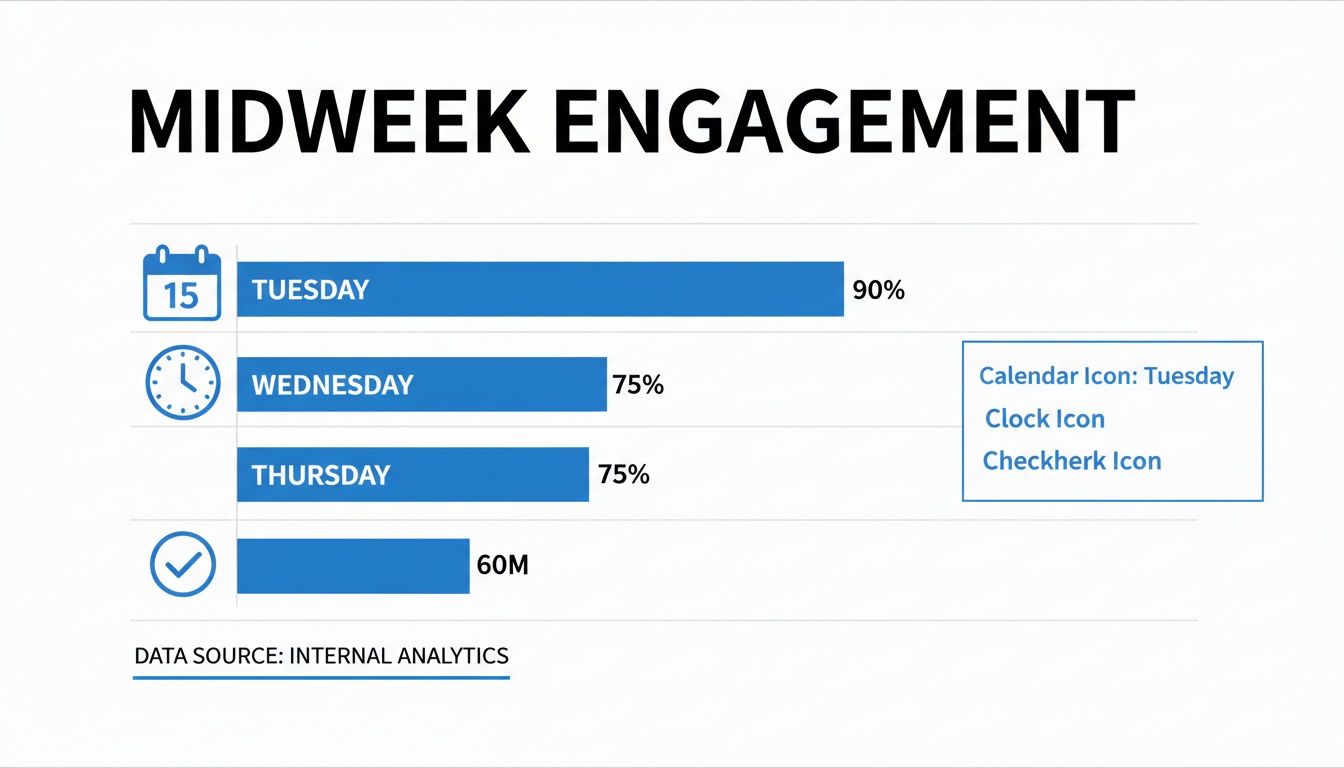
As you can see, while the whole middle of the week is solid, Tuesday often leads the pack, with Wednesday and Thursday right behind it.
LinkedIn: The Professional Powerhouse
LinkedIn is where professionals live online, so it's no shock that its peak activity is locked into the traditional workweek. Posting here on a weekend is like trying to host a business meeting on a Sunday morning—almost nobody is going to show up.
The absolute best days to post on LinkedIn are Tuesdays, Wednesdays, and Thursdays. Engagement is at its highest during business hours, and you'll want to aim for two key windows:
- Morning: When people are starting their day and catching up on industry news.
- Midday: Around lunchtime, when users take a break to scroll their feeds.
If you post outside of these core business days, you're just not going to reach this career-focused audience.
X (Formerly Twitter): The Real-Time News Feed
X moves at the speed of light. It's a non-stop feed of news, updates, and hot takes. To make a dent, your content has to drop right when users are plugged in and ready to jump into the conversation.
Following the trend, the midweek trio of Tuesday, Wednesday, and Thursday is your best bet here, too. Engagement on X stays strong all through the business day, as people pop in for breaking news and discussions during their work breaks.
Key Takeaway: The one thing Facebook, Instagram, LinkedIn, and X all have in common is the power of the midweek. That Tuesday-to-Thursday stretch is a super reliable, high-engagement window where audiences are locked into their routines and ready for your content.
TikTok and YouTube Shorts: The After-Hours Entertainment
Short-form video platforms like TikTok and YouTube Shorts play by a completely different set of rules. Their audiences are generally younger and use the apps to unwind and be entertained, not to work.
For these platforms, the best times to post are concentrated in the late afternoons and evenings on weekdays, right after school and work let out. Weekends are also massive, as users have way more free time to get lost in an endless scroll of videos.
If you're a creator focused on short-form video, learning the specific quirks of your platform is crucial. You can find more details on the optimal times to post YouTube Shorts to really nail your timing. This user behavior is a world away from the professional networks, which is exactly why a one-size-fits-all schedule is doomed from the start.
How to Find Your Audience's Peak Engagement Day

Industry benchmarks are a fantastic starting point, giving you a general map of the social media landscape. But to find the real best day to post, you have to look closer to home. Your own analytics provide the exact address for where your audience hangs out online.
Think of it like being a detective. The general data gives you a list of likely suspects, but your own insights are the clues that actually solve the case. This is about moving from broad recommendations to a personalized, data-backed strategy that is completely unique to your brand.
It’s time to stop guessing and start measuring. By digging into your own performance data, you can uncover the specific days and times your followers are most active, turning good results into great ones.
Unlocking Insights with Native Platform Tools
Every major social media platform comes with its own set of analytical tools, and they are packed with valuable information. You don’t need to shell out for expensive software to get started; the answers are often waiting right inside the apps you already use every day.
These built-in tools are designed to show you exactly how your content is performing and who is seeing it. Learning to navigate them is the first step toward building a truly effective posting schedule.
Here’s where to look on the biggest platforms:
- Instagram Insights: Available on business and creator accounts, this tool shows you follower demographics and, most importantly, "Most Active Times." This section gives you a day-by-day and hour-by-hour breakdown of when your followers are online.
- Facebook Page Insights: Head to the "Audience" tab to find similar data. You can see detailed reports on when your fans are most active, helping you pinpoint the perfect time to post.
- TikTok Analytics: Under the "Followers" tab in your analytics, you'll find a "Follower Activity" section. This chart highlights the days and hours your audience is most engaged.
- LinkedIn Analytics: For company pages, the "Analytics" tab offers visitor data that reveals which days of the week bring the most traffic and engagement to your page.
Your analytics dashboard is your direct line of communication with your audience. It tells you their habits, preferences, and behaviors without you ever having to ask. Listening to this data is the key to showing up when it matters most.
By checking these insights regularly—aim for at least once a month—you can spot emerging patterns. For instance, you might discover your audience is surprisingly active on Sunday evenings, a time you might have previously ignored based on general advice. These unique discoveries are where your competitive advantage lies. Our complete guide to social media analytics and reporting can help you go even deeper into this data.
Running Simple Tests to Confirm Your Best Day
Once you've gathered some initial data from your analytics, it's time to put your hunches to the test. This doesn't need to be complicated. A simple A/B test can provide clear, actionable results to confirm your brand's unique best day to post.
The goal is to isolate one variable—the day you post—to see how it impacts performance. Here’s a straightforward framework you can follow:
- Form a Hypothesis: Based on your analytics, make an educated guess. For example: "My audience engages more on Thursdays than on Tuesdays."
- Create Similar Content: Prepare two posts that are very similar in format, topic, and tone. Think two behind-the-scenes carousels or two educational single-image posts.
- Schedule and Post: Post the first piece of content on a Tuesday at 11 AM. Post the second piece on a Thursday at 11 AM the following week. Keeping the time consistent is crucial.
- Measure the Results: After a set period (like 48 hours), compare the key metrics for both posts. Look specifically at reach, likes, comments, and shares.
- Analyze and Repeat: Did one day clearly outperform the other? The results will either confirm or challenge your hypothesis. Repeat this process with different days and content types to build a reliable picture of your audience's behavior.
This repeatable method gives you firsthand performance data, moving you beyond industry averages to a schedule truly optimized for your specific followers.
Automating Your Perfect Posting Schedule
So, you’ve put in the work. You’ve sifted through industry benchmarks, explored your own analytics, and maybe even run a few A/B tests to pinpoint your ideal posting day. Great! But now comes the hard part: actually posting at those perfect times, every single time.
Let's be real—manually posting at precise, optimal times across multiple platforms is a logistical nightmare. It’s a fast track to burnout.
This is exactly where smart automation steps in. It’s not about being lazy; it’s about transforming your hard-won insights into a consistent, effective system. Instead of setting alarms and scrambling to post, you build a workflow that does the heavy lifting for you. The goal is to stop just finding your best day and start acting on it effortlessly.
Let AI Do the Heavy Lifting
Modern social media tools have evolved far beyond simple "set it and forget it" schedulers. Today, they act more like an intelligent partner, using your own historical data to take the guesswork out of the equation. This is the whole idea behind PostSyncer’s AI-powered scheduling.
The system crunches the numbers on your past performance—every like, comment, share, and click—to identify your unique peak engagement windows. It's like having a data scientist on call 24/7, constantly reviewing your account to find the exact moments your audience is online and ready to interact.
This AI-driven approach has some serious advantages:
- Truly Personalized Recommendations: The tool doesn't care about generic industry stats. It builds its suggestions based on your specific audience's behavior.
- It Gets Smarter Over Time: As you publish more content, the AI gathers more data, continuously refining and improving its recommendations. Your schedule gets sharper the more you use it.
- Frees Up Your Time: It completely eliminates the need for manual data-diving and endless testing, letting you get back to what matters—creating great content.
To get a feel for what’s out there, checking a good social media management tools comparison can help you find a platform that aligns with your automation goals.
This is what PostSyncer's AI scheduler looks like in action, flagging the best time slots so you can choose a high-impact window with confidence.
Each recommendation is backed by your own performance data, turning what used to be a guess into a solid, strategic decision.
Visualizing and Planning Your Success
Data is only helpful if you can actually understand and use it. A great tool shouldn't just tell you the best day to post; it should make it easy to see your entire content strategy at a glance. This is where an intuitive dashboard and a drag-and-drop calendar become your best friends.
Think of your content calendar as a strategic map. With a tool like PostSyncer, you can see your whole month laid out, with your optimal posting days clearly highlighted. This bird's-eye view lets you plan your most important campaigns and announcements to land right in those peak engagement windows.
For example, you can:
- See Performance Data Right on the Calendar: A built-in dashboard shows you which days are hitting the mark, confirming your strategy without forcing you to dig through separate analytics pages.
- Plan Around Big Moments: Easily drag and drop content to align with product launches or holidays, making sure they get maximum visibility on your highest-traffic days.
- Spot Gaps in Your Schedule: A clear calendar view helps you maintain a steady, consistent presence without feeling overwhelmed or posting erratically.
Key Insight: Automation isn't just a time-saver; it’s about putting your data to work. It creates a direct line from your analytics to your execution, giving every single post the best possible shot at success.
From Strategy to Execution, Seamlessly
Once you’ve nailed down your ideal posting days and times, the final step is making it happen. The manual approach is filled with pitfalls—missed alarms, last-minute rushes, or just plain forgetting to post. True automation eliminates that friction entirely.
With a centralized platform, you can batch-create your content for the week or month ahead and load it all into a queue. From there, the AI scheduler takes over, automatically publishing each post at the pre-determined optimal time for that specific platform.
This automated workflow is the final piece of the puzzle. It takes all your careful planning and turns it into a reliable, hands-off system. If you want to dive deeper, you can learn more about how to automate social media posting to build a more efficient strategy. By setting this up, you ensure your data-driven insights aren't just theories—they're consistently applied, boosting your reach and engagement day in and day out.
Got Questions About Social Media Scheduling?
Even with the best strategy in hand, you're bound to have questions when you're trying to nail down the perfect time to post. The little details can make a huge difference in your results, so let's clear up some of the most common questions marketers and creators run into.
Think of this as your go-to cheat sheet for fine-tuning your content calendar.
How Often Should I Post on Social Media?
Honestly, there's no single magic number. Consistency will always beat frequency. It's far better to publish 3-5 high-quality posts a week than to spam your followers' feeds with mediocre content just to say you posted every day.
Start with something you know you can handle, like three solid posts per week on your main platform. Once you get into a good rhythm and can keep the quality high, then you can think about posting more often. The goal is to stay on your audience's radar without burning out or annoying them.
The right frequency is whatever you can stick with without letting your quality slide. Your audience wants value, not volume. Make every post count.
Should I Post on Weekends?
This one completely depends on where you're posting and who you're talking to. On a professional hub like LinkedIn, you'll probably hear crickets on a Saturday. But for visual, entertainment-driven platforms like TikTok and Instagram, weekends can be your best-performing days.
- B2C Brands: If you're selling directly to consumers, weekends can be gold. People are relaxing, browsing, and shopping, especially on Saturdays.
- B2B Brands: If your audience is other professionals, stick to the work week. Most have already mentally checked out by Friday afternoon.
The only way to know for sure? Test it. Schedule a couple of posts for a Saturday or Sunday and see how the numbers stack up against your weekday content.
Does the Type of Content Change the Best Day to Post?
Absolutely. The kind of content you're sharing should match your audience's mindset, which definitely changes throughout the week.
A dense, educational carousel or an in-depth video will probably land better on a Tuesday or Wednesday morning when people are in work mode and ready to learn. But a lighthearted poll, a fun behind-the-scenes Reel, or a user-generated content feature? That has "Friday afternoon" written all over it, when people are winding down and looking for a quick dose of fun.
How Do I Handle Audiences in Different Time Zones?
Time zones are a classic headache if your audience is spread across the country or the globe. Posting at 10 AM EST is great for the East Coast, but it’s only 7 AM PST, meaning a huge part of your audience is still asleep.
The secret is to find the sweet spot. Dive into your analytics and see where most of your followers live. If you have a big split between the East and West Coasts of the U.S., for instance, try posting around 1 PM EST / 10 AM PST to catch both. For a truly international audience, you might need to post the same content twice at different times or just focus on the time zone where your most engaged followers are.
Ready to stop guessing and start scheduling with confidence? PostSyncer’s AI analyzes your unique audience engagement to automatically recommend the perfect posting times for you. Take control of your content calendar and get the most out of every single post. Start your free 7-day trial of PostSyncer today.