












Your team manages six social channels across several brands. A launch post waits for legal approval in a direct message, a community manager answers customers from a personal browser tab, and the analyst rebuilds performance reports from separate exports. Everyone is busy. Nobody has a reliable view of what was approved, what was published, or what social activity contributed to the business.
That isn't a content shortage. It's an operating-system failure.
What Enterprise Social Media Actually Means
Enterprise social media is the governed use of external social networks and internal collaboration systems to produce measurable business outcomes. It includes publishing, scheduling, engagement, employee advocacy, approvals, analytics, access controls, and the data connections that keep those activities accountable.
A social media manager posting from a single account is running a marketing tactic. A team managing multiple brands, networks, reviewers, markets, and customer conversations is running an operational system. The difference isn't the size of the company. It's whether social work depends on personal memory and scattered messages, or on repeatable processes that other people can inspect and operate.
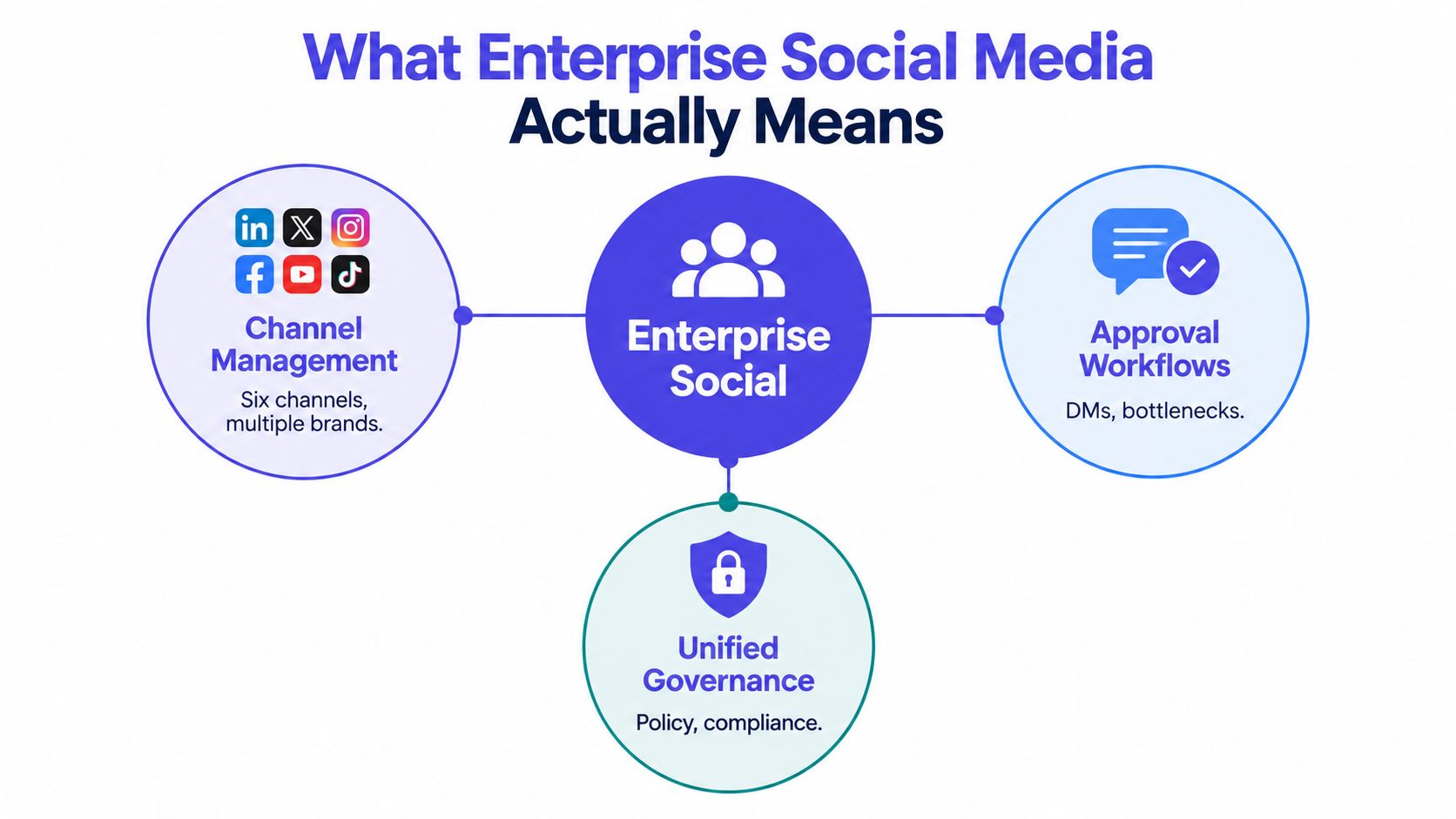
The line between posting and operations
Enterprise social media covers four connected jobs:
- Channel management: Teams plan and publish content across public networks, adapting formats and tone to each audience.
- Audience engagement: Community managers monitor comments, answer questions, escalate complaints, and identify recurring customer themes.
- Internal collaboration: Employees share knowledge, coordinate launches, and reuse expertise through internal social systems.
- Measurement and governance: Leaders define permissions, preserve approval context, connect activity to business outcomes, and manage risk.
The strongest organizations don't treat these jobs as separate software problems. A customer complaint can reveal a product issue. A high-performing post can become sales enablement material. An employee answer can become a documented support resource. The operating model determines whether those connections survive beyond the person who noticed them.
Why the term applies beyond large corporations
Eurostat reported that 60.9% of EU enterprises used at least one type of social media in 2023, including social networks, blogs, content-sharing websites, and collaborative knowledge platforms. That was a 24.1-percentage-point increase compared with 2015, showing that enterprise social media has moved into ordinary organizational activity across industries, not just technology companies or global brands. Eurostat's enterprise social media statistics also shows a strong association with company size, with large enterprises more likely to use social media than small firms.
Small businesses and agencies face the same operational problem at a different scale. If approvals live in DMs, content ownership is unclear, and customer replies aren't classified, the team has enterprise risk without enterprise discipline. A clear distinction between publishing activity and managed community operations is outlined in this guide to community management.
Practical rule: If a second person can't understand why a post was approved, who owns the reply, and where the result is recorded, you don't have an enterprise social process yet.
External Brand Channels vs Internal Collaboration Networks
Enterprise social media developed along two paths, and treating them as one is a strategic mistake.
External brand channels exist in public networks. Marketing teams publish campaigns, schedule product education, respond to customers, amplify selected content through paid media, and protect the brand's public reputation. Their audiences include prospects, customers, partners, journalists, creators, and employees. Their operating risks include inaccurate claims, missed complaints, inconsistent regional messaging, and uncontrolled access to brand accounts.
Internal collaboration networks serve employees. Teams use them for announcements, knowledge sharing, cross-functional problem solving, and organizational communication. Their value comes from making distributed expertise easier to find and reuse. Their risks are different: information overload, poor searchability, unclear ownership, and conversations that never become decisions or documented assets.
The historical distinction matters
The commercial expansion of social tools made both paths visible. In 2009, 92% of Inc. 500 companies reported using at least one social-media channel, up from 77% in 2008, a 15-percentage-point increase in one year. Internal collaboration followed a related trajectory. Yammer, founded in 2008 and acquired by Microsoft in 2012, reported nearly 8 million registered users, more than 200,000 organizations worldwide, and adoption by approximately 85% of Fortune 500 companies by June 2013. The history of enterprise social networking documents how external marketing and internal collaboration matured as connected but distinct practices.
The management implication is simple:
| Environment | Primary outcome | Core operators | Useful measures |
|---|---|---|---|
| External brand channels | Revenue, reputation, customer relationships | Social, content, community, media, legal | Qualified traffic, response quality, pipeline influence, sentiment themes |
| Internal collaboration networks | Agility, knowledge reuse, employee coordination | Operations, communications, subject experts, HR | Time to resolution, solution reuse, cross-team contribution, innovation progress |
An enterprise may use similar communication principles in both environments, but the governance model shouldn't be identical. Public publishing needs brand, legal, and customer-response controls. Internal networks need access policies, retention rules, search, topic ownership, and mechanisms that turn discussion into reusable knowledge.
External social drives visibility and relationships. Internal social reduces the distance between people who hold the knowledge needed to act.
Leadership should assign separate owners and measurement plans, even when one platform supports both workflows. Conflating the two produces vague objectives, overloaded teams, and reports that can't explain whether social improved customer outcomes or employee execution.
Platform Capabilities That Actually Matter
Feature breadth is a poor buying criterion. A platform earns its place when it removes operational failure points.
Publishing must respect network differences
A serious platform should support the networks your audience uses, but cross-network publishing can't mean blindly duplicating one asset everywhere. Look for native format handling, platform-specific previews, scheduling controls, media compatibility, and a clear record of which version went live.
The dealbreaker is a calendar that creates the appearance of scale while forcing teams to edit each post manually after export. Multi-workspace management matters just as much for agencies and multi-brand teams. Each workspace should separate accounts, assets, permissions, calendars, and reporting without making collaboration impossible.
Workflow should show ownership
A visual calendar is useful only when it answers operational questions. Who drafted the post? Which reviewer is blocking it? What changed after approval? Can an approver see the final media and caption together? Can the team label content by campaign, region, audience, or risk?
Good workflow includes role-based access, approval stages, comments, status history, and permission boundaries. A single “approved” label without context is weak governance. Teams evaluating the market can use this practical resource to find the right social media management tool, then test each shortlisted product against real approval scenarios rather than brochure claims.
Engagement must become a managed queue
A unified inbox should bring comments and messages into one working surface, while preserving the network, author, post, timestamp, assignee, status, and escalation path. Spam filtering and contact context can reduce noise, but automation must never hide a sensitive complaint from a human owner.
The dealbreaker is an inbox that aggregates messages but doesn't support assignment, internal notes, filtering, or response history. Consolidation without accountability just creates a larger queue.
Analytics needs usable dimensions
Executives need business interpretation, while operators need detail. The platform should let teams compare results by platform, content type, campaign, audience, and timing, and expose data through exports or an API. It should also connect with web analytics, CRM systems, campaign tags, storage, and compliance workflows.
PostSyncer illustrates this all-in-one workspace model through multi-network planning, scheduling, publishing, approval workflows, multi-workspace management, unified comments, AI-assisted content creation, and real-time analytics. Treat that as an example of capability grouping, not a substitute for testing permissions, integrations, data retention, and reporting against your own requirements.
Using AI for Enterprise Social Without Breaking the Brand
AI isn't primarily a productivity decision. In enterprise social media, it's a permission and accountability decision.
A caption draft based on an approved product brief is low risk. Resizing an approved asset or summarizing a published post is also relatively contained. An autonomous reply to an angry customer, an unsupported product claim, or advice in a regulated category is high risk. These actions shouldn't share the same automation setting.

Adoption doesn't solve the operating problem
A 2025 SMB study found that 71% of decision-makers were using or considering AI for social and marketing, while 54% struggled to keep content fresh across channels and 54% struggled to keep pace with trends. Those figures show demand and friction, not proof that more generation solves the workflow. HubSpot trend reporting covered by CMSWire also identifies disconnected data sources, silos, distrust around personal-data use, poor data quality, and privacy regulation as obstacles to understanding audiences.
The correct default for many teams is AI suggests, humans approve. The platform should make that policy enforceable, not merely recommend it.
Controls that belong in the product
Require the following controls before enabling AI at scale:
- Risk-based approval: Let teams publish low-risk transformations automatically while routing claims, complaints, regulated topics, and sensitive audiences to designated reviewers.
- Source grounding: Restrict generation to approved briefs, product documentation, campaign assets, and verified URLs. Preserve the source used for each draft.
- Human review: Give reviewers the final caption, media, target network, audience context, and suggested reply in one view.
- Permissions: Prevent AI from accessing workspaces, customer data, or brand assets outside the user's role.
- Audit trails: Record who generated, edited, approved, published, or changed an AI-assisted asset.
- Regional adaptation: Require local review for language, cultural references, legal wording, and market-specific offers.
- Disclosure rules: Define when synthetic media or materially AI-generated content must be disclosed.
- Reply boundaries: Block autonomous responses to complaints, legal threats, safety issues, personal-data requests, or regulated advice.
A faster content queue is worthless if it increases factual errors, duplicate messaging, localization failures, or trust damage. Teams exploring the operating model should also review AI for social media management with governance at the center, not as a footnote.
An Implementation Roadmap That Sticks
Many organizations buy the platform first and define policy later. That order creates expensive retrofitting because the tool's defaults become the organization's unofficial process.
Establish the operating boundary
Start by auditing the current state. List every brand, network, workspace, account owner, content type, approval path, integration, and recurring failure. Then define the smallest set of jobs the new system must handle, such as campaign publishing, customer response assignment, regional approval, or performance reporting.
The first gate is a written decision: what belongs in the platform, what stays in another system, and who owns the result. Don't migrate every historical asset or every experimental channel before the core workflow works.
Design governance before migration
Create the policy before you connect accounts. Define roles, permissions, approval thresholds, content labels, retention expectations, escalation rules, AI boundaries, and the process for revoking access. Legal and compliance reviewers should help design the workflow, not appear only after a problem reaches the public.
Use a small responsibility map:
- Creator: drafts and attaches sources.
- Editor: checks quality, format, and brand consistency.
- Approver: accepts risk for the relevant market or topic.
- Publisher: releases the approved version.
- Community owner: handles responses and escalations.
- Analyst: interprets outcomes and maintains definitions.
Pilot for evidence, not excitement
Choose one or two priority networks and a representative brand or campaign. Define the measurement window in advance, record the baseline process, and test normal publishing, urgent edits, approval rejection, customer escalation, and access removal. A pilot that only tests a smooth launch proves very little.
The gate is operational confidence. Can the team identify the owner of every item? Can an approver work without private messages? Can the analyst retrieve the data needed for the KPI hierarchy? Can the incident lead stop publishing and preserve the record?
Scale through playbooks
Add brands, regions, and channels only after documenting the successful workflow. Create playbooks for recurring campaign types, response categories, review requirements, naming conventions, and reporting. Train new users against those playbooks, not against informal demonstrations from the original project team.
Change management includes the first crisis. Assign an incident lead, define escalation contacts, rehearse account compromise and inaccurate publication scenarios, and review the process after real events. Enterprise social media becomes durable when people know what to do under pressure, not just when the calendar is full.
A KPI Framework That Connects to Revenue
Reach is not revenue. Engagement is not automatically intent. A leadership report that combines every interaction into one “social performance” number gives the CFO less clarity than a smaller, honest measurement system.
The measurement gap is real. In the 2025 Enterprise Content Marketing Benchmarks report, only 48% of enterprise marketers said their organizations measure content performance effectively, while 66% reported difficulty tracking customer journeys, 63% reported difficulty attributing ROI, and 55% cited internal data silos. The CMO Survey's 2025 report identified demonstrating marketing's impact on financial outcomes as the top challenge, cited by 64% of marketing leaders.
A tiered framework is more defensible than a universal attribution formula because it separates facts from interpretation.
Tier one measures operational control
Track publishing cadence, approval cycle time, revision volume, response time, escalation time, queue ownership, and failed publication attempts. These metrics show whether the team can execute reliably. They don't prove market impact, but they expose process waste and service risk.
Tier two measures audience signals
Track meaningful replies, saves, shares, qualified conversations, recurring customer themes, follower growth, and share of voice. Separate low-intent activity from signals that indicate attention, relevance, or a request for more information. Define “quality” before reporting it, otherwise each channel manager will use a different standard.
Tier three measures pipeline influence
Connect social activity to tagged sessions, assisted traffic, qualified leads, opportunities touched, event registrations, and sales conversations. Use campaign parameters, CRM fields, landing-page paths, and documented influence rules. Never claim that social alone caused an outcome merely because a prospect interacted with a post.
Tier four measures controlled business outcomes
Report revenue influenced, customer acquisition cost movement, retention, conversion quality, or other financial outcomes only when the measurement design supports the claim. Where control groups or credible comparisons aren't available, label the result as influence and state the uncertainty.
CFO-ready language: “Social generated these observable actions, contributed to these journeys, and cannot independently claim these outcomes.”
PostSyncer's platform positioning includes real-time analytics by platform, content type, and timing, which is useful for the operational and audience layers. Your data architecture still needs CRM and web analytics connections for pipeline interpretation. For a deeper treatment of attribution choices, use this social media ROI measurement guide, and apply the same discipline to ROI on social media rather than presenting engagement as financial proof.
Use Cases and Roles Across the Organization
The software changes by team shape, but the ownership problem stays consistent.
An in-house marketing team running a product launch needs a social media manager to own the calendar, a content strategist to map messages to the launch journey, a designer to adapt creative, a community manager to handle questions, an analyst to classify outcomes, and legal or compliance reviewers to approve claims. Product marketing supplies source material. The executive approver accepts the final brand and business risk.
An agency managing five client brands needs separate workspaces, client-specific permissions, shared creative resources, and a clear boundary between agency production and client approval. The strategist owns positioning, the account lead owns the relationship, the social manager owns execution, the community manager owns response queues, and the analyst reports by client. A client approver shouldn't need access to unrelated brands.
A creator-led startup has a different tension. The founder owns voice and authority, while the social manager or content strategist turns founder material into repeatable formats. A designer supports repurposing, an analyst compares organic and paid signals, and a reviewer checks claims before amplification. The founder shouldn't become the approval bottleneck for every low-risk transformation.
| Team shape | Critical owner | Common failure | Staffing recommendation |
|---|---|---|---|
| In-house launch team | Social operations lead | Legal enters too late | Assign reviewers during briefing |
| Multi-brand agency | Account and workspace owner | Client approvals remain in email | Give each client a defined approval path |
| Creator-led startup | Founder voice owner | Founder approves every detail | Reserve founder review for high-risk or voice-critical work |
Teams often hire more content production before they fund community and analytics. That is backwards. Publishing creates the visible workload, but response quality and interpretation determine whether the organization learns, protects relationships, and improves decisions. If hiring externally, a structured brief for a remote social media manager should specify ownership of approvals, escalation, reporting, and platform operations, not just posting frequency.
Vendor Selection Criteria and a Short Adoption Checklist
Score vendors against failure prevention, not feature count. Weight governance, integrations, analytics, and multi-workspace execution heavily because those capabilities determine whether the system survives staff changes, client growth, and urgent incidents.
| Criterion | Why It Matters | What Good Looks Like |
|---|---|---|
| Network coverage | Limits manual work and channel gaps | Required networks, native formats, reliable publishing |
| Governance and approvals | Controls brand and compliance risk | Roles, stages, comments, history, escalation |
| AI controls | Prevents unsafe automation | Source grounding, permissions, review gates, audit trails |
| Unified engagement | Gives conversations accountable owners | Assignment, filters, notes, escalation, response history |
| Analytics | Separates activity from business evidence | Platform, content, timing, campaign, exportable data |
| Security and compliance | Protects accounts and customer information | Secure authentication, access controls, retention options |
| Multi-workspace support | Keeps brands and clients separated | Independent workspaces with controlled collaboration |
| Integrations | Connects social to the operating stack | API, CRM, web analytics, storage, workflow compatibility |
| Total cost of ownership | Exposes scaling surprises | Clear seats, AI credits, storage, support, and upgrade costs |
For the first 30 days, define the policy, map roles, obtain executive sign-off, pilot a representative workflow, and instrument all four KPI tiers before launch. Test rejection, escalation, urgent edits, AI review, and account access removal.
Enterprise social media rewards teams that invest in governance and measurement before adding channels. Choose the platform that makes responsible execution easier, not the one with the longest feature list.
PostSyncer brings multi-network publishing, visual planning, approval workflows, multi-workspace collaboration, unified comments, AI-assisted creation, and analytics into one workspace. Visit PostSyncer to evaluate whether its workflow fits your governance model, team roles, and measurement requirements.