










Every killer marketing campaign starts long before you write a single ad or schedule a post. The real magic happens in the foundational work—the strategic thinking that separates campaigns that soar from those that fizzle out.
Jumping straight into tactics without this groundwork is like trying to build a house on sand. You'll waste your budget, your message will get lost in the noise, and you'll be left wondering why nothing worked. Let's dig into how to build a rock-solid foundation for a campaign that actually gets results.
Building a Foundation for a Winning Campaign

This initial phase isn't about flashy creatives; it’s about getting crystal clear on your strategy. Before you can even think about execution, you have to nail down your objectives and define exactly who you're talking to. This is a core part of creating a marketing plan that actually works and it’s non-negotiable.
Get Laser-Focused on Your Campaign Goals
Goals like "increase brand awareness" or "get more followers" are too fuzzy. They sound nice, but they're impossible to measure and don't tie back to what really matters: your bottom line.
To set goals that have teeth, use the SMART framework. It forces you to get specific and anchor your campaign to real business outcomes.
- Specific: Don't say "more leads." Say, "Generate 50 marketing qualified leads (MQLs) from our new ebook."
- Measurable: How will you track it? Define your metrics, like MQLs, conversion rates, and cost per lead.
- Achievable: Be ambitious, but realistic. If you've never generated more than 20 MQLs from a campaign, aiming for 50 is a stretch, but it's not impossible.
- Relevant: Does this goal actually help the business? Make sure it supports bigger objectives, like increasing quarterly sales revenue by 10%.
- Time-bound: Give yourself a deadline. For example, "within the next 60 days."
With this approach, a vague idea becomes an actionable target: "Generate 50 MQLs with a target cost per lead under $75 within 60 days to support our Q3 sales goals." Now that's a goal you can build a campaign around.
Go Deep on Audience Understanding
This is probably the single most critical step. If you don't know who you're talking to, you're just shouting into the void.
Basic demographics like "women aged 25-40" are a starting point, but they're not nearly enough to craft messaging that connects. You have to go deeper and build out detailed customer personas that feel like real people. For a full playbook on this, check out our guide on how to identify your target audience.
The biggest mistake I see is campaigns built on assumptions instead of data. This leads to messaging that completely misses the mark and ad spend that goes down the drain. Take the time to build real buyer personas. It will pay off tenfold.
Let's say you sell project management software. A weak persona is "Project Manager, 35, works in tech."
A strong persona is "Alex, 35, manages a remote team of 10 at a fast-growing startup. He's struggling to keep projects on schedule, feels totally overwhelmed by scattered communication across Slack and email, and secretly fears missing a key deadline. What he really wants is efficiency and a clear, centralized dashboard that makes him look like a rockstar."
See the difference? Now you can craft messaging that speaks directly to Alex's specific pain points and aspirations.
Scope Out the Competition
You don't exist in a bubble. Your competitors are fighting for the same eyeballs and wallets as you are. A quick competitive analysis will help you spot both threats and golden opportunities.
Take a look at what your direct and indirect competitors are doing. What channels are they on? What’s their core message? Where are they crushing it, and—more importantly—where are the gaps?
Maybe no one in your space is using short-form video on LinkedIn effectively. Or perhaps all their content is surface-level fluff. These gaps are your openings to stand out, offer something different, and carve out a unique position in the market. This intel ensures your campaign is a strategic move, not just more noise.
Alright, you've nailed down your campaign goals and figured out exactly who you're talking to. Now comes the fun part: deciding where to have that conversation and exactly what to say.
This is where a lot of campaigns either take off or fall flat. It's not about carpet-bombing every social platform out there. It’s about being strategic and showing up in the right places—the places where your audience already hangs out and is ready to listen.
The channels you pick will completely shape your message. A buttoned-up, professional campaign for LinkedIn would be a fish out of water on TikTok. A Google Ads campaign needs a totally different mindset than an email newsletter. They’re different worlds.
Find Your Audience in Their Natural Habitat
Those customer personas you built? They're your treasure map now. Where do these people spend their digital lives? Don't just guess. Dig into your analytics, use social listening tools, or just straight up ask your existing customers with a quick survey.
Let's say you're a B2B software company trying to reach "Alex the Project Manager." Your map would probably point you to:
- LinkedIn: This is a no-brainer. It's the watering hole for professionals. You can run hyper-targeted ads aimed squarely at people with "Project Manager" in their job title and share content that establishes you as an expert.
- Google Search: When Alex has a problem, like finding the "best project management tool for remote teams," where does he go? Google. Being visible here through smart SEO and paid search is non-negotiable.
- Niche Communities: Alex is likely reading industry blogs or swapping stories in project management forums on Reddit. Becoming a helpful voice in these spaces can build incredible trust.
On the flip side, if you’re a direct-to-consumer brand selling sustainable fashion, your focus would shift dramatically to visual, community-first platforms like Instagram, TikTok, and Pinterest. Getting this first step right is half the battle.
To help you map this out, think of it like a framework.
Marketing Channel Selection Framework
Here’s a simple table to help you decide where to invest your energy, based on your goals and who you’re trying to reach.
| Channel | Primary Audience | Best For (Goal) | Key Content Formats |
|---|---|---|---|
| B2B Professionals, Job Seekers | Lead Generation, Brand Authority, Networking | Articles, Whitepapers, Case Studies, Carousels | |
| Millennials & Gen Z, B2C Consumers | Brand Awareness, Community Building, E-commerce | High-Quality Images, Reels, Stories, Carousels | |
| TikTok | Gen Z & Younger Millennials | Viral Reach, Trend Engagement, Brand Personality | Short-Form Videos, UGC, Duets, Stitching |
| Broad (Gen X & Millennials) | Community Building, Local Business, Ad Targeting | Video, Images, Events, Groups, Live Streams | |
| Google Search | High-Intent Problem Solvers | Lead Generation, Sales, Answering Questions | Search Ads, SEO-Optimized Blog Posts, Landing Pages |
| Existing Leads & Customers | Nurturing Leads, Customer Retention, Sales | Newsletters, Promotional Offers, Educational Drips |
This isn't an exhaustive list, of course, but it's a solid starting point for matching your campaign to the right playground.
Nail Your Core Campaign Message
With your channels locked in, it's time to figure out the soul of your campaign: its core message. This is more than a catchy tagline. It’s the central idea that holds everything together—every ad, every post, every email. It has to hook directly into the problems and dreams you uncovered during your audience research.
A truly great campaign message will always do three things:
- Hit them in the feels. It connects on an emotional level, whether that's offering relief from a headache, the joy of a perfect solution, or the desire to be a better version of themselves.
- Show off what makes you special. What's your unique selling point? Why should they choose you over anyone else?
- Keep it simple. It needs to be instantly understandable. No jargon, no fluff.
Your message is the golden thread weaving through your entire campaign. It’s what makes a bunch of separate tactics feel like a single, powerful story and builds the recognition you need to stand out.
For that project management software targeting Alex, a core message could be: "Stop chasing updates. Start leading projects." It immediately taps into his biggest frustration and frames the product as a tool for empowerment. See the difference?
Bring Your Message to Life with Great Creative
Now it's time to turn that message into something people can see and read. Your goal is to create ads and content that don't just get noticed but actually convince people to act.
Writing Copy That Sells
Good copy is clear, sharp, and all about the customer. Ditch the long list of features and focus on the benefits. How will this make their life better? We go way deeper on this in our guide to copywriting for social media—it’s worth a read.
Designing Visuals That Stop the Scroll
Let’s be real: in a crowded social feed, your visuals are your handshake. They have seconds to make an impression. Whether you’re using a static image, a GIF, or a video, it has to be a thumb-stopper.
- Multi-Image Carousels: Perfect for Instagram and LinkedIn. Use them to tell a mini-story, break down a complex topic into easy steps, or show off different angles of a product.
- Short-Form Video: Reels, TikToks, and YouTube Shorts are absolute engagement machines. They’re fantastic for behind-the-scenes glimpses, quick-fire tutorials, or highlighting user-generated content.
- High-Quality Photos: This is non-negotiable. Your product shots and lifestyle images need to be crisp, well-lit, and perfectly in sync with your brand’s vibe.
The online space is getting more crowded and expensive by the day. According to research from Sprout Social, marketers are now spending an average of $46.47 per user to get their attention, with ad costs like CPM averaging $9.18.
And with 83% of ad spend projected to be on mobile by 2030, creating visuals that pop on a small screen isn't just a nice-to-have; it's essential for survival. This is exactly why a powerful message and killer creative are so important—they make every single dollar you spend work harder.
Mapping Out Your Campaign Calendar and Budget
A brilliant campaign idea without a schedule and a budget is just a daydream. This is where your grand vision gets real—where strategy meets deadlines and dollars. Without a concrete plan, even the most creative concepts can drift off course, miss key windows of opportunity, or just flat-out burn through cash with nothing to show for it.
Think of this step not as boxing in your creativity, but as building the structure that lets it succeed. Proper planning ensures every part of your campaign, from the first creative brief to the final performance report, has the time and resources it needs to shine. Let's dig into how to build a timeline that keeps everyone on track and a budget that makes every dollar count.
Architecting Your Campaign Timeline
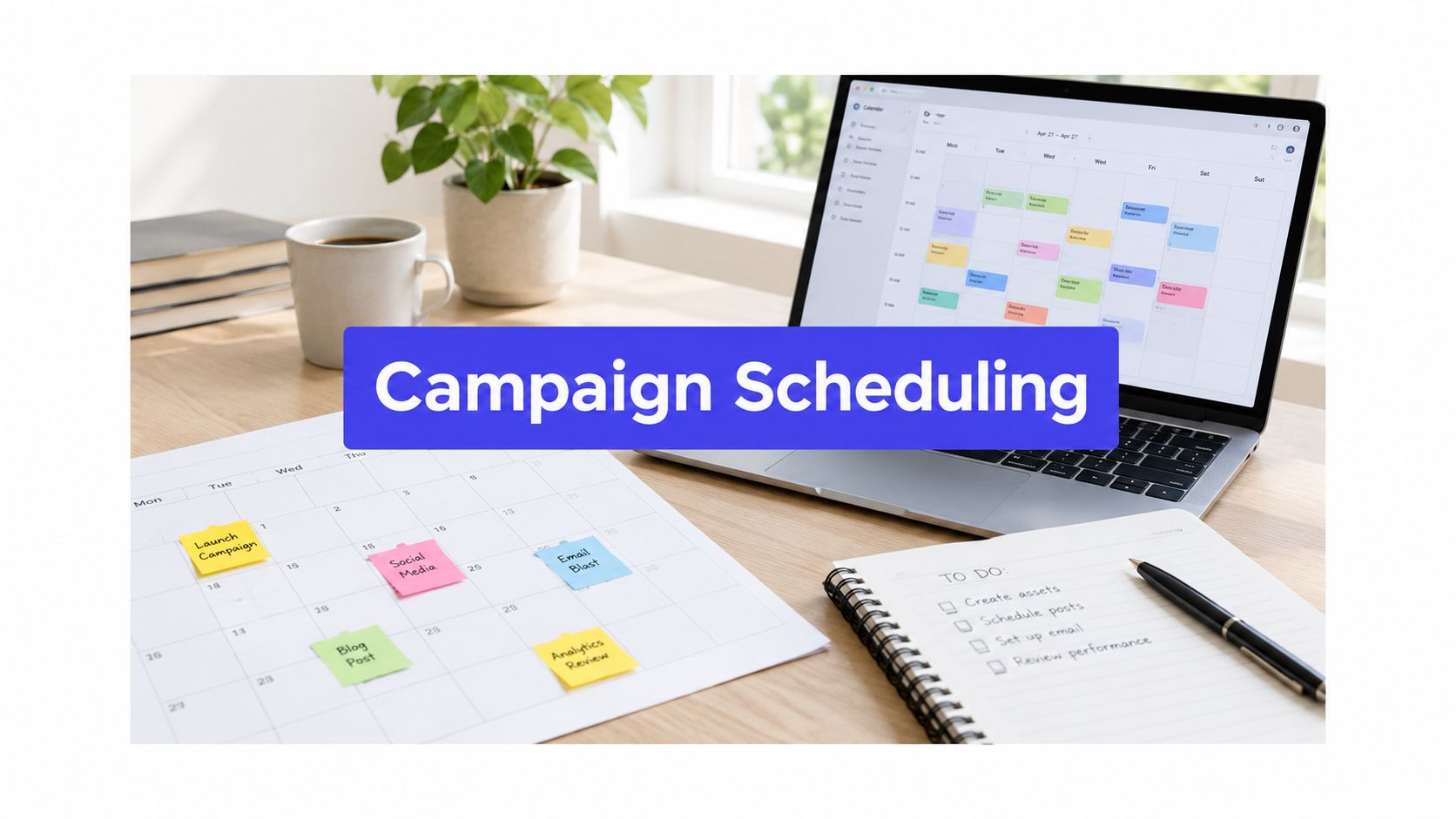
A campaign calendar is so much more than a list of publish dates. It’s your project’s central nervous system, mapping out every critical phase, assigning owners, and setting deadlines to keep the whole machine moving forward. A solid calendar is what stands between a smooth, coordinated launch and a last-minute, all-hands-on-deck scramble.
I like to think about campaigns in four distinct phases:
- Pre-Launch (Weeks 1-2): This is all the foundational work. We're talking about finalizing creative briefs, hammering out the copy, getting visuals designed, and securing all those necessary stakeholder approvals. Nailing this phase is the secret to a stress-free launch.
- Launch (Week 3): It's go-time. This is the initial push when ads go live, the first emails deploy, and organic posts hit the feeds. I always recommend monitoring everything like a hawk for the first 48 hours to catch any unexpected technical glitches.
- Sustain & Optimize (Weeks 4-7): Your campaign is out in the wild, and the data is rolling in. This period is all about monitoring performance, running A/B tests on your creative and copy, and smartly reallocating your budget toward what’s actually working.
- Post-Campaign (Week 8): The active promotion might be over, but the work isn't. This final stage involves pulling all the performance data, measuring the results against your original goals, and compiling a report with key learnings to make your next campaign even better.
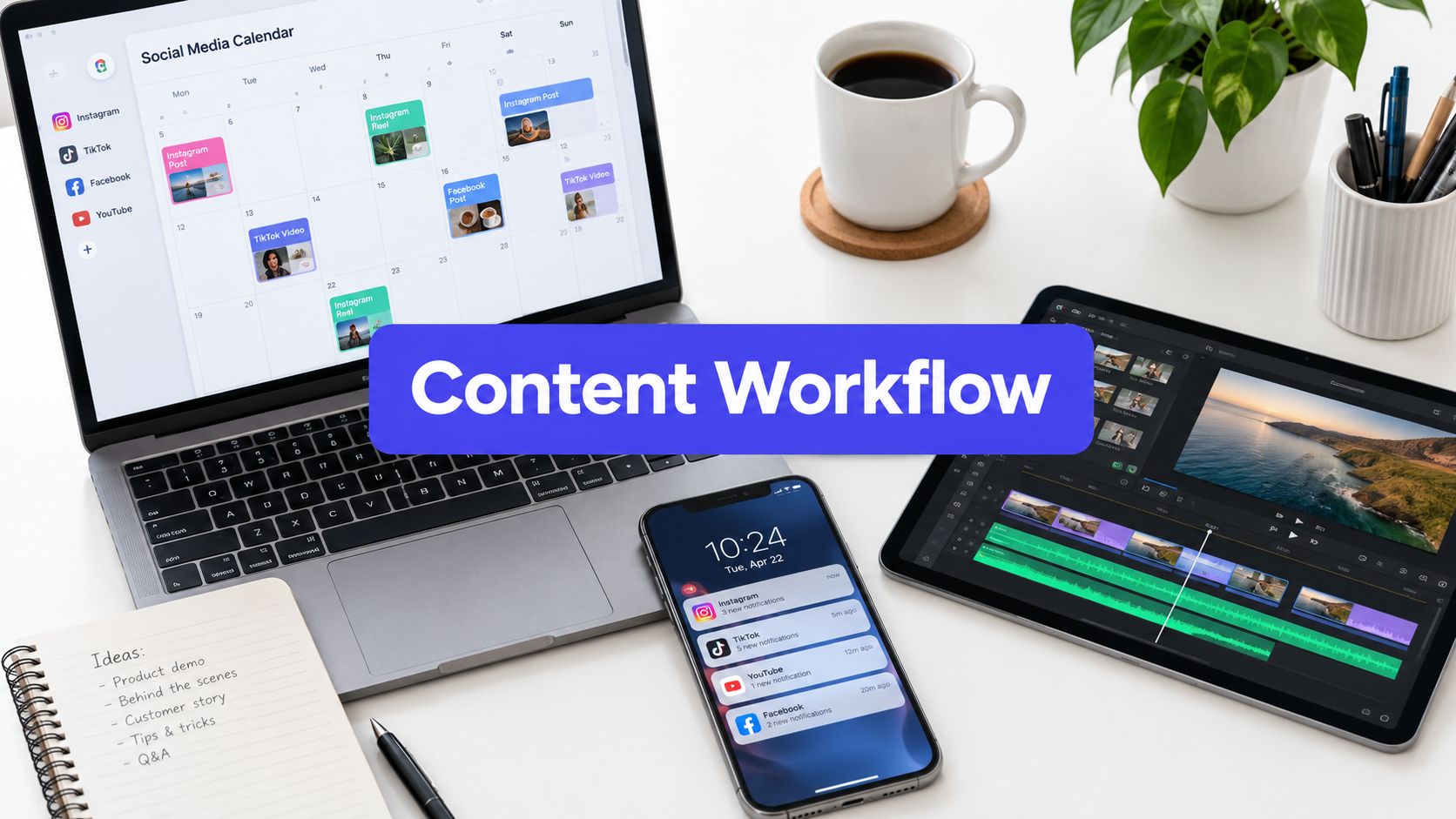
To get a better sense of the creative workflow, this timeline shows how everything flows from channel selection to the final design.
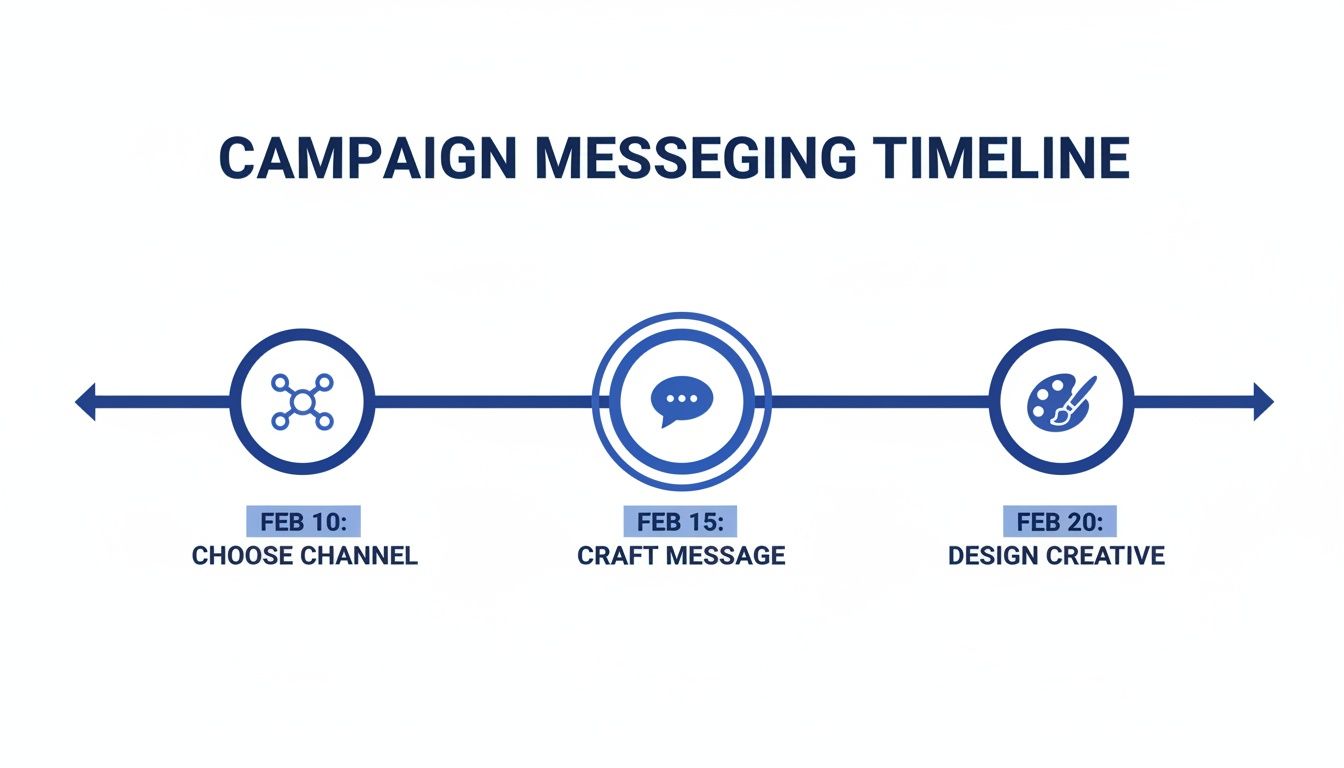
The key takeaway here is that your message and creative aren't one-size-fits-all. They need to be tailored to the specific channel you’ve chosen so your content feels natural and native to the platform.
Allocating Your Budget with Precision
Alright, let's talk money. A poorly planned budget is the fastest way to kill a promising campaign. Instead of just pulling a number out of thin air, you need to build your budget from the ground up, allocating funds based on your strategic priorities. For a much deeper dive and some great downloadable resources, our guide on creating a media plan template is a must-read.
A simple but incredibly effective approach I’ve used for years is the 70-20-10 rule:
- 70% for Proven Channels: Put the lion's share of your budget into the channels that have consistently delivered results for you. Think of this as your safe, reliable engine for hitting your core targets.
- 20% for New Experiments: Set aside a smaller chunk to test out new platforms or strategies. Maybe it's finally time to try TikTok ads, or perhaps you want to experiment with a few influencer collaborations. This is how you discover your next big growth channel.
- 10% for a Contingency Fund: This is non-negotiable. Trust me, unexpected opportunities will pop up. A particular ad set might perform so well that you'll want to double down on it immediately. This fund gives you the flexibility to be agile without siphoning money from other critical parts of the campaign.
Your budget isn't just a spending limit; it's a strategic document. It reflects your priorities and dictates your ability to scale what works and pivot away from what doesn't.
For instance, with a $10,000 campaign budget, you’d put $7,000 toward your heavy hitters like Google Ads and Meta, earmark $2,000 to test a new partnership, and keep $1,000 in reserve. This balanced approach minimizes risk while still encouraging innovation, creating the financial backbone your campaign needs to succeed.
Executing a Flawless Campaign Launch
This is it. The moment of truth. All the strategic groundwork—the goals, audience profiles, messaging, and budgeting—leads right to this point. Executing a campaign launch is where your detailed blueprints finally come to life.
Believe me, a smooth rollout is never about luck. It’s the direct result of meticulous prep, crystal-clear communication, and having a plan for what comes next. This is when your strategy becomes tangible, and a flawless start builds the momentum you need to start gathering valuable data from the very first click.
Your Pre-Launch Readiness Checklist
Before you even think about hitting that big red "launch" button, you absolutely need to run through a final pre-flight checklist. I can't tell you how many times this simple step has saved a campaign from an avoidable, face-palm-worthy error in the first few hours. It’s your final quality check.
I always break this down into three core areas. It’s the best way I’ve found to make sure nothing slips through the cracks.
- Technical Setup: Are all your tracking pixels firing correctly? Have you triple-checked the UTM parameters on every single link? Go back and confirm that your ad targeting—geography, demographics, interests—is set exactly as you defined it.
- Creative and Copy: Is every visual uploaded in the right format and resolution for each platform? Has the final copy been proofread one last time? Seriously, do it again. Make sure the landing pages are a perfect match for the ad creative.
- Approvals and Alignment: Has every stakeholder signed off on the final assets? Is your customer support team briefed and ready for questions? A quick final huddle ensures everyone knows their role the second you go live.
A campaign launch is a coordinated effort, not a solo mission. The most successful launches I’ve managed were built on clear, documented approval workflows that eliminated last-minute surprises and kept the entire team on the same page.
The Power of a Soft Launch
One of the most valuable tricks in any marketer’s playbook is the soft launch. Instead of unleashing your full budget on day one, you start small. Roll out the campaign to a limited audience segment and see what happens. This isn't about hitting your KPIs right away; it’s about stress-testing your entire system in a live environment.
Think of it as an early warning system. It helps you catch the weird issues that are impossible to spot on a test server, like a broken link on a specific mobile browser or an ad set that’s tanking for no obvious reason. You get to gather initial performance data, confirm your tracking works, and make critical tweaks before you scale up.
For example, you could run your ads at just 10-15% of your planned daily budget for the first 24-48 hours. This gives you a low-risk window to find and fix any problems, ensuring that when you do open the floodgates, your campaign is ready to perform.
Automating for Peak Performance
Timing is everything, especially on social media. Pushing content when your audience is most active can completely change your results. But who wants to be manually posting at 9 PM on a Friday? This is where scheduling tools become your best friend.
Platforms like our own PostSyncer let you build out your entire campaign calendar in advance and automate your posts for peak engagement times. This isn't just a time-saver; it’s a strategic advantage. You guarantee a consistent flow of content without being chained to your desk, freeing you up to focus on monitoring performance and actually engaging with your community.
By front-loading the scheduling work, your campaign rolls out exactly as planned. This proactive approach ensures your message reaches the right people at the right moment, giving you the best possible shot at hitting your goals from day one.
Measuring Performance And Optimizing For Growth

Launching your campaign isn't crossing the finish line; it’s the starting gun. Seriously. The real work begins the moment your campaign goes live. A campaign that runs on autopilot is a campaign destined for mediocrity.
True success comes from obsessive measurement and relentless optimization. This is where you move from assumptions to answers, using hard data to make every dollar and every minute you invest more effective than the last. Let's dig into how you can build a campaign that learns, adapts, and gets stronger over time.
Define What Success Actually Looks Like
You can’t hit a target you haven't defined. Before you get lost in a sea of metrics, you have to pinpoint the key performance indicators (KPIs) that directly tie back to the SMART goals you set earlier. Not all data is created equal. Vanity metrics like impressions might feel good, but they don't pay the bills.
Focus on the numbers that signal real business impact. To get a handle on what's truly working, it's crucial to know how to measure marketing performance effectively. This is all about linking your metrics directly to your original objectives.
So, what should you be tracking? It really depends on what you're trying to achieve. The table below breaks down the most important KPIs you should be watching for different campaign goals.
Essential KPIs for Different Campaign Goals
| Campaign Goal | Primary KPIs | Secondary KPIs | Tools for Tracking |
|---|---|---|---|
| Brand Awareness | Reach, Impressions, Video Views | Social Mentions, Share of Voice | Native Social Analytics, Google Analytics |
| Lead Generation | Cost Per Lead (CPL), Conversion Rate | Click-Through Rate (CTR), Form Submissions | Ad Platform Dashboards, HubSpot, Google Analytics |
| Sales/E-commerce | Return on Ad Spend (ROAS), Cost Per Acquisition (CPA) | Average Order Value (AOV), Cart Abandonment Rate | E-commerce Platform Analytics, Ad Dashboards |
| Engagement | Engagement Rate (Likes, Comments, Shares) | Time on Page, Bounce Rate | Native Social Analytics, PostSyncer, Google Analytics |
Choosing the right KPIs brings immediate clarity. It transforms a vague question like, "Is this working?" into a specific, answerable one, like, "Is our CPA below the $50 target we set?" That’s a question you can actually do something about.
Establish Your Optimization Loop
Great marketers don't just "set it and forget it." They operate within a constant cycle of analysis and improvement. This process, often called an optimization loop, is what separates the average campaigns from the exceptional ones. It’s a simple but powerful framework.
The loop has four key stages:
Analyze Data: Dive into your campaign dashboards. Look for the outliers—the ads that are wildly outperforming the rest or the landing pages with a surprisingly high bounce rate. Identify what's working and, just as importantly, what isn't.
Form a Hypothesis: Based on your analysis, make an educated guess. For example: "I believe changing the headline on our top-performing ad to focus on the 'time-saving' benefit will increase our click-through rate by 15%."
Run an A/B Test: This is where you put your hypothesis to the test. Create a variation of your ad or landing page (the "B" version) with the one change you want to test. Run it against your original version (the "A" version) to see which one performs better.
Measure and Implement: After the test runs long enough to gather meaningful data, declare a winner. If your hypothesis was correct, roll that change out across your campaign. If not, document what you learned and form a new hypothesis.
This loop is the engine of campaign growth. Each cycle gives you a valuable insight that makes your marketing smarter and more efficient.
Optimization isn't a one-time task; it's a mindset. The goal is to be a little bit better today than you were yesterday. Over the life of a campaign, those small, incremental wins compound into massive results.
Using Dashboards For Real-Time Insights
You can't optimize what you can't see. Trying to manage a modern campaign by manually pulling reports from five different platforms is a recipe for disaster (and a huge headache). This is where a centralized dashboard becomes your best friend.
Tools like PostSyncer bring all your performance data into one clear, real-time view. You can see at a glance which posts are driving engagement, which channels are delivering the best ROI, and how your overall campaign is tracking against its goals.
This unified view helps you make faster, smarter decisions. Instead of waiting for a weekly report, you can spot a failing ad on Monday morning and reallocate its budget to a winner by lunchtime. This kind of agility is your competitive advantage, allowing you to react to market feedback instantly and maximize your return.
Of course. Here is the rewritten section, crafted to sound completely human-written and natural, following all your specified requirements.
Your Top Marketing Campaign Questions, Answered
When you’re staring down the barrel of a new marketing campaign, a few questions always seem to bubble up. Let's tackle them head-on. Getting these right from the beginning can save you a world of headaches (and budget) down the road.
How Long Should a Marketing Campaign Actually Run?
This is the classic "how long is a piece of string?" question, and the honest answer is: it completely depends on what you're trying to achieve. There’s no magic number.
If you’re launching a new product, promoting a webinar, or running a flash sale, a short, intense burst of 2-4 weeks is your sweet spot. The built-in urgency creates a sense of FOMO and pushes people to act now.
But for bigger goals—like building real brand awareness or nurturing leads from cold to close—you need to play the long game. Think in terms of 3-6 months. This "always-on" approach gives you enough time to gather real data, test your creative, and actually build some momentum instead of just making a quick splash.
What's the Single Biggest Mistake I Can Make?
I've seen this one sink more campaigns than I can count: launching with a fuzzy, poorly defined target audience. It’s so tempting to jump straight to the creative, but building a campaign on vague assumptions about who you're talking to is like building a house on sand.
Your messaging will feel generic, your ad spend will vanish into thin air, and you'll be left wondering why nothing connected.
Taking the time to build out detailed buyer personas isn't just a box-ticking exercise. It's the absolute foundation of your entire campaign. Everything from the copy you write to the channels you choose hinges on deeply understanding your audience's pain points.
Without that clarity, you’re just shouting into the void and hoping someone listens. It’s the fastest way to waste a perfectly good budget.
How Do I Set a Realistic Budget for My First Campaign?
Pulling a budget out of thin air is a recipe for anxiety. A much smarter way to do it is to work backward from your goals.
- Figure out your target Cost Per Acquisition (CPA): How much is a new customer or lead realistically worth to your business? Be honest with yourself here.
- Do some window shopping: Jump into the ad platforms you plan to use. Their estimators can give you a rough idea of what it'll cost to reach the audience you just defined.
- Start small and test: You don't need to bet the farm on day one. For paid ads, kick things off with a small daily budget—maybe $25-$50—just to get some data flowing. This is your learning phase.
Once you see which ads and audiences are actually working, you can pour more fuel on the fire with confidence. And a pro tip: always budget for your creative production separately from your ad spend. Great creative isn't free, and it can make or break your performance.
Ready to manage your next campaign with a powerful, all-in-one tool? PostSyncer provides AI-driven scheduling, a drag-and-drop calendar, and unified analytics to help you execute flawless campaigns. Start your free 7-day trial of PostSyncer today and see how easy campaign management can be.