












Before you even think about which hashtags to use, we need to lay some groundwork.
Jumping straight into hashtag research without a plan is like setting off on a road trip with no map and an empty tank of gas. Sure, you're moving, but you're probably not going to end up anywhere you want to be. A truly effective hashtag strategy doesn't start with the '#' symbol—it starts with a deep, honest look at your brand, your audience, and what you’re actually trying to accomplish.
Building Your Foundation for a Smarter Hashtag Strategy

Before you do anything else, you have to answer one simple question: What's the goal here?
Your answer will shape every single hashtag choice you make. Without that clarity, you're just throwing spaghetti at the wall and hoping something sticks.
Define Your Core Objectives
What's the end game? Are you trying to build a loyal community, get your brand name out there, or straight-up drive sales? Each one of these goals demands a totally different hashtag playbook.
A brand focused on building a community, for example, might lean heavily into user-generated content hashtags to get followers involved. On the other hand, a brand gunning for sales will be all about product-specific tags and promotions.
Some of the most common goals include:
- Increasing Brand Awareness: Getting in front of fresh eyes that have never heard of you.
- Building Community: Sparking conversations and making your followers feel like part of a club.
- Driving Website Traffic or Sales: Nudging people to take a specific action, like clicking the link in your bio.
- Promoting a Specific Campaign: Generating buzz around a new launch, an event, or a special offer.
Your hashtags aren't just an afterthought; they are precision tools. The clearer you are on your goals, the sharper those tools become, helping you cut through the noise and connect with the right people.
Before you start hunting for hashtags, it's essential to have a clear picture of these foundational elements. Think of them as the four pillars holding up your entire strategy.
The Four Pillars of an Effective Hashtag Strategy
| Pillar | Key Question to Answer | Example for a SaaS Company |
|---|---|---|
| Goals | What business result are you trying to achieve with this post/campaign? | "We want to drive sign-ups for our new webinar on productivity." |
| Audience | Who are you trying to reach and what do they care about? | "Project managers at mid-sized tech companies who struggle with team alignment." |
| Content | What is this specific post about, and what value does it offer? | "A carousel post sharing 5 actionable tips for better team communication." |
| Brand Voice | What is the tone and personality of your brand? | "Helpful, expert, and slightly witty—no corporate jargon." |
Once you've nailed down these four pillars, you'll find that choosing the right hashtags becomes much more intuitive and far more effective.
Understand Your Audience and Content Pillars
With your goals locked in, it's time to get specific about your audience and your content. Who, exactly, are you talking to? What kind of stuff do they actually find interesting?
A B2B SaaS company that sells to project managers is going to use a completely different set of hashtags than a fashion brand targeting Gen Z. It’s night and day. Dive into your audience personas. What language do they use? What online communities are they part of?
This insight helps you define your core content pillars—the main themes you talk about over and over again. If you're a fitness coach, your pillars might be things like #WorkoutTips, #HealthyRecipes, and #MindsetMotivation.
Every single hashtag you select should tie back to one of these pillars. This focus keeps your content consistent and, more importantly, attracts people who are genuinely interested in what you do. This is how you move from using generic, low-impact tags to building a strategic mix that delivers real results.
Mastering Hashtag Research and Discovery

Finding the right hashtags can feel like throwing spaghetti at the wall, but it’s a skill you can build with a little strategy. Tossing a generic tag like #marketing onto your post is the fastest way to get it buried under millions of others. The real wins come from digging in and finding the tags your ideal audience actually follows and uses.
Think of it as digital detective work. Your mission is to get past the obvious and uncover the niche, community-specific, and branded hashtags that your competitors are probably ignoring. It's about being strategic, not just loud.
Start by Spying on Your Competitors and Influencers
Honestly, one of the easiest ways to get started is by seeing what’s already working for others in your niche. Pinpoint 5-10 of your top competitors or influencers—the ones who are killing it with the exact audience you want to reach.
But don't just blindly copy-paste their hashtag list. That's a rookie mistake. Instead, you need to analyze why they work. Scroll through their best-performing posts from the last few months and really look at the hashtags they’re using. Patterns will start to jump out at you.
- Check for consistency: Do they use certain tags on almost every single post? Those are likely their core community hashtags.
- Hunt for niche tags: See any hyper-specific, less common tags? For instance, a post on project management software might use the broad
#projectmanagement, but a smarter play would be a niche tag like#agileworkflow. - Spot campaign tags: Notice any unique, branded hashtags? These are often created for a specific launch or a user-generated content campaign, and they give you a ton of insight into their marketing strategy.
Think of this as market research for your content. Analyzing what successful accounts are doing gives you a clear roadmap to the conversations your audience is already having. It's your ticket to joining in authentically.
Use the Platform's Own Search Tools
Every social media platform has a built-in search bar, and it’s an absolute goldmine for hashtag discovery if you know how to use it. These tools were literally built to help people find content, which is exactly what you want.
When you start typing a hashtag into the search bar on Instagram or TikTok, the algorithm does you a favor. It doesn't just show you that one tag; it suggests a whole list of related ones and—most importantly—shows you the post volume for each. This is crucial data.
A tag with 10 million posts is a huge, competitive space. But a tag with 50,000 posts? That's a tight-knit community where your content has a much better chance of being seen and making an impact. A solid strategy uses a mix of both. In many ways, the same principles that guide good keyword research apply directly to building a powerful hashtag game.
Uncover Trends with a Little Social Listening
Beyond just searching, you can tap into what’s happening in real-time through social listening. This is all about monitoring the actual conversations and topics relevant to your industry. You’re looking for the words your audience uses naturally, not just the tags brands are trying to popularize.
Platforms like X (formerly Twitter) are fantastic for this with their "Trends" section, which shows you what’s buzzing right now. Following industry-specific hashtags on LinkedIn can also reveal the topics that professionals in your space are actively discussing. And if you need a place to kickstart your research, a tool like our free hashtag generator can give you some great initial ideas.
By paying attention to these organic conversations, you can jump on emerging hashtags before they get too crowded. This is how you position your brand as a relevant, timely voice in your industry and connect with new, highly engaged audiences.
How to Build a Powerful Hashtag Taxonomy
Once you've finished your research, you're probably staring at a massive, sprawling list of potential hashtags. The first instinct is often to just cherry-pick a few for each post and call it a day. But that’s like trying to build a house with a random pile of lumber—you might get something standing, but it won't be stable or effective.
For consistent, predictable results, you need a blueprint. This is where a hashtag taxonomy, sometimes called a "hashtag ladder," comes into play. It’s a structured system that organizes your hashtags into tiers, moving from incredibly broad, high-volume tags down to the super-specific, low-volume ones that are all your own. This isn't just about being organized; it's a proven strategy to hit different audience segments all at once.
The Foundation: Broad Industry Hashtags
Let's start at the bottom of the ladder with the big guns: broad, foundational hashtags. These are the general, high-volume terms that define your entire industry or core topic. Think of massive tags like #SocialMediaMarketing (which has over 80 million posts) or #DigitalAdvertising (with over 10 million posts).
Using these is like planting your flag in the middle of Times Square. You get a massive, immediate burst of visibility, but your content can get buried by the sheer volume of new posts in a matter of minutes. They're essential for that initial, widespread reach, but they should never be the only tools in your arsenal.
- Their Purpose: To get that first wave of visibility and signal to the algorithm what industry you're in.
- Typical Volume: Anything over 500,000+ posts.
- Real-World Example: A graphic designer would use something like
#GraphicDesignor#Branding.
These tags are your ticket into the main conversation. But if you only use them, you're shouting into a hurricane, competing against everyone and making it nearly impossible to stand out.
The Mid-Tier: Niche and Community Tags
Moving up a rung, we get to the real sweet spot: niche and community hashtags. These are way more specific and have a lower post volume, but the audience they attract is infinitely more targeted, engaged, and ready to connect. These tags represent the actual conversations your ideal customers are having right now.
Instead of the generic #GraphicDesign, our designer might get more focused with tags like #LogoDesignerForStartups or #BrandIdentityDesign. See the difference? These don't just say what you do; they scream who you do it for.
This is where the magic happens. While broad tags get you seen, niche tags get you found by the right people—the ones actively searching for your specific skills or expertise.
Community tags are just as important here. These are the hashtags a specific group of people uses to identify themselves and find each other, like #CreativeEntrepreneurs or #WomenInBusiness. Tapping into these shows you’re a part of the tribe, not just some outsider trying to sell something.
The Top Rung: Branded and Campaign Hashtags
Right at the very top of your ladder are the hashtags you completely own. These are unique to your business and serve very specific, strategic goals.
- Branded Hashtags: Think of tags directly tied to your company, like our own
#PostSyncerTips. They are absolute gold for collecting user-generated content (UGC), keeping an eye on brand mentions, and building a searchable library of your own content. When someone clicks that tag, the only thing they see is content related to your brand. - Campaign Hashtags: These are temporary, created for a specific marketing push. It could be a product launch (
#PostSyncerAI), a contest (#PostSyncerGiveaway), or an online event. They create a concentrated stream of conversation around a single moment, which makes it incredibly easy to track participation and see how well the campaign performed.
These top-rung hashtags are low-volume by design, but they give you the highest level of brand control and tap into the most focused audience intent. They're your best tool for building a loyal community around your business.
Putting It All Together in Practice
The real power of a hashtag taxonomy is unlocked when you use a strategic mix from all three tiers in a single post. A good, balanced approach usually looks something like this:
- 2-3 Broad Tags: To catch the algorithm's attention and get that initial reach.
- 5-7 Niche/Community Tags: To connect directly with your core target audience.
- 1-2 Branded/Campaign Tags: To build your brand identity and track specific initiatives.
For instance, if we at PostSyncer were announcing a new feature, our hashtag mix might look like this:
- Broad:
#SocialMediaTools,#MarketingAutomation - Niche:
#SocialMediaManagerLife,#ContentCreationTools,#SaaSMarketing - Branded:
#PostSyncer
By organizing your researched hashtags into these categories within a tool like PostSyncer, you can save them as distinct groups. This lets you quickly apply a balanced, strategic mix to every single post without having to reinvent the wheel each time. It saves a ton of time and makes sure every piece of content is working as hard as possible to reach the right people.
Optimizing Hashtags For Each Social Media Platform
A hashtag strategy that absolutely kills it on Instagram can fall completely flat on LinkedIn. It's a common mistake to think you can just copy and paste. The truth is, where you put your hashtags, how many you use, and even which ones you pick are all dictated by the unique algorithm and user culture of each platform.
A one-size-fits-all approach isn’t just lazy; it’s a surefire way to tank your reach. To get hashtags to actually work for you, you've got to adapt your tactics for each network. Let's break down the rules of engagement for the big players so your content is set up to win, no matter where you post it.
Instagram: A Delicate Balance of Volume and Niche
Instagram is the platform that made hashtags a marketing staple, but the game has changed. While you can technically cram in up to 30 hashtags, the consensus from top creators and marketers has shifted. These days, it's all about "less is more" and focusing on laser-sharp relevance.
The goal is to avoid looking spammy. Hiding a giant block of 30 generic tags in the first comment is an old-school tactic that algorithms now see right through. Instead, your energy is better spent on a hand-picked selection of tags that perfectly describe your post and speak directly to your target audience. If you want to dive deeper into creating content for the 'gram, check out our guide on how to create Instagram Reels.
- Optimal Number: Stick to 3-5 highly relevant, niche hashtags placed right in your caption. Some accounts still get good results with 10-15, so don't be afraid to experiment.
- Placement: The cleanest and most common practice is to put them at the very end of the caption. The first-comment trick still technically works, but it can cause a slight delay in your post showing up in hashtag feeds.
- Strategy: Create a smart mix. Combine niche tags (#SocialMediaForStartups), specific content descriptors (#ReelsTutorial), and your own branded tag (#PostSyncerTips). Steer clear of super-competitive tags like #love or #instagood—your content will get buried in seconds.
TikTok: The Land of Trending Sounds and Tags
On TikTok, hashtags aren't just for discovery; they're woven into the very fabric of the platform's culture and algorithm. Using the right trending hashtag can be your express ticket to the coveted For You Page (FYP), where content goes viral.
Unlike Instagram where broad tags are often a waste of space, on TikTok they’re essential. The algorithm uses them to categorize your video and serve it up to users who've already shown interest in similar stuff.
Don't overthink it on TikTok. Jumping on a relevant trend with the right mix of broad and niche tags is often way more effective than a perfectly curated list of obscure hashtags. Speed and relevance are your best friends here.
This infographic breaks down the essential types of hashtags that build a strong foundation, no matter the platform.
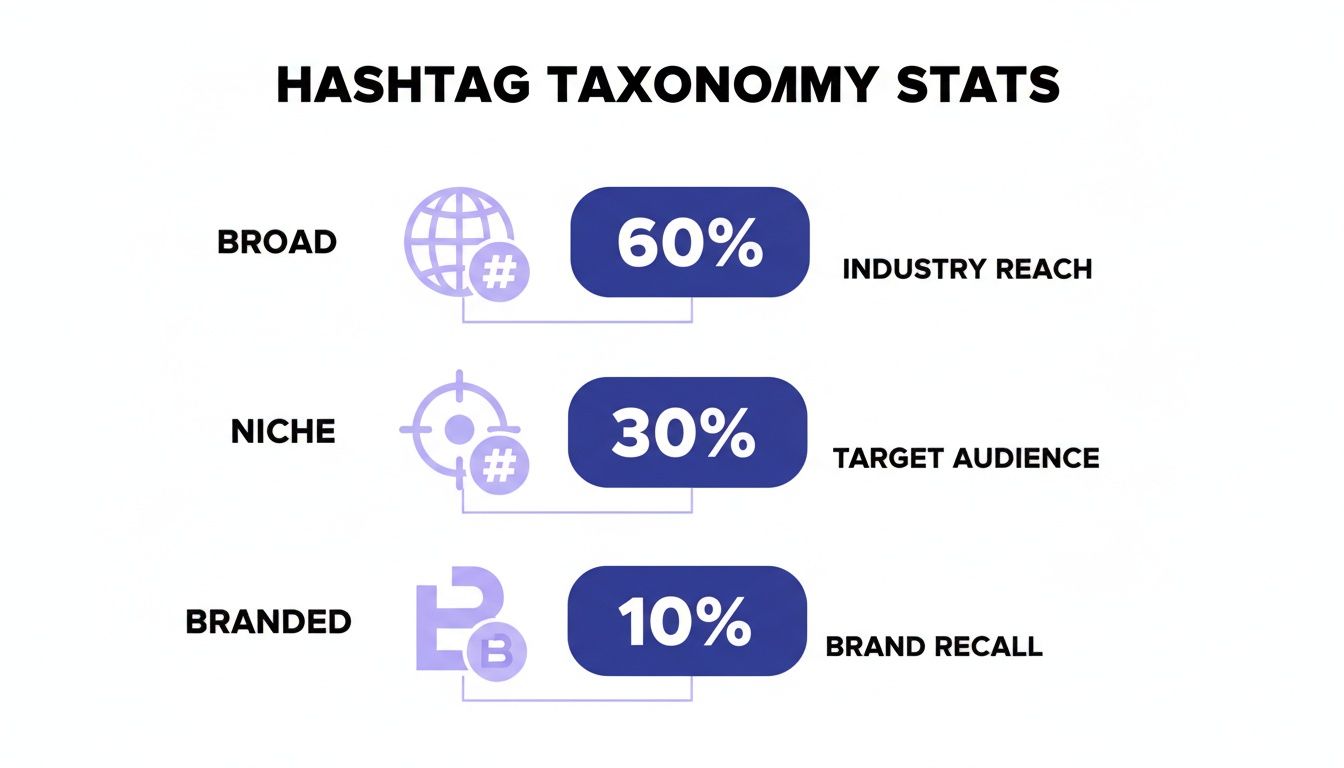
The sweet spot is balancing broad industry tags (for reach), specific niche tags (for targeting), and your own branded tags (for community building). That's the key to a solid strategy.
X (Formerly Twitter): The Heart of Real-Time Conversation
X is the birthplace of the hashtag, and they still serve their original purpose: joining conversations that are happening right now. On this platform, it's all about what's trending, what events are unfolding, and what your industry is buzzing about in the moment.
Because of the character limit and fast-paced nature of the feed, less is definitely more. Using more than two hashtags can make a tweet look cluttered and hard to read, which is the kiss of death.
- Optimal Number: Keep it tight with 1-2 highly relevant hashtags per tweet.
- Placement: Weave them naturally into your sentence or pop them at the very end.
- Example: "Just wrapped up an amazing session on the future of AI in marketing at #MarketingConference2025. My key takeaway is..."
LinkedIn: Professional Polish and Precision
LinkedIn is a professional network, and your hashtag strategy needs to reflect that. Dropping a dozen flashy, irrelevant tags on a post is the quickest way to look like you don't belong. Here, hashtags are used to categorize your content for a professional audience and boost its visibility within specific industry circles.
Thinking about the big picture, smart content repurposing strategies can help you get more mileage out of your best work, but you still have to tailor the delivery for each platform.
- Optimal Number: Stay concise. 3-5 targeted hashtags are all you need.
- Placement: Always put them at the end of your post. It looks clean, professional, and doesn't interrupt the flow of your message.
- Strategy: Focus on industry (#SaaS), community (#ProjectManagers), and topic-specific (#ProductivityTips) hashtags. This signals your expertise and helps your content get discovered by peers, decision-makers, and potential clients.
By tailoring your hashtag approach for each platform, you stop shouting into the void and start having meaningful conversations where your audience is already listening.
Measuring and Refining Your Hashtag Performance
Building out your hashtag taxonomy is a huge first step, but a great strategy is never a "set it and forget it" deal. To really see results, you have to turn your hashtag efforts into a data-driven process. Just tossing hashtags out there and hoping for the best won't cut it. You have to measure what's working, what isn't, and most importantly, why.
This is where you close the loop on your strategy, shifting from making educated guesses to making informed decisions. By tracking performance, you can constantly refine your hashtag sets, double down on what resonates, and make sure your content is always finding the right people.
Establishing Your Key Performance Indicators
Before you can measure success, you have to define what success actually looks like for you. Your Key Performance Indicators (KPIs) need to tie directly back to the goals you set in the very beginning. Are you chasing reach, engagement, or something else entirely?
The specific metrics will change a bit depending on the platform, but there are a few critical ones you should always keep an eye on:
- Impressions: The total number of times your post was seen. Think of this as the top-level indicator of your content's visibility.
- Reach: How many unique accounts saw your post. A high reach number is a great sign that your hashtags are successfully pushing your content in front of new eyes.
- Engagement Rate: The percentage of people who saw your post and actually did something—liked, commented, shared, or saved it. This is a powerful metric for judging how well your content landed.
- Profile Visits: This tells you how many people were curious enough to click through and check out your profile, which is a crucial step toward gaining a new follower.
- Website Clicks: For a lot of businesses, this is the end goal. Tracking this metric draws a direct line from your social content to your business objectives.
By consistently monitoring these core metrics, you'll start to get a really clear picture of which hashtag combinations are giving you the most bang for your buck.
Leveraging PostSyncer Analytics for Deeper Insights
While the analytics inside each social media app are helpful, a dedicated tool like PostSyncer gives you a much cleaner, more consolidated view of your performance across every channel. It helps you cut through the noise and see exactly what’s driving results without jumping between five different tabs.
Here’s a quick look at the PostSyncer analytics dashboard, which gives you a high-level overview of key metrics like engagement and follower growth.
Having this centralized view is a game-changer for spotting trends and comparing performance across platforms.
One of the most powerful features for fine-tuning your strategy is the use of campaign labels. This lets you group posts by a specific initiative or—in our case—by the exact hashtag set you used. You could create labels like "Product Launch Tags," "UGC Campaign Tags," or "Niche B2B Tags."
By consistently labeling your posts based on the hashtag groups you apply, you can generate reports that show the direct impact of each set. It transforms your analytics from a general overview into a precise A/B testing machine.
This method takes all the guesswork out of the process. You’ll be able to see, for example, that your "Niche B2B Tags" consistently drive a higher engagement rate than your broader industry tags. That's actionable data you can use to guide all your future content. For a complete walkthrough, you can explore our detailed guide on social media analytics and reporting.
Conducting A/B Tests on Your Hashtag Groups
With your labels set up in PostSyncer, you can start running structured A/B tests to pinpoint your most effective hashtags. The process itself is straightforward, but the key is consistency.
To get clean, reliable data, you need to isolate one variable. Post two similar pieces of content but use two different hashtag sets (for instance, a post with "Set A" tags versus another with "Set B" tags).
Try to keep other factors like the posting time, visual style, and caption format as consistent as possible between the two posts. A single test isn't enough to draw a solid conclusion, so run the same A/B test a few times to make sure your results aren't just a fluke.
After a set period, dive into your analytics. Compare the performance reports for your "Set A" and "Set B" campaign labels. Whichever set consistently performed better on your key metrics is your winner. This iterative cycle of testing, analyzing, and refining is the real secret to building a hashtag strategy that gets better over time.
Understanding the Nuances of Hashtag Quantity
As you dig into your performance data, you'll also start to notice trends related to the sheer number of hashtags you use. Research from 2023 shows that on Instagram, posts with 11 or more hashtags tend to generate the highest overall engagement. This is especially true for smaller accounts (under 1,000 followers), which see a 79.5% increase in interaction rates.
But here's the paradox: posts using 6-10 hashtags achieve a higher average of 307 interactions per post compared to just 188 interactions for those with more than 10. This suggests that while a higher volume of tags can boost exposure, going overboard might look spammy and actually reduce the engagement on that specific post.
This data really hammers home why testing is so critical. There's no universal "perfect" number of hashtags. It all depends on your account, your audience, and the platform you're on. Through continuous measurement and refinement, you'll find the sweet spot that delivers both maximum reach and meaningful interaction, turning your data into predictable growth.
Got Hashtag Questions? We've Got Answers
Even with the best strategy in your back pocket, hashtags can still throw you a curveball. The rules feel like they're always changing, and what works on one platform might fall flat on another. It's totally normal to have questions pop up.
So, let's cut through the noise. I've rounded up some of the most common questions I hear from marketers and laid out straightforward answers to get you back on track. Think of this as your go-to cheat sheet for those "am I doing this right?" moments.
Should I Put Hashtags in the First Comment on Instagram?
Ah, the great debate. The short answer? It's really just about aesthetics. Putting your hashtags in the first comment definitely makes for a cleaner, less cluttered caption, which is a big win for many brands.
Performance-wise, Instagram itself has confirmed it makes no difference. Hashtags in the caption and the first comment are both picked up by the algorithm for discovery.
But there is one tiny catch. There's a split-second delay between your post going live and you adding that first comment. In the hyper-fast world of Instagram, that could mean missing out on a tiny sliver of immediate engagement.
My two cents: Unless a minimalist caption is a non-negotiable part of your brand's look, I'd suggest putting your 3-5 most important hashtags right in the caption. That way, you know they're working for you from the very instant you hit "Publish." Of course, the best answer comes from your own data, so test both and see what your audience prefers.
How Often Should I Refresh My Hashtag Lists?
Your hashtag strategy can't be a "set it and forget it" kind of thing. It needs to be a living, breathing part of your content plan. Just reusing the same block of tags over and over is a fast track to looking spammy and severely limits your reach.
Here’s a simple rhythm I recommend:
- Quarterly Review: Once every three months, take a deep dive into your core hashtag lists—those evergreen niche and community tags. See what's still driving results, cut what's not, and research some fresh ones to test out.
- Weekly (or even Daily) Check-in: For anything tied to a trend, an event, or a specific campaign, you have to be way more nimble. Keep an eye on these weekly, or daily if you're in a fast-moving industry.
Is It Bad to Use the Same Hashtags All the Time?
In a word, yes. It can really hurt your performance. When you copy and paste the exact same block of hashtags on every post, platforms like Instagram can flag it as lazy or bot-like behavior. The result? Your reach could get throttled.
A much smarter move is to rotate between different, relevant hashtag groups from the taxonomy you built. Every post is unique, so its hashtags should be, too. This tells the algorithm you're being thoughtful and, more importantly, helps you tap into different audience segments over time.
What's the Difference Between Branded and Community Hashtags?
Getting this distinction right is fundamental to a solid hashtag strategy. They serve two very different, but equally important, purposes.
A branded hashtag is yours and yours alone. It's your digital calling card, like our #PostSyncerTips. You use it to collect user-generated content (UGC), track conversations about your brand, and build a unique gallery of your own posts.
A community hashtag, on the other hand, is one that already exists. It’s a digital watercooler where people gather to talk about a shared interest, like #SocialMediaManagers or #ContentStrategy. Using these tags is how you join the conversation and show that your brand belongs in that space.
Ready to stop guessing and start building a data-driven hashtag strategy? PostSyncer gives you the tools to research, organize, schedule, and analyze your performance all in one place. Save your hashtag sets, use campaign labels to track what works, and get the insights you need to grow faster. Start your free trial and see the difference for yourself.