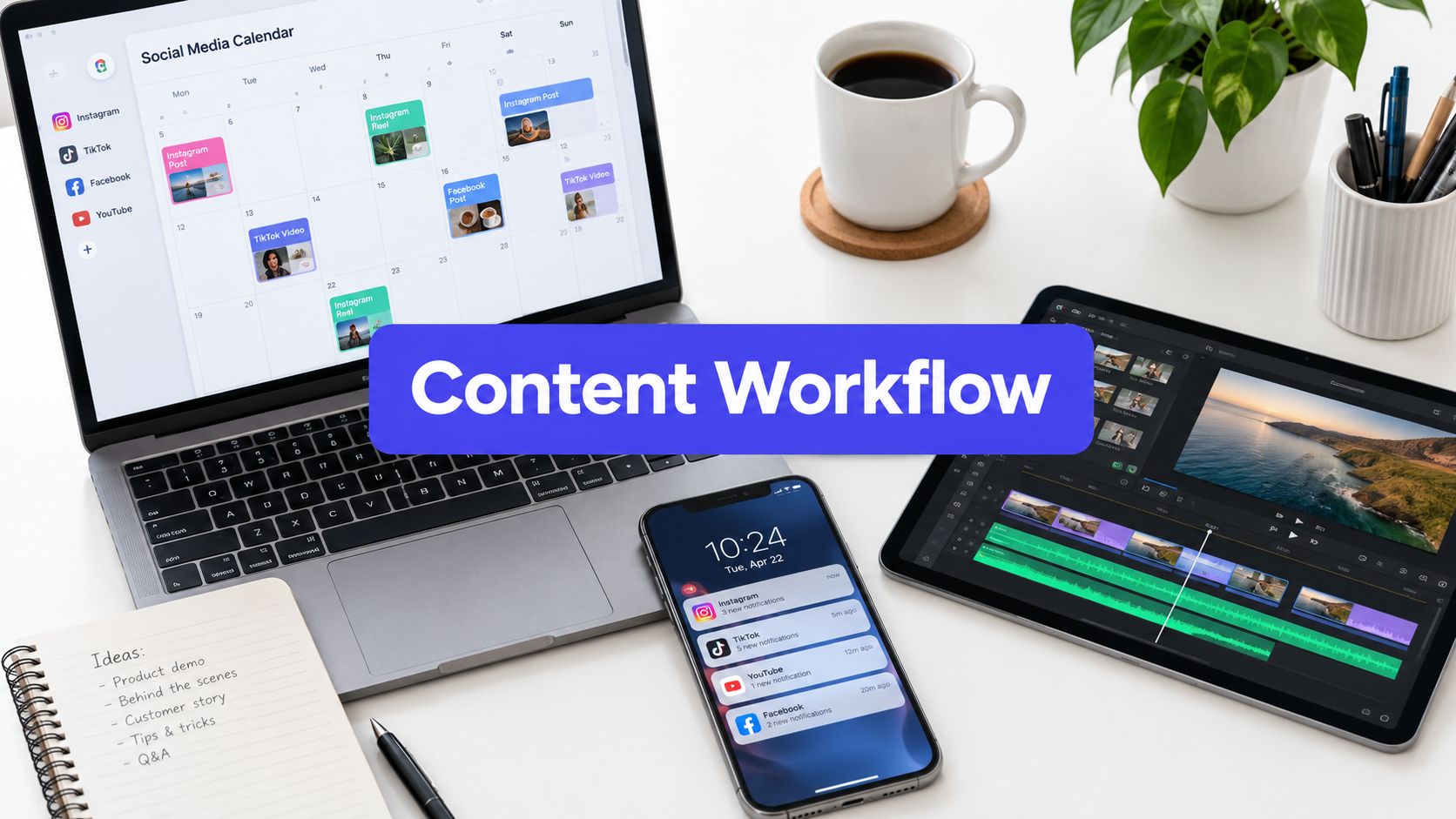












Think of marketing automation software as your secret weapon—a tireless digital assistant who works around the clock to grow your business. It takes all those repetitive, time-consuming marketing tasks off your plate, freeing you up to focus on big-picture strategy and building real relationships with your customers. It’s what makes powerful, consistent marketing a reality for small businesses, not just giant corporations.
Why Automation Is a Game Changer for Small Businesses
If you’re a small business owner, your to-do list is probably a mile long. You’re the CEO, marketer, salesperson, and customer support team all rolled into one. With so much to juggle, critical tasks like following up with new leads or keeping your social media active often get pushed aside. That’s the exact problem marketing automation was designed to solve.
The simplest way to picture it is a series of "if-then" rules you create for your marketing. If someone new signs up for your newsletter, then the system automatically sends them a personalized welcome email. If a potential customer leaves items in their shopping cart, then a friendly reminder gets sent their way a few hours later. You build the playbook just once, and the software runs it flawlessly every single time.
More Than Just a Timesaver
Saving time is a huge win, of course, but the real magic of automation is its ability to create consistent, personalized experiences for every single person who interacts with your brand. It makes sure no lead is ever forgotten and every new subscriber feels seen. That steady, reliable engagement is what builds trust and slowly turns curious visitors into loyal customers.
This move from manual grunt work to automated systems isn't just a passing trend; it’s a major shift in how smart businesses operate. The global marketing automation market hit $6.65 billion in 2024 and is expected to rocket to $15.58 billion by 2030. That growth is being driven by small teams who are seeing an incredible return—for every $1 they invest, they get an average of $5.44 back. Some studies have even shown it can drive an average revenue increase of 34%.
The Core Benefits for Your Business
By automating the routine tasks, marketing automation software for small business finally gives you the space to work on your business instead of just in it. You get to reclaim your time for the creative, strategic work that only a human can do.
Automation isn’t about replacing the human touch. It’s about creating more opportunities for it. By handling the routine stuff, it frees you to build genuine relationships and make the smart decisions that actually grow your brand.
Here’s what that looks like in the real world:
- Boosted Efficiency: You’ll spend far less time on manual data entry, scheduling social media posts, or sending one-off emails. A simple workflow like social media automation can easily give you back hours every single week.
- Consistent Lead Nurturing: Set up automated journeys that guide potential customers from their first visit to their final purchase with timely, helpful messages.
- Enhanced Personalization: You can easily segment your audience based on their actions—like what they’ve clicked on or purchased—and send them targeted messages that actually feel relevant, which naturally leads to better conversion rates.
- Improved Scalability: Your business can grow without your payroll needing to grow at the same rate. Your automated systems can handle 10 leads or 10,000 without breaking a sweat.
Essential Automation Workflows to Implement Today
Knowing that marketing automation is powerful is one thing. Actually putting it to work for your business is a whole different ballgame. So, let's get practical and walk through three high-impact workflows you can set up right away. These aren’t complicated, enterprise-level behemoths; they're simple, effective sequences built to save you time and get results.
Think of these workflows like recipes. You put in the effort to set them up once, and the system takes over from there, reliably delivering the same great result every time. The idea is to build automated assets that work for you around the clock, even when you're busy running the rest of your business.
This approach lets you reinvest the time you save directly into generating and nurturing leads more effectively.
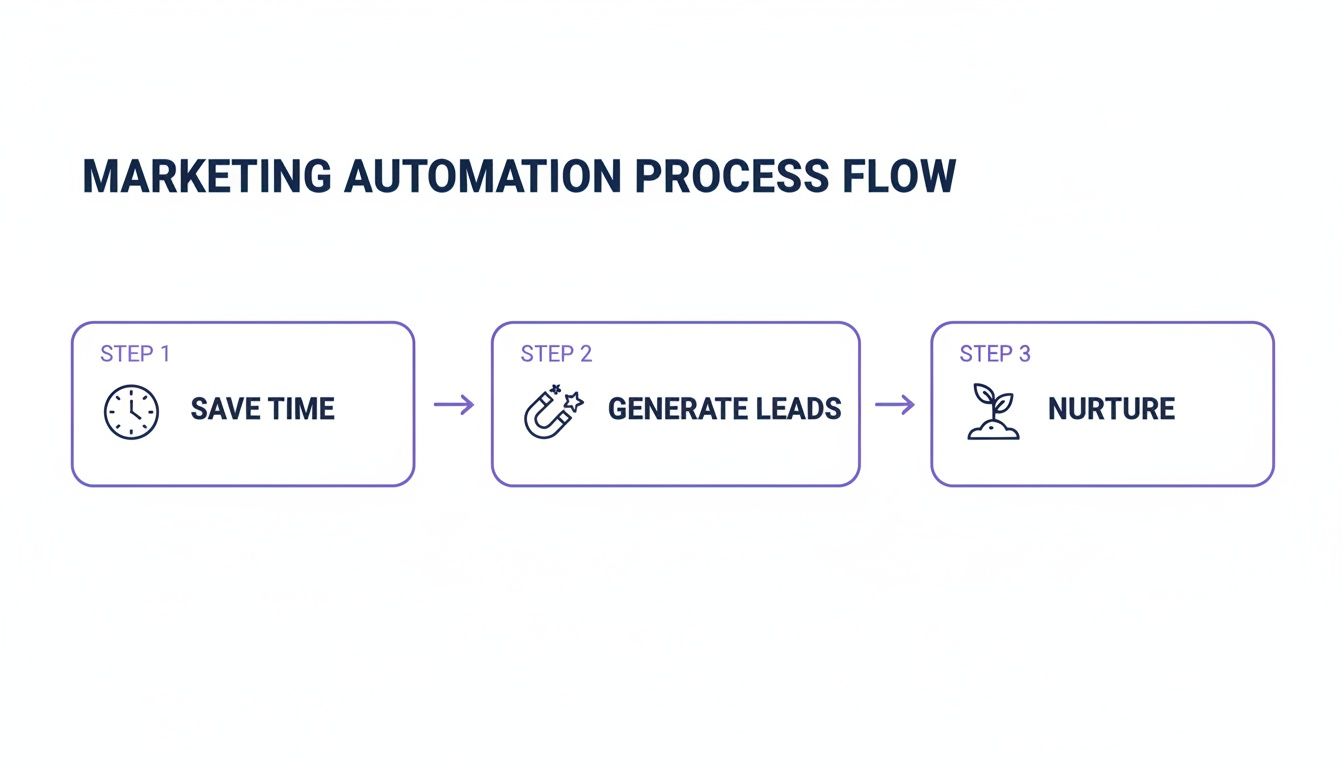
As you can see, the initial effort to get organized pays dividends by fueling better lead generation and stronger customer relationships down the line.
To give you a clearer picture, here are a few core workflows that small businesses rely on to drive growth.
Essential Automation Workflows for Small Business Growth
| Workflow Type | Primary Goal | Example Tool/Feature |
|---|---|---|
| Social Media Scheduling | Maintain consistent brand presence, save daily posting time. | A visual content calendar with batch scheduling. |
| Email Welcome Series | Make a strong first impression, deliver value immediately. | A timed sequence of 3-5 automated emails. |
| Lead Nurturing Campaign | Guide prospects with helpful info until they are sales-ready. | An automated email drip based on user actions. |
| Abandoned Cart Reminder | Recover potentially lost sales from e-commerce customers. | A triggered email sent after a cart is left inactive. |
These workflows are the foundational building blocks for a smart, automated marketing engine. Let's dig into the first three.
The Always-On Social Media Calendar
Stop the daily scramble of trying to figure out what to post on social media. An automated social media calendar is your best friend for maintaining consistency across platforms like TikTok, Instagram, and LinkedIn. The strategy is simple: batch all your content creation into a single, focused session, then let your software handle the publishing schedule.
Here’s how you can make it happen with a tool like PostSyncer:
- Plan Your Content: Block out a couple of hours to map out your posts for the next few weeks. Aim for a healthy mix of promotional content, educational tips, and behind-the-scenes glimpses into your business.
- Create in Batches: Use PostSyncer’s AI Content Agent to help you whip up captions, find images, or even turn a simple prompt into a short video. This single step can dramatically slash your creation time.
- Schedule Everything: Just drag and drop your finished posts onto the visual calendar, picking the exact date and time for each one to go live. Now, your content is locked and loaded.
This one workflow alone frees you from the constant pressure of having to post every single day. Your brand stays active and visible without eating up all of your time.
The Automated Email Welcome Series
Your first conversation with a new email subscriber is your most important one. A well-crafted, automated welcome series makes a fantastic first impression, builds on their initial interest, and sets the foundation for a real relationship. The moment someone signs up, they should automatically receive a pre-built sequence of helpful emails.
A welcome email series is your digital handshake. It’s your chance to introduce your brand, deliver value immediately, and show new subscribers they made the right choice by joining your community.
This is a surprisingly simple workflow to build out:
- Email 1 (Sent Immediately): Say hello! Welcome them to the list and deliver whatever they signed up for, whether it was a discount code or a helpful guide.
- Email 2 (Sent 2 Days Later): Share your brand's story or mission. This is where you connect with them on a more personal level.
- Email 3 (Sent 4 Days Later): Offer them something valuable, like your best piece of content, a powerful customer testimonial, or a tip that solves a problem they have.
Each email builds on the last, gently guiding a new subscriber from being mildly curious to being genuinely interested in what you have to offer. For a deeper dive, check out our guide on how to build your first marketing automation workflow.
The Simple Lead Nurturing Sequence
Let's face it, not every lead is ready to buy the second they find you. A lead nurturing sequence automates the entire follow-up process, keeping your brand top-of-mind by sending helpful information until they’re ready to make a move. This kind of workflow is usually triggered when someone shows interest, like by downloading a guide or requesting more information.
The impact here can be huge. For small businesses, social media automation is already used by 50% of companies to nurture leads and build loyalty. When you combine that with AI, those efforts can boost engagement by 60% and increase customer loyalty by 58%. These aren't just vanity metrics; these simple, targeted automations deliver real results for lean teams.
This sequence is designed to turn lukewarm interest into genuine, sales-ready intent. If you want to get more ideas for nurturing leads and handing them off to sales, explore these actionable marketing automation workflow examples. Implementing even just one of these workflows can make an immediate difference in your productivity and growth.
Key Features Your Automation Software Must Have
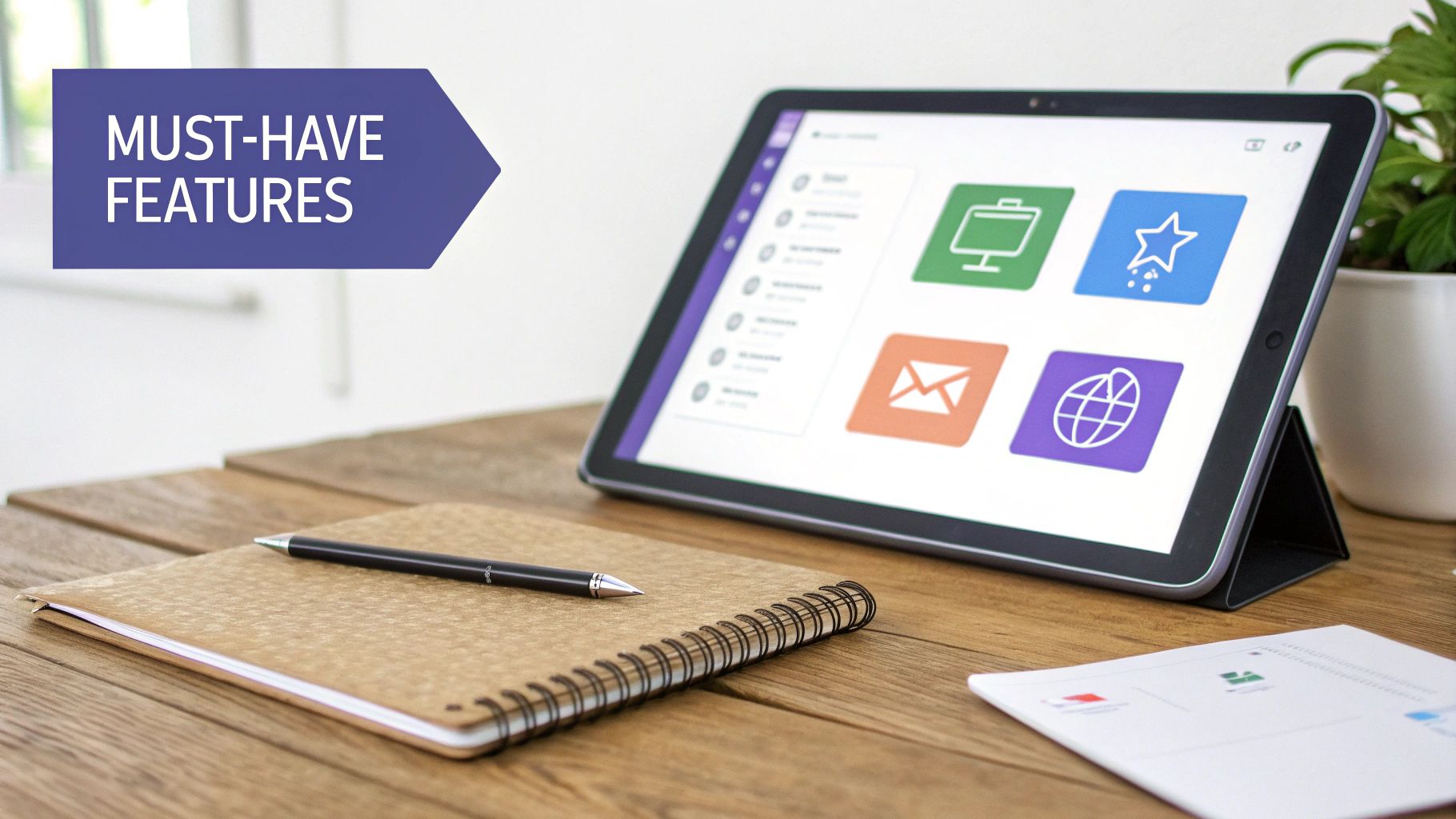
Picking the right marketing automation software for your small business can feel like you're lost in a jungle of tech jargon and never-ending feature lists. It gets overwhelming, fast. The easiest way to cut through the noise is to stop thinking about it as a random collection of tools and start seeing it as your central marketing cockpit.
From this one spot, you need to see and control everything that matters without juggling a dozen different apps. So, let’s focus on the absolute non-negotiables. These are the core functions that will actually save you time, give you real insights, and help you grow. Think of this as your must-have checklist before you invest a single dollar.
Intuitive Campaign and Workflow Builder
The heart and soul of any automation tool is its ability to build workflows—those "if this, then that" sequences we talked about earlier. Any platform worth its salt has to have a visual, drag-and-drop builder that makes this process feel natural. You shouldn't need a coding background just to set up a simple welcome email series or plan out a social media campaign.
The goal is to see your entire campaign laid out visually, so you can instantly spot what's working or where a step is missing. This turns a really complex process into something you can actually manage, letting you build powerful automations with confidence.
Multi-Channel Social Media Scheduling
Let's be real: your customers are everywhere, scattered across different social networks. Your marketing needs to be there, too. A deal-breaker feature is the power to schedule and publish content across all your key platforms from a single dashboard. This means you can craft a post once and push it to TikTok, Instagram, LinkedIn, and more, without the tedious login/logout dance.
It’s about more than just saving time; it's about keeping your brand presence consistent and professional. Platforms like PostSyncer let you map out your entire content calendar weeks ahead, so your brand stays active and engaging even when you're busy running the business.
A Unified Inbox for All Your Conversations
As your brand grows online, so will the flood of comments, DMs, and questions coming from all directions. Trying to keep up by bouncing between platforms is a surefire way to miss important messages and leave customers hanging.
This is where a unified inbox saves the day. It pulls every single message from all your connected social accounts into one clean, manageable feed. For a solopreneur or a small team, this isn't just a nice-to-have; it's a total game-changer.
For instance, a small business owner using PostSyncer can manage comments and DMs from over 12 networks in one dashboard. This centralized view ensures every customer interaction is seen and addressed promptly without the chaos of constant tab-switching.
Simple Contact Management (CRM)
You might not need a massive, enterprise-level CRM, but your automation tool absolutely should have basic contact management built in. At a minimum, you need a central place to keep track of your leads and customers—their names, emails, and a history of how they've interacted with you.
This simple database is what makes true personalization possible. It’s what lets you segment your audience into different groups and send them messages that actually resonate. Any good marketing automation software for small business knows that customer relationships are everything and gives you the tools to nurture them.
Clear and Actionable Analytics
You can't fix what you can't see. Your software has to give you clear, easy-to-digest analytics that tell you what's working and what's a waste of time. I'm talking about more than just vanity metrics like likes and followers.
You need a dashboard that quickly shows you:
- Best performing content: Which posts are actually driving clicks and engagement?
- Optimal posting times: When is your audience online and most likely to see your stuff?
- Audience growth: Which channels are bringing in new followers and growing your reach?
These are the insights that let you make smart, data-driven decisions. You can double down on what works and stop wasting energy on what doesn't.
Finally, look for a platform that can grow with you. Features like collaboration tools are essential if you plan on bringing on a team. A platform that lets you add team members without jacking up the price, like PostSyncer does, is a sign that it’s built to support your business for the long haul.
How to Choose the Right Software on a Small Business Budget
Picking the right marketing automation software for your small business can feel like a make-or-break decision. You're worried about confusing contracts, hidden fees, and ending up with a tool that costs a fortune but gathers digital dust.
Here's the good news: you don't need a massive, enterprise-level budget to get your hands on powerful automation. The real trick is finding a platform that fits what you actually do, not one that tries to sell you on a hundred features you’ll never touch.
To skip the overspending and buyer's remorse, you need a simple framework. Instead of getting mesmerized by a slick sales demo, zero in on four practical criteria that truly matter. This approach guarantees you find a tool that works for you, not the other way around.
Evaluate Ease of Use
As a small business owner, your time is your most valuable currency. The last thing you need is a piece of software so complicated it feels like it requires a PhD to operate. The best marketing automation software for small business is built for users, not engineers. It should just make sense the first time you log in.
Look for a clean, visual interface, especially one with a drag-and-drop builder for your workflows. Can you figure out how to schedule a social media post or set up a basic email sequence without having to binge-watch tutorials? If a platform feels clunky and unintuitive during the free trial, it’s not going to magically get better once your credit card is on file.
Prioritize Smart Integrations
Your marketing automation tool isn’t an island. It has to talk to the other software you rely on every single day, whether that's your e-commerce store, your CRM, or your design tools. A platform that plays nicely with others saves you from the soul-crushing nightmare of manual data entry and disconnected systems.
Before you even think about committing, list your must-have tools and check if the software offers direct integrations. This is non-negotiable for creating a single source of truth for all your customer data and ensuring your automated campaigns can actually pull the information they need to work. When you're figuring out how to choose the right software on a small business budget, checking out lists of the best social media management tools for small business is a great place to start, as they often highlight which platforms have the strongest integration game.
Scrutinize the Pricing Model
Small business budgets need two things: transparency and predictability. Steer clear of platforms with convoluted pricing tiers or iron-clad annual contracts that lock you in before you know if the tool is a good fit.
Look for a pricing model that scales with you. A generous free trial is non-negotiable, as it lets you test-drive the software. Beyond that, the ideal platform offers flexible monthly plans that allow you to upgrade (or downgrade) as your business needs change.
Always read the fine print on what's included in each plan. Some companies love to slap on extra fees for essentials like adding team members or unlocking certain integrations. A tool like PostSyncer is a breath of fresh air here, offering an affordable, all-in-one platform with unlimited team members so your costs don't spiral as your team grows. If you want to see how different pricing models stack up, our guide to social media scheduling tools can give you a broader perspective.
Confirm Reliable Customer Support
When you're running a lean operation, you can't afford to be stuck for days waiting on an email reply to a mission-critical question. Think of good customer support as your safety net. Before you sign up, do a little digging on what kind of help they actually offer.
- Live Chat: Can you talk to a real person, right now, when you hit a snag?
- Knowledge Base: Is there a library of clear, helpful articles and video guides you can turn to at 2 a.m.?
- Community Forums: Is there an active user community where you can swap tips and ask questions?
Responsive, helpful support can be the difference between a five-minute hiccup and a three-day headache. A company that invests in great support is a company that cares about its customers' success. By carefully weighing these four factors—usability, integrations, pricing, and support—you can confidently pick a tool that fits your budget and genuinely helps you grow.
Your Step-By-Step Implementation Checklist
Jumping into new marketing software can feel like you're staring at a giant, complicated control panel with a thousand blinking lights. It’s easy to get overwhelmed. But trust me, getting started is way simpler than it looks. The secret is to ignore the noise and focus on one small, achievable win at a time.
This isn't about trying to do everything at once. It's about building momentum. Think of it like laying down a single brick perfectly, then another, and another. Before you know it, you’ll have a powerful, automated engine working for you 24/7. This checklist is your roadmap to getting there without the stress.
Step 1: Define One Clear Goal
Before you touch a single setting, stop and ask yourself: what is the single biggest time-drain I want to eliminate? Your first goal has to be incredibly specific and measurable. Vague wishes like "get more leads" are useless here. You need something concrete.
Here are a few great starting points:
- Save 5 hours per week on social media by scheduling all my posts in one batch.
- Instantly welcome every new subscriber by creating a 3-part automated email series.
- Never miss a new comment or DM by pulling all my social media conversations into one place.
Pick one. Just one. This focused approach makes your efforts real and gives you a clear finish line to cross.
Step 2: Audit Your Existing Channels
Next up, take a quick inventory of what you’re already doing. It's impossible to automate a process you don't understand. This doesn't need to be some massive, formal report; a simple list will do just fine.
Jot down the answers to these questions:
- Where does my audience actually hang out? (e.g., Instagram, LinkedIn, my email list)
- What kind of content performs best right now? (e.g., video tutorials, customer stories, quick tips)
- What is my single most repetitive marketing task? (e.g., posting every day, answering the same five questions in DMs)
This quick snapshot will point you exactly where your first automation efforts will deliver the biggest bang for your buck.
Step 3: Build Your First Simple Workflow
Okay, now for the fun part. Using the goal you set in step one, it's time to build your very first automated workflow. The key here is to keep it brutally simple. If your goal was to save time on social media, your entire workflow is just scheduling one full week of posts.
Your first automation isn't about creating a masterpiece. It's about proving to yourself that the system works. A simple, functioning workflow is infinitely more valuable than a complex, half-finished one.
In a tool like PostSyncer, this literally means logging in, uploading your content for the week, and dragging each piece onto the visual calendar. That’s it. You’ve just built your first automated asset.
Step 4: Connect Your Essential Tools
Once your first workflow is up and running smoothly, it's time to make your automation software the central hub of your marketing. Connect it to the other tools you already rely on. This might mean linking your e-commerce store to track sales or connecting your email marketing platform.
This step ensures data flows seamlessly between your systems, which is the foundation for more advanced automation later on. More importantly, it stops you from having to manually export and import customer lists—a mind-numbing task that automation was born to kill.
Step 5: Set Up Your Key Metrics
Finally, you need to know if your efforts are actually paying off. Based on the goal you set at the very beginning, define one or two key performance indicators (KPIs) to track from day one.
- If your goal was to save time, your KPI is hours saved per week.
- If your goal was to welcome subscribers, your KPI is the open rate of your first email.
- If your goal was to manage DMs, your KPI is your average response time.
Tracking these simple metrics gives you concrete proof that your marketing automation software for small business is delivering a real return on your investment. It's the difference between hoping it's working and knowing it is.
Why PostSyncer Is the Smart Choice for Your Business
Choosing a marketing automation tool can feel like a huge commitment, but it doesn't have to be complicated. Throughout this guide, we've walked through how automation saves time, nurtures leads, and gives you the hard data you need to grow. Now, let’s tie it all back to a platform built from the ground up for small businesses, creators, and agencies: **PostSyncer**.PostSyncer isn’t just another scheduler or a separate analytics dashboard. Think of it as your all-in-one growth engine, designed to replace a handful of expensive subscriptions. Instead of jumping between different tools for content ideas, scheduling, engagement, and reporting, you get one unified workspace to run the whole show.
A True All-In-One Platform
For a small business, every dollar and every minute is precious. We built PostSyncer on that very principle. Our goal was to provide a single, affordable solution that pulls your entire social media marketing operation under one roof.
The point isn't just to automate a few tasks; it's about simplifying your entire workflow. PostSyncer acts as your central command center, giving you the power of a full marketing team without the hefty price tag or complexity.
This integrated approach means you spend less time flipping between browser tabs and more time actually thinking about your strategy. You can plan, create, publish, and analyze everything from one intuitive dashboard.
What Makes PostSyncer Different
Plenty of platforms offer basic scheduling, but PostSyncer gives ambitious small businesses a distinct advantage. We’ve focused on the features that deliver a real, measurable impact on your growth.
Here’s what sets us apart:
- Powerful AI Content Creation: Our AI Content Agent does more than just spit out captions. It helps you brainstorm ideas, find the right visuals, and repurpose winning content, which dramatically speeds up your creative process.
- Extensive Network Support: You need to be where your audience is. We support over 12 social networks, including up-and-coming platforms like Bluesky and Mastodon, ensuring your brand is always part of the conversation.
- Unified Inbox with AI Replies: Manage every single DM and comment from one feed. Our AI can even help you draft replies, so you can engage faster and never let a message slip through the cracks.
- Unlimited Team Members: Grow your team without your bill growing, too. Collaboration shouldn't be a premium feature, so you can add unlimited users to your workspace at no extra cost.
Ultimately, PostSyncer is the ideal marketing automation software for a small business because it’s built to scale with you. It gives you the tools to save a massive amount of time, create better content more efficiently, streamline customer conversations, and track what’s working with powerful analytics. It’s more than software; it’s your partner in growth.
Ready to see how much more you can get done with less effort? Start your free trial of PostSyncer today and experience the difference firsthand.
Your Top Questions, Answered
Jumping into marketing automation can feel like a big step, and it's natural to have a few questions. We hear a lot of the same concerns from small business owners, so we've put together some straight-to-the-point answers to help you see things clearly.
Isn't Marketing Automation Too Expensive for a Small Business?
Not anymore. It’s true that the old, enterprise-level systems could cost a fortune, but a new wave of marketing automation software for small business has completely changed the game. Today's tools, including PostSyncer, are built with tight budgets in mind. Many offer affordable monthly plans and even free trials, so you’re only paying for what you’ll actually use.
The real question is about return on investment. When you add up the hours you get back each week and the new leads you’re able to consistently capture, marketing automation often becomes one of the smartest, most profitable investments a growing business can make.
How Much Technical Skill Do I Actually Need?
Honestly, if you can handle email and post on social media, you’ve got this. The best platforms for small businesses are designed to be incredibly user-friendly, with no-code, drag-and-drop editors that make everything visual.
The whole point of modern automation software is to feel intuitive, not intimidating. You'll find visual content calendars and simple workflow builders that turn what sounds complicated into a few easy clicks. You definitely don’t need to be a developer to get powerful results.
Plus, most companies provide huge libraries of tutorials and have real-human customer support ready to help. You're never left to figure it out on your own.
Will Automation Make My Marketing Feel Robotic?
This is a huge, and very valid, fear. But great automation does the exact opposite. By taking over the repetitive, impersonal stuff—like sending a welcome email or scheduling a post—it frees you up to have genuine, one-on-one conversations where they count the most.
Even better, today’s tools are all about personalization. You can easily segment your audience based on their interests or how they've interacted with you before, then send messages that are incredibly relevant and helpful. It actually makes your marketing feel more personal, not less. AI tools can even learn your unique brand voice, making sure every automated message sounds like it came straight from you.
Ready to stop juggling repetitive tasks and start focusing on growth? PostSyncer puts all the tools you need into one simple, affordable platform. Start your free trial today and see just how easy automation can be.