

The launch email is out, the discount link is broken, and support is already getting messages. The copywriter checked the wording, the designer checked the layout, and the campaign owner assumed someone had tested the offer. Nobody owned that check.
Fixing the link is straightforward. Working out why the team missed it matters more, because the next launch might fail somewhere else.
What Quality Assurance Processes Are and Why They Matter
A quality assurance process is the repeatable system of checks, owners, records, and decisions that prevents defects from reaching audiences or users. It also determines what happens when something slips through. Without that second part, a team can repair individual mistakes while continuing to make them.
QA isn't another name for testing
Quality control inspects the output. Testing is one type of check. QA establishes which checks run, who performs them, what counts as a pass, and who acts on a failure.
Think of a restaurant kitchen. The head chef tastes a sauce before plates leave, but tasting alone isn't the quality system. Written recipes, ingredient standards, preparation instructions, and a log of returned dishes help the kitchen produce consistent food and correct recurring problems.
For marketing teams, the defects include unsupported claims, off-brand posts, broken offers, and inaccessible media. For product teams, they include incorrect permissions, failed payments, and changes that break existing workflows. Both create work beyond the original task: corrections, support conversations, refunds, and explanations to customers.

A process needs organizational backing
ISO 9001 formalizes quality management around documented processes, customer requirements, performance evaluation, corrective action, and continual improvement; ISO's certification survey reflects its use across organizations well beyond manufacturing, including services and technology.
You don't need certification to adopt that discipline. You need a clear standard, someone responsible for applying it, and evidence that failures lead to changes.
If customers find your errors first, nobody maintains a written checklist, and no named person can stop publication, you have scattered checks rather than a dependable process.
The useful question isn't whether your team cares about quality. It's whether people can explain how they establish it without relying on whoever happens to remember the right check.
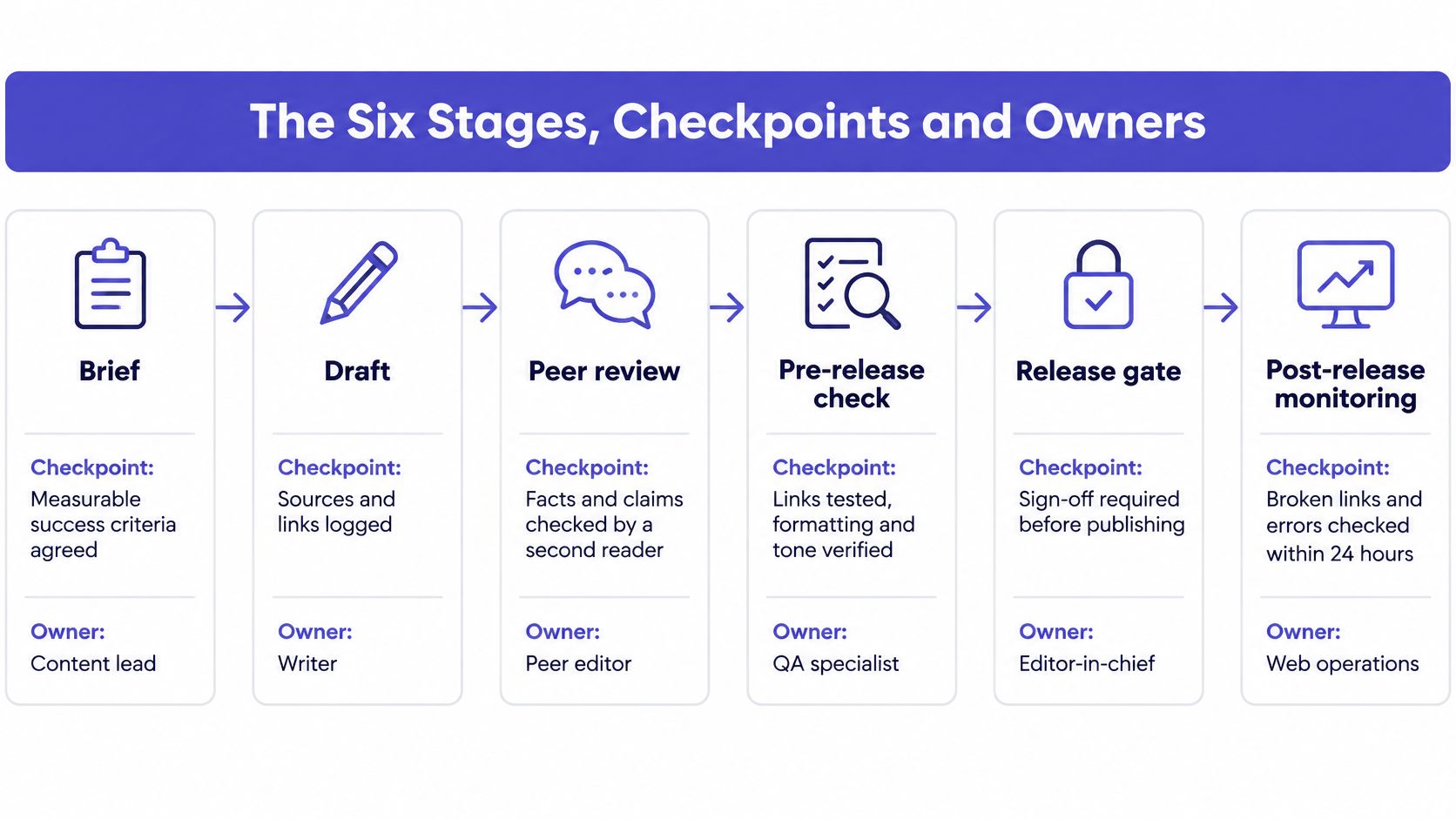
The Six Stages, Checkpoints and Owners
| Stage | Checkpoint | Owner | Pass criterion |
|---|---|---|---|
| Brief | Goal, audience, claims, and platforms agreed | Campaign owner or product lead | Written brief with every claim listed |
| Draft | Self-check against the checklist | Creator or developer | No open placeholders; checklist items marked |
| Peer review | Second-person review | Reviewer who didn't write the item | Accuracy, tone, and brand fit confirmed |
| Pre-release check | Final preview or staging test | QA owner | No critical defects; links, media, and formatting verified |
| Release gate | Go or no-go decision | Named approver | Sign-off recorded; no blockers open |
| Post-release monitoring | Track errors, complaints, and performance | Analyst or support lead | No new critical errors or unexplained complaint spike during the agreed monitoring window |
Make checkpoints observable
A checkpoint is a pass-or-fail decision, not a meeting. A discussion can support the decision, but attendance doesn't prove that anyone checked the work.
Replace vague conditions such as ready for launch with observable evidence. A reviewer should be able to open the brief, preview, test result, or approval record and understand why work moved forward. If a condition requires interpretation, give the reviewer an example of acceptable and unacceptable output.
The same applies to severity. A critical defect could expose private information, misstate an offer materially, or prevent a core transaction. Agree on those categories before a launch deadline makes everyone more willing to accept risk.
This visual map can help assign responsibilities before work begins.
Separate authorship from approval
The author shouldn't approve their own output. Name the approver before production starts, not when the creator needs permission to publish.
Small teams can combine roles. A campaign owner might also perform the pre-release check, and a developer might help investigate monitoring alerts. That's workable as long as another person makes the approval decision and has enough context to challenge the work.
Use the same stages across departments without forcing everyone through identical checks:
- Marketing stream: Brief, draft, peer review, final platform preview, approval, publication monitoring.
- Product stream: Requirements, build, code and test review, staging verification, go-or-no-go decision, production monitoring.
The handoffs deserve as much attention as the stages. Specify where the creator submits work, how the reviewer requests changes, and how the approver knows they're reviewing the final version. An approval on a document doesn't automatically cover a later edit in the publishing tool.
At every checkpoint, record the date, decision, decision-maker, and any waiver. A waiver should explain the accepted risk, the person accepting it, and the condition that ends it.
Keep routine records short. The point is to reconstruct a decision when something goes wrong, not to make people write a report every time a caption passes review.
Test Types and Where Each One Belongs
| Test type | What it catches | Marketing example | Product example |
|---|---|---|---|
| Factual accuracy check | Wrong claims, prices, or dates | Verify a statistic and its source before a LinkedIn post | Confirm the pricing page matches billing rules |
| Brand and tone review | Off-voice or off-message copy | Compare a caption against the style guide | Check UI text against the terminology list |
| Accessibility check | Missing alt text, low contrast, absent captions | Add image alt text and review video captions | Run automated and keyboard-only checks on a sign-up form |
| Functional test | Behavior that doesn't match the specification | Confirm a scheduled post publishes as configured | Test checkout in supported browsers |
| Regression test | Existing behavior broken by a change | Recheck tracking after a template edit | Rerun core user flows after a release change |
| Integration or API test | Failures between connected systems | Confirm posting after a platform API change | Verify a webhook is accepted and processed |
| Failure-path test | Incorrect behavior under bad conditions | Attempt publication with an expired connection | Interrupt the network during a file upload |
Select tests by consequence
Don't run every test on every item. Select the rows that address a credible failure in the output you're releasing.
Marketing teams usually need strong accuracy, brand, and accessibility checks. A caption can be grammatically perfect yet make a claim the business can't support. An attractive video can still exclude viewers because its captions are missing or inaccurate.
Product teams usually put more effort into functional, regression, integration, and failure-path tests. A successful checkout test doesn't establish what happens if payment succeeds but the confirmation response never arrives.
There are overlaps. An e-commerce campaign needs functional checks on its offer, and a product release needs clear, accessible customer-facing language. Department labels shouldn't decide coverage.
Automate repetition, retain judgment
In the JetBrains Qodana State of Software Quality Report 2024, 27% of surveyed software professionals reported lacking automated quality gates for every merge request, while 39% identified manual testing as their most resource-intensive quality practice.
Automation is useful where the expected result is stable and observable. It works less well when reviewers must interpret evidence, audience expectations, or cultural context.
- Link and accessibility checks: Use a link checker and an accessibility scanner such as axe to flag repeatable problems. Confirm redirects, destination meaning, and reading order manually.
- Browser and API tests: Playwright can exercise browser flows; Postman collections can check API responses and contracts.
- Human sign-off: Use an approval workflow in a scheduling tool or ticket tracker for claims, tone, and brand decisions.
A scanner can find missing alt text, but it can't reliably determine whether the description communicates the image's purpose. A working link can still send customers to the wrong offer.
Start with the test types that cover your most expensive plausible mistakes. Add coverage when incidents expose a gap, not because a longer test list looks more mature.
How to Build Your QA Process in Seven Steps
Start with an actual campaign or release rather than an abstract policy document. Put the output, its risks, and its handoffs where the people doing the work can inspect them together.
A shared workflow sketch helps expose missing decisions.

Establish standards and coverage
Define good for each output type.
Write criteria someone can verify: every published statistic has supporting evidence, each promotional link reaches the intended offer, and each product rule has a corresponding test. For campaign work, use a content brief to establish the audience, offer, approved claims, and destination before drafting. The usual mistake is describing quality with adjectives such as polished or intuitive.Rank risks by impact and recurrence.
Put financial harm, privacy exposure, misleading claims, and broken core tasks ahead of cosmetic preferences. Consider exposure too: a reusable template can distribute a small defect across many outputs. Don't confuse frequently noticed mistakes with consequential ones.Trace requirements to tests.
NASA's software-assurance guidance requires coverage of functional and safety-critical requirements, documented results and defects, and corrective actions tracked through closure. Apply that discipline with a matrix containing the requirement, its check, the evidence, and its owner. For a publishing product, cover authentication, permissions, scheduling, media transformation, API responses, retries, rate limits, analytics, and deletion. Include expired tokens, partial network failures, duplicate webhooks, malformed media, and schema changes; testing only the successful path leaves predictable gaps.
Make decisions enforceable
Set escalation rights.
Name who can stop a release, who can accept residual risk, and where that acceptance is recorded. Separate a technical fix from a business decision to proceed. The common failure is allowing a deadline owner to override a block without accepting responsibility for the consequences.Write short checklists and reusable templates.
Give each output type its own checklist, with required fields beside the work rather than in a separate handbook. For teams turning long videos into clips, Klap's guidance can help you standardize your video repurposing workflow before adding checks for captions, framing, and context. Don't use a universal checklist that mixes irrelevant tasks with essential ones.
A walkthrough can support the team discussion, but your written rules still need to match your own workflow.
Define the release rule.
Require required approvals and resolved blockers, with evidence attached to the final version. Specify what invalidates approval, such as a changed price, replaced video, or modified authentication flow. Otherwise, people can approve one version and release another.Pilot and revise.
Run the process on a small batch of real work before making it mandatory everywhere. For each escaped defect, assign a corrective action, a regression check, and an owner. Remove checks that don't inform a decision, and strengthen the ones that missed a meaningful failure.
A successful pilot doesn't produce a flawless checklist. It produces a usable process and a clear account of what needs changing.
Metrics That Show Whether QA Works
Measure whether defects are caught, not how many checks ran. A growing test suite can coexist with recurring customer failures if the tests cover the wrong behavior.
NIST's guidance on evaluating automated defect-finding tools recommends recall, the proportion of known defects detected, and precision, the proportion of reported warnings that are genuine defects, alongside examination of overlap between tools.
Read recall and precision together
Low recall means a control misses defects. Low precision means it produces too many false alarms, consuming review time and making valid warnings easier to ignore.
Measure recall against a reviewed set of known defects, not against an assumption that production contains nothing else. Keep representative failures as test cases, including defects from previous incidents. For precision, have a reviewer classify warnings as genuine, false, or unresolved rather than treating every dismissed warning as harmless.
Compare unique defect yield too. If another tool mostly repeats existing findings, it may add review work without materially improving coverage. Keep it only if its independent checks, reliability, or workflow benefits justify the cost.
Use targets as operating rules
The targets below are suggested directions for calibration, not industry benchmarks. Establish your baseline first, then set numeric thresholds where the volume and severity of work make them meaningful.
| Metric | How to calculate | Suggested starting target | What it reveals |
|---|---|---|---|
| Defect escape rate | Defects found after release divided by all defects found in the same tracked group | Falling across comparable release groups | Whether checkpoints catch problems before exposure |
| Recall | Known defects detected divided by known defects | Detect every critical case in the reference set | Gaps in automated detection |
| Precision | Genuine findings divided by all reported findings | Reduce false alarms without sacrificing critical detection | Alert fatigue and wasted review time |
| First-pass approval rate | Items approved without rework divided by items submitted | Improve without weakening review criteria | Draft readiness and checklist usefulness |
| Rework time | Hours spent fixing items after review | Falling across comparable output types | The cost of late corrections |
| Time to close an escaped defect | Elapsed time from report to verified fix | Meet a documented, severity-based response rule | Corrective-action responsiveness |
Measurement caution: A better approval rate isn't progress if reviewers have stopped challenging weak work.
Keep definitions stable. Decide whether a repeated complaint represents another incident or another report of the same defect, and distinguish containment from a verified permanent fix.
A shared spreadsheet is enough for a small team. A ticket tracker supports ownership and closure evidence; an analytics dashboard shows post-publication behavior. An electronic quality management system makes sense when formal audits, controlled documents, and traceable approvals become operational requirements.
Quality Checks for AI-Generated Content
AI doesn't automatically make QA easier. It can produce more material than reviewers can responsibly inspect, including fluent claims that are false, biased language, unsafe advice, and outputs that change unexpectedly after a small prompt edit.
In the global Applause 2025 AI survey, only 33% of respondents used red-teaming to test AI systems for inaccuracies, bias, toxicity, and other risks. Ordinary proofreading doesn't cover those failure modes.

Separate evaluation from generation
A social media AI post generator can help create drafts. Acceptance still needs explicit rules.
Use a layered review process:
- Pre-publication policy checks: Maintain prohibited claims, evidence requirements, and escalation rules. Route sensitive advice, customer promises, and recognizable likenesses to the appropriate specialist.
- Risk-based human review: Inspect every product claim and complaint reply. Sample lower-risk captions, increasing review when prompts, languages, or source material change.
- Post-publication monitoring: Watch comments, corrections, and moderation escalations for problems that preview review didn't expose.
Don't treat an AI detector result as an editorial approval decision. For reviewers who need to distinguish provenance questions from content-quality decisions, Simple Unmark's watermark and detector guide provides useful context.
Classify failures so reviewers can act
Use a shared failure vocabulary rather than a single rejected label:
- Fabricated fact: An invented statistic, unsupported benefit, or nonexistent citation.
- Off-brand tone: Language that's inappropriate for the audience or situation, including biased phrasing.
- Unsafe recommendation: Advice that could cause harm or bypass a necessary escalation.
- Rights issue: Material with unresolved copyright, permission, or likeness concerns.
- Wrong language: Incorrect language selection, misleading translation, or unsuitable regional wording.
These categories guide ownership. A subject specialist checks factual accuracy; an editor checks brand fit; accessibility and platform compliance require their own checks. A fluent translation still needs someone who can judge its meaning in context.
Retain the prompt, source material, tool version when available, output version, reviewer, and decision. Build a reusable evaluation set from approved examples and rejected outputs.
Without that foundation, automated generation only moves the bottleneck from drafting to review. Faster production is useful only when the team can still distinguish publishable material from plausible-looking mistakes.
Common Pitfalls and How to Close the Feedback Loop
The most damaging QA failure is fixing the visible mistake without changing the conditions that produced it. The broken offer gets repaired, the support ticket closes, and the same handoff remains unowned.
Remove the recurring obstacles
- End-only QA: Move checks for ambiguous requirements and unsupported claims into the brief and draft, before teams build around them.
- Overloaded checklists: Remove low-value items and split checks by output type. An ignored checklist provides no protection.
- Approver bottlenecks: Assign a trained backup with the same decision rights and access to evidence.
- Activity-only reporting: Replace test counts as the headline measure with defects caught, escapes, and corrective-action results.
- Ownerless fixes: Give preventive work an accountable owner and a verification condition, not just an informal request.
The 2025–26 World Quality Report found that 94% of organizations review production data, yet nearly half struggle to convert those insights into actionable quality strategies. Observing problems isn't the same as changing how work gets done.
Turn signals into preventive controls
Collect. Bring rejected posts, failed publishes, support complaints, comments, and unusual analytics changes into a shared issue log. Preserve the affected output and enough context to investigate; a screenshot without the platform, version, or conditions may be insufficient.
Classify. Assess impact and recurrence. Investigate whether a performance drop reflects a quality defect, a distribution change, or ordinary audience behavior before assigning corrective work.
Change. Connect recurring failures to a preventive control: a required template field, revised approval rule, prompt constraint, or integration test. Improving the content approval process helps when a reviewer lacked context or the wrong version reached sign-off.
Verify. Check subsequent comparable outputs for recurrence. A completed ticket proves someone performed a task; it doesn't prove the change worked.
Say a team repeatedly publishes image posts without alt text. Asking creators to remember accessibility won't resolve a workflow that lets them submit incomplete posts. Add a required alt-text field, have the reviewer assess its usefulness, and monitor whether inaccessible posts still reach publication.
Close an incident when you've verified the repair. Close the corrective action when you've verified the prevention.
This loop doesn't require a large testing department. It requires someone to connect an audience signal to a production change, then return to check the result.
Choose Your First QA Checklist This Week
Marketing post checklist
- Claims: Supporting evidence is attached to factual statements and offers.
- Links: Destinations, tracking, and promotional behavior have been tested.
- Platform fit: Aspect ratio, caption length, cropping, and previews match the intended channel.
- Accessibility: Meaningful image descriptions and accurate video captions are included.
- Language: Brand terminology and prohibited phrases have been reviewed.
- Approval: The approver and approved version are recorded.
Product release checklist
- Coverage: Requirements map to tests and recorded results.
- Regression: Core user flows pass against the release candidate.
- Failure behavior: Expired credentials, duplicate deliveries, and relevant interruptions have been tested.
- Recovery: A rollback plan names its owner and activation conditions.
- Support readiness: Support has reviewed release notes and known limitations.
- Decision: The go-or-no-go decision identifies the approver.
Turn the relevant checklist into work rather than another reference document:
- Choose the costliest stream. Start where a mistake would cause the greatest customer harm or operational disruption, not where the checklist is easiest to introduce.
- Run a small pilot. Apply it to upcoming outputs and log every defect with an owner. Record skipped checks too, because they reveal friction that a completed checklist can hide.
- Review results. Compare escape rate and rework time across similar outputs, then revise the checks that missed problems or created unnecessary delay.
For social publishing, PostSyncer is one option alongside a ticket tracker and shared issue log: its approval workflows and visual calendar support pre-publication routing, while its unified comments inbox keeps audience issues available for follow-up.
Your first checklist will be imperfect. Keep it short enough to use, concrete enough to challenge, and connected to the failures customers experience in practice.
PostSyncer brings content planning, approval workflows, publishing, and audience comments into a shared workspace. Visit PostSyncer to organize review before posts go live and keep post-publication feedback connected to your team's next quality improvement.